Editor's Note: Based on L2BEAT data and multi-chain operational realities, the author _gabrielShapir0 points out that while leading enterprise-grade L2s are posting impressive commercial results, most remain stuck at the Stage 0/1 level, having yet to truly achieve "Stage 2" finality settlement, and contribute minimally to Ethereum in fees (e.g., Base pays roughly $290 per day). The author argues that L2 commercial success cannot be equated with Ethereum's success, as it more closely resembles regulatory arbitrage and brand borrowing, and suggests shifting R&D focus toward CROPS (censorship resistance, privacy, security) — tracks that are natively Ethereum and cannot be replicated.
Backed by extensive public data and regulatory logic, this article offers a systematic reassessment of the "Rollup-centric" roadmap assumptions of recent years. Its core contribution lies in exposing a question often sidestepped: when L2 operators, driven by their own interests, choose to remain in an intervention-capable state, how should Ethereum position itself? Whether or not readers agree with its conclusions, the misaligned incentives and boundary conditions it raises provide a verifiable framework for discussion. At the end of the article, Ethereum community member Ryan Berckmans' differing perspective is appended for readers' reference.
The Paradox: L2s Are a Commercial Triumph, Yet Fundamentally a Failure for Ethereum
By every commercial metric, various L2s have achieved massive success, even sparking a renaissance in the Ethereum ecosystem.
Robinhood Chain is the most striking example, reigniting debate over whether Ethereum should — and how it could — accommodate the diverse demands of L2s. This global top-tier stock trading platform serves nearly 28 million users across 38 countries, tokenizing its core business into stock tokens deployed on a self-custody wallet supporting 120+ countries. On day one, it integrated with Uniswap for 24/7 token trading, built the GonzoFi experimental environment for developers, and allowed users to deposit tokens into lending pools.
Other L2s are growing just as rapidly. Base, operating within a publicly listed company, holds $14.42 billion in total value locked; Arbitrum One has $12.6 billion locked. With the advent of Orbit and the OP development suite, launching a public chain has been reduced to a procurement decision.
None of this is accidental: operating an L2 is itself a highly lucrative business. From this chain alone, Robinhood generates $3-4 million in daily on-chain revenue, not including potential earnings from commercial partnerships related to its trusted token wrapping business (which underpins its stock token offering).
Faced with such booming commercial results from L2s, the question inevitably resurfaces: where exactly does the value of these L2s lie? And what does Ethereum actually get out of them?
L2BEAT categorizes L2s into multiple tiers. The most important category is Rollups, which includes Robinhood Chain, Base, Arbitrum, and Optimism. Rollups are classified into Stage 0, Stage 1, and Stage 2. Only Stage 2 Rollups truly delegate final settlement to Ethereum smart contract execution. Stage 0 is almost entirely controlled by sequencer operators; Stage 1 is typically governed by a security council holding multi-signature management authority. Although these control mechanisms are masked by various surface-level designs (such as some chains claiming to implement "forced transaction inclusion"), operators retain absolute control over the entire chain; Ethereum can only help identify fraudulent behavior but cannot enforce sanctions.
Years have passed since Vitalik published "A Rollup-Centric Ethereum Roadmap" in October 2020 and proposed the stage classification criteria in November 2022. To date, only four chains carry the Stage 2 label: Facet with $661,000 in total value locked, Honeypot v2 with $1,000 locked, Aztec with under $1,000 locked, and Ethscriptions with no available data. The combined TVL of all four chains is less than $700,000. In contrast, Base and Arbitrum One hold $14.42 billion and $12.6 billion in TVL respectively, yet both remain at Stage 1. Robinhood Chain holds $2.9 billion in TVL, but its contracts can be instantly upgraded by a 7-of-8 multi-signature account, leaving users with zero exit window in the event of a malicious upgrade; its fraud proof system only accepts submissions from two whitelisted entities; and operators can censor any transaction without delay, including those touted as "forced inclusions" (L2BEAT project page, 2026-09-07).
There is no reason to believe the status quo is merely temporary. In January 2026, Optimism co-founder Mark Tyneway wrote: "Stage 2 deviates from what users actually want, and everyone is afraid of community backlash, so no one dares speak the truth." He pointed out that the real "users" are the chain operators, who want a feature set that minimizes their own legal risk, which often runs counter to Stage 2 requirements. Imagine explaining in court why you couldn't pause the bridge contract, resulting in all user funds being stolen; or why you couldn't prevent North Korea-linked entities from holding assets on your platform. The prevailing industry view is that nearly all enterprise-operated top L2s (such as Robinhood and Base) will never evolve to Stage 2.
If the original intent of Rollups was to progress to Stage 2, then this L2 vision has already failed. Even if L2s are commercially thriving, that statement rings dissonant. Ethereum finds itself in an awkward position: it has achieved product-market fit, but the customers it serves are using Ethereum only "incidentally and symbolically." L2s treat Ethereum merely as a settlement-layer fallback option, not as a genuine foundation for real usage. So where do we go from here?
The remainder of this article will lay out the structural misalignment between Ethereum's interests and the L2 market. While L2s do generate some revenue for Ethereum and ETH, that revenue is insufficient to justify making L2s the focal point of Ethereum's R&D efforts. Seeing through the dazzling commercial success of L2s and resisting the temptation to chase the hype—though difficult—is essential.
The Four Paths by Which L2s Give Back to Ethereum—and Why Only "True Settlement Rent" Qualifies as a Viable Route
L2s create value for Ethereum through no more than the following four channels:
1. Data Availability Rent: L2s purchase Blob data space. Blobs are essentially fungible commodities, and alternatives exist in the market: external data availability layers or operator-run committees. Switching to an alternative only requires a configuration change—no asset migration needed—making the switching cost nearly zero. What's more problematic is that Ethereum has publicly committed to continuous scaling; this is itself a goal of the scaling roadmap. A commodity with ever-expanding supply and buyers who can substitute at any moment cannot generate scarcity rent. The data confirms this. In the 30-day cycle ending September 7, 2026, Base—the L2 with the largest locked value—processed 292 million user operations while paying only about $8,800 to Ethereum for data, proof, and state update-related fees, translating to roughly $290 per day. Over the same period, Arbitrum One paid only about $2,700. By this estimate, Robinhood Chain generates $3–4 million in daily revenue, yet it pays Ethereum only a few hundred dollars per day in fees. Furthermore, for chains where users cannot freely exit, Blobs fail to deliver even their intended value. The purpose of putting data on-chain is to allow anyone to reconstruct chain state and exit; operators can upload only hashes to L1 and still gain reorg resistance at a lower cost. No amount of Blob pricing optimization changes the reality: with Ethereum promising ample supply, it cannot sell at a scarcity premium.
2. ETH as Gas, Capturing a Monetary Premium: This path is entirely voluntary, with no coercive force. Operators can denominate fees in stablecoins, deploy custom gas tokens, or even subsidize fees down to zero—the protocol layer cannot prevent any of this. So-called "ETH-L2s" are mostly marketing concepts with a faint "ETH as money" effect, and such a soft effect cannot generate stable revenue.
Multiple factors continue to erode this pathway. First, corporate operators report financials in U.S. dollars, and the ETH received by sequencers is merely working capital, not long-term reserves. Coinbase has been criticized for selling the ETH fees generated by Base but has refused to disclose the flow of funds. Public financial reports show that in 2026 Q1-Q2, Coinbase's ETH holdings for investment purposes moved from 150,193 to 150,279 tokens. Even though Base, as the largest L2 during that period, generated fees, no significant accumulation of ETH holdings was observed. Second, L2 teams continue to face pressure to issue their own tokens: investors and employees need liquid assets to realize returns, and the product itself requires an incentive mechanism controlled by the operator. Third, proprietary tokens need designed use cases: on the commercial level, a token without utility has no demand; on the regulatory level, a token with actual functionality is easier to argue is not a security. The most natural function for an L2 token is to pay sequencer fees, and both the Orbit and OP development frameworks natively support custom gas tokens. Each funding round further compresses the expected returns of this pathway.
3. Settlement rights: Ethereum holds a right that operators cannot revoke, and this right is exercised by L2 users. Among the four pathways, only this one constitutes a property relationship rather than a simple transactional one. Only through this pathway can Ethereum act as a franchisor rather than just an ordinary supplier.
4. Brand licensing: This refers to the "secured by Ethereum" label. Ethereum has no trademark, no licensing body, and this permission is granted to everyone for free and irrevocably. For projects that already control traffic distribution, community consensus cannot constrain them. Even if Ethereum wanted to charge for this, the protocol's pricing mechanism is uniform and undifferentiated, and there is no business development department dedicated to engaging with companies like Robinhood. A "license" that cannot be revoked and has no pricing is essentially a gift, not a source of revenue.
Data availability rent and the network effects brought by ETH are both loose and lack enforceable guarantees; brand licensing is entirely non-commercializable. Only when Ethereum completes true final settlement can it build structural, endogenous interest alignment and forge a moat. But true settlement capability only takes effect at Stage 2, and corporate L2 operators subjectively refuse Stage 2. This creates an intractable misalignment of interests.
Without true settlement, L2 and Ethereum can only be a mutually beneficial relationship—but nothing more
Ethereum can indeed capture a small amount of genuine data availability revenue; massive numbers of users will hold and use ETH on-chain, generating some monetary premium; developers, capital, and attention that would otherwise flow to other chains are attracted here; and it also reaps reputational dividends: a brokerage launching an "Ethereum L2" signals to regulators that Ethereum is infrastructure, not contraband.
However, all of the above returns are voluntary, revocable at any time, unpriced, and loosely fragile. This is precisely what it means for "L2s to treat Ethereum as a fallback option." At best, they amplify the influence of ETH as an asset, but they cannot amplify Ethereum as a chain itself. An option holds immense value for its holder; but the issuer of the option has to look at how much premium it collected—in this case, the premium is zero.
Behind this dividend lies another side, which is also the core driver for large general-purpose L2s to willingly adopt the L2 shell: regulatory arbitrage. Strip away the marketing packaging, and what remains is a centralized ledger operated by a corporate entity, equipped with pause switches, transaction filtering, and contract upgrade permissions. If you ran this system nakedly, you'd be a custodian or a money transmitter, clearly visible to regulators. But attach an Ethereum bridge to it, call it a Rollup, and you can leverage social consensus to claim it belongs to Ethereum and is sufficiently decentralized—the intermediary regulatory framework seemingly no longer applies, yet the operator retains all the powers of an intermediary in full.
A common counterargument: big L2s build L2s to save costs. Then the question is: what costs are saved? The cost of achieving decentralization, or the compliance cost of not doing so. Either way, it's essentially regulatory cost savings at the core. Mark Tyneway's post said out loud what everyone knew tacitly. He later admitted that many institutional L2s have a "vibe that doesn't match reality"—they are clearly not Ethereum, lack credible neutrality, and are not trustless; operators can switch rule versions at any time. The label serves a legal function, not a cryptoeconomic one. Operators are simply following incentives, which is hardly blameworthy in itself.
Why Stage 2 Is the True Critical Dividing Line
L2BEAT defines Stage 2 with three hard requirements: ① a permissionless fraud proof system; ② users have at least a 30-day exit window in the event of malicious upgrades; ③ the security council can only handle errors verifiable on-chain. Notably, this standard does not require a decentralized sequencer. Stage 2 constrains upgrade authority and user escape hatches, but does not interfere with transaction ordering rights or fee revenue.
Business perspective: Stage 2 creates an asymmetry. An L2 chain itself can detach from Ethereum, but it can no longer drag user assets along in an exit, because users hold withdrawal rights that operators cannot erase through upgrades. Only with this asymmetry can Ethereum potentially raise its "rent" without directly losing customers. Without it, Ethereum is like a supplier on a month-to-month contract, where customers can switch to alternatives at any time.
Legal Dimension (the author's own area of expertise): Referring to FinCEN's 2019 crypto asset guidance and case law under 18 U.S.C. §1960, the core determining criterion is whether the entity holds fully independent control over the assets being transmitted. As long as the operator can filter transactions, freeze balances, and unilaterally upgrade the bridge contract without an exit window, then no matter how polished the documentation reads, it factually holds complete control. Conversely, if the implementation includes permissionless proof, a 30-day exit window, and Security Council authority limited to on-chain verifiable bugs, the operator has strong grounds to argue it is merely publishing software rather than conducting a money transmission business. This is why the two-phase architecture is the strongest technical defense against being classified as a "centralized money services business wrapped in a Rollup shell." This also explains why enterprises voluntarily abandoning phase 2 warrants deep reflection, not just disappointment.
Governance Dimension: L2s that do not support forced transaction inclusion do not inherit Ethereum's censorship resistance. They only inherit data availability and state roots—two capabilities that can expose operator misconduct but cannot undo its consequences. Censorship occurs at the sequencer level, and Ethereum's properties simply break off there.
If phase 2 becomes the industry default standard, "secured by Ethereum" would represent a tangible legal relationship. The common refrain that "even if Coinbase goes down, user assets on Base remain safe" would no longer be mere wishful thinking. The reality is that phase 2 has not become mainstream, and almost no major project has implemented it.
Why Phase 2 Cannot Be Implemented: Community Pressure Alone Cannot Solve the Root Problem
The real cost of phase 2 to operators is the loss of operational discretion. A popular misconception is that phase 2 strips sequencer fee profits. It does not. Phase 2 restricts upgrades and provides user escape mechanisms, but does not interfere with the monopoly over transaction ordering. Even running a fully centralized, highly profitable sequencer can still satisfy all phase 2 conditions, with fees collected in full.
What is genuinely lost is operational discretion. Regulated financial institutions must be able to execute court-ordered account freezes, block addresses per OFAC sanctions lists, halt and reverse fraudulent transfers, urgently patch vulnerabilities before funds are drained, and name specific responsible parties during regulatory inquiries—rather than throwing up their hands. The phase 2 architecture is designed to eliminate all of these capabilities—and that is precisely its core purpose.
Let us run a reductio ad absurdum: as long as an operator retains the ability to freeze accounts, it fails the phase 2 definition; if it abandons that ability, corporate legal counsel cannot sign off, and the enterprise becomes unable to fulfill its legal obligations. Therefore, for operators holding broker-dealer licenses, money transmitter licenses, banking charters, or public listing status, the set of business models compatible with phase 2 is empty—not small, but entirely nonexistent.
Let's flip the perspective. Suppose you're pitching Elon Musk on building X Money as a Stage 2 rollup, rather than a disguised Stage 0 chain masquerading as an L2, a permissioned L1 with a small validator set (the Hyperliquid model), or just a plain database. How would you convince him? He trusts himself to safeguard user assets—minimal-trust mechanisms hold zero appeal to him; any of these options would work fine for his use case. Under the current legal framework, as long as you package the product as an L2 or spin up a permissioned L1 with a few "independent validators," you face no fines or jail time even if the chain is fully centralized; running a bare, unlicensed database, by contrast, carries real legal exposure. So building a blockchain has its necessity, but there's no need to choose a true Stage 2 rollup. Users won't vote with their feet either: Robinhood is Stage 0, Hyperliquid runs a permissioned validator set, and users still flock to them at scale with a great experience. The pitch has no footing. A true Stage 2 doesn't solve the buyer's real-world pain points—no one will pay for it.
The constraints aren't limited to licensing issues. There's a counterexample worth pondering: Arbitrum holds no broker-dealer license, no banking charter, and isn't publicly listed—it's a DAO-governed project that should, in principle, be best positioned to forgo intervention powers. Yet in April 2026, the Arbitrum Security Council executed an atomic transaction to upgrade the Inbox contract, temporarily implanting a privileged function that sent cross-chain messages on behalf of victims, moving 30,766 ETH (approximately $71 million) allegedly stolen by the Lazarus Group into a governance wallet before rolling back the upgrade. The entire process saw 9 of 12 council members approve—no court order, no notice, no hearing.
I agree with the outcome of recovering those funds, and I don't want to take a cypherpunk purist stance arguing that North Korea-affiliated actors should be left to keep stolen assets. But the case itself is momentous: the hypothetical scenario Mark Tyneway described in court became reality on Arbitrum in just three months. No public chain wants to be the one watching Lazarus walk off with $71 million. Yet once you go Stage 2, the protocol has preemptively surrendered that intervention capability.
Real-world constraints extend far beyond licensing: any project with a reputation and assets to protect will fear a wide range of real-world consequences.
The handful of Stage 2 projects precisely illustrate this logic: inscription chains, honeypots deliberately built to be attacked, protocol-native experimental projects, and Aztec (which has fully implemented Stage 2 on its live Ignition mainnet). Aztec proves the technology is entirely feasible. But none of these four chains has significant commercial interests requiring real-world protection. Stage 2 only emerges where intervention capability is a net liability for the operator. For a privacy chain, intervention powers are a product flaw; honeypot projects couldn't care less; but anywhere there's a license, a board of directors, or commercial reputation at stake, that intervention capability becomes insurance no one is willing to give up.
(Note: honeypot project, a cybersecurity trap designed to lure and capture hacker attacks.)
This also explains why all community pressure tactics have proven ineffective: public deadlines, community condemnation, and difficulty-bomb-like mechanisms that strip Blob permissions from chains that fail to advance to Stage 1/2. These approaches all frame the problem as one of aligned goals but failed coordination. Coordination issues can be resolved through pressure; but fundamental conflicts of interest cannot. What outsiders perceive as "unwillingness" is essentially the legal team identifying hard compliance constraints and diligently executing them.
Four days after Tyneway's post, Vitalik expressed a similar view in his February 3, 2026 blog post (a passage most coverage overlooked):
"I've already seen at least one team explicitly state that they may never want to go beyond Stage 1. This isn't solely a technical issue of ZK-EVM security; client regulatory requirements force them to retain ultimate control. For their clients, this might actually be the right choice."
This is the judgment of the roadmap's own author. The obstacle stems from client regulatory demands; operators meeting those demands is simply delivering what the market requires, and no amount of advocacy or persuasion will change that. He then immediately writes a conclusion consistent with this article: L2s taking this path are not "scaling Ethereum" as originally envisioned in the Rollup roadmap.
Native Rollups Can't Save the Situation Either
Native Rollups solve Ethereum's own technical problems, but they cannot solve the problems of clients like Robinhood. Robinhood already has a chain that meets all its business requirements, including transaction interception capabilities, proving that the proving system is not its pain point. Even if native Rollup technology were perfectly implemented, it cannot force enterprises to adopt it. Robinhood holds the choice, and after weighing costs and benefits, a non-native chain disguised as a Rollup serves its interests better.
Additionally, there's value interception in the middle: Robinhood Chain is built on Arbitrum's commercial platform. In the value flow chain, Arbitrum and Ethereum are competitors, and Arbitrum must also protect its own revenue. Structurally, such chains are closer to L3s, with significant value being siphoned off by the intermediate layer before reaching Ethereum. Building a more sophisticated base layer for a partner that rejects the entire property rights framework amounts to a free subsidy with an attached roadmap.
It's certainly good that independently funded chains are willing to continuously purchase Ethereum data availability services—revenue is better than none. But we must recognize the nature of this revenue: it's commodity supplier income. With continuously expanding supply and abundant substitutes, it can only command a commodity supplier valuation, not a licensor valuation. Blob pricing itself is not the issue. Ethereum's largest L2 pays only about $290 per day; the product is designed to be cheap, and substitutes are even cheaper. Even if R&D resources were redirected to serve such clients, it wouldn't change the size of the bill.
Therefore, equating enterprise L2 business metrics directly with ETH fundamentals constitutes a category error. These metrics describe client financial reports—Ethereum can neither enforce performance nor penalize client exits. Market narrative hype can certainly drive ETH prices higher, but that falls within the realm of market psychology, not fundamental accounting. Just because Robinhood becomes a hot topic doesn't mean we should restructure Ethereum's economic model and abandon the core work that compounds over time—the cost of that would be enormous, and it would be a step backward.
If the focus isn't on L2, then what should it be? The Ethereum Foundation's direction: CROPS
The unexpected lesson from the last cycle: avoiding legal risk doesn't necessarily require decentralization. Almost no one saw this coming, and the target market for decentralization itself has consequently shrunk. Yet a "sanctuary niche market" still exists, similar to GrapheneOS: its user base is smaller than the mass market chasing peak user experience, but these users genuinely need the properties that decentralization provides—not just slogan marketing—and there are virtually no other credible suppliers in the space. One credible supplier in a niche beats three competitors fighting over commoditized products. And this niche inherently belongs to Ethereum.
CROPS (Censorship resistance, Open-source freedom, Privacy, Security) are the core attributes these users are actually paying for. People often argue from an ideological standpoint that Ethereum should allocate resources here; this article attempts to analyze it from an asset value perspective.
Let's examine which of Ethereum's capabilities capital-rich competitors cannot replicate: throughput can be bought with money; the EVM can be forked and cloned at any time; data availability is a standardized commodity; L2 development kits are readily available for purchase.
What truly cannot be replicated: a track record of continued building despite state-level crackdowns. In August 2022, OFAC added Tornado Cash to its sanctions list; in November 2024, the Fifth Circuit's ruling in Van Loon v. Department of the Treasury (the civil suit against the U.S. Treasury following OFAC's sanctions on the Tornado Cash privacy mixer) established that immutable smart contracts do not constitute property of foreign nationals under IEEPA, and the sanctions were lifted in March 2025. In August 2025, a jury found Roman Storm guilty of conspiracy charges, with felony counts still pending and prosecutors seeking a retrial. Amid the turmoil, development related to privacy and financial inclusion never stopped. No other smart contract platform has endured comparable trials. A historical track record cannot simply be forked—replicating it means bearing the same costs. In contrast, sequencer gross margins can be replicated by anyone with the channels and capital to procure them.
The actual progress of this CROPS roadmap is far ahead of what public perception suggests. In February 2026, the Ethereum Foundation launched a dedicated "Harden the L1" workstream, with core EIP-7805 (FOCIL), Blob expansion, and statelessness, embedding quantifiable censorship-resistance metrics into delivery targets — no longer just rhetoric. Kohaku released its SDK, allowing ordinary wallets to integrate RAILGUN coin mixing and generate independent addresses for each DApp. Aztec Ignition went live on mainnet, fully running all Phase 2 features. The L1 Gas limit was raised from 30M to 60M in 2025, the first major increase since 2021; the scaling working group is targeting 100M+. The Pectra upgrade doubled Blob throughput in May 2025; Fusaka's PeerDAS increased theoretical Blob capacity 8x in December.
FOCIL won't go live until the Hegota upgrade, and incorporating list functionality at the protocol layer still requires a fork; the privacy moat needs to be plug-and-play before it's truly complete. But the direction and staffing are already in place — a substantive shift compared to two years ago.
The decisive characteristic lies in unilateral deliverability. Every item on the CROPS agenda can be advanced by Ethereum's existing developers without requiring any counterparty's consent or cooperation. In contrast, items on the L2 coordination agenda require operators to voluntarily relinquish certain powers — but regulators, boards, legal departments, or simply the desire to protect their own reputations all demand that operators retain those powers. Given severely constrained resources and energy, abandoning unilaterally executable solutions in favor of ones dependent on mutual cooperation is essentially betting that other parties will act against their own interests. That is mere wishful thinking — yet it still demands engineering R&D costs.
Boundary Conditions: What Would Change This Conclusion
Only if any of the following four scenarios occur would my entire assessment be overturned:
1. A top-5 L2 by TVS (Total Value Secured, measuring the total scale of assets protected by protocol guarantees and custodial safeguards in L2 networks) formally achieves Stage 2 without shrinking its locked value. Testnet commitments or Stage 1 paired with governance tweets don't count. Requirements: permissionless proof systems, a 30-day user exit window, Security Council powers limited to on-chain verifiable bugs, and locked value exceeding $1 billion.
2. US or European regulators introduce rules linking custodial responsibility, asset control rights, and capital requirements to operators' censorship/freezing capabilities. In that case, Stage 2 would shift from a compliance burden to a compliance dividend, inverting the entire incentive logic overnight. Among these four scenarios, this one has the highest real-world probability and deserves continued monitoring.
3. Interest alignment is reflected in cash flows, not public statements. By basing design on sequencers or native sequencing, L2 revenue becomes substantively tied to L1 proposers; if an L2 defaults, it suffers direct financial losses, not just reputational damage. This gives Ethereum a truly enforceable constraint mechanism.
4. Building an L2 offers product advantages unavailable elsewhere. Only chains that actually settle to Ethereum can enjoy specific cross-chain experiences and atomic composability. Relevant R&D exists, but it has yet to reach a point where L2 operators would willingly abandon their current interests for it.
Unless any of the above changes occur, the assumption of interest alignment does not hold, and no amount of marketing rhetoric will change that.
L2s have proven that "sequencer + traffic distribution" is an excellent business. But that doesn't mean it should become Ethereum's business. Empirical evidence shows it cannot become Ethereum's core business: achieving such binding would require operators with commercial interests to protect to voluntarily give up capabilities essential to their own survival.
The underlying assumption of the roadmap over the past few years was that everyone would eventually reach Stage 2. Reality proves otherwise, and the reason has nothing to do with courage. L2s hold this option of Ethereum settlement granted for free—holding the option yields high returns, leaving zero incentive to exercise it. Ethereum gave away this option for nothing. So let's stop treating L2 financials as Ethereum's financials; stop designing protocols for customers who pay only a few hundred dollars in service fees per day.
The good news is that alternatives are already advancing without needing anyone's permission: L1 is scaling at its own pace; anti-censorship work has a clear timeline; privacy tools are entering mainstream wallets; and production-grade Stage 2 chains already prove that technology was never the obstacle. Ethereum should treat L2 operators as welcome tenants, but not fantasize about them becoming partners. This is simply how reality works, and it's a perfectly viable state.

Attached is a comment from Ethereum community member Ryan Berckmans on this article:
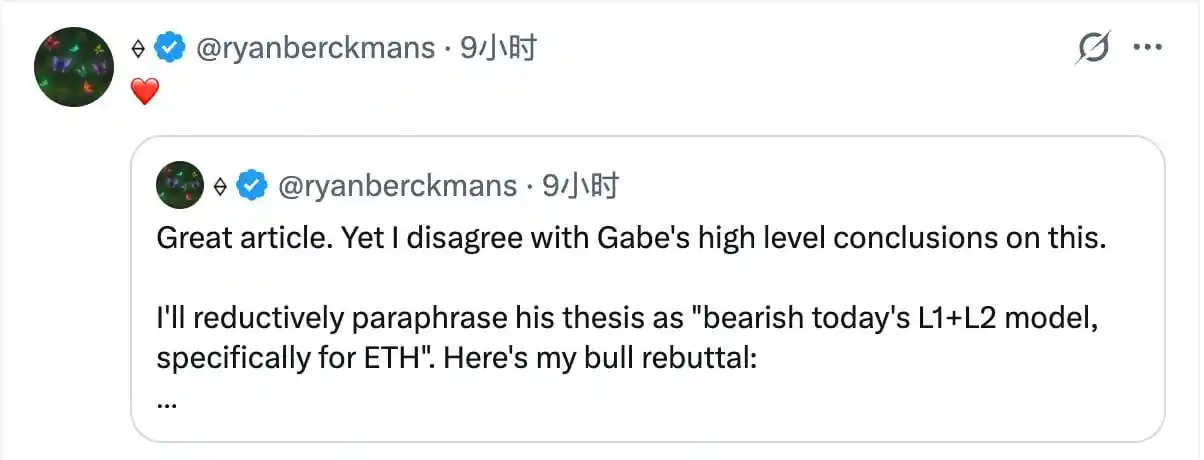
Great article, but I disagree with the core conclusion Gabe draws. To summarize his central thesis: he is bearish on the current L1+L2 model, particularly bearish on Ethereum (ETH). Here's my bull-case rebuttal:
The current depressed ETH price is primarily driven by the fact that the vast majority of investors believe Ethereum's L1 will ultimately fail to achieve global dominance—not by the various other reasons circulating in the market.
But most investors got it wrong, or failed to see the reality: Ethereum L1 will ultimately become the global settlement layer, and by then ETH's market cap will reach trillions of dollars. Here's why:
Gabe, along with many others including myself, share a consensus: for institutions like Coinbase and Robinhood, building L2s is a highly advantageous choice, and the L2 track will continue to expand at a rapid pace—even those with opposing views acknowledge this.
· The continued explosion of L2s, combined with the growth of L1 itself, will shape a future landscape where:
· L2s expand rapidly;
· L1 also grows at a high speed;
· L1 retains roughly two-thirds of the application capital market share it has held for years;
· L1 firmly holds nearly 99% of the market position as the underlying settlement layer for L2s.
This logic doesn't get bogged down in which development stage L2s are in or how much fees they pay to L1—the core focus is simply this: L1 is the structural hub of the entire system;
· In the future, a wave of mature and reliable L2 projects will emerge, naturally further cementing L1's status as the global hub;
· More L2 projects on par with Base and Robinhood in scale will be born, including several that are less frequently discussed: Sony's Sonieum, ADI Chain launched by major Dubai enterprises, and Zksync (backed by a U.S. banking consortium and other institutions currently advancing its rollout). Once L1 carries trillions of dollars in application capital, ETH's value will naturally rise accordingly, pushing its market cap toward the trillion-dollar mark.
The above is my argument for why Ethereum L1 will achieve global dominance.
"Wait, you've only said the Ethereum ecosystem will win, but you haven't explained why that means the ETH token will win."
My crypto friends, if you can't figure out why the Ethereum ecosystem growing to such a massive scale will inevitably benefit the ETH token, then I have nothing more to say.
Welcome to join the official BlockBeats community:
Telegram Subscription Group: https://t.me/theblockbeats
Telegram Discussion Group: https://t.me/BlockBeats_App
Official Twitter Account: https://twitter.com/BlockBeatsAsia
