Capex Begins to Slow, but AI Semiconductors Have Not Peaked in Sync
Over the past two years, the most direct way for the market to judge AI prosperity has been to watch whether Meta, Google, Microsoft, and Amazon are still willing to continue raising capital expenditure.
In 2026, this indicator remains very strong. Morgan Stanley statistics show that the combined capital expenditure of the four major cloud providers—Amazon, Google, Microsoft, and Meta—grew 87% year-over-year in the second quarter, while Capex/EBITDA has risen above 70%.
But such a high growth rate clearly cannot continue forever.
Therefore, this research report extends its perspective to 2028. Morgan Stanley expects that by then, the capital expenditure of the world's top 14 listed cloud service providers will approach $1.6 trillion, but overall year-over-year growth may have fallen to about 12%.
Looking at this number alone, it is easy to conclude that "the AI investment cycle is beginning to cool." But the report immediately provides another set of data: global 2.5D advanced packaging capacity is still expected to grow about 50% year-over-year in 2028.
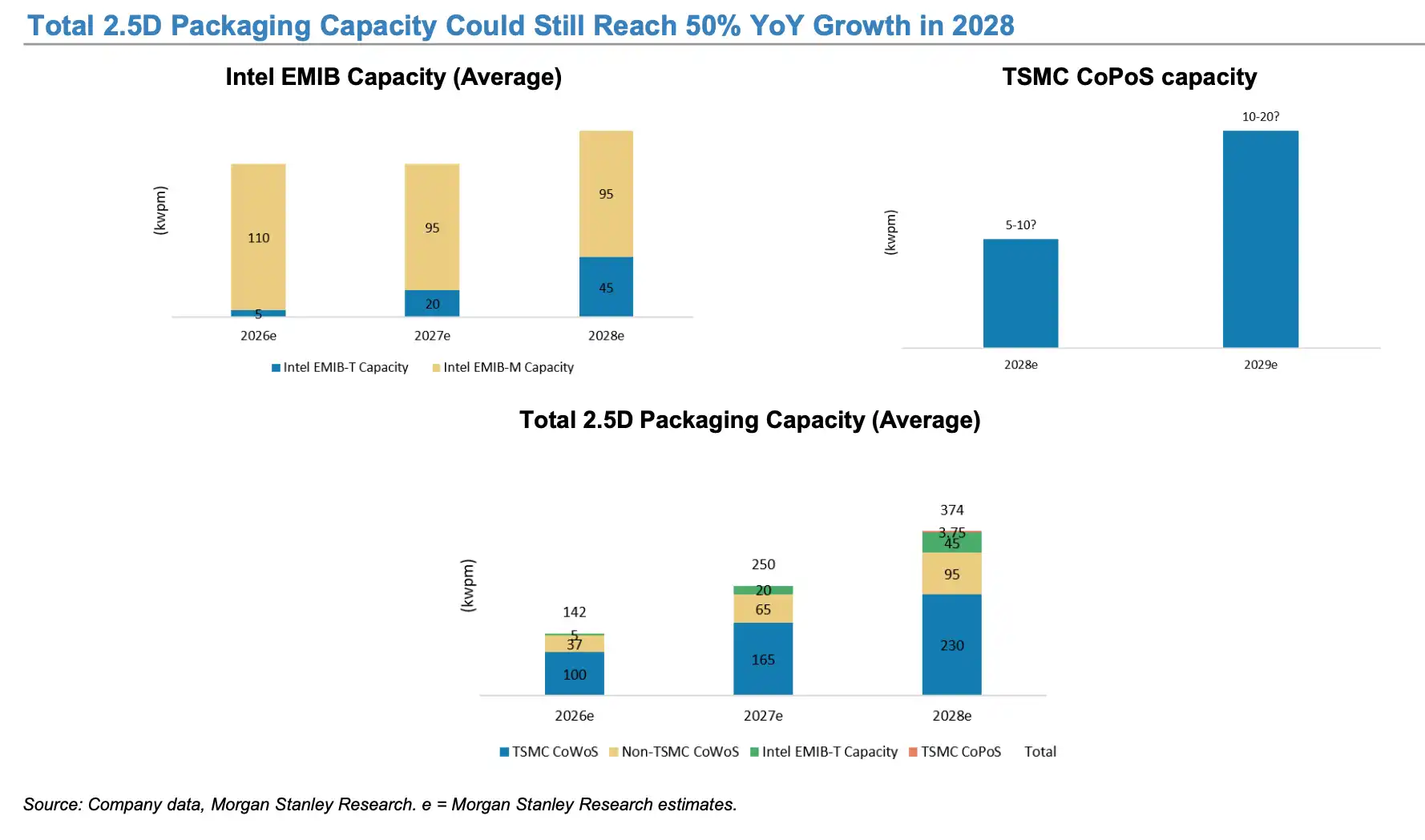
This is precisely the most noteworthy point in the entire report.
The overall deceleration in cloud vendors' Capex does not equate to AI semiconductors peaking in tandem.
Over the past few years, AI chip growth has primarily relied on total capital expenditure expansion: the more data centers built, the more GPUs purchased.
But entering the next phase, even if CSP Capex growth slows from 50%, 80% to 10%-20%, as long as AI's share of overall capital expenditure continues to rise, GPUs, ASICs, HBM, advanced processes, and advanced packaging can still outperform total Capex.
In other words, the market is transitioning from a "volume story" to a "structural story."
Morgan Stanley's long-term market size forecast also reflects this. The report estimates that by 2030, the global semiconductor industry could reach approximately $1.5 trillion, with AI semiconductor TAM at about $753 billion, accounting for nearly half of the entire market. Its supply chain-driven optimistic scenario even projects that the cloud AI semiconductor market could reach $485 billion in 2026. It should be noted that $485 billion is explicitly labeled as a bull case in the report, not a base case forecast.
At the same time, the divergence between AI and non-AI semiconductors is widening.
The report predicts that if memory and NVIDIA AI GPU revenue are excluded, non-AI semiconductor growth in 2026 could actually decline. This means this cycle can increasingly no longer be simply framed within the traditional narrative of "broad semiconductor industry recovery."
What is truly experiencing high growth is an independent supply chain formed by AI continuously absorbing wafer, memory, advanced packaging, and testing resources.
The growth logic is shifting from "buying more GPUs" to higher AI value content
If the core of first-phase AI investment was "buying more GPUs," then the more important question in the second phase is: how many more expensive and complex semiconductors does each AI server actually require?
TSMC is the most direct example.
Morgan Stanley estimates that AI semiconductors could already account for more than 30% of TSMC's 2026 revenue. Meanwhile, TSMC's N2 family capacity is expected to achieve a compound growth rate of approximately 70% from 2026 to 2028; N3 capacity continues to increase, while N5 may begin to decline starting in 2027.
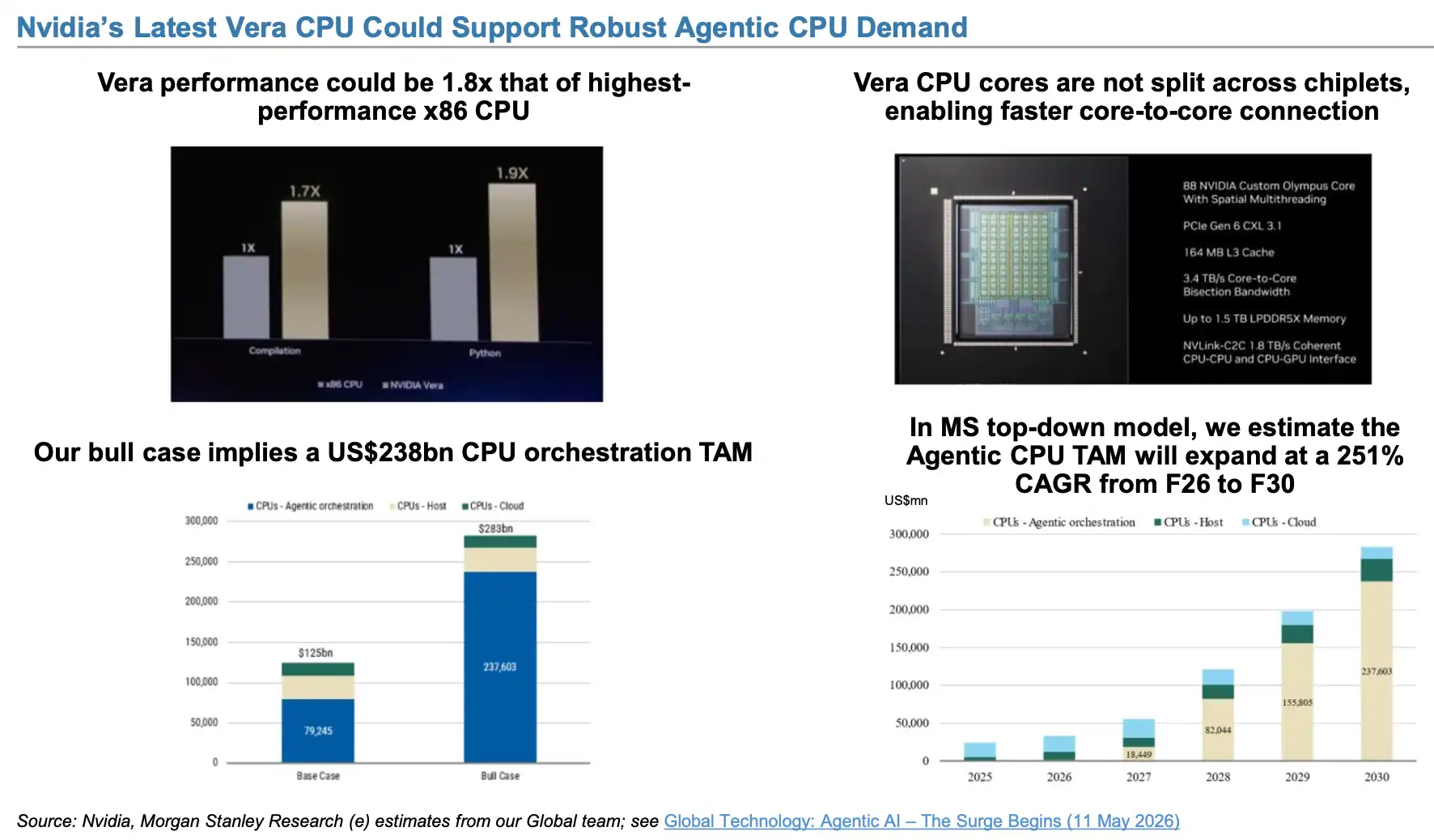
The logic behind this is not complicated.
AI chips are not only increasing in volume, but each individual chip itself is also constantly becoming more expensive. Moving from 5nm to 3nm and 2nm, from conventional packaging to CoWoS and SoIC, combined with more HBM, each generation of AI accelerators is raising the wafer, packaging, and memory value per chip.
Therefore, even if the growth rate of server volumes gradually slows in the future, the semiconductor value per unit may still continue to rise. This is also why the growth rate of advanced packaging can far exceed overall Capex.
At the same time, the growth sources of AI chips are also beginning to spread from NVIDIA to custom ASICs.
Morgan Stanley believes that even if NVIDIA continues to launch more powerful GPUs, large CSPs will still need their own custom chips. Google has TPU, Amazon has Trainium, and companies such as Meta are also advancing their own ASIC projects.
When a cloud provider has sufficiently large computing demand, in-house ASICs can optimize cost, performance, and energy efficiency around specific workloads, while reducing dependence on a single GPU supplier.
Therefore, the future AI chip market is not necessarily about "who takes over after NVIDIA's growth ends," but more likely about GPUs continuing to grow while ASICs become a second growth curve.
Morgan Stanley expects that Alchip's revenue from AWS Trainium may rise from about $1.8 billion in 2026 to $2.8 billion in 2027, and reach $8 billion in 2028, at which point Trainium revenue may account for about 82% of Alchip's total revenue.
The forecast for Google TPU is even more aggressive.
The report estimates that under its model, MediaTek's TPU-related revenue may rise from $13.5 billion in 2027 to $43.5 billion in 2028, and further reach $70 billion in 2029; in 2028, TPU revenue may already account for about 65% of MediaTek's total revenue.
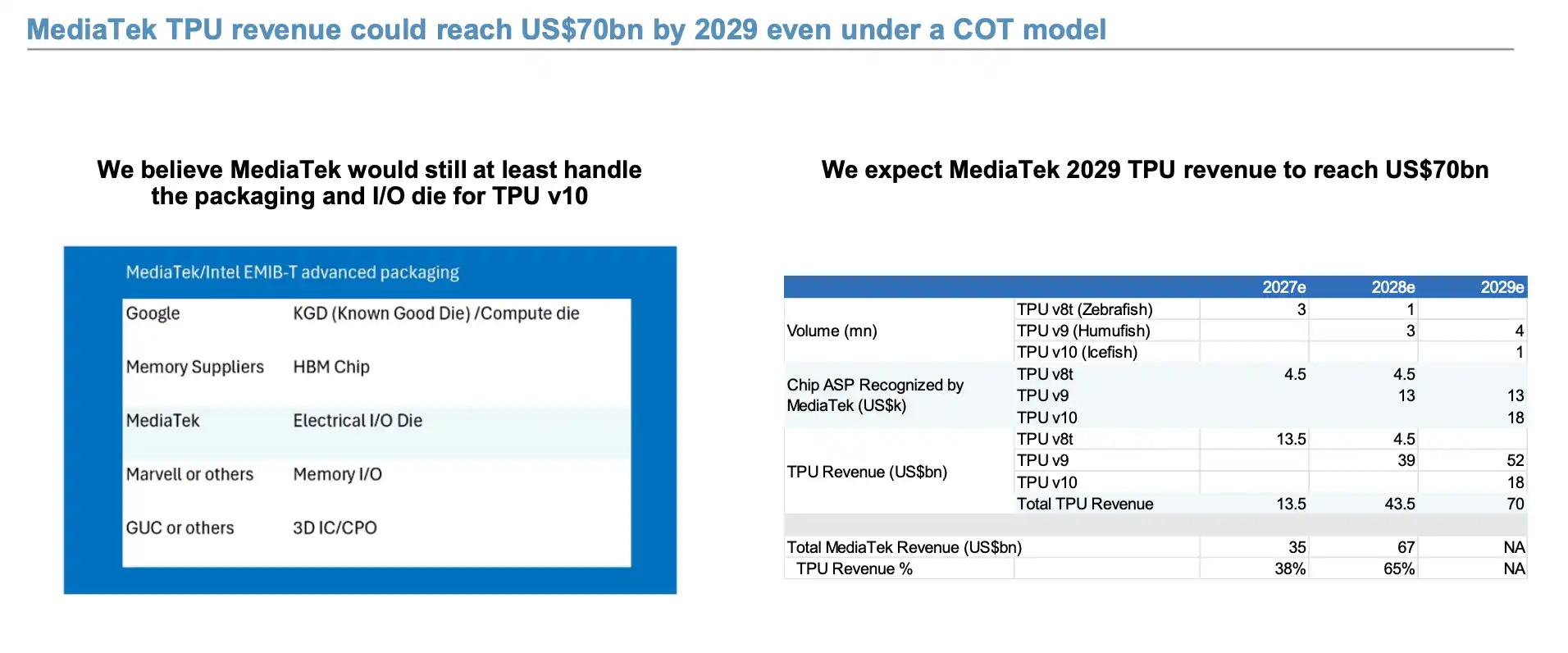
These figures themselves are all long-term models, and the ultimate degree of realization still depends on chip mass production, yield rates, customer procurement, and cloud providers' own capital expenditures. But the direction is very clear: the growth of the AI industry chain is expanding from pure GPU shipments to ASICs, advanced processes, advanced packaging, ABF substrates, and chip testing.
The report even specifically points out that Google TPU's potential for further volume ramp-up in the future may be constrained by ABF substrate supply. Therefore, when judging the AI cycle, "how many GPUs were sold" is still important, but it is increasingly not the whole story.
China's AI demand is picking up, but the real bottleneck is still capacity
The Chinese market, meanwhile, is showing a different kind of change.
In the past, when discussing domestic AI chips, the market mainly focused on "domestic substitution." But this time Morgan Stanley places more emphasis on demand creation.
The report argues that DeepSeek has demonstrated lower-cost AI inference capabilities, which could further stimulate inference demand; at the same time, China's domestic wafer manufacturing supply chain is also improving its capabilities in AI GPU production.
This means that the logic for China's AI chips is gradually shifting from simple "import substitution" to: falling inference costs → more applications → expanded computing power demand → increased demand for domestic chips.
Therefore, in the China AI and semiconductor equipment space, Morgan Stanley highlights Iluvatar, Cambricon, Hygon, Naura, and AMEC, while SMIC is also included in the Overweight portfolio for the AI direction.
But demand is not the biggest constraint at present. When summarizing the major bottlenecks in global AI development, the report characterizes the corresponding problem in the United States as Energy, while China's is Chip Capacity. In other words, how much China's AI chips can ultimately ship depends more on how much effective capacity can be released in advanced processes, advanced packaging, and memory.
Memory is the most typical example.
Morgan Stanley estimates that by 2028, global DRAM capacity could reach about 3,374kwpm, of which ChangXin Memory Technologies would account for about 500kwpm, or roughly 15% of the global total; from 2025 to 2028, CXMT's bit shipment is expected to achieve a compound growth rate of about 40%.
Meanwhile, ChangXin has also begun to enter the HBM market.
The report estimates that its HBM TSV capacity could rise from 20kwpm in 2026 to 40kwpm in 2027 and 70kwpm in 2028. On a bit shipment basis, ChangXin could account for about 3.8% of the global HBM market in 2026 and about 4.4% in 2027.
But that has not immediately changed the global memory tightness landscape.
Even including ChangXin's newly added capacity, Morgan Stanley's model shows that the global DRAM supply-demand gap could still reach 17% in 2026 and about 15% in 2027; the HBM market also remains in a state of supply shortage.
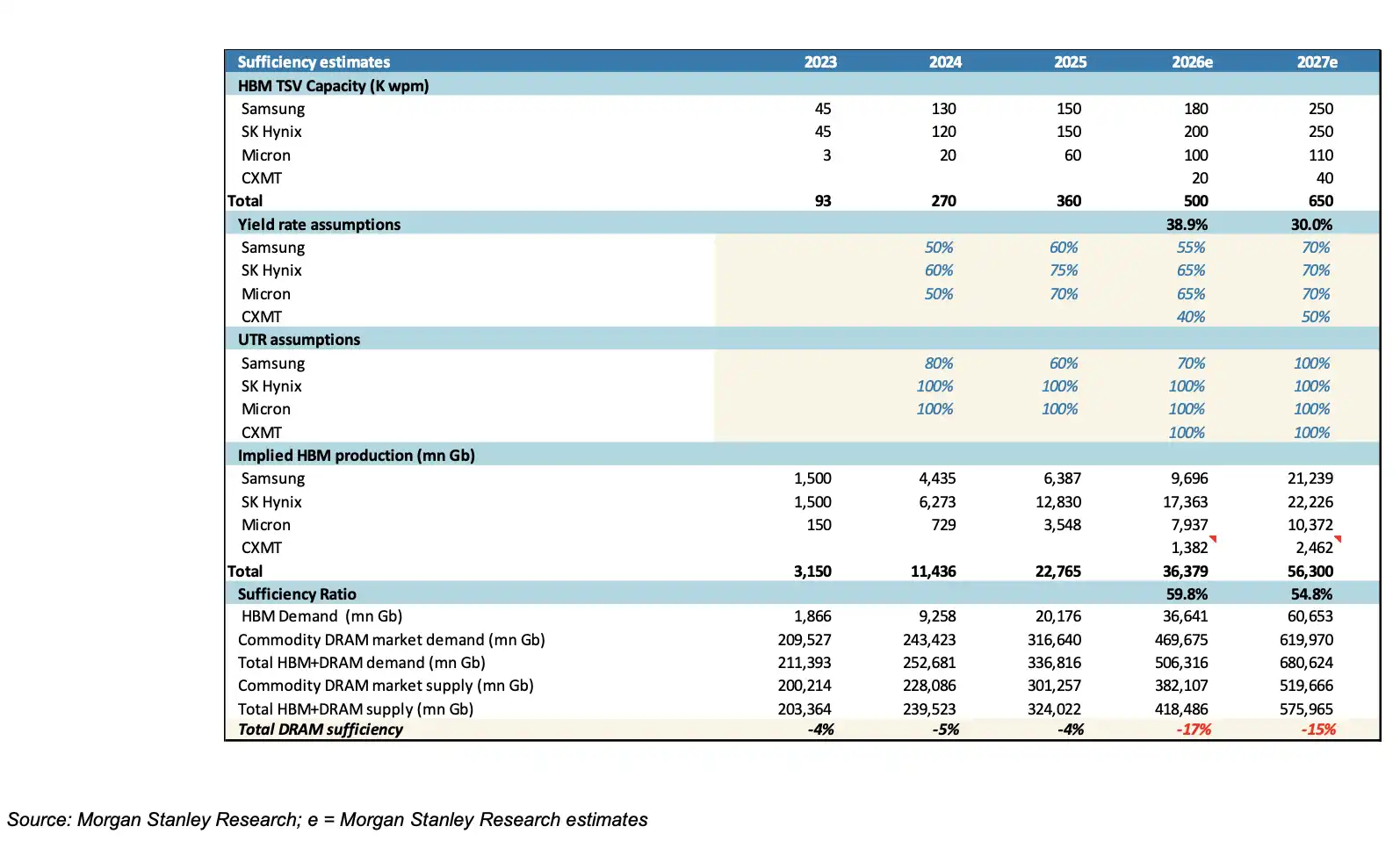
This is also one of the biggest differences between this memory cycle and those of the past.
In the past, DRAM and NAND were closer to typical PC and smartphone cyclical products: demand picks up, prices rise, manufacturers expand capacity, and then supply becomes excessive. But in AI servers, HBM, server DRAM, and high-performance memory have become increasingly close to a kind of infrastructure bottleneck asset. They are no longer just supporting components beside the GPU, but have begun to directly determine whether an AI server can be produced and whether an entire computing cluster can expand as planned.
Ultimately, what this 61-page research report is really trying to say is not simply that "AI will keep rising." More accurately: AI semiconductors are moving from the first stage, which relied on rapid growth in CSP capital expenditure, into the second stage, which relies on a rising AI share and higher value per unit.
Therefore, to judge in the future whether the AI hardware cycle is truly approaching an inflection point, looking only at the Capex growth rates of Meta, Google, Microsoft, and Amazon is no longer enough.
What is more worth watching is the AI Capex share, CoWoS/EMIB capacity, HBM supply and demand, 2nm utilization, and the actual shipment pace of ASICs such as Google TPU and AWS Trainium.
If overall CSP Capex growth slows in the future, but these indicators still maintain high growth, then the prosperity of AI semiconductors may not necessarily peak along with total Capex. On the contrary, only when these core indicators begin to weaken simultaneously would that be a signal closer to a true inflection point in the AI semiconductor cycle.
Welcome to join the official BlockBeats community:
Telegram Subscription Group: https://t.me/theblockbeats
Telegram Discussion Group: https://t.me/BlockBeats_App
Official Twitter Account: https://twitter.com/BlockBeatsAsia
