Masayoshi Son is borrowing money again.
This time it's $10 billion, plus €1 billion, all to buy OpenAI.
On September 21, Reuters dug up SoftBank's latest bond filing. Citigroup and JPMorgan sat side by side in the bookrunner column, preparing to peddle this batch of high-risk notes on the public market. SoftBank's issuer credit rating still sits at BB+, and the more polite term for high-yield debt is, in fact, junk bonds.
The bond issuance timetable is tight: the interest rate was locked in on September 24, the funds were received on the 29th, and immediately after, on October 1, the money had to be wired untouched into OpenAI's account. This is the third installment of investment agreed upon by both parties.
Tens of billions of dollars pass through, lingering in SoftBank's accounts for only two days.
A tech visionary who claims to see thirty years into the future is now calculating his cash flow day by day.
He never used to rush big deals like this. When he met Jack Ma in 1999, he invested $20 million. At the time, everyone thought he was crazy, but he was using his own spare cash, win or lose on his own terms, and he could afford to wait a full fifteen years.
Back then, time was his ally.
Now it's all reversed. On the surface, it's still the grand narrative of changing the world; beneath the surface, he is racing against the calendar before every repayment deadline arrives.
Chips Locked in a Drawer
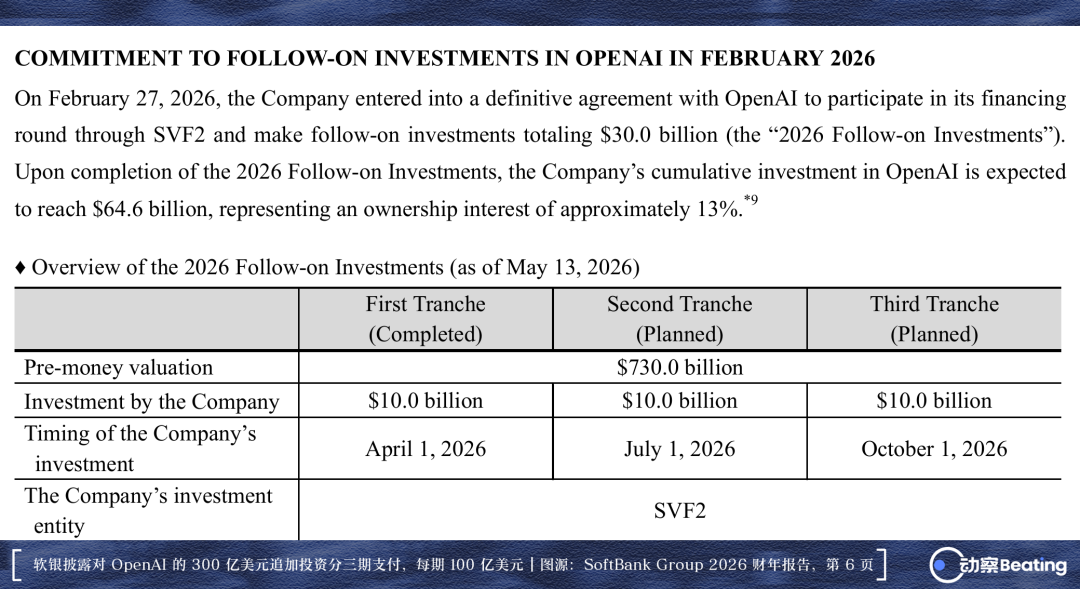
On February 27, SoftBank signed the final agreement with OpenAI.
A total of $30 billion in additional investment was split into three installments, each exactly $10 billion, due on April 1, July 1, and October 1 respectively. Once the final payment is settled, SoftBank's hard cash plowed into the company will reach $64.6 billion, translating to roughly a 13% equity stake.
$64.6 billion is twice the amount SoftBank spent acquiring Arm in 2016.
In this round, OpenAI's pre-money valuation surged to $730 billion, leaving SoftBank Group's own market capitalization far behind. Installment payments were the result of compromise: OpenAI locked in its funding for most of the coming year, and SoftBank carved out breathing room for itself.
But the price is that every three months, SoftBank has to scramble to raise $10 billion among financial institutions.
What pushed Masayoshi Son to make up his mind was a roadshow document written for top-tier capital backers.
The document shows that OpenAI expects revenue of $36 billion in 2026, which will balloon to $350 billion by 2030, raking in a cumulative $840 billion over five years. The massive $122 billion financing just finalized in March pushed its valuation to $852 billion. Rival Anthropic is planning a listing, and Son, eyeing the rapidly inflating valuation, is convinced he has secured the most critical seat in the era of superintelligence.
But behind this document lies nothing but bottomless holes.
The same document predicts that from 2026 to 2030, OpenAI's negative free cash flow will accumulate to $278 billion over those five years. Computing power and data center infrastructure costs alone will devour $856 billion, a single line item that directly exceeds the sum of all projected revenue over the five years.
Every step of technological iteration is bleeding out in units of tens of billions.
That is why it needs Son. A company with vast ambitions but continuous bleeding urgently needs a buyer willing to pledge the credit of an entire conglomerate to advance it funds.
But the asset SoftBank gets in return is currently a stagnant pool.
The agreement states clearly that all subscriptions are preferred shares, which cannot be converted into freely tradable shares before a public listing and bell-ringing. There is also almost no institution in the off-exchange market with the appetite to take on a tens-of-billions-dollar position. Converted into a $64.6 billion holding certificate, before the actual listing bell rings, it is just a stack of paper locked in a safe.
Son is no stranger to waiting.
In 1995, he bet on Yahoo, with paper gains at one point exceeding 300 times, briefly propelling him into the chair of the world's richest man; the $20 million invested in Alibaba slept underwater for more than a decade before finally waiting for that bell on the NYSE that resounded across the globe.
Two famous battles shaped his superstition about major trends, but they also made him overlook a premise: whether it was Yahoo or Alibaba back then, the money underneath was his own.
His own idle money could afford to be spent, and the worst outcome was nothing more than admitting the loss and leaving the table. As long as he did not get up, there was always the possibility of enduring until a miracle happened.
In the official announcement on February 27, he spoke without hesitation:
"AI is changing the world at an unprecedented pace. OpenAI is the clear leader, with world-class technology and an unparalleled global user base, and we are confident in its continued growth."
He laid out clearly why he was bullish, yet stayed silent on where the money would come from.
Grand visions belong to the era; the price of realizing them is written into another contract filled with borrowing clauses.
The $40 Billion Floating Bridge
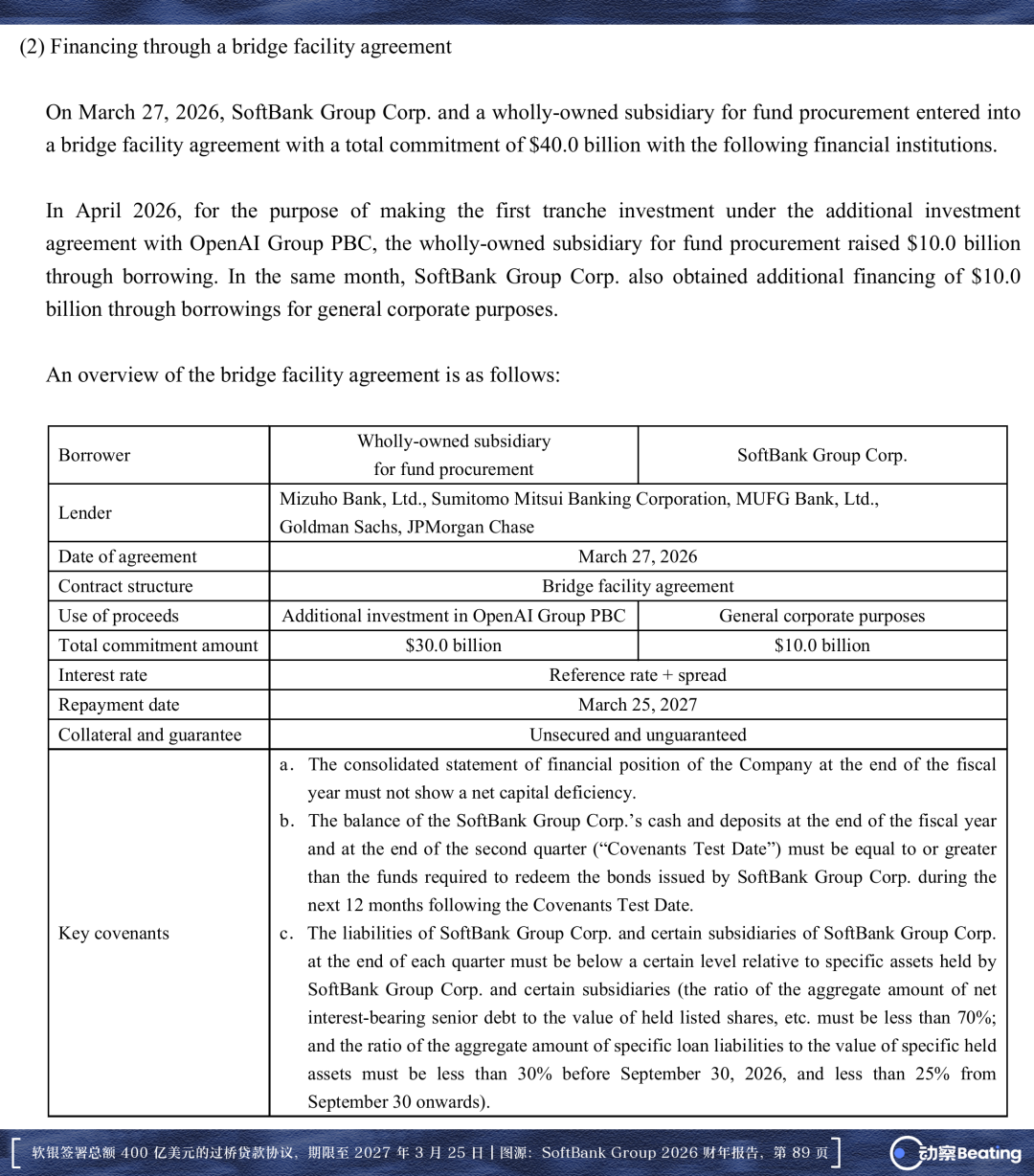
On March 27, SoftBank signed an unsecured bridge loan totaling $40 billion.
JPMorgan, Goldman Sachs, Mizuho, Sumitomo Mitsui and Mitsubishi UFJ led the deal, backed by a syndicate of more than twenty international banks. The entire borrowing carried no physical asset collateral, with a term of just one year, maturing on March 25, 2027.
The reason Wall Street cleared this massive exposure was solely SoftBank's corporate credit and Arm, sitting at the bottom of its balance sheet. In the credit market, a bridge loan is by nature a temporary stopgap tool, its purpose merely to fill the gap before long-term funding is in place.
But SoftBank drew down at breakneck speed.
On April 1, it drew $10 billion for the first tranche, and on July 1, another $10 billion for the second tranche. SoftBank also drew an additional $10 billion in April as a liquidity reserve. Of the $40 billion facility, $30 billion was drawn in the blink of an eye.
What was more delicate was September.
On September 9, SoftBank announced it would prepay $25.9 billion of the outstanding balance on September 15. The loan was not fully settled, leaving a tail of about $4.1 billion on the books; as for the source of funds to fill that more than $20 billion, the official announcement said not a word.
The replacement was no panicked move. As early as the initial investment announcement on February 27, SoftBank had already stated that the payment would first be advanced via the bridge loan, then replaced using existing assets and long-term financing.
At the end of August, market rumors emerged that Mizuho Bank was leading a $10 billion two-year loan, with a spread of about 275 basis points, directly used to take over the bridge loan. CFO Yoshimitsu Goto said on a conference call that SoftBank had absolutely no reason to wait until near maturity to act, and that the replacement would only come earlier.
What SoftBank is doing is replacing one-year short-term debt with public bonds of three and a half or even seven and a half years.
The only goal is to push back the repayment deadline.
What Masayoshi Son has subscribed to is frontier equity that may take a decade or even longer to pay off, while what he holds to settle the bills is rigid debt that must be cleared in a year.
This is his most adept playbook: using massive capital to suppress probability, and brute force to produce miracles. He once compared his investment style to fishing with a large net rather than holding a rod.
But even a large net has times when it cannot hold everything.
Back then, the Vision Fund invested $11 billion in WeWork, which ultimately headed toward liquidation, and in fiscal 2023 SoftBank lost more than $32 billion. Even though the cost was heavy, what was consumed, after all, was its own capital and fund shares; there was no syndicate of creditors knocking at the door.
A Fuse Attached to Valuation
What truly welded the long-term technological vision to the immediate cash pressure was the loan signed on August 5.
The deal had been locked in behind-the-scenes tug-of-war since early spring. SoftBank's initial goal was to borrow a full $10 billion, but the lenders had many concerns. Pricing equity for a company not yet listed, whose business model has not even closed the loop, makes the risk extremely difficult to weigh. Negotiations once reached a deadlock, and the loan amount was forcibly compressed to $6 billion.
It was not until July that Masayoshi Son personally raised the stakes and decided that SoftBank Group would step in to provide a full corporate guarantee, after which the syndicate finally relented and pushed the facility back to $10 billion.
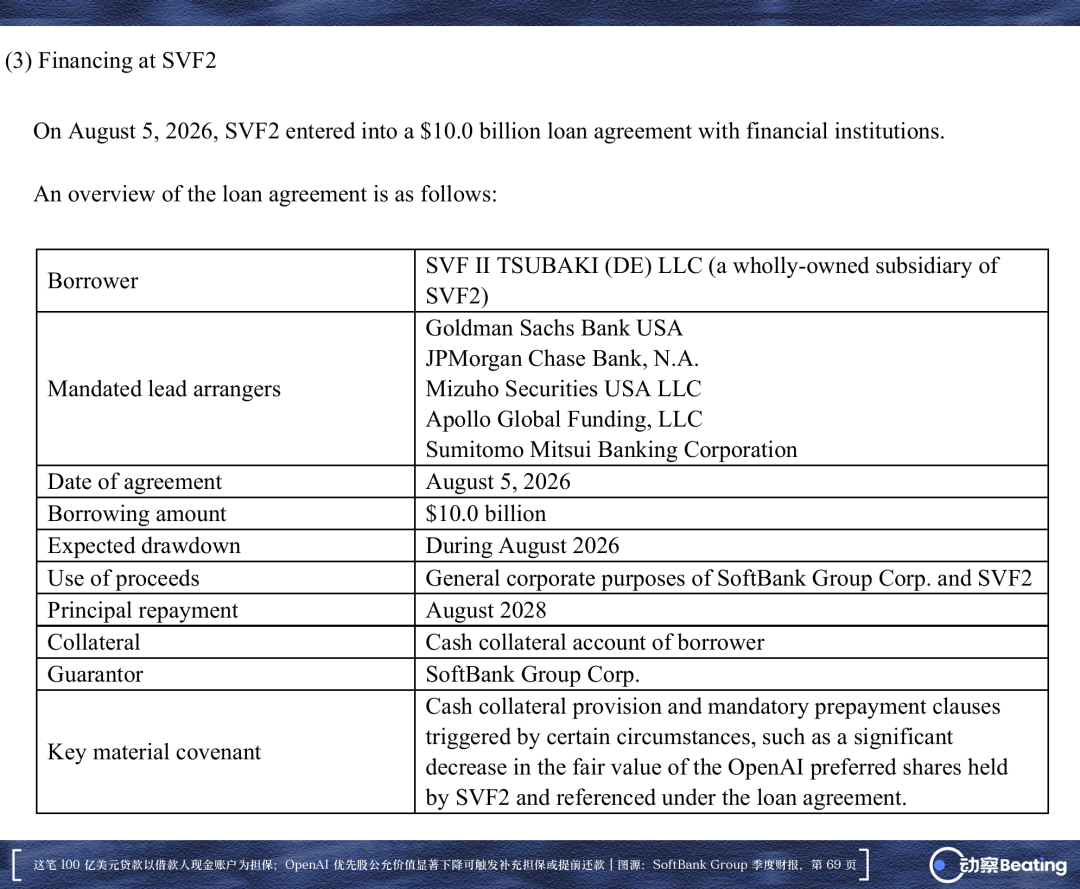
It was formally signed on August 5. The borrower is SVF II TSUBAKI (DE) LLC, registered in Delaware, a wholly owned subsidiary of Vision Fund II, with a two-year term maturing in August 2028. The lineup of lead banks is exceptionally deep, with Goldman Sachs, JPMorgan Chase, Mizuho Securities, Apollo, and Sumitomo Mitsui all on the list.
During negotiations, the spread quoted for this money was once as high as 425 basis points, a full 150 basis points more expensive than ordinary loans used to take on bridge loans during the same period. This is the risk premium Wall Street charges for illiquid private equity. The use of proceeds specified in the contract is not direct capital injection, but general corporate purposes of SoftBank Group and Vision Fund II, for routine liquidity turnover.
When outside media reported the deal, most habitually summarized it as SoftBank borrowing $10 billion by pledging OpenAI shares.
But the financial statements record a completely different structure. The legal collateral under the agreement, from beginning to end, was only a cash collateral account in the borrower's name; OpenAI shares were never actually pledged.
That equity locked in a drawer serves as a taut cursor within the entire structure. The contract explicitly stipulates that if the fair value of the OpenAI preferred shares referenced in the agreement significantly declines, it will trigger cash collateral shortfall provisions and mandatory early repayment clauses.
The shares were not handed over to the bank, but the price tag on the shares was set up as a target.
As long as the valuation shrinks, creditors have the right to demand that SoftBank quickly mobilize real cash to fill the collateral account, or directly recover the loan principal and interest. At that juncture, the preferred shares locked in SoftBank's vault still have no legal channel for monetization; the shares were not handed over, yet the valuation has become a trigger the bank can pull at any time.
Extremely perilous.
When the internet bubble burst in 2000, SoftBank's stock price fell by 90%. After that, Masayoshi Son himself pledged SoftBank shares to borrow money from banks, but what he pledged were shares under his personal name, so losses only hit his personal account and did not implicate the group.
This time it is completely different. Not a single share was pledged, but SoftBank's stock price has been used by the bank as a yardstick to measure whether this loan is safe. In the past, when the stock price fell, it was merely a shrinking number on the financial statements; now, once the stock price falls too far, it will directly force SoftBank to pay out cash to top it up.
This point becomes even clearer when compared with another margin loan SoftBank made using Arm shares. That one was non-recourse to the group, so if the bank lost money, it could only go after the Arm shares; but for this OpenAI loan, SBG is the guarantor, and Goto's exact words on the earnings call were "recourse to SBG." When calculating LTV (loan-to-value ratio), this debt is fully counted in SoftBank Group's debt, with not a single cent adjusted.
In other words, for the same $10 billion borrowed, this time the bank wants SoftBank Group's entire balance sheet to back it up.
Goto said on the earnings call that he believed the safety cushion was "more than sufficient." But contract terms do not follow feelings; once the stock price falls below the agreed level, SoftBank must either post additional margin or repay early.
What is more troublesome is that liquidity will be locked up on the spot. When the day comes that margin must be topped up, SoftBank will have to transfer real cash into the collateral account, and that money will be frozen instantly, unable to be used for new investments or to repay other debts.
Waiting costs money
Having to top up margin when the stock price falls is a problem that only arises when something goes wrong. The more everyday cost is interest; as long as this money remains on the books, interest keeps increasing every quarter.
In the three months from April to June 2026, SoftBank Group and its financing subsidiaries saw interest expenses reach ¥281.65 billion, an increase of ¥147.3 billion compared to the same period last year. Converted at an exchange rate of 150, this is approximately $1.88 billion.
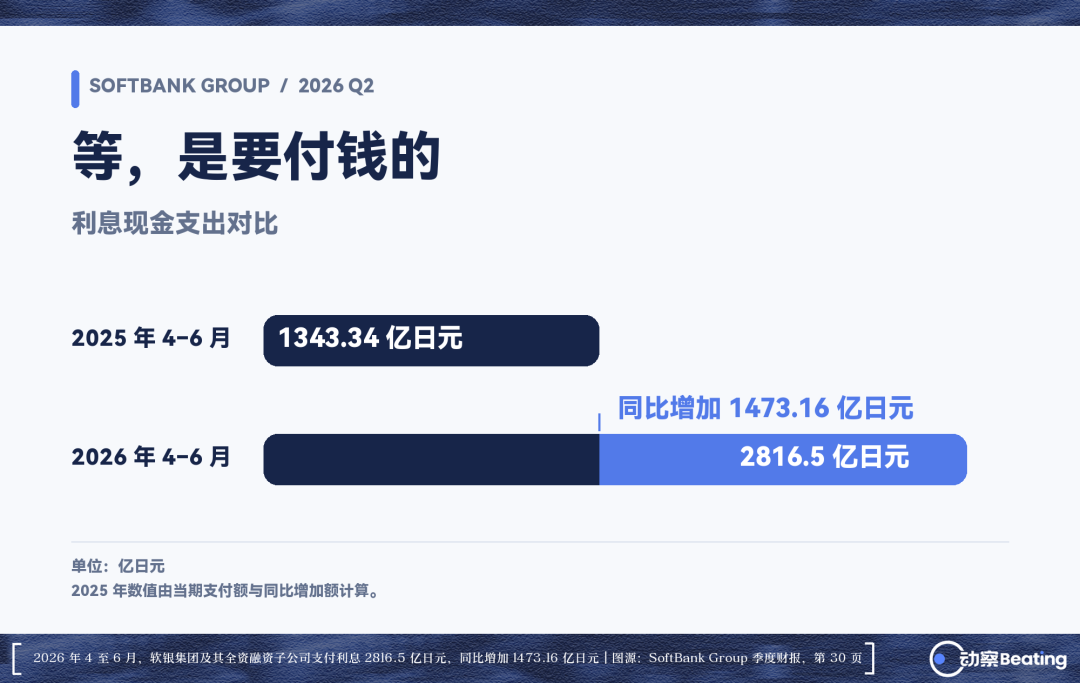
The $11.5 billion Arm margin loan borrowed in December 2025, the $20 billion bridge loan drawn in April 2026, rising corporate bond balances, and higher global interest rates all combined. Several massive new debts stacked together caused interest expenses to jump a notch.
SoftBank had originally hoped that OpenAI would ring the bell and go public as soon as possible, cash out equity, and this rigid debt could be bridged.
But Sam Altman told Fortune in September that due to concerns about AI safety, now is an "inappropriate time" to ring the bell.
The four words "inappropriate time" translate into real money on SoftBank's books.
The bridge loan is pressed against March 2027, and the valuation-linked loan is stuck at August 2028. Just the $10 billion debt hanging for an extra year, calculated at an 8% interest rate, amounts to $800 million in interest.
What's harder is that OpenAI itself cannot stop.
A cumulative cash flow hole of $278 billion over five years, spread out to over $55 billion per year. OpenAI's burn rate means it must raise funds round after round to sustain itself.
SoftBank is the one stuffing in the most money. Whether it can recoup its investment all depends on whether OpenAI can reach the IPO stage. If OpenAI's next round runs out of fuel, everything SoftBank has poured in will go to zero.
So it has no choice but to help. On one hand, it must pay interest on the money already borrowed; on the other, it must continue to arrange the next round of funding so that its investment can stay alive until the IPO.
The Trump Card
With so much debt, why is Wall Street still willing to lend him tens of billions of dollars?
The answer is Arm.
This chip architecture design company headquartered in Cambridge, UK, almost monopolizes 99% of global smartphone processor architectures. In 2016, Masayoshi Son raised $32 billion in cash by significantly reducing his stake in Alibaba to take it private. By the time it relisted on the US stock market in the fall of 2023, riding the frenzy for underlying computing power efficiency in AI chips, Arm's stock price surged about 270% within the year, with its market value once breaking through $300 billion.
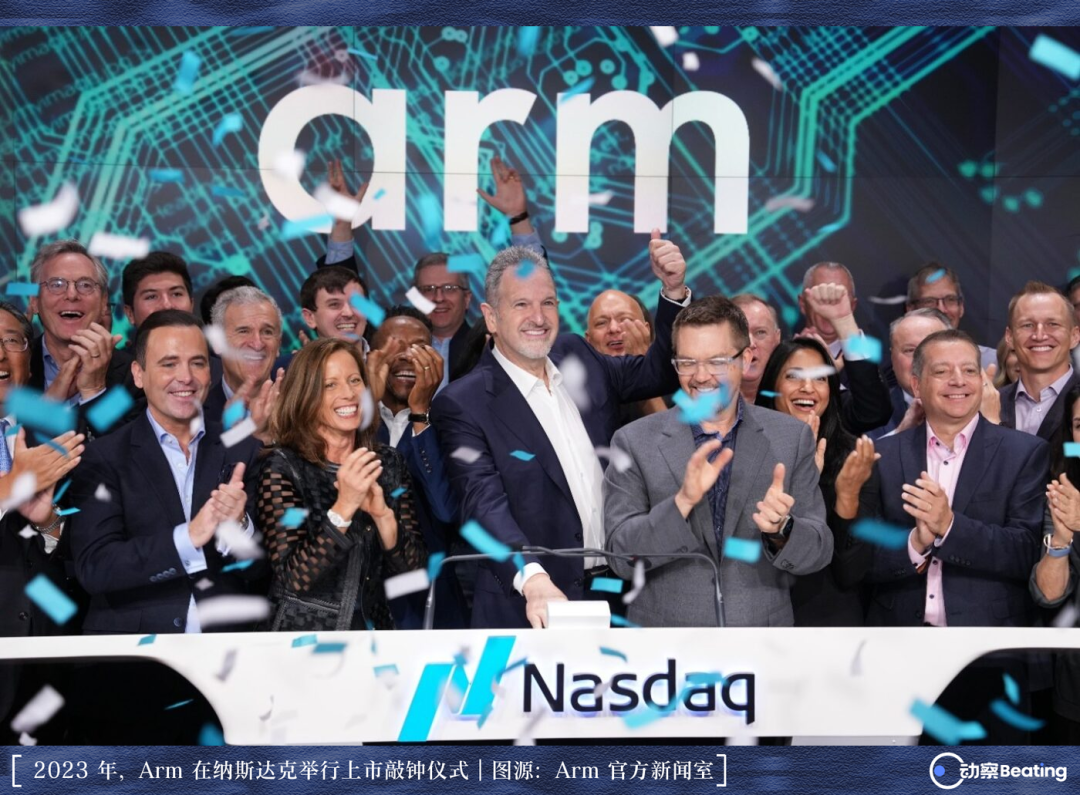
SoftBank still firmly holds 90% of Arm's equity, and the unrealized gains from this asset exceed $220 billion.
Banks don't care how profound large models are; they only recognize the hard currency in SoftBank's hands.
SoftBank's management loves to show the market one metric: LTV (net debt divided by equity value), used to measure the proportion of borrowings to assets. From March to June this year, this figure dropped from 17% to 13%, seemingly indicating that leverage has converged.
But this is just a numbers game.
During the same period, SoftBank's net debt actually rose from 8.2 trillion yen to 10.8 trillion yen. The borrowed money not only didn't decrease but increased by a full 2.6 trillion; the so-called decline in leverage was purely due to Arm's stock price surge, which enlarged the denominator in the calculation formula.
But asset appreciation doesn't equal cash in hand. SoftBank's cash and equivalents on the books not only didn't increase but fell from 3.5 trillion yen to 2.3 trillion yen, with money flowing out in large amounts to pay OpenAI investment installments on schedule and to repay old debts.
Relying on this passively inflated denominator, SoftBank portrays a respectable sense of security in its financial reports. The 13% level is still far from the group's internal red line of 25%, and S&P has accordingly upgraded its rating outlook from "negative" to "stable."
But this cannot conceal the approaching peak of debt repayments.
Within the next two years, SoftBank still has about 1.5 trillion yen in corporate bonds awaiting redemption, equivalent to approximately $9 billion—one tranche next year, another the year after. Private equity giant Apollo is also in negotiations, attempting to expand a NAV loan for Vision Fund II from $5.4 billion to $9 billion.
Wall Street still loves to circle around SoftBank because at the very bottom of that balance sheet lies Arm, a card that can be cashed in.
Back then, UK and EU regulators blocked the merger between Arm and Nvidia, leaving Masayoshi Son with only a $1.25 billion breakup fee; after going in circles, this chip company has instead become the last pillar sustaining his entire credit chain.
On September 24, the final interest rate for this $10 billion high-risk bond will be finalized. This figure is the public market's explicit price tag for "how much longer Masayoshi Son has to wait for OpenAI"—the higher the pricing, the more Wall Street feels this wait is fraught with danger.
Delivery on September 29, payment on October 1. Then, the clock keeps ticking.
He's waiting for OpenAI to ring the bell, while his creditors wait for him to repay principal and interest by March 2027.
Money waits for no one.
Welcome to join the official BlockBeats community:
Telegram Subscription Group: https://t.me/theblockbeats
Telegram Discussion Group: https://t.me/BlockBeats_App
Official Twitter Account: https://twitter.com/BlockBeatsAsia
