HyperEVM has always been the weakest link in the Hyperliquid ecosystem, constrained by performance, it is temporarily unable to shoulder the重任 of serving as the execution environment for complex applications running continuously around Hyperliquid.
Kinetiq, as the protocol with the largest TVL in the Hyperliquid ecosystem, is attempting to fill this gap. Kinetiq started with the HYPE liquid staking product kHYPE, with a TVL of approximately $1.3 billion. Since then, Kinetiq has launched the HIP-3-based perpetual contract market Markets.xyz, extending its business from staking to trading. But what the community is most anticipating is Kinetiq's recently launched Hyperliquid L2: Elysium.
Parallel with HyperCore
Elysium adopts the Arbitrum Orbit tech stack, with transactions executed on L2, state settled to HyperEVM, and HYPE directly serving as the native gas. Kinetiq's performance target is 300 million gas per second, 100 to 200 milliseconds per block, with throughput approximately two orders of magnitude higher than HyperEVM. Currently, Elysium has already launched its testnet.
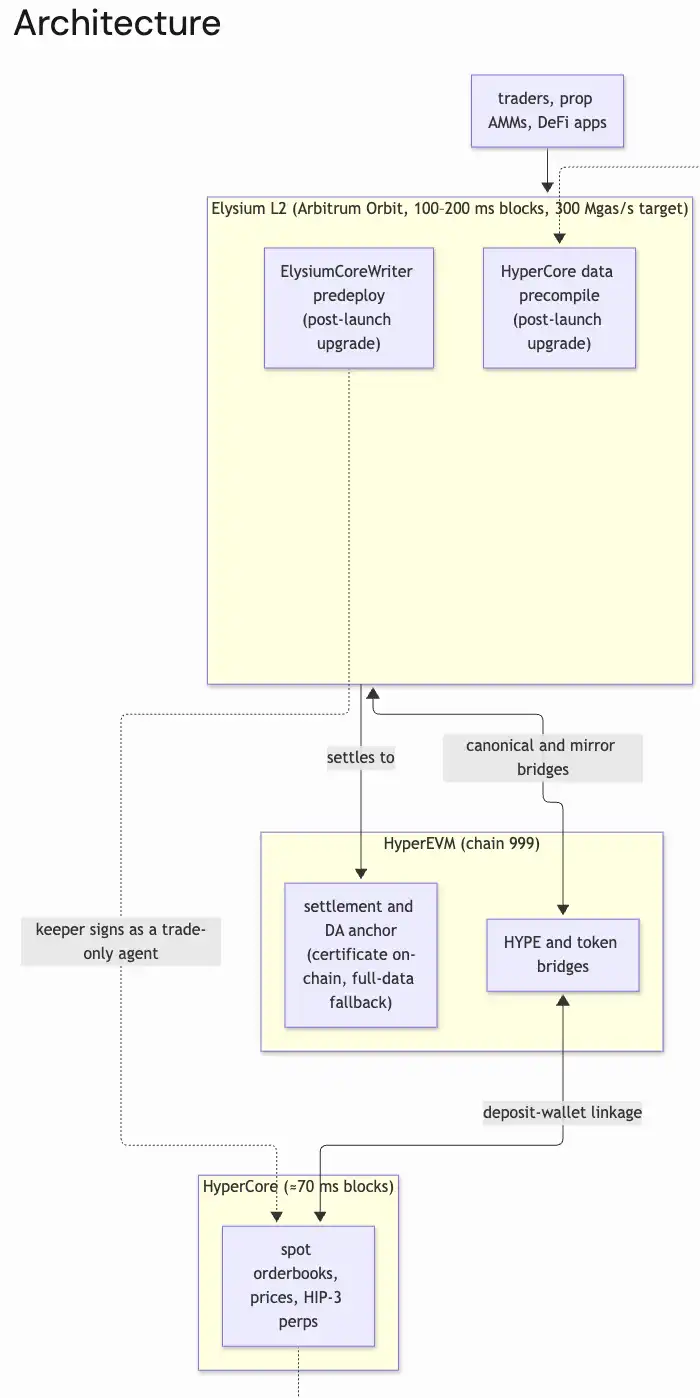
Speed is only the first layer. What Elysium truly aims to achieve is enabling smart contracts to directly utilize the trading markets that HyperCore has already formed. HyperEVM's current L1Read interface mainly provides the best bid and ask prices from the order book. Elysium plans to allow contracts to read deeper order book depth, prices, account balances, and positions on demand, and also plans to enable applications to send orders to HyperCore with low latency.
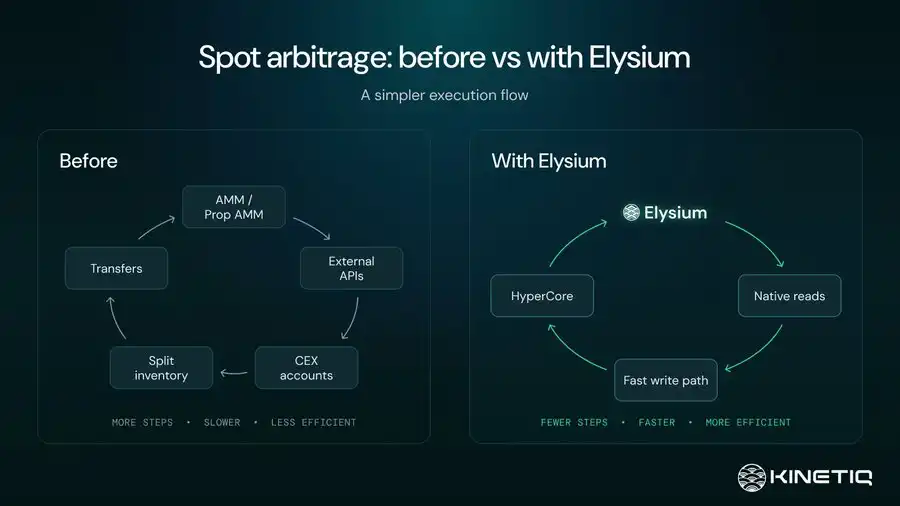
PropAMM operated by proprietary market makers can continuously update quotes on Elysium based on inventory and market conditions, then hedge on HyperCore after execution; arbitrage programs can also simultaneously observe price differences between AMMs and the order book, reducing reliance on external oracles and cross-platform accounts.
Another clear use case for this chain is to support the entire process of new tokens from cold start to a mature trading market.
Currently, Hyperliquid has no stable path for asset issuance. If a newly issued token is first priced in Elysium's AMM, and after liquidity grows, professional market makers provide deeper spot trading quotes, then the token is mapped to HyperEVM, connecting to the HyperCore spot order book; once the spot market is sufficiently mature, the project team can also strive to launch a HIP-3 perpetual contract market. This would establish a "standard process" from issuance to spot and then to contracts.
Value Flows to KNTQ and HYPE
Elysium has designed a relatively direct revenue path for Kinetiq's token KNTQ. According to the published distribution plan, 25% of sequencer fees go to app builders who consume block space, 25% go into the Kinetiq treasury, and the remaining 50% is used to buy back and burn KNTQ on the open market. If Elysium succeeds, it would be a huge boon for KNTQ.
HYPE's value flow takes a few more turns. First, HYPE is Elysium's native gas. Second, if Elysium's AMM generates sufficient volume and spreads, market makers and arbitrageurs will return to HyperCore to hedge and match orders, generating new order book fees.
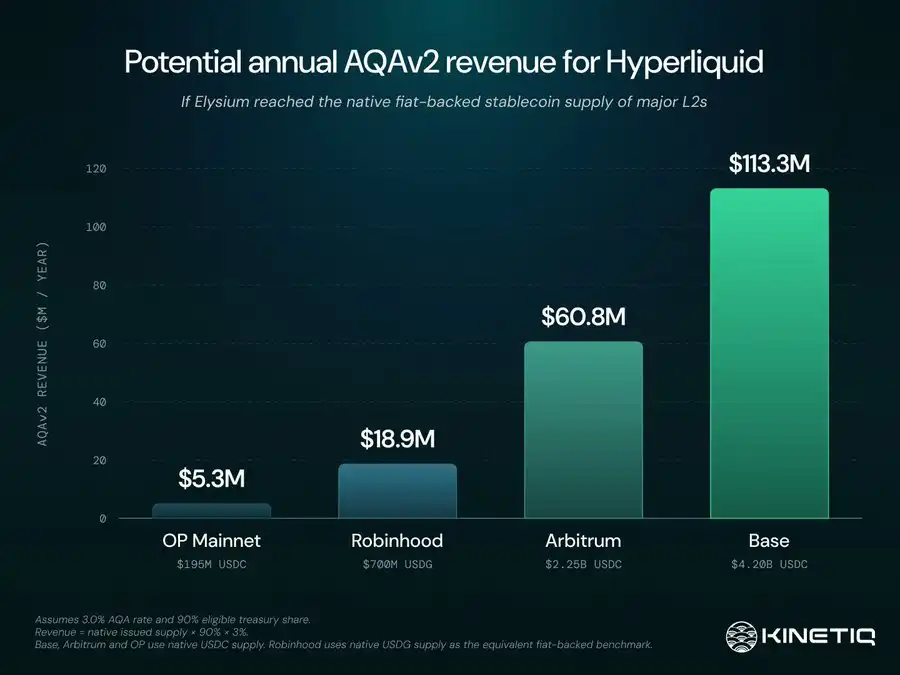
USDC circulating on Elysium can also increase Hyperliquid's revenue. Elysium's USDC is backed by native USDC on HyperEVM. Under the AQAv2 arrangement, Hyperliquid can earn a share of the yield from native USDC reserves on its network. If Elysium genuinely attracts new external capital, even if that capital is used on the L2, it could increase the network's USDC reserves, thereby increasing Hyperliquid's revenue and HYPE buybacks.
Launchpad
Ascend, co-founded by KOL CryptoTomYT, is the first project to announce deployment on Elysium, and currently Ascend is expected to be Elysium's flagship launchpad.
Ascend's documentation shows it plans to have tokens go directly into closed hook trading pools, with no separate bonding curve phase, initially quoted in USDC or supported tokenized real-world assets. A project's trading volume, independent holders, market cap, and holding concentration determine whether it qualifies for "Ascended" status. Qualified projects can receive platform buybacks and display, then pursue listing on HyperCore spot and HIP-3 contract markets.
Ascend's most distinctive mechanism is that users can convert HYPE deposited into Ascend into Kinetiq's kHYPE, and the staking yield generated by kHYPE is used to buy new tokens that have obtained "Ascended" status, which are then distributed to stakers. In effect, you can stake HYPE to earn quality meme coins from the launchpad.
Ascend does not plan to issue its own platform token. The trading fee is proposed at 1%, with devs receiving 25% of this fee; platform-approved active creators or project takeover parties can receive 50%. The platform will use 90% of net protocol revenue to buy HYPE and 10% to buy KNTQ.
The Elysium mainnet is planned to launch in one month. Whether the Hyperliquid community's frenzy can ignite Elysium is worth observing.
Welcome to join the official BlockBeats community:
Telegram Subscription Group: https://t.me/theblockbeats
Telegram Discussion Group: https://t.me/BlockBeats_App
Official Twitter Account: https://twitter.com/BlockBeatsAsia
