On September 28, Manus 2.0 went live.
This version was actually completed back in August. It sat locked in a drawer for a full two months, only seeing the light of day after that cross-border mega-acquisition involving $2 billion was fully settled.
Over the past nine months, Manus lived through a story rarely seen in the history of Chinese venture capital: first acquired by Meta for over $2 billion, then halted by the National Development and Reform Commission, and ultimately bought back at the original price by a group of old shareholders led by Tencent.
For the vast majority of startups, nine months like that would be enough to leave them broken and battered.
Yet Manus only ran faster at the center of the storm. During the three months of investigation and restructuring, its daily revenue grew nearly fivefold, and less than three weeks after regaining its freedom, the new funding round it is negotiating has already reached a valuation of approximately $4 billion — exactly double the buyback price from half a year ago.
After going around in a big circle, this independent company returned to the table worth more than when it was sold to a giant.
And just twenty days before the launch of Manus 2.0, Meta launched its own personal agent product Muse, which shot to the top of the U.S. App Store free chart within ten days. What Muse is doing now, Manus had actually already pioneered during its months at Meta.
Only this time, Manus must finish it on its own.
Manus 2.0
When it announced the restoration of its independence on September 1, Manus set three military orders for itself: embed the agent more deeply into users' daily workflows, interact more directly with real environments, and, once authorized, more proactively handle things on people's behalf.
Four weeks later, the 2.0 release was almost a direct answer to those three statements.
The entire launch announcement made no mention of Meta whatsoever, nor did it say a word about the turbulence of the past year. Its focus was on trying to push the definition of an agent from "doing tasks for you" to "delivering works."
A year and a half ago, what first made this team famous was a different kind of experience: the user tossed over a single sentence, and the cloud automatically spun up a virtual machine, searched for information, wrote code, ran data, and finally returned a result. If the user was unsatisfied with the soundtrack of a generated video, they often had no choice but to scrap it and start over, readjusting the prompt and running it again.
Manus 2.0 chooses to hand the process back to the human.
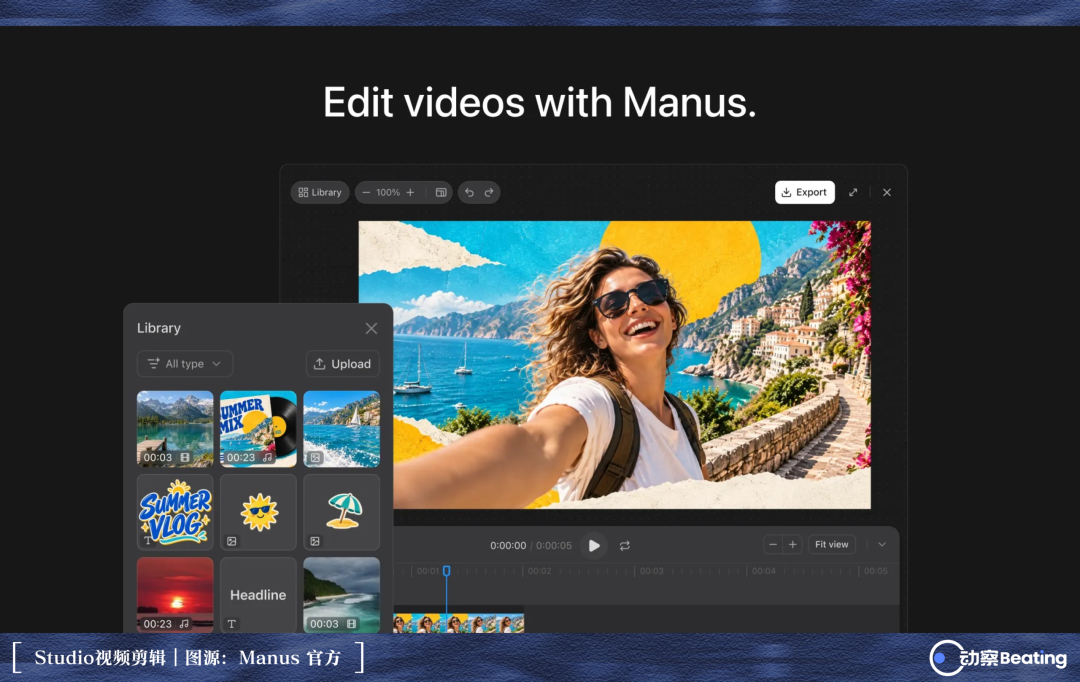
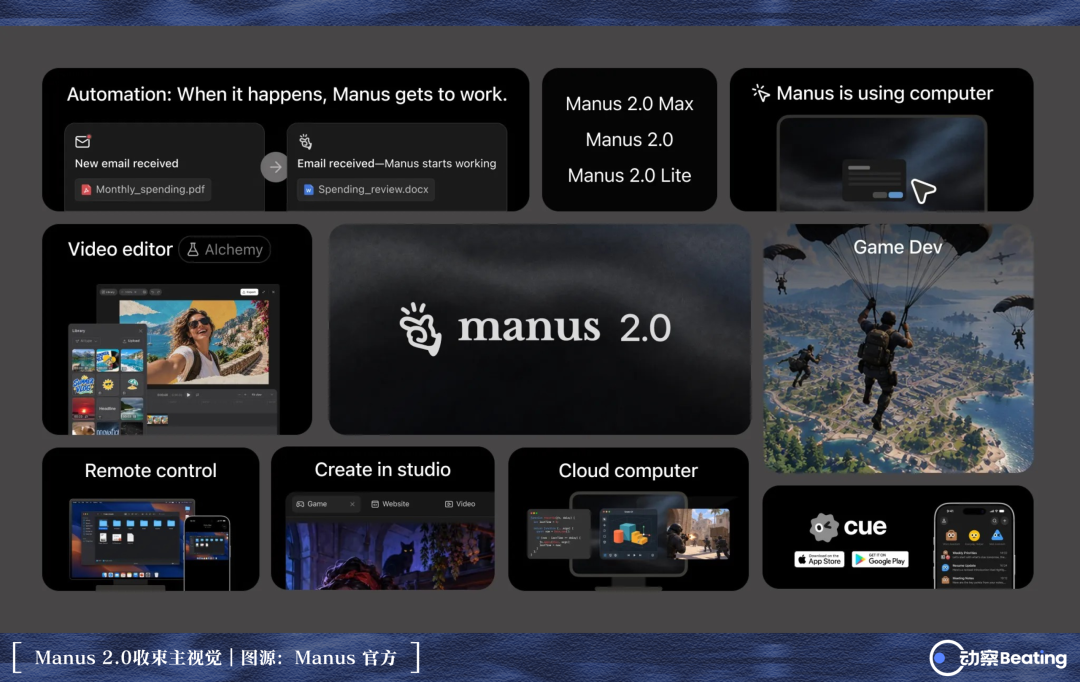
The new video editor produces a rough cut in minutes, then lays out the timeline. Clips, images, text, motion graphics, and audio are all independent assets—you can swap the soundtrack, drop in your own product shots, nudge the animations, and hand it back to Manus to carry on. Another mode called Alchemy has it acting as creative director, concurrently orchestrating the video generation and code engines.
The same goes for the game development environment. It connects to video, image, and programming models simultaneously. If a villager's hair shouldn't be brown, just click on that villager to fix it individually—all other logic and art assets remain untouched. The finished game can be published as a webpage with one click, and even supports multiplayer, all it takes is checking a box for a cloud computer—server architecture, network traversal, and underlying operations are all handled by the backend agent.
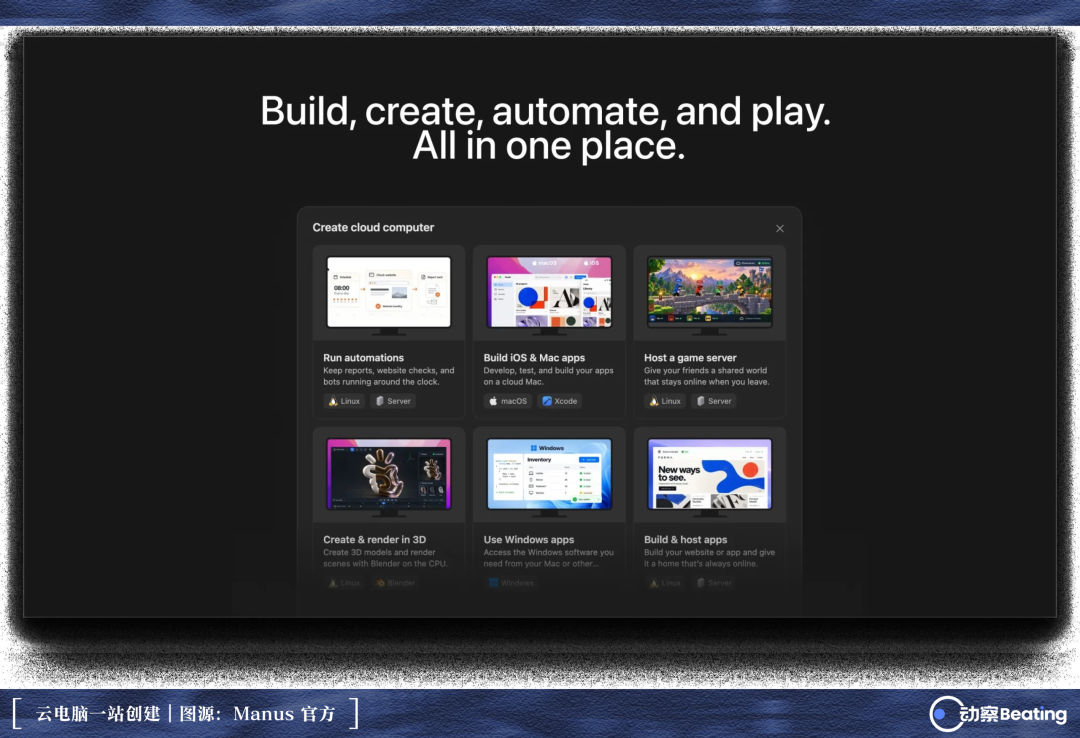
Embedding into workflows relies on cloud computers and automation.
The cloud computer is the core new infrastructure this time—a machine that stays online 7×24 in the cloud even when the user closes their laptop. It serves as both a multiplayer game server and a persistent node for complex tasks.
Meanwhile, automation has moved beyond mechanical scheduled polling to become fully event-driven. A new inbound email, an anomaly in ad campaign data, a specific Slack message—any of these can instantly wake up the entire pipeline.
Interacting with the environment is handled by Computer Use.
Imagine this scenario: you're sitting in a taxi and simply send a command from your phone. Manus remotely takes over your home computer's desktop, picks out the latest presentation from the launch event folder and sends it back. You can even see the cursor's movement in real time on your phone. And all of this is strictly isolated within an independent, visualized workspace, only touching apps that have been explicitly authorized.
What makes all this possible is the new framework Cascade. According to Manus, it stays extremely lightweight in the initial project phase, only mounting specialized models on demand when bottlenecks arise. In benchmark tests, compared to the old architecture, this system reduced token consumption by 23.2%, shortened task time by 28.2%, and cut overall operating costs by 32%.
As for "proactively doing things for people," that's been packaged into a separate new product, Cue.
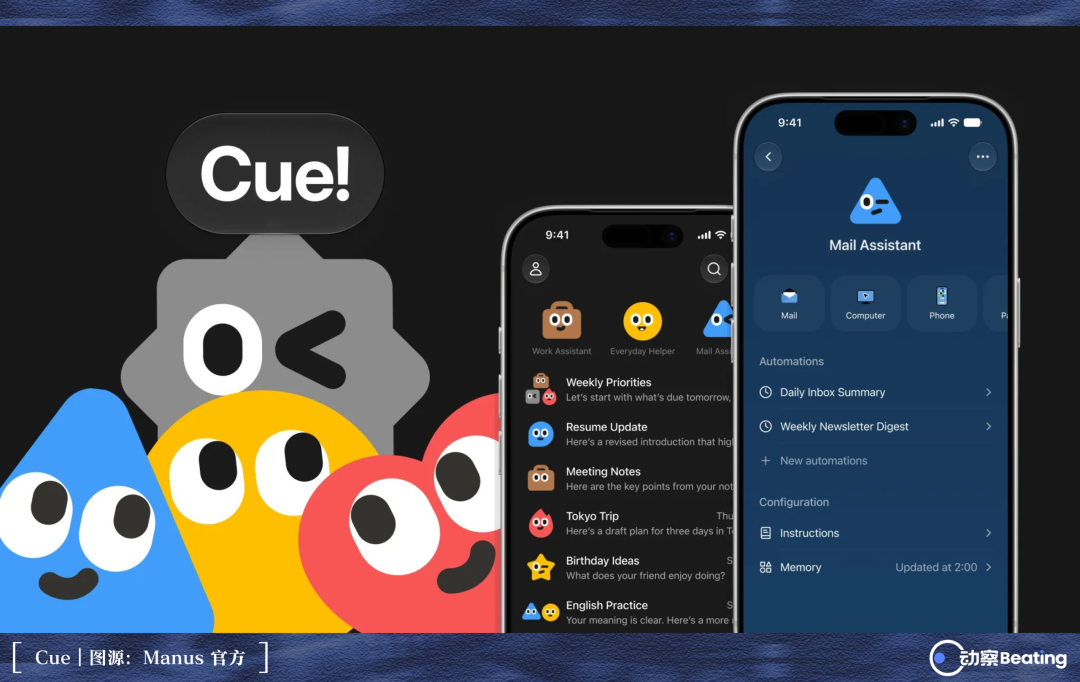
It works on both mobile and desktop, sharing the same infrastructure as Manus. Each agent has its own email address, phone number, wallet, and computer. It can send messages, make payments within a budget set by the user, answer calls on someone's behalf, and leave a call summary. Several agents can be pulled into the same group chat, given a common goal, and sent off to work separately—one researching a venue for a New York launch event, one compiling a candidate list, and a third drafting a presentation. Currently, Cue still requires an invite code for free early access.
At this point, Manus's business map has been cut into two clear parts. Studio is responsible for making things, and Cue is responsible for running errands on people's behalf.
Ten Days
Manus's journey back to its origins traces to a seemingly unremarkable browser extension.
In 2022, Xiao Hong founded Butterfly Effect and brought in Ji Yichao and Zhang Tao. The first product, Monica, fitted a large model into the browser sidebar.
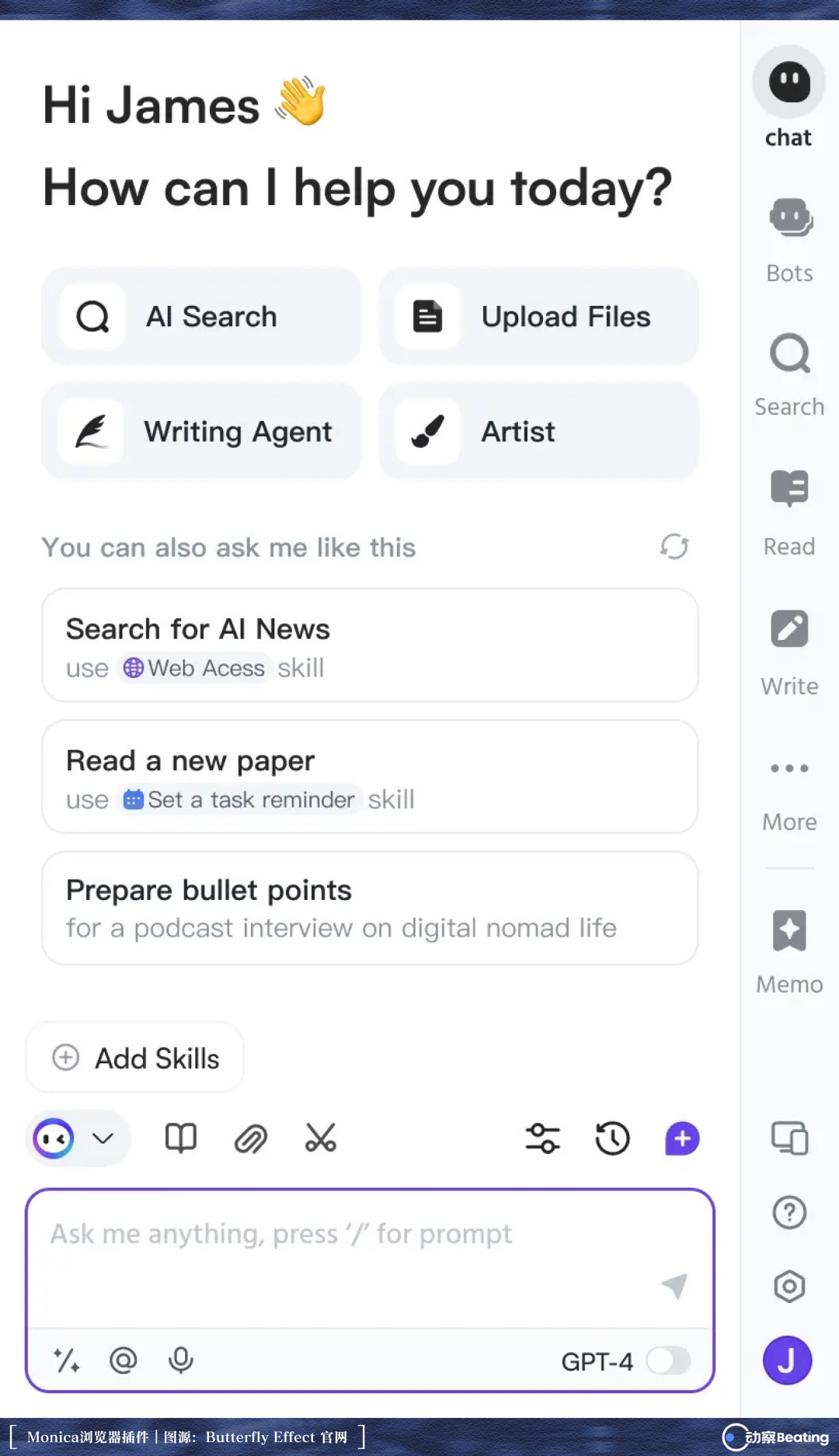
That was a period of feeling around in the cracks between the big tech giants. When most people in the industry were still carefully calculating the cost of a single API call, they were already doing Wide Research, which consumed enormous amounts of computing power. The logic behind it was a high-stakes bet that token costs would eventually depreciate at a Moore's Law-like pace.
On March 6, 2025, Manus was officially released.
In just 20 hours, its demo video surpassed one million views, and beta invite codes were bid up to five figures on secondhand trading platforms.
In July of that year, Xiao Hong decided to leave Wuhan, where he had lived for a long time, and move to Singapore with his core team. From then on, Manus fully anchored its strategic focus overseas.
Singapore gave Manus a good stretch of days.
By the end of that year, the company had set up offices in Singapore, Tokyo, and San Francisco, and expanded its team to 105 people. On December 17, 2025, it was officially disclosed that just 8 months after launch, its ARR had crossed the $100 million mark, and its run rate including usage-based payments exceeded $125 million; it had cumulatively processed 147 trillion tokens and spun up more than 80 million virtual computers in the cloud.
It says it is the fastest startup in the world to go from 0 to $100 million in ARR.
At that time, the team was conducting a new round of equity financing at a valuation of around $2 billion.
That was when Meta came knocking.
At first, Meta framed it as an executive visit to discuss deeper business collaboration. But after several rounds of engagement, at a closed-door meeting attended by all core members, Meta without warning slapped an acquisition offer on the table.
From initial contact to signing the agreement, it took no more than ten days.
So fast that even angel investor and ZhenFund partner Liu Yuan later admitted that given the pace, "I even briefly wondered if this was a fake offer."
On December 29, Manus announced it would merge into Meta at a valuation of over $2 billion. This is Meta's third-largest acquisition in its commercial history, after WhatsApp and Scale AI. Xiao Hong was appointed Vice President of Meta, reporting directly to COO Javier Olivan.
Starting from the $14 million seed-round valuation led by ZhenFund in February 2023, in less than three years, the paper return has multiplied more than 140-fold.
The early partners and engineers who weathered multiple startup journeys alongside Xiao Hong finally secured a handsome exit chip. To observers at the time, this was an impeccable exit.
Mens et Manus
The name Manus is derived from MIT's motto, Mens et Manus — mind and hand.
Chief Scientist Ji Yichao explained that no matter how powerful intelligence is, it cannot internalize the environment into itself. To engage with the real world, it needs a "hand."
What Manus wanted to build was precisely that hand.
And what Meta lacked at the end of 2025 was precisely that hand.
That year, Zuckerberg spent $14.3 billion to take a stake in Scale AI, recruited Alexandr Wang to head the newly formed Meta Superintelligence Labs, and offered sky-high salaries in Silicon Valley to aggressively poach top researchers. On the "brain" side, Meta was sparing no expense to rebuild its defenses.
But it still didn't have a killer app that could truly complete end-to-end tasks for users and independently generate software subscription revenue.
In the official blog post announcing its joining of Meta, Manus wrote that it looks forward to bringing this technology to the millions of businesses and billions of ordinary users behind the platform.
The B2B integration advanced extremely quickly.
On the earnings call on January 28, 2026, Zuckerberg deliberately set aside time to comment on the progress of the acquisition, saying outright that a considerable number of enterprises were already paying for it, and that integrating it into the advertising and business suite could provide clients within the ecosystem with a closed-loop solution.
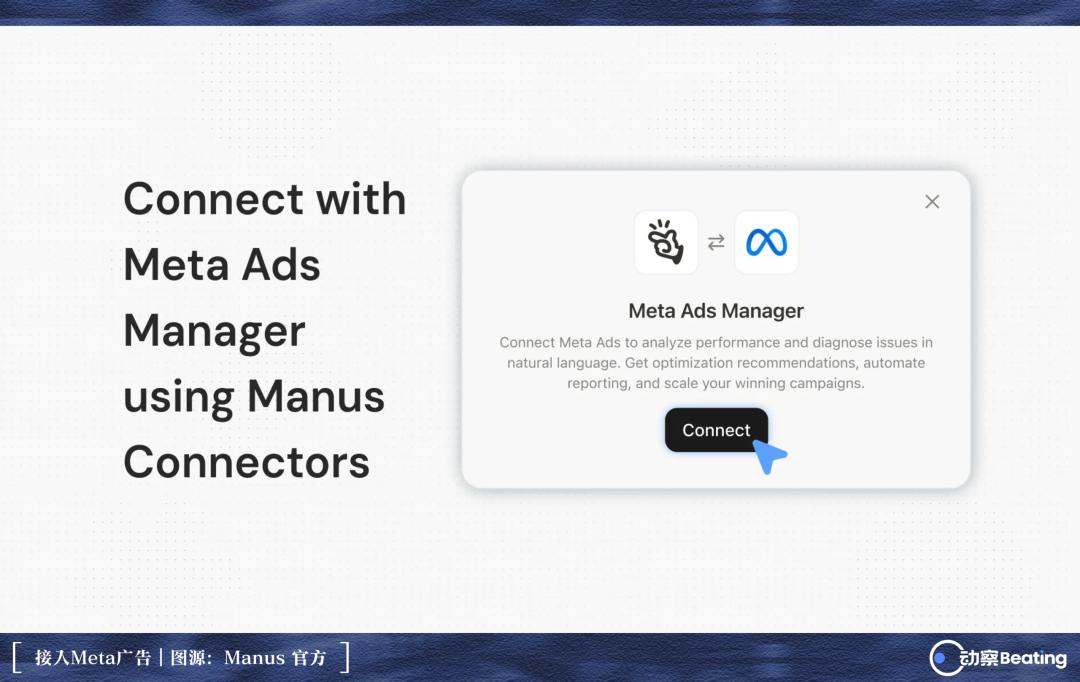
Three weeks later, all Meta advertisers could directly invoke Manus in the Ads Manager toolbox to generate post-campaign diagnostics. From signing to business integration, it took only 7 weeks in total.
Its consumer-facing capabilities were also being quietly laid out.
In mid-February, Manus tested the waters with an independent personal agent on Telegram; in March, the team began busily preparing to connect with WhatsApp Business. Tech bloggers quickly and keenly realized that Meta's Ray-Ban smart glasses already supported voice-activated WhatsApp, and once this capability was in place, users could simply press the temple of the glasses to wake up Manus remotely and have it handle real-world affairs on their behalf.
As of March, about 100 Manus employees had moved into Meta's Singapore headquarters office building.
Also in March, Xiao Hong and Ji Yichao received a notice from Beijing.
Revocation Order
The other shoe had, in fact, been hanging in the air for a long time.
As early as January 8, 2026, one week after the merger announcement, a spokesperson for China's Ministry of Commerce clearly stated at a regular press conference that activities involving outbound investment, technology export, and cross-border mergers and acquisitions must strictly fulfill statutory review procedures, and that relevant departments would assess the transaction's consistency with national export control and other regulations.
In late March, Xiao Hong and Ji Yichao traveled to Beijing for communication and were subsequently restricted from leaving the country.
On April 27, the Office of the Working Mechanism for Foreign Investment Security Review of the National Development and Reform Commission issued a final notice: "A decision prohibiting investment is made with respect to the foreign acquisition of the Manus project, and the parties are required to revoke the acquisition transaction."
In the view of the cross-border legal community, this is the first foreign acquisition case in China's frontier AI track to be halted since the introduction of the 2020 Measures for the Security Review of Foreign Investment; more unusually, it required the mandatory dismantling and rollback of a mature transaction that had already been completed, for which there was no prior precedent.
In June, the split was finalized. According to an internal memo seen by Bloomberg, Meta required all departments to halt any new project development based on Manus and began migrating existing data to its in-house systems; starting that month, the Manus team had all internal Meta access revoked, and Meta employees were no longer permitted to use Manus internal tools.
A seemingly joyous union thus came to an end.
Buying Back at the Original Price
The turmoil did not slow Manus down.
During the three months of regulatory tug-of-war, Manus's daily revenue not only did not fall but surged from $300,000 to nearly $1.5 million; during this period, its ARR broke through the $300 million mark for the first time. Other media outlets offered a more optimistic figure, with annualized revenue already in the $400 million to $500 million range.
Product development maintained a resilient iteration pace of one to two times per week. The team was in no rush to upgrade major version numbers; they focused their efforts on key milestones, integrating Gmail, Shopify, and Slack, advancing local clients, and successively finalizing ecosystem interoperability with Canva, Zoom, and Notion.
The 150-person startup team saw no departures. Xiao Hong, Ji Yichao, and Zhang Tao remained in Beijing, controlling the pace of the Singapore team's progress through daily cross-border video calls.
The primary market sentiment shifted dramatically.
When the acquisition was initially blocked, many VCs steered clear; but by mid-year, as strong business data emerged again, hot money began lining up off-market, waiting to participate in its first funding round after breaking away from Meta.
Existing shareholders were the first to act.
In June, Sequoia China, ZhenFund, and Tencent reached a consensus to buy back the entire company at the $2 billion cost Meta originally paid. In July, Tencent further clarified it would contribute to take on a larger share.
Interestingly, Benchmark's name was quietly removed from the investor list.
The former lead investor ultimately chose to forgo the buyback, with its original stake fully covered by Tencent. After the deal was finalized, Tencent rose to become Manus's largest external shareholder, but still adhered to the minority equity principle and did not obtain controlling stakes; the company's registration location and operational axis remain in Singapore.
Late at night on August 11, Manus's official website quietly removed the Meta-owned label and replaced it with a notice stating "independent operations to resume soon." Due to compliance requirements, some incremental data generated during the acquisition period must be cleared first according to regulations, and then manually pulled back from backups by users. The company immediately suspended billing for affected accounts and offered refunds and rewards.
On September 1, Manus announced the official resumption of independent operations, with Xiao Hong, Ji Yichao, and Zhang Tao continuing to lead the team. It gave itself a new label: an "independent agent lab."
Over $2 billion in capital spun idly on the books: distributed by the tech giant to the founders and financial institutions, and eight months later, returned intact to the giant, led by Chinese capital.
The price didn't change, but what was bought back did.
At the time of acquisition, $2 billion corresponded to $100 million in ARR, a premium multiple as high as 20x; at the time of the buyback, $400 million to $500 million in ARR compressed its actual valuation multiple to a remarkably healthy 4x to 5x.
In mid-September, Bloomberg reported that Manus was advancing a new funding round of $500 million, with a post-money valuation heading straight to $4 billion. New faces including IDG Capital, Boyu Capital, and CATL were all on the list, with existing shareholders also intending to oversubscribe and follow on; at the same time, adjustments to the red-chip structure for a Hong Kong listing had also been placed on the agenda.
From redeeming itself at the original price to doubling its valuation, it took no more than three weeks.
The Enemy in the Mirror
Across the ocean, Meta has not slowed its pace for a single moment.
As early as January 2026, the month after the acquisition was just finalized, Nat Friedman, product lead of Meta Superintelligence Labs, deeply experienced OpenClaw in his own workflow. Friedman revealed on social media that he had purchased hundreds of Mac minis for the team in one go, and everyone entered an immersive internal beta.
On March 23, Meta brought the entire team of agent startup Dreamer into Superintelligence Labs, including former Xiaomi Global Vice President Hugo Barra and former Stripe CTO David Singleton.
At the first-quarter earnings call in late April, Zuckerberg spoke about this technological vision without concealment: local agents showed the prototype of the future, but the barrier to use was too high, requiring terminal configuration, standalone hardware, and cumbersome tuning, with an audience of only a few hundred thousand geeks for now; Meta's destiny, by contrast, was to build an industrial-grade product that works out of the box, fully underpinned by cloud infrastructure, and reaches billions of ordinary people.
By the second-quarter conference call in late July, the name Manus had been completely sealed away. In its place was Zuckerberg's intensive evangelism for 24/7 autonomous agents.
On September 8, Muse burst onto the scene.
The system provisions each user with a dedicated cloud host called Muse Secure VM, underpinned by a security agent named Sentinel that conducts round-the-clock inspections. It knows how to navigate web pages, fill in credentials, and negotiate on behalf of users, and even continues to operate in the background after the app is closed, with its settlement channel linked to Stripe's payment components. With a free quota of 100 million tokens per week, Muse quickly topped the U.S. app stores, helping drive Meta's market value up by nearly 30% in a single month.
Subsequently, the geek community discovered that the code architecture of SOUL.md, the configuration file Muse uses to define interaction boundaries, was almost identical to that of the open-source project OpenClaw. In response, Friedman readily acknowledged that although the system was rewritten by the team, the product design was "indeed deeply inspired" by it.
The inspiration may be credited to the open-source community.
But Zuckerberg's key card for leveling the playing field—distributing dedicated virtual machines to billions of users in real time in the cloud—is precisely the forte that Manus spent the past two years honing to perfection. As early as late 2025, this small team had already orchestrated more than 80 million cloud computers.
An independent agent with a built-in hardware identity, residing within a communication tool, and transforming external reality on behalf of humans—Manus had already built the skeleton back in February.
Meta replicated this pipeline with formidable engineering throughput, and the capital markets priced in its purchase with a 30% stock price gain.
Yet this pathway was never smooth sailing. Less than two weeks after launch, Amazon moved to block Muse's crawling and ordering activities, with core concerns centering on its failure to proactively declare its agent identity and the risk of unauthorized access to historical assets.
For an agent that acts on behalf of others, the first obstacle it often hits is not its own technical ceiling, but the ecosystem walls of others.
Cue was released twenty days after Muse launched.
The two products share nearly the same starting point: giving each agent its own computer to handle affairs in the outside world on behalf of humans. But Cue chose to go a step further on the real-world interface: it equips agents with native phone numbers and independent prepaid accounts, enabling them to answer voice calls, summarize conversations, and settle payments autonomously.
Behind it is an independent company with annual revenue exceeding $300 million, product iterations measured in weeks, and which just used the Cascade framework to cut inference costs by 32%. Unlike competitors betting on a single giant, Manus has chosen from day one to dynamically orchestrate across multiple open-source and closed-source models.
For it, this was not the first time facing head-on competitive pressure from giants.
In early 2025, when Manus first emerged, a major domestic tech company internally launched at least 7 pixel-level benchmarking projects in one go, but in the end, none of them managed to steal its users.
The Third Journey
After the storm subsided, the real test returned to the underlying technology.
Over the past six months, the team successively filled in the desktop ecosystem and planning mode, which was essentially a passive catch-up to the standard paradigms established by Claude and Codex. After the equity relationships were clarified, the strategic choice facing the management became sharp. Should they continue to fly low with keen product engineering intuition, or must they step into the heavy-asset quagmire of large model pre-training?
Xiao Hong once summarized his business methodology as "trade, industry, technology"—first carve out ecological dividends, then refine the product matrix, and finally feed back into the underlying technology. After this battle, the first two steps have clearly been completed.
Just after New Year's Day 2026, in the days when the merger agreement had just been signed, Xiao Hong once walked alone along the coastline of Singapore. At that time, he briefly thought that this tortuous decade-long marathon had finally come to an end under the eaves of a giant, and that he would next go to work at a big company, which instead left him feeling somewhat lost.
It was instead the heavy blow of regulators halting the deal that reignited the fire in the eyes of this group of weary serial entrepreneurs.
In an internal call with all employees, Xiao Hong admitted that he was absolutely unwilling to degenerate into a bystander and recorder of this era, and that only by being in the torrent could entrepreneurship have meaning.
On the night of August 11, in an English letter sent to the team and investors, he wrote this sentence:
"This is my third trip."
Before this, he had started businesses twice. After graduating from Huazhong University of Science and Technology in 2015, he worked deeply in Wuhan as a WeChat ecosystem service provider, and five years later successfully sold and exited; in 2022, he regrouped and founded Butterfly Effect, fighting his way from Monica all the way to Manus.
Now, the signal for this third journey to set off has dramatically returned to the starting point.
On September 28, Manus posted again on domestic social media to announce the launch of Manus 2.0. The notice said that 2.0 was released for overseas users; the company is building a team to develop products for the domestic market, and cooperation with domestic model manufacturers is also progressing steadily.
More than a year ago, Manus cleared all content from its Weibo and Xiaohongshu accounts.
Welcome to join the official BlockBeats community:
Telegram Subscription Group: https://t.me/theblockbeats
Telegram Discussion Group: https://t.me/BlockBeats_App
Official Twitter Account: https://twitter.com/BlockBeatsAsia
