On October 12, DBS Group CEO Tan Su Shan said in a Bloomberg TV interview that the market has spoken and risk on AI-related investments is being repriced. Investors want higher returns and stricter deal structures to ensure that money poured into AI capex ultimately generates repayable long-term returns.
She called this a healthy phenomenon and said weaker companies could face rating downgrades.
What gives her remarks weight are three deals happening at the same time. On October 9, Nvidia-backed Australian data center operator Firmus Grid withdrew an IPO plan worth up to about $5.5 billion.
On October 12, $3.7 billion of the chip portion in AI cloud infrastructure platform Volta's $5 billion loan failed to secure underwriting from JPMorgan and Goldman Sachs. On the same day, wafer-scale chip company Cerebras closed at about $147, nearly halving from its first-day close.
The variable the market is trading has shifted from whether to invest in AI to what structure, what stage, and what rate of return. In the past, even unbuilt data centers could raise financing at hundreds of times sales multiples. Now buyers are starting to ask whether the asset can repay and who is backstopping it.
DBS warns while leading $20 billion in AI deals
Tan Su Shan's remarks are not empty talk. She also disclosed that DBS has led about S$25 billion (about $20 billion) in AI-related deals this year, concentrated in semiconductors, storage, and data centers, mostly as syndicated loan arranger while retaining only a very small portion of the risk.
The distinction is worth spelling out. Arranging means organizing the loan and selling it to other institutions, earning arrangement fees. Underwriting means taking it onto your own books first when it cannot be sold, bearing the risk.
DBS saying it led $20 billion, while $3.7 billion in Volta had no underwriter, describes the same thing. Banks are willing to be organizers, but not to keep the risk on their balance sheets. So warning while lending is not a contradiction, but a business model.
The real test is in distribution. Buyers want higher yields and stronger collateral; the slower loans sell, the more expensive they get, and the less room lead arrangers have. The financing tap hasn't been turned off—what's changed is the direction of flow and the pricing.
Firmus withdraws $30 billion IPO: public markets won't accept high multiples
Firmus Grid had planned to price at about A$11, implying a valuation of roughly $30.6 billion—nearly triple its August valuation of about $10.5 billion—raising up to about $5.5 billion, in what could have been one of Australia's largest listings in nearly three decades.
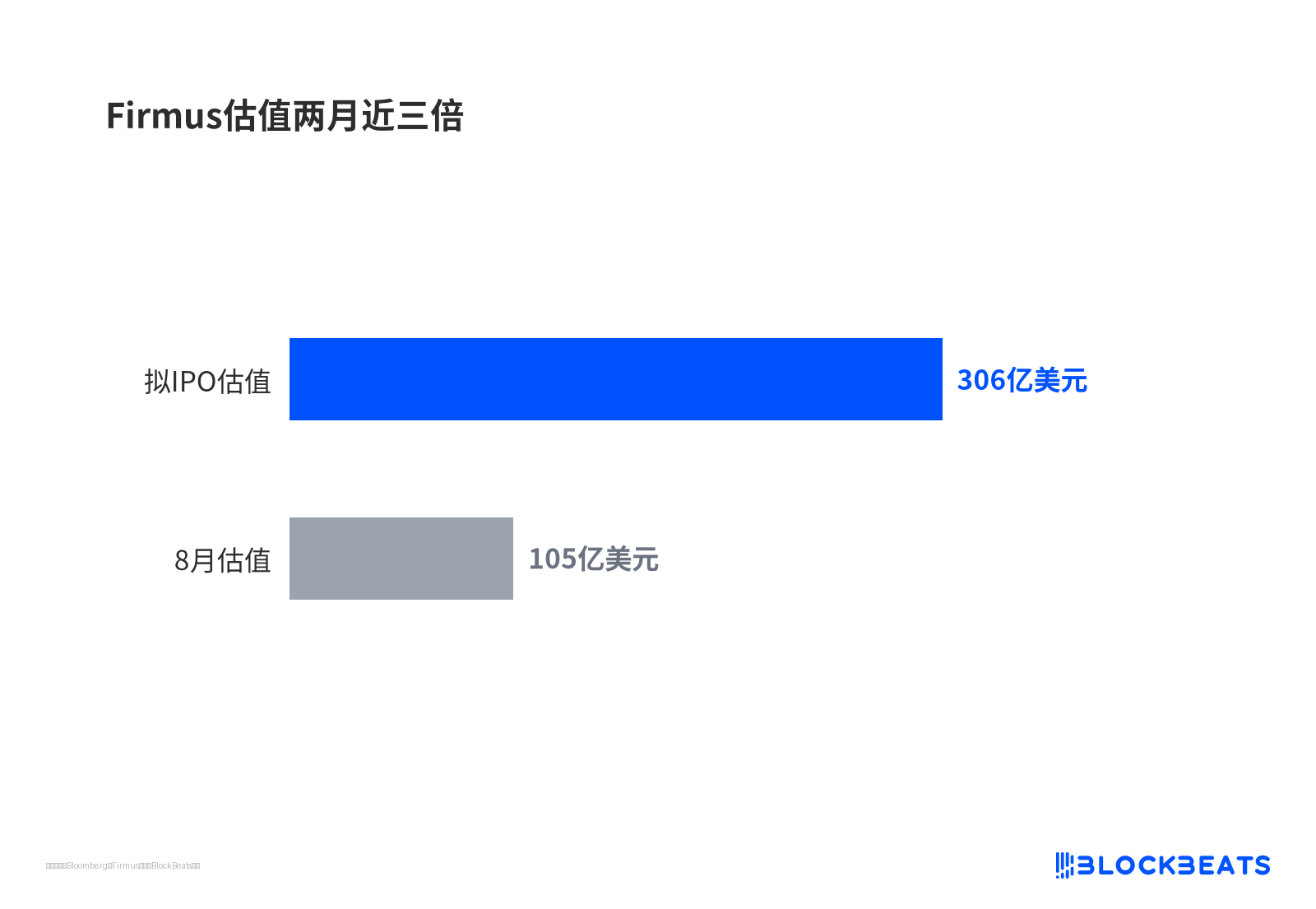
On October 9, the company announced it was withdrawing, citing market volatility as the official reason and saying current conditions could not reflect the company's value, and that it would pursue private placement options instead.
Buyers' concerns lie in the gap between the numbers. According to listing materials, Firmus's current revenue is about $51 million, corresponding to roughly 600 times sales. The company says it has about $72.8 billion in future revenue commitments, but the remaining five data centers are still under construction, costing about $37.7 billion, with debt of about $30 billion. Shareholders include Nvidia, Coatue, and Blackstone.
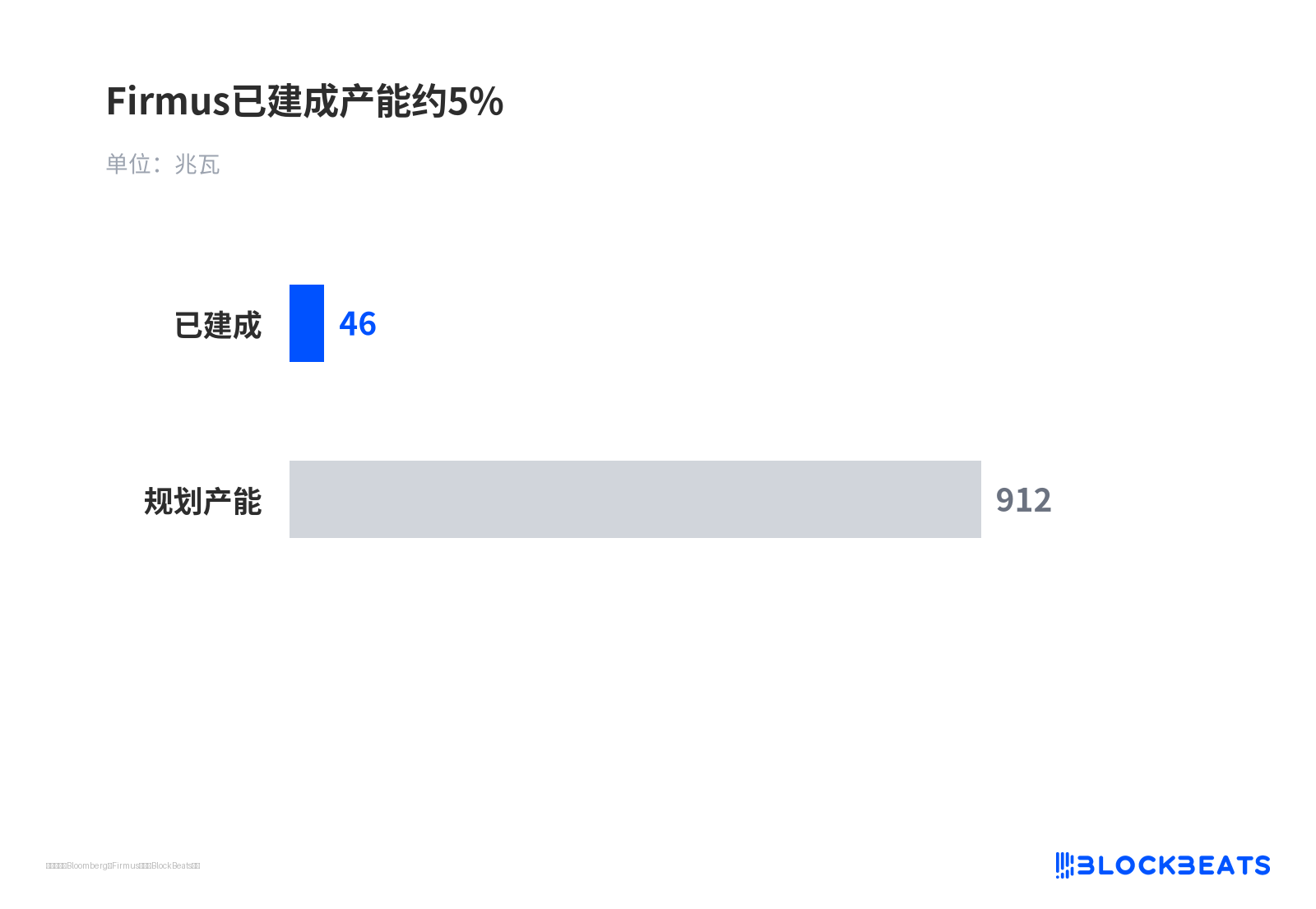
The gap between committed revenue and completed capacity is at the core of this round of pricing. Public markets are no longer willing to pay for high-multiple narratives from the private stage, especially when the assets have yet to generate substantial revenue.
Volta's $5 billion loan: only $1.3 billion underwritten, $3.7 billion chip loan priced at 11%
In the same week, Volta Infrastructure launched a roughly $5.012 billion six-year loan. A $1.3 billion term loan was underwritten by JPMorgan and Goldman Sachs, while the $3.712 billion GPU loan was not underwritten by these two banks. The funds are used for letter-of-credit collateral for data center leases and to purchase about 36,000 Nvidia GPUs.
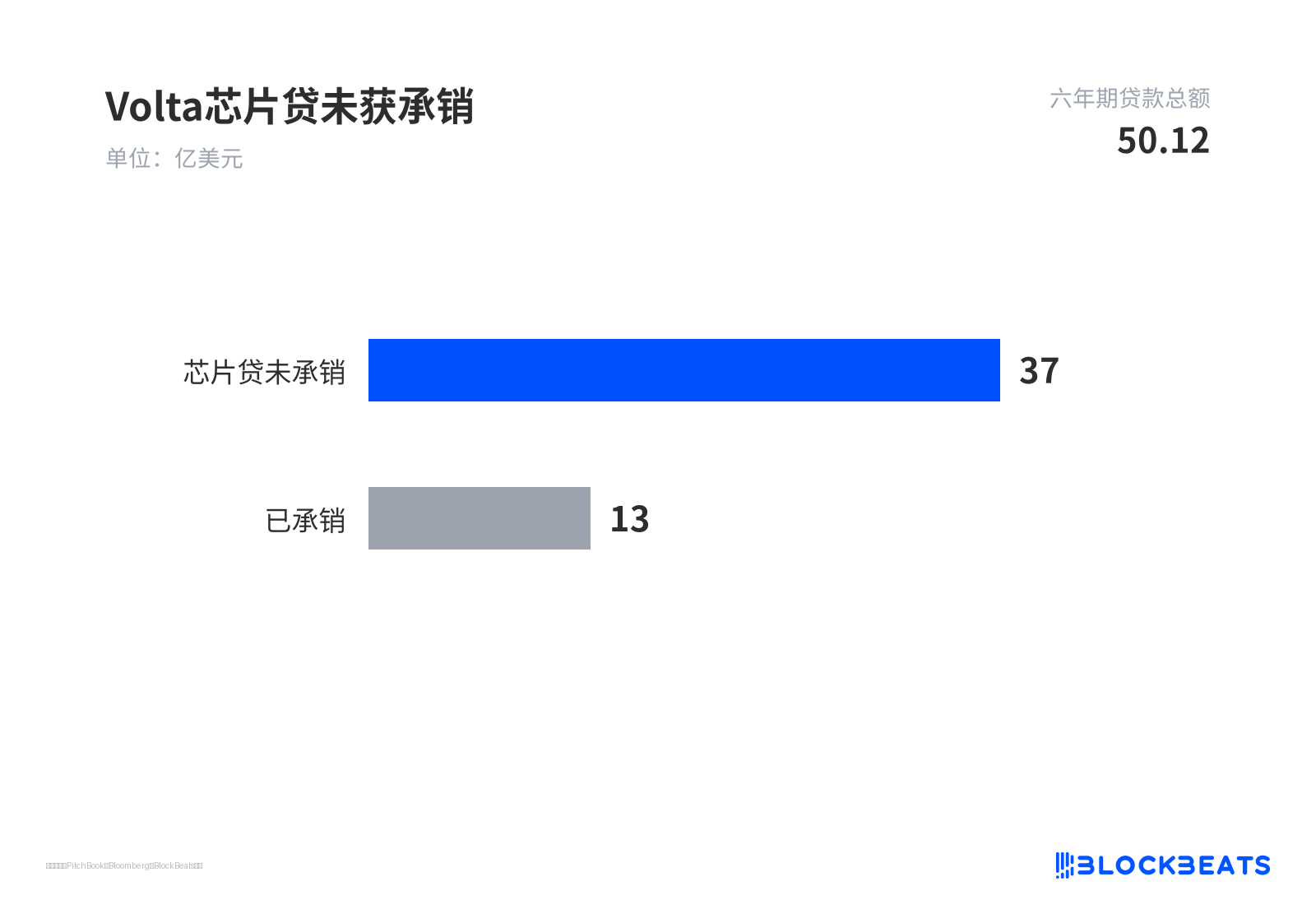
This chip loan carries no credit rating, is priced at SOFR plus 625 to 650 basis points, with an issue discount of 97 to 98, an overall yield to maturity of approximately 11.2% to 11.75%, and a commitment deadline of October 14, making it significantly more expensive than earlier GPU loans such as CoreWeave's.
Unrated GPU loans involve borrowing high-interest money using chips that have not yet been fully depreciated as collateral. Rating agencies won't assign a score, so buyers must price it entirely on their own. Two banks are willing to lead but only underwrite the better portion, pushing the harder $3.7 billion into the market — the most direct evidence of tightening risk controls.
Cerebras Nearly Halved: Customer Concentration and Lockup Expiry Pressure Pricing Simultaneously
Cerebras Systems (CBRS) priced its May IPO at $185, closed its first day at $311.07, and has been declining steadily since. On October 12, it closed at approximately $147, less than half its first-day close and below its IPO price, with a single-day drop of about 8% to 10%.
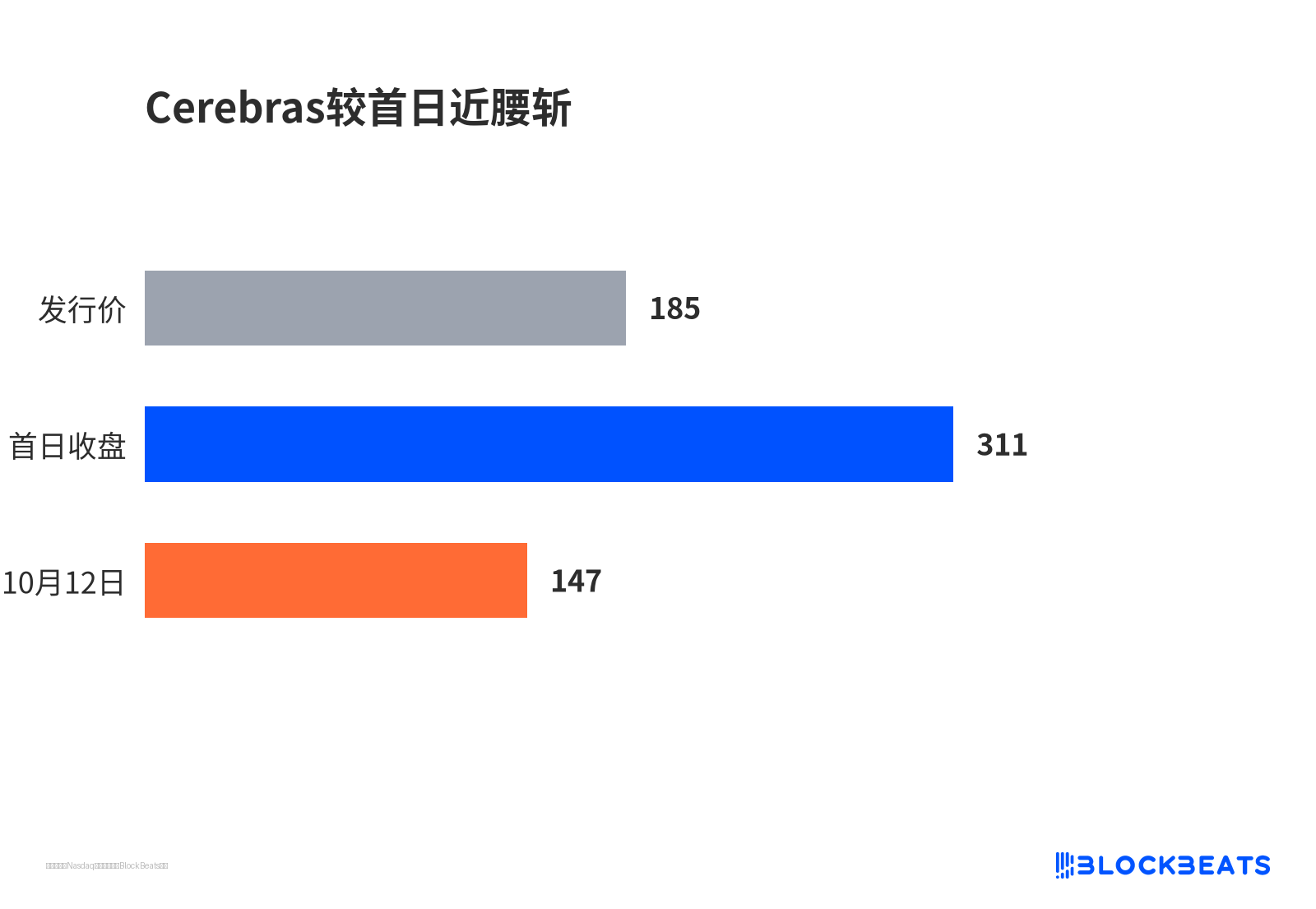
One trigger was industry research firm SemiAnalysis stating in late September that OpenAI's new model GPT-6.1 Sol switched its fastest inference tier to Nvidia GPUs, whereas the same tier for GPT-5.6 Sol had previously been provided by Cerebras at approximately 750 tokens/s. Neither party confirmed the switch, and OpenAI CEO Altman subsequently said on X that Cerebras remains a close partner.
The other half of the pressure comes from supply. Approximately 19.4 million locked-up shares are about to be released; insiders were barred from selling for a period after the IPO, and upon expiry, supply will be released in a concentrated wave. The market is simultaneously pricing in high customer concentration and potential diversion, even though the two parties still have a compute agreement worth over $10 billion extending through 2028.
Whether the $3.7 Billion Chip Loan Can Be Sold Will Determine the Dual-Track Landscape
What these three things have in common is not that AI demand has been disproven, but that pricing power has shifted to the buyer. Public funds refuse to directly mark up private valuations that nearly tripled within two months, banks are unwilling to backstop unrated chip loans, and the secondary market is applying a discount for customer concentration.
The three deals are at different stages, yet buyers' answers are consistent: first comes calculable cash flow, then the growth story.
The validator nodes are very specific. After October 14, whether Volta's $3.7 billion chip loan can be fully distributed at existing prices is the most direct sample for testing the dual-track landscape.
What terms Firmus secured after pivoting to private placement shows whether high-quality projects can still obtain reasonable valuations. Whether Cerebras' next earnings report can prove its independent deployment capability outside the OpenAI contract will determine whether the customer concentration discount is short-term or long-term.
Current evidence only supports selective repricing, not enough to infer an industry-wide retreat. If high-yield loans sell smoothly and quality projects can still secure financing, then structurally sound players continuing to borrow while story-driven ones are forced to adjust will become the norm for this round of the AI financing cycle.
Welcome to join the official BlockBeats community:
Telegram Subscription Group: https://t.me/theblockbeats
Telegram Discussion Group: https://t.me/BlockBeats_App
Official Twitter Account: https://twitter.com/BlockBeatsAsia
