Summary
The thing most similar to HIP-4 isn't Polymarket, but an options order sitting next to your perpetual position. Yes shares and your leveraged position are in the same account, use the same margin, and are matched on the same engine, so a bet and the position it's meant to hedge always live on the same screen. Three other things set it apart: anyone who stakes 500,000 HYPE can open a market; settlement conditions are hard-coded into the template before the first trade; entry is free, exit costs about one basis point, the exact reverse of how Kalshi and Polymarket charge.
For the first four months, only Hyperliquid itself was running. When it launched on May 2, 2026, all markets were operated directly by the protocol, 691 in total, and it wasn't until August 29 that it opened to external venues. Since then, three have paid the stake, and so far there's no fourth.
Whether you can see it depends on where you are. Prediction markets have a separate page at app.hyperliquid.xyz/outcomes, and the frontend decides by region whether to put it in the trading list alongside perps and spot. Accessing from a South Korean network, you can see this column in the market list; on the network we tested with, it's nowhere in the list or menu, but the page itself still opens and trades fine. Hyperliquid restricts frontend access in several countries, and an entry point you can't see on your end may be visible to someone two time zones away.
From May to now, HIP-4 has done $317 million in cumulative volume, which Kalshi can do in under four hours. In September, for every $1,000 traded on Kalshi and Polymarket, HIP-4 did about 70 cents.
The design is its best part; the problem is scale. Of HIP-4's all-time volume, more than a quarter came from the already-finished soccer World Cup. The daily Bitcoin market that carried the first four months is down 93% from its May high. New venues pulled September back to $51 million, flat with July, and the biggest contributor is subsidizing traders about 0.6 cents for every dollar traded. October started slower, averaging about $1.25 million a day. Fees across the whole market run about $1,300 a day, less than half the interest a single venue earns by leaving its stake idle.
1. Product Design: Four Ways It Differs from Kalshi and Polymarket
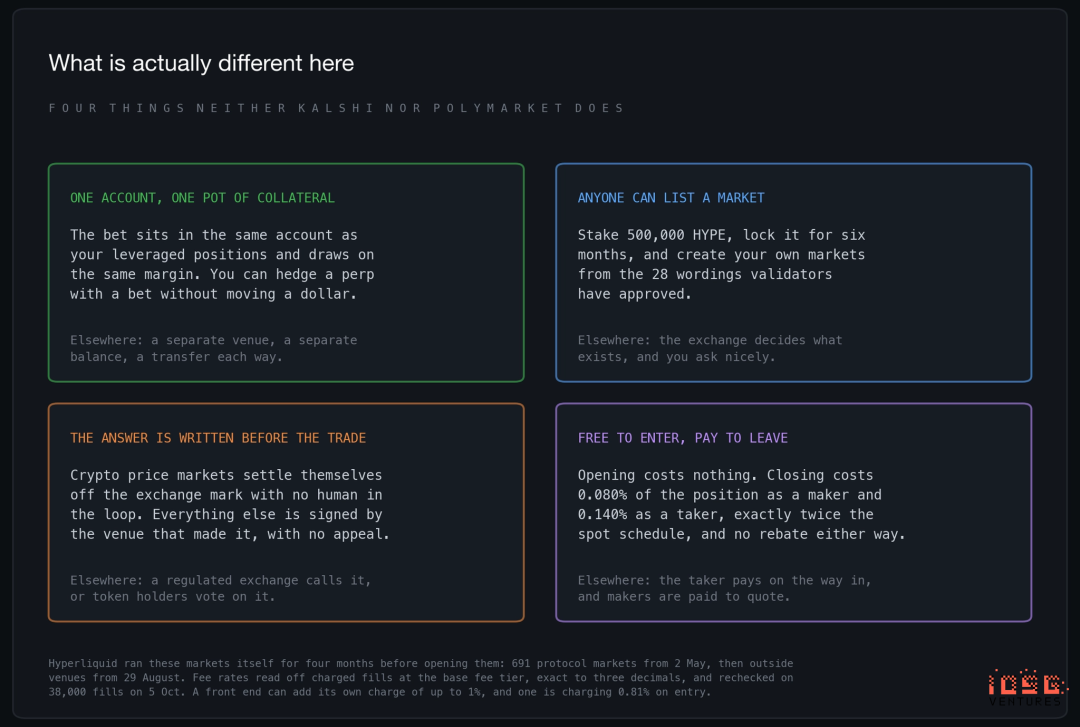
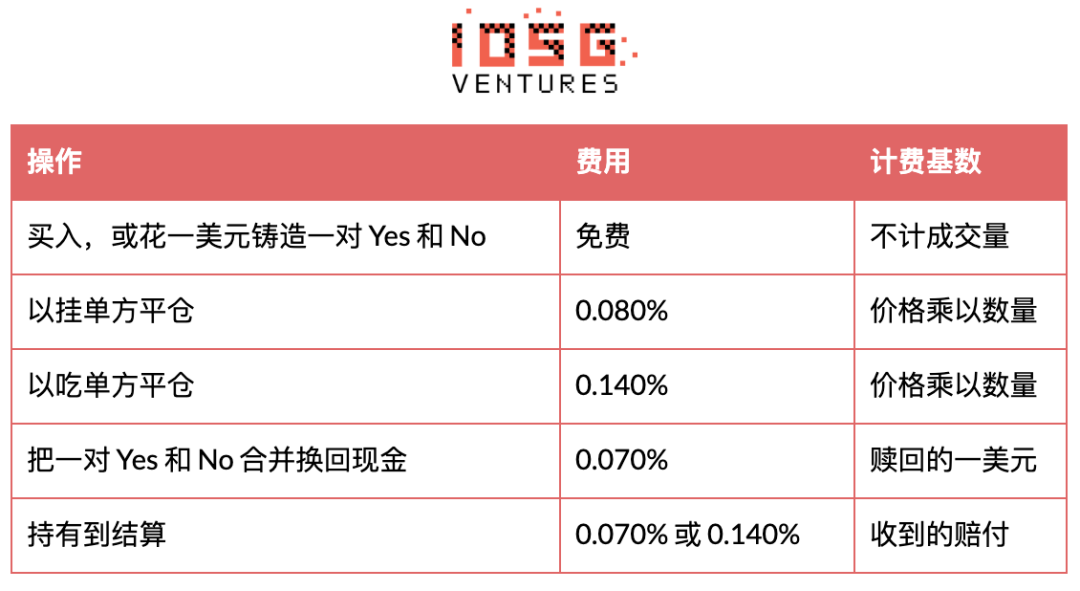
This is exactly double the spot rate: the spot base tier charges 0.070% for takers and 0.040% for makers. One side doubled, the other zeroed out — a round trip costs the same as spot, except everything is collected on exit. Common discounts are simple multiplication: a 4% referral discount turns 0.140% into 0.1344%, and stacking a 10% staking discount on top brings it to 0.12096%. Every trade we checked matched to the decimal. There is no maker rebate, which is the one place market makers come out worse here than in other sections of the exchange.
No venue has currently set its fee coefficient above the default, so venue revenue is carved out of the protocol fee, not added on top. The only charge you might hit on entry comes from front-end apps: under spot rules, the builder fee cap is 1%, and one app charges 0.81% on entry — roughly six times the protocol exit fee.
Settlement deserves a closer look, because that is where venue risk lives. Polymarket relies on UMA token holders voting to resolve disputes — earlier this year, a $375 million Microstrategy market sparked a heated controversy over this. Kalshi, as a regulated exchange, resolves disputes itself, with regulators overseeing it. HIP-4 splits this apart: crypto price markets read the exchange mark price at the agreed minute and settle automatically; all other markets are resolved by the market creator signing off on the outcome, with no dispute period and no one else able to sign on their behalf.
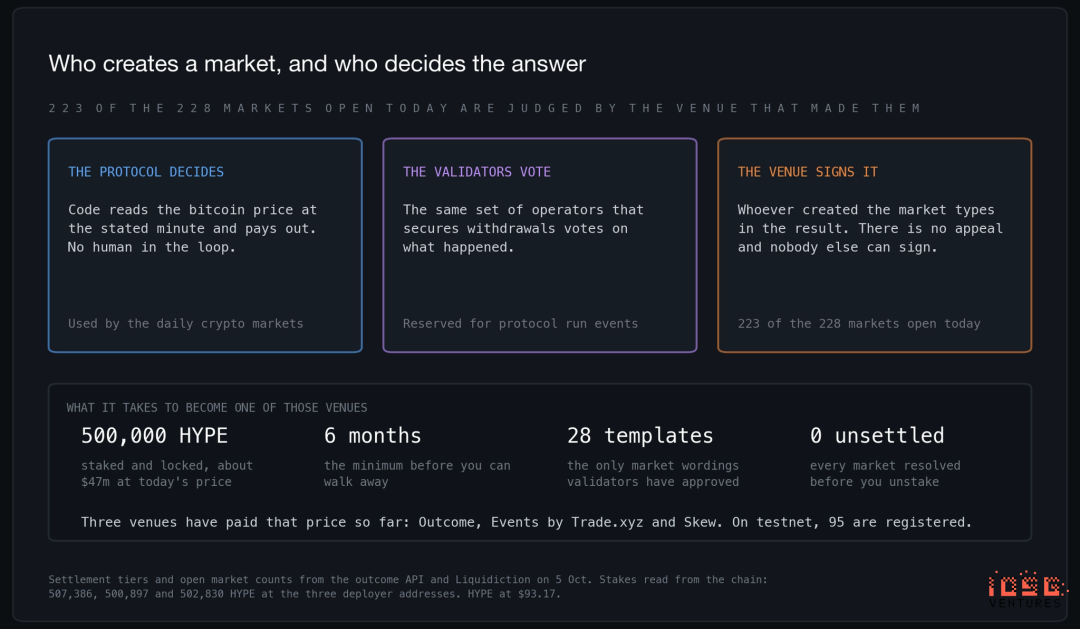
Of the 228 markets open today, 223 fall into the latter category. The constraints rely on money and time, not code. As long as the venue has unsettled markets, the stake stays locked; it cannot be withdrawn for six months; and only pre-approved wording from validators can be used. These wordings are deliberately long and pedantic — the "company IPO" template, for instance, spends an entire page just defining what counts as an IPO. Rules written before trading beats arguing after the fact. Handing the pen to a named party with no appeals channel is indeed worse than having a procedure — but only if that procedure itself doesn't break down.
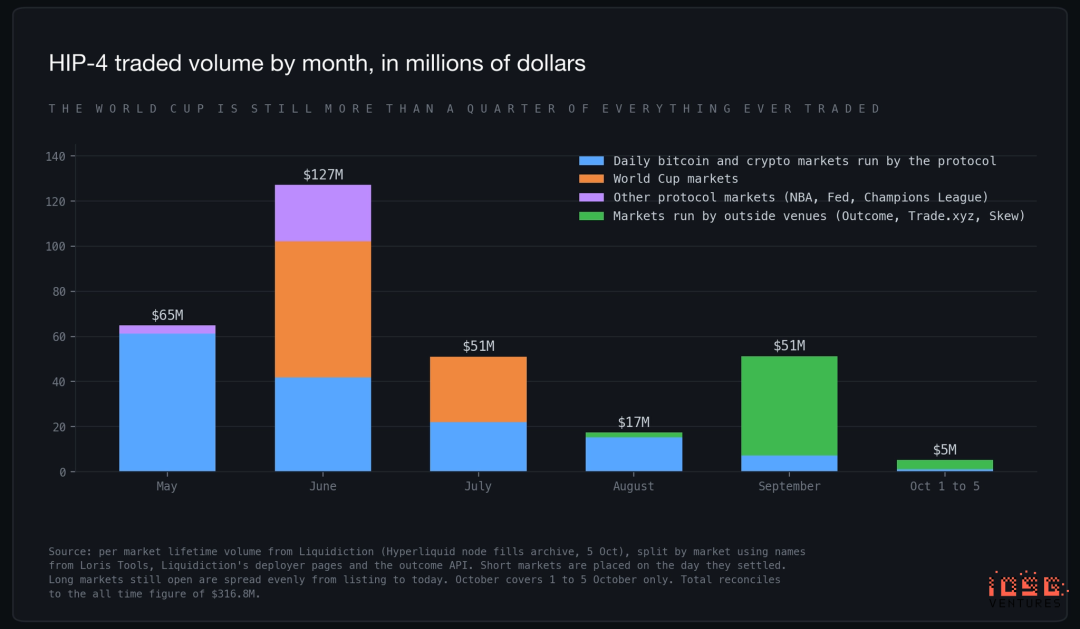
June was the peak, driven by the World Cup. Soccer markets alone did $89.5 million in volume, accounting for 28% of HIP-4's cumulative volume. Once the World Cup ended, volume dropped over 80% in two months. September came back to $51 million, with the entire rebound coming from external venues; the first five days of October saw $5 million in volume.
Beneath these events, the protocol has been running the same market every day since May: whether Bitcoin will be above a certain price at 6 a.m. the next morning. This is probably the most Hyperliquid-flavored product, and it took four straight months of decline to bottom out.
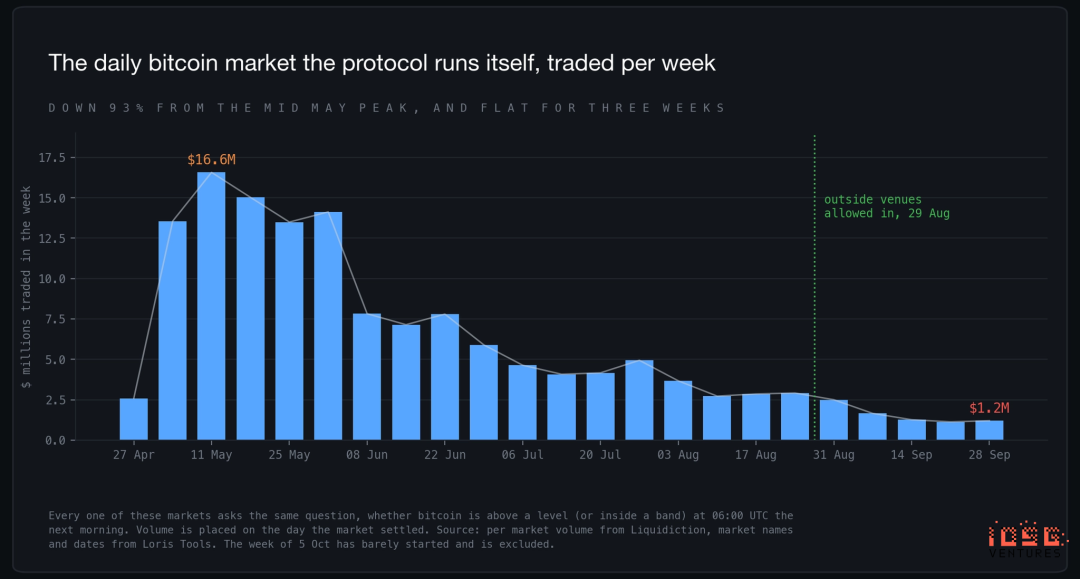
The week of May 11 saw $16.6 million in volume, while the week of September 28 saw only $1.2 million, with the prior two weeks hovering around the same figure. The same question asked once a day, with fewer and fewer listeners, only stopping when almost no one was left. Whatever HIP-4 becomes in the future, it won't look like this.
2. Five Weeks of Open Deployment: Subsidy-Fueled Volume and Duplicate Listings
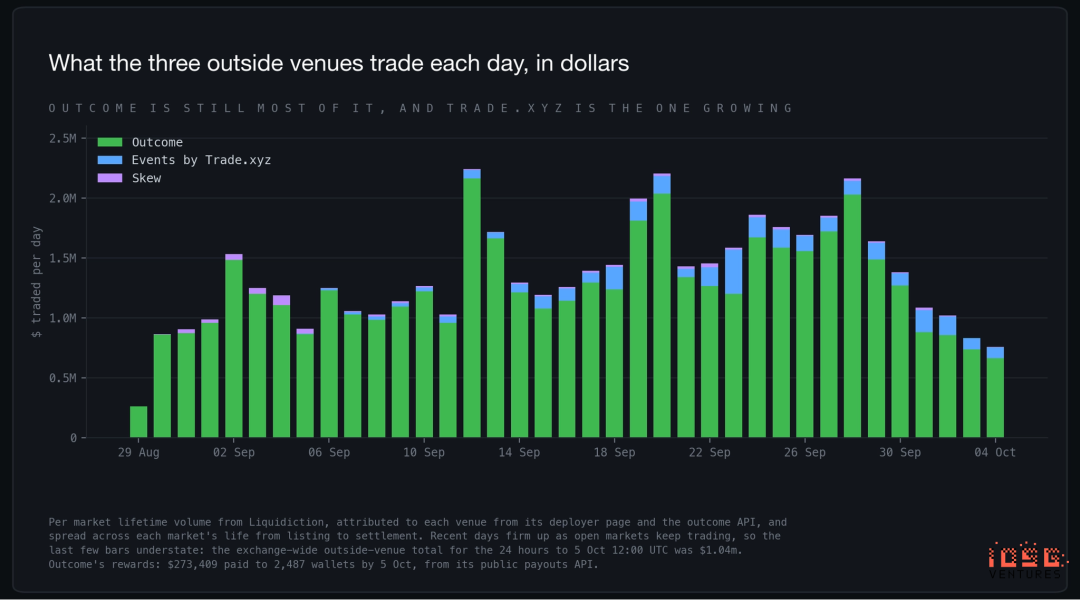
Outcome was the first to launch on August 29. Skew registered a market the next day, and has seen almost no volume since. Trade.xyz's Events registered on September 5 and opened to the public on the 10th. Across all of HIP-4, in the most recent day Outcome accounted for 68%, Trade.xyz 21%, protocol-operated markets 10%, and the rest was Skew. Counting only external venues, Outcome has accounted for 92% since August 29, while Trade.xyz has grown from zero to nearly a quarter in the most recent day. It picks its markets with the most conviction: binary contracts betting on its own stock and commodity perpetual prices, the NFL, and the only questions on the trading platform about whether Anthropic and OpenAI can list before a deadline.
These volumes should be discounted. Outcome has a $1 million rewards program, paying out to makers and traders by market and by day, but only rewarding orders carrying its own app code. As of October 5, it had paid $273,409 to 2,487 wallets, averaging about $7,400 per day, equivalent to roughly 0.6% of Outcome's total volume—four times the cost of a round-trip trade. A quarter of the budget has been spent, and daily distributions show no sign of slowing. External venues did $1 million to $2 million per day in September, busiest on weekends; by October it fell back to around $1 million per day, while rewards kept flowing.
Open listings have also produced the first duplicate markets. Both Outcome and Trade.xyz listed markets on the Fed's October rate decision; over the past seven days Outcome did $354,000 in volume while Trade.xyz did only $90. Both also listed a set of questions on Anthropic's market cap on its first day of trading, with little volume on either side. The ability for anyone to list a question means two venues can list the same question, and their order books won't merge. Volume flows to the one paying subsidies.
Trading activity is tilting toward sports. Over the past 30 days, soccer, American football, and esports accounted for 45% of volume, crypto price questions 42%, stocks and commodities 7%, and the Fed 6%. Open interest is even more skewed: two-thirds of capital at risk is on sports, mostly season-long markets like English Premier League, Champions League, and NFL champion futures, while crypto price makes up only 17%.
Available templates are growing faster than venues. Validators have approved 28 templates, up from 18 in mid-September, adding spreads and totals, the Ballon d'Or, a head-to-head between two AI models on a leaderboard, and first-day market cap for company IPOs. The next network upgrade will double the per-venue cap, while live markets reach 200 and new listings hit 1,000 per day. 95 deployers have registered on testnet, versus just three on mainnet.
3. Order Flow: 70% of Traffic Routes Through Outcome
For a front-end app to place orders on your behalf, it needs you to authorize a separate signing key, and that key is named after the app. So wallets registered through outcome.xyz permanently carry a label like Outcome-9d3c74de, publicly visible to anyone. The trading platform's own mobile login works the same way, showing up as Mobile QR; the desktop version signs every step with your own key, leaving no label. We only looked at Outcome because it accounts for roughly 90% of external venue volume, and only its numbers carry weight.
About 70% of volume comes from wallets registered through outcome.xyz, roughly one-fifth from wallets with no label at all, and one-tenth from scripts and third-party tools that named their own keys. The larger the scale, the higher Outcome's share: three-quarters of dollar volume among the top 20 wallets, and about half among the rest. This is exactly what a rewards program produces: it only rewards orders routed through Outcome's code, and the market makers claiming rewards happen to be the largest wallets.
This method has limits. A label only shows that a wallet once registered through some app; it doesn't prove a given trade was routed by it. The unlabeled fifth can't be treated as users of the trading platform's official page either: most are quoting both sides across many order books simultaneously, scripts signing with their own keys. The sample was drawn from 121 wallets in recent trades across the 60 most active order books, weighted by dollar volume within 48 hours, inherently biased toward market makers. Fees don't answer the question either. Less than 1% of dollar volume in the sample paid builder fees, nine dollars total over two days, and Outcome's own code charges nothing, making free-routing apps indistinguishable from no app at all.
4. Benchmarking Against Kalshi and Polymarket: A Gap of About 1,400x, and Still Widening
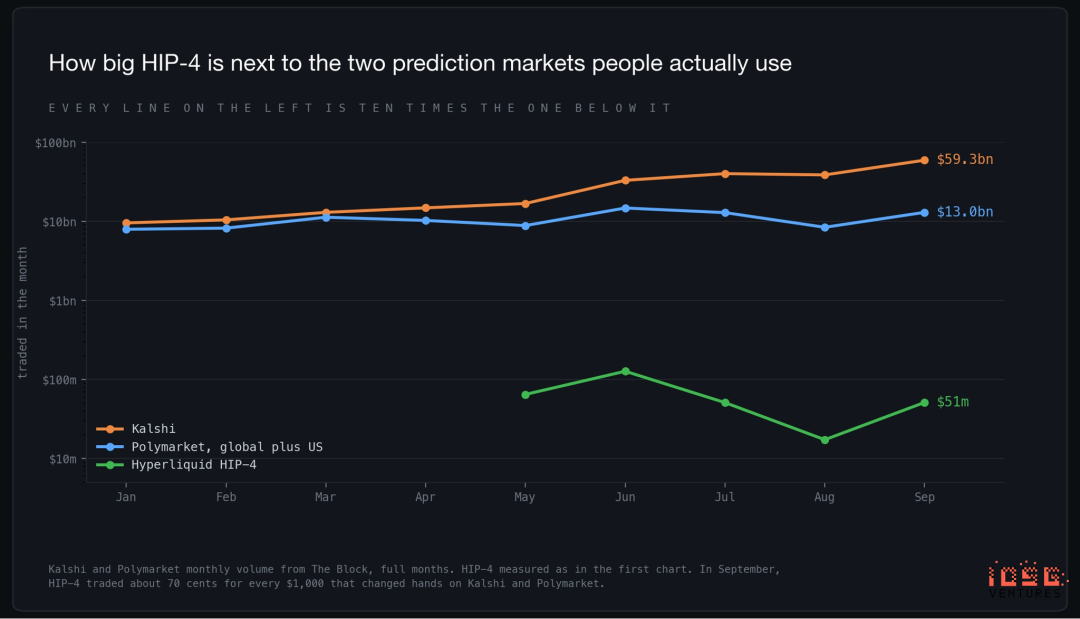
The gap is roughly 1,400x, and in dollar terms it is still widening, even as HIP-4 itself grows. Kalshi did $59.3 billion in September volume, up $20.6 billion from August. Polymarket plus its U.S. business did $13 billion, with the bulk now coming from the U.S. app. HIP-4 did $51 million.
The incumbents' advantage is not market design; they win on the two things that actually drive volume. First, events people care about, thousands of them, listed within hours of the news. Second, distribution: apps, brand, sports audiences, and in Kalshi's case a compliance wrapper that U.S. brokerages can plug into directly. HIP-4 has 28 templates, three venues, and a user base that was already trading perps.
The incumbents are also starting to move toward Hyperliquid. Polymarket launched perpetuals for non-U.S. users in early September, with 67 markets covering crypto, equities, indices, and commodities, at up to 20x leverage. Putting bets and leveraged positions under one roof was supposed to be HIP-4's unique thing. Now it is a feature race, and Polymarket is entering it holding events.
5. The Economics: Whole-Market Fees Are Less Than Half of a Single Venue's Staking Yield
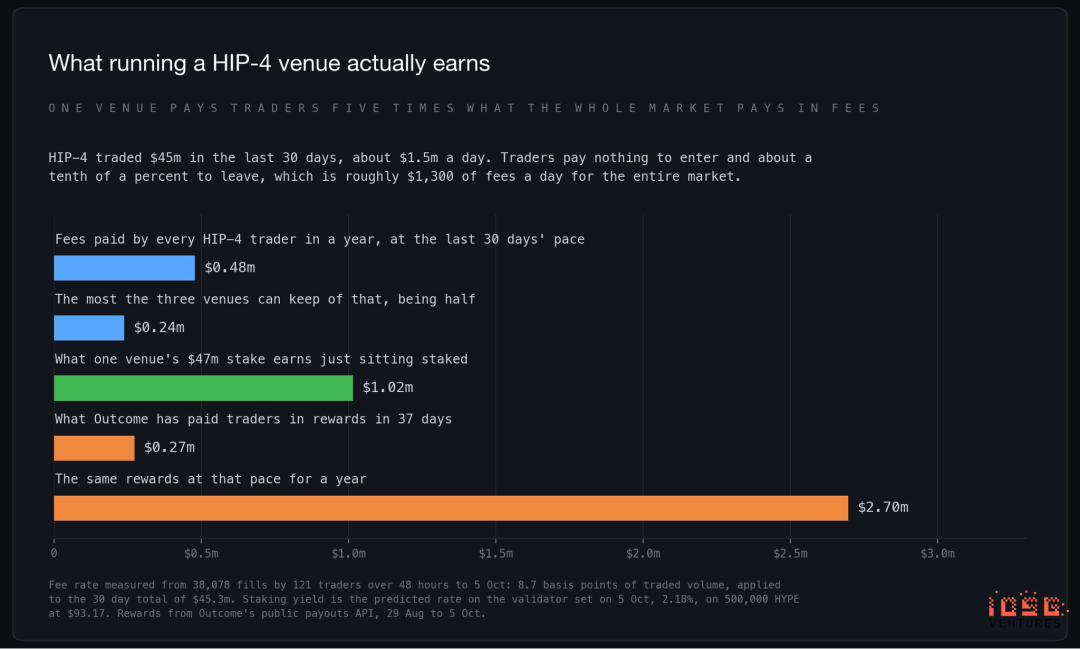
At the pace of the past 30 days, all HIP-4 traders pay roughly $480,000 a year in fees. Venues take at most half, split three ways. The stake a single venue must lock up to enter would earn $1 million a year just sitting there; and the venue with the most volume is paying out rewards at an annual rate of $2.7 million to buy that volume.
By those numbers, no venue is running a business. They are buying an option, and that option has value too: Hyperliquid says deployers can raise fees themselves later, volume can grow enough to support fees, and private comparable valuations in this sector are $22 billion and $21 billion, with Kalshi still in talks at $40 billion. But it is still an option, and the cost of holding it is a $47 million stake that expires worthless if the volume never comes.
6. Conclusion: Leading Design, Market Not Yet Here
The blocks are stacked well, but the market hasn't arrived.
By the dimensions engineers would pick, Hyperliquid has built a better product: one account, one margin pool, bets and the positions they hedge in the same interface; settlement terms written into the template before the first trade; Yes and No on the same question sharing one order book, so liquidity isn't split in two. Nothing in the past five months suggests design is the bottleneck.
The strongest argument for it is that you never have to leave. Margin, hedges, and bets all in one account — for a desk already trading perps on Hyperliquid, adding a prediction position is just a click, no switching platforms, opening new balances, or shuffling funds around. Regardless of how the competition with Kalshi plays out, that has value, and it's why it will persist at some scale even if it never becomes a real business. But it's less unique than it was in August: Polymarket now sells leverage alongside bets too, and it started from the side that has users.
It isn't deep enough. Across the 25 most active order books, the median bid-ask spread is 0.29 cents, with roughly $4,700 resting within one cent of the best ask. A $1,000 market buy fills just a few basis points above the best ask; a $10,000 buy pays 2% to 3% more, and in four or five of those 25 order books, it simply can't be filled against visible quotes. Retail-sized trades work fine here; big money doesn't. Market makers keep requoting, and patient limit orders will do better than these numbers, but an order book this thin is what a five-month-old market looks like.
There's also not much to trade. Prediction market volume is built on topics, and topics come either from an editorial team listing a few hundred events a week or from sports schedules. HIP-4 has 28 approved wordings, and three venues each staked $47 million just to use it, with two of them already listing the same questions. Kalshi can open a market for a news story in an afternoon.
The user base is also wrong in a very specific way. Eight trades per address per day — that's a trading desk, not the betting masses. If the goal is to give crypto traders a capped-upside tool, that's fine, and it's exactly what this design does best. If the goal is the crowd Kalshi and Polymarket are fighting over, it doesn't work — and the fact that two-thirds of capital at risk is on season-long football futures shows the venues are still pushing in that direction.
The most likely path is the unremarkable one. HIP-4 will remain a feature of Hyperliquid, earning pocket change, and its significance will be saving perp traders from opening accounts elsewhere. That's worth doing, but it's not worth valuing as a prediction market business.
Welcome to join the official BlockBeats community:
Telegram Subscription Group: https://t.me/theblockbeats
Telegram Discussion Group: https://t.me/BlockBeats_App
Official Twitter Account: https://twitter.com/BlockBeatsAsia
