Cross-market investors often need to manage multiple accounts: U.S. stocks in one brokerage, Hong Kong stocks in another. Different platforms have different account opening processes, deposit channels, and trading hours, and moving funds requires transfers between multiple platforms.
BIT launched Hong Kong stock trading on October 12 and debuted under the "BIT Securities" business brand. Together with its existing crypto business and U.S. stocks, all three asset classes can now be traded within the same account. With services provided by licensed institutions and users purchasing real stocks, users can trade cryptocurrencies, U.S. stocks, and Hong Kong stocks through a single BIT account, further lowering the barriers to account opening, trading, and deposits/withdrawals.
1. BIT Is Creating a New Generation of Brokerage
Traditional finance and the crypto market are accelerating their convergence. In traditional finance, Schwab announced its spot crypto trading plan on April 16, and Morgan Stanley's E*Trade began supporting BTC, ETH, and SOL trading on July 16. In the Hong Kong market, brokerages laid out crypto trading earlier: Interactive Brokers opened BTC and ETH trading to Hong Kong retail investors in November 2023, and Futu joined in August 2024. Meanwhile, crypto platforms and companies are also expanding into traditional financial services. Coinbase opened stock and ETF trading to U.S. users in February of this year; Kraken has offered stock trading in the U.S. for over a year; and Binance has progressively listed various U.S. stock trading products.
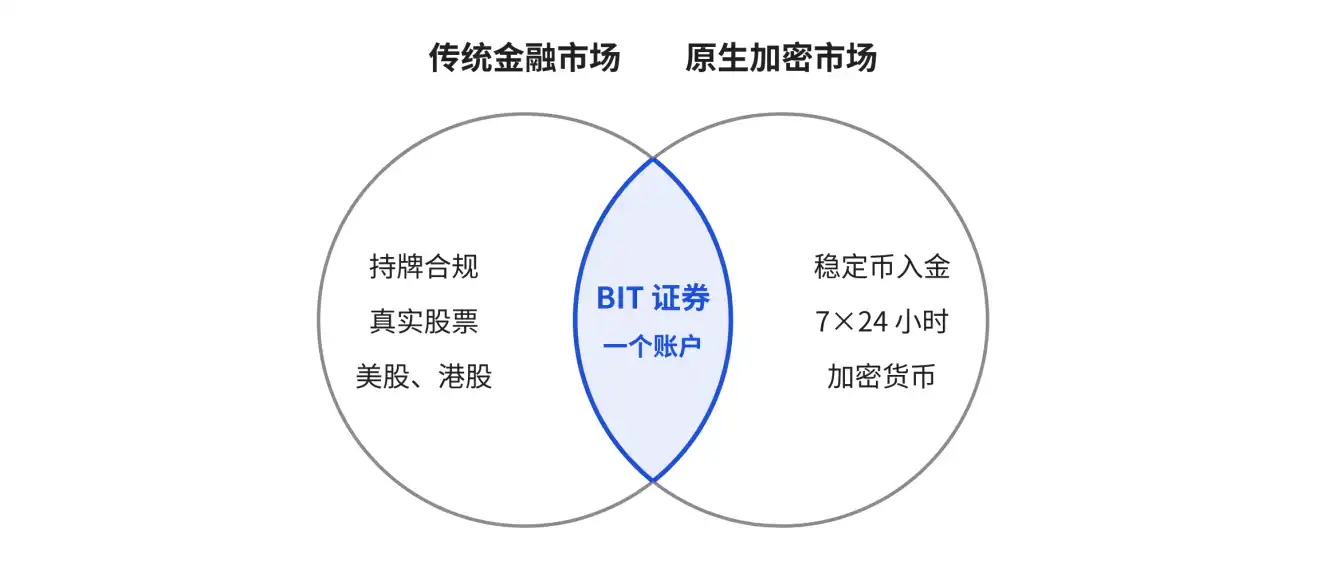
Among these institutions, BIT is relatively unique, positioned at the intersection of traditional finance and native crypto, combining the compliance rigor of traditional finance with the innovative characteristics of the crypto industry. U.S. and Hong Kong stocks are provided by licensed institutions, and users purchase real stocks; stablecoin deposits align with crypto users' habits. Users who already have a BIT U.S. stock account can directly open a Hong Kong stock account, managing cryptocurrencies, U.S. stocks, and Hong Kong stocks within the same account.
This model balances compliance and efficiency: stock trading is provided by licensed institutions, and users hold real stocks; funds are deposited and withdrawn via stablecoins, enabling round-the-clock operations. The advantages of both models are combined in a unified account.
2. A New Generation of Brokerage: Unified Account Trading of Global Assets
Crypto, U.S. stocks, and Hong Kong stocks each exhibit distinct market performances, making it more aligned with user needs to trade multiple classes of global assets within a single account—this is also the fundamental form of next-generation brokerages.
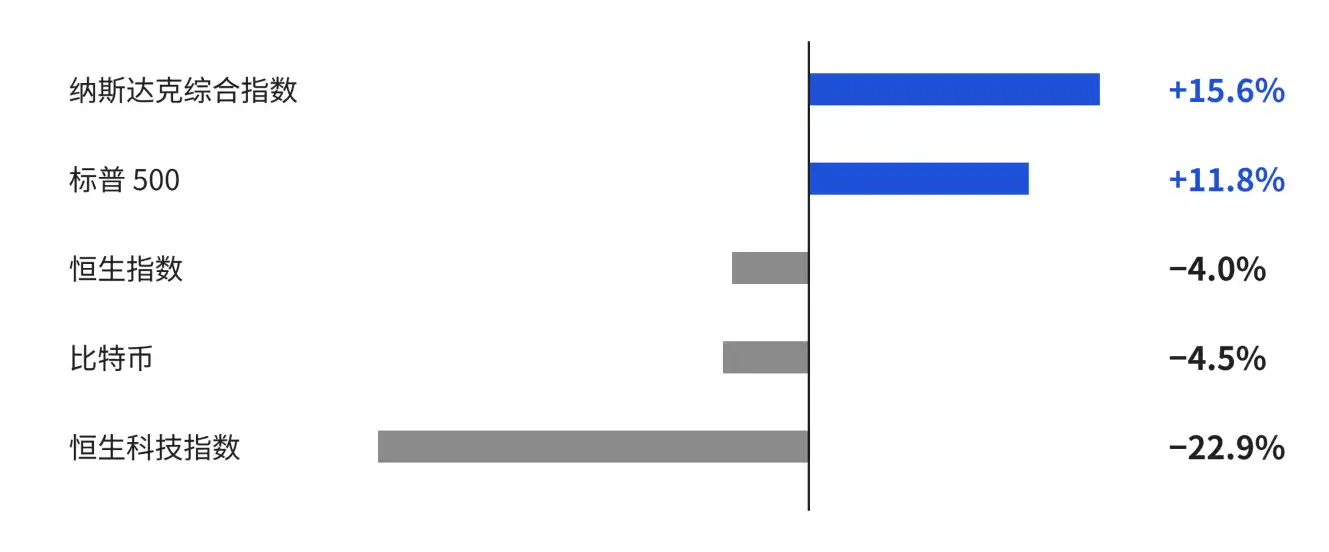
For investors, the asset characteristics of cryptocurrencies, U.S. stocks, and Hong Kong stocks differ significantly. In terms of trading rules, cryptocurrencies support round-the-clock trading with instant settlement of assets upon completion; U.S. stocks have a T+1 settlement cycle, while Hong Kong stocks operate on T+2 and use board lot trading. The investment themes across these markets also vary: U.S. stocks focus on AI, with Goldman Sachs raising its year-end target for the S&P 500 from 7,600 to 8,000 in May and expecting AI infrastructure beneficiary companies to contribute about half of this year's earnings growth; Hong Kong stocks are driven by valuation recovery and new share issuance, with average daily turnover from January to August reaching HK$282.5 billion, up 14% year-over-year; cryptocurrencies exhibit greater volatility elasticity, staging a significant rebound since August amid stable performance in stock markets. At the platform level, U.S. and Hong Kong stocks require licensed brokerage and settlement services, while cryptocurrencies necessitate custody and round-the-clock operations.
Accounts scattered across different platforms increase operational costs for traders. The three markets are spread over three platforms, each requiring separate account opening, verification, and deposits. Every cross-platform fund transfer entails additional waiting. To redirect U.S. stock gains toward Hong Kong stock trading, one must first withdraw, then remit, then deposit; by the time funds arrive, market conditions may have already shifted.
The advantages of BIT's unified account become more evident in such scenarios. Stablecoins support 7×24-hour deposits and withdrawals, allowing funds to arrive quickly. U.S. stock deposits via stablecoins require no manual currency conversion, and Hong Kong stocks also support direct investment with stablecoins. With crypto, U.S. stocks, and Hong Kong stocks integrated into the same platform, users can deposit once and share balances; after selling assets in one market, funds can remain in the account for the next trade without the need for additional deposits or withdrawals. Currently, BIT supports cryptocurrencies, over 10,000 U.S. stocks and ETFs, approximately 2,000 U.S. stock options underlyings, and all Hong Kong stock underlyings, along with subscription for Hong Kong IPOs.
For crypto users, stablecoins in the account can be directly used to purchase U.S. and Hong Kong stocks without the need for prior withdrawal. Crypto.com estimates that as of June 2026, there are approximately 774 million cryptocurrency holders globally, representing a direct potential user base for BIT's unified account. Hong Kong stock investors also gain an additional channel to directly subscribe to new shares using stablecoins, eliminating the need to prepare separate deposit methods. Users already trading U.S. stocks on BIT can also trade Hong Kong stocks within the same account and utilize their account balances.
3. Beyond Compliance: Lower Trading Thresholds and Reliable Security Safeguards
Licensed compliance and the ability to buy real stocks are the prerequisites of BIT Securities. BIT Securities' U.S. and Hong Kong stocks are both provided by licensed institutions, and what users buy are real stocks. There is an easy way to verify real stocks: whether they can be transferred out to another brokerage. BIT currently lists Futu, moomoo, Interactive Brokers, and Longbridge, and U.S. stock holdings can be directly transferred in, serving as proof of holding real stocks.
While ensuring that users hold real stocks, BIT has also lowered the usage threshold and established a trustworthy fund security system. The first advantage is the low usage threshold, with simplified processes for account opening, trading, and deposits/withdrawals. Account opening is free, and applications on business days can typically be completed within a few hours. Users who have completed BIT verification can authorize information synchronization during account opening, eliminating the need to resubmit documents.
The second advantage is trading costs. BIT U.S. stock options are commission-free, with a platform fee of $0.30 per contract and a minimum of $0.99 per order; based on the comprehensive cost per order, this is approximately half the average level of other large retail brokerages. For Hong Kong stocks, users can enjoy commission-free trading during the launch period, interest-free margin financing for IPOs, and no subscription fees (activity rules are subject to official announcements).
It is worth noting that the advantages of stablecoin deposits/withdrawals and trading are expected to further expand in the future. Institutional forecasts and regulatory progress across various jurisdictions both indicate that the application scope of stablecoins is expected to expand. Standard Chartered predicts that the stablecoin market will reach $2 trillion by the end of 2028. Citi's baseline forecast for 2030 is $1.9 trillion, with a bullish scenario of $4 trillion. The U.S. GENIUS Act was signed on July 18, 2025, and Hong Kong's Stablecoin Ordinance took effect on August 1, 2025. The Hong Kong Monetary Authority granted its first two stablecoin issuer licenses on April 10, 2026, having received 36 applications in total, and stated that the licensing threshold will remain at a high level.
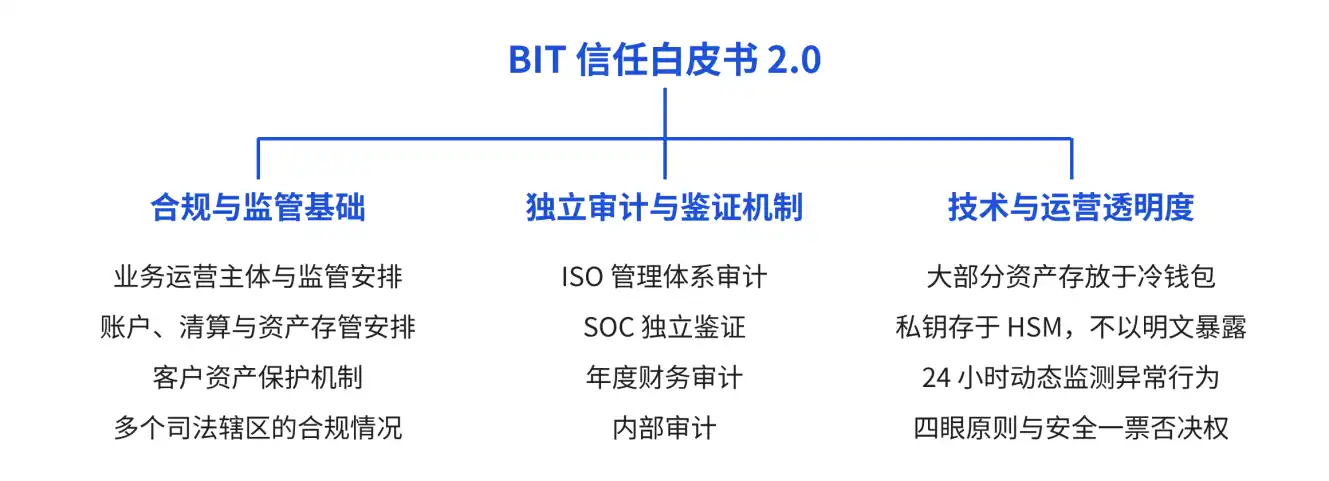
The third advantage is security. Compared with trading platform businesses, BIT Securities differs in both its security architecture and operating philosophy. U.S. stock trade execution, asset custody, and clearing are all supported by partner U.S.-licensed brokers, with operations running within the FINRA and SEC regulatory framework and the DTCC clearing system. Hong Kong stock business is likewise provided by licensed institutions. On the crypto asset side, according to BIT's disclosures, 98% of its assets are stored in offline cold storage in Switzerland, Hong Kong, and Singapore. Custody operations are certified under SOC 1 Type II and SOC 2 Type II. Private keys are stored in hardware security modules compliant with FIPS 140-3 Level 3 standards. Two-factor authentication is mandatory for account login, and 24-hour dynamic monitoring is conducted for abnormal login, device, and withdrawal activities. Key operations such as asset transfers and permission changes follow the four-eyes principle, requiring the joint participation of at least two authorized personnel.
In addition, BIT released version 2.0 of the "BIT Trust White Paper" on September 10, emphasizing that trust should be independently verifiable. The white paper lists compliance and regulatory foundations, independent audit and attestation mechanisms, and technical and operational transparency as its three pillars, with coverage expanding from digital assets to US equities, RWA, and asset management. Risk management runs through pre-trade assessment, intra-trade monitoring, and post-trade processing. When there are major security risks in product plans, system architecture, or launch changes, the security team has veto power.
4. A new super unicorn is being nurtured
BIT sits at the intersection of traditional finance and native crypto, combining the safety and reliability of traditional financial institutions with the innovation and inclusive characteristics of crypto and fintech. This fusion characteristic gives BIT the opportunity to build a new-generation brokerage model and advance toward becoming a super unicorn.
This unique integrated advantage ultimately lands in BIT's four business directions.
——Market connectivity. Through a unified account, it connects global markets and provides diversified asset allocation and trading services for individual and institutional clients. Individual users can trade cryptocurrencies, US equities, and Hong Kong equities in the same account, while institutional clients can also use OTC trading, prime brokerage, and algorithmic execution services.
——Financial infrastructure. It provides institutional-grade custody, security risk control, and compliance capabilities. BIT currently holds 12 licenses in 7 countries and regions, including a Major Payment Institution license in Singapore and a Collective Asset Manager license in Switzerland. On September 30, Cactus Custody, BIT's institutional custody business, launched Swiss custody services, with private keys for the Swiss entity generated and kept in Swiss data centers.
——Investment solutions. It provides asset and wealth management, liquidity, and financing solutions for institutions and high-net-worth clients. Clients can use eligible digital assets as collateral to obtain liquidity, while the value of collateral is continuously monitored; repayment, interest, and maturity arrangements are clearly defined at the outset of the transaction.——Future finance. It explores new financial forms such as tokenization and RWA. Matrixdock, under BIT, issues the gold token XAUm, the silver token XAGm, and the tokenized short-term US Treasury STBT. Matrixdock announced on July 16 that Bureau Veritas completed its fourth semi-annual reserve audit and verified 574 gold and silver bars across three vaults, with no discrepancies found. On September 23, XAUm launched on Arc, the chain introduced by Circle.
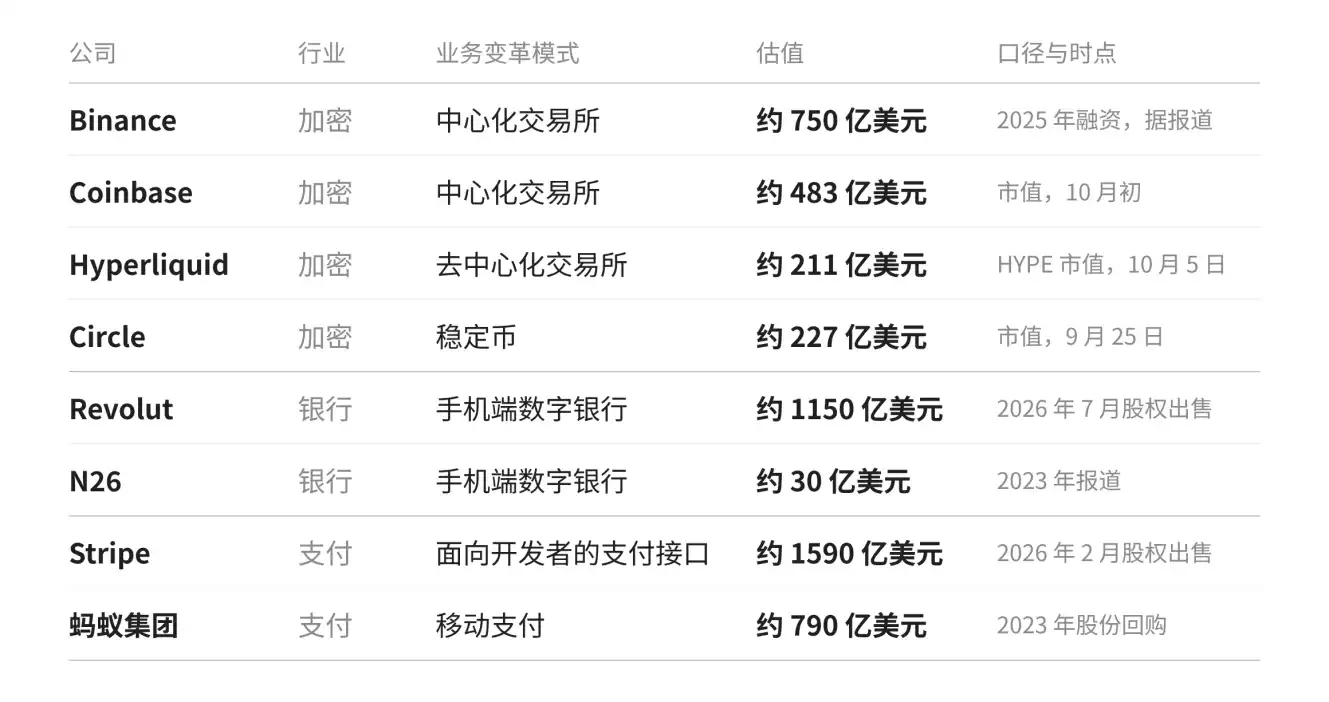
Looking back at the evolution of fintech, every paradigm shift in products has spawned a new batch of super unicorns. In the crypto industry, centralized trading platforms gave rise to Binance and Coinbase, decentralized trading platforms gave rise to Hyperliquid, and stablecoins gave rise to Circle. In traditional finance, the banking sector produced Revolut and N26, while the payments sector produced Stripe and Ant Group. Except for N26, all of these companies have valuations exceeding $10 billion; Stripe and Revolut have surpassed $100 billion.
The convergence of crypto assets and traditional finance will evolve into the next financial paradigm shift. This trend has drawn attention from multiple institutions: DTCC announced in May that its tokenization service has brought together more than 50 institutions. Standard Chartered projected in May that on-chain asset scale will reach $4 trillion by the end of 2028, with stablecoins and RWA each accounting for half. Citi's baseline forecast in June was that tokenized securities will reach $5.5 trillion by 2030. When the Hong Kong SAR government released the "Policy Statement on Digital Asset Development 2.0" in June 2025, it stated that Hong Kong possesses unique advantages and is well positioned to lead in ushering traditional finance into the digital asset era.
This round of paradigm shift is expected to spawn a new batch of super unicorns. BIT was founded in 2019 and currently has a valuation exceeding $1 billion, making it a unicorn company. Publicly disclosed information shows that the company is exploring opportunities to enter the U.S. capital market. While expanding its licensed securities business, BIT retains stablecoin accounts and digital asset access for crypto platforms. Today, BIT's business has extended from digital assets to U.S. stocks, Hong Kong stocks, and tokenized assets, becoming a modern financial platform connecting traditional finance and digital finance, and is also expected to grow into a super unicorn in the new wave of brokerages.
Risk warning: Investment involves risk. Prices of crypto assets, securities, and options may fluctuate significantly, and you may lose all of your principal; options and margin trading carry higher risks, and stablecoins are subject to de-pegging risk; past performance does not represent future results. Hong Kong stock business is not provided to Hong Kong residents or persons located in Hong Kong. This article does not constitute investment advice or an offer or solicitation. Services are only provided to eligible users in jurisdictions where permitted, and are not applicable to persons in restricted jurisdictions, subject to the terms of each licensed entity.
Welcome to join the official BlockBeats community:
Telegram Subscription Group: https://t.me/theblockbeats
Telegram Discussion Group: https://t.me/BlockBeats_App
Official Twitter Account: https://twitter.com/BlockBeatsAsia
