Two things in the primary market have clearly inflated. One is called narrative, and the other is called outlier.
For a long time, after chatting with investors and entrepreneurs, we often have a slight sense of恍惚. People spend less and less time discussing product details and user retention, and more and more time discussing "narratives." It seems that as long as a company still applies the latest narrative that has become the "consensus" in the circle, it is as if they went out without clothes on, and it is absolutely impossible to push it to IC.
Along with narratives, the pricing of a set of casting aesthetics popular in Silicon Valley and domestic VC circles has also risen. The weirder the outlier, the more sought after.
In the context of many investors, conventional excellence is no longer sexy enough. It seems that as long as a person is sufficiently out of line and controversial enough, even if they tread on the edge of rules and morality, even if they maliciously poison and obstruct colleagues from training models, in the mouths of some VCs, it can still be described as "having a certain drive."
What is more subtle is the reaction around the card table. When an institution heavily bets on some out-of-line weirdo, it often wins applause from some onlookers, who think this is the courage to go against consensus.
There is actually a secretly swapped causality here. The quirks left by those great entrepreneurs were originally just shadows they dragged on the ground after accomplishing things; now, some capital has begun to pick people according to the shape of the shadow. As for whether the person standing under the shadow is a genius or a bastard, and whether there is anything real at all, fewer people ask.
It is also understandable. If the purpose of an investment is no longer to accompany a company through to producing a product that truly has user buy-in, but merely to sell the stake to the next round of buyers at double the valuation six months later, then whether the product actually works is indeed not so important. As long as the narrative can be sold to the next round, it does not burn.
Even the core operating numbers on the books are just a matter of the founder saying a sentence offhand.
Roy Lee, founder of AI startup Cluely, did exactly that. In July 2025, he told the media that the company's ARR had doubled to $7 million within a week.
This number ran for a full eight months in tech media headlines and in the benchmarking tables of countless peer financings. How many startups used it as a multiple reference, and how many investors used it at investment committee meetings to prove how explosive AI application growth was.
It wasn't until March 2026 that Roy Lee casually admitted on X that the numbers were made up. He said that on that day, he happened to receive a call from a strange woman asking about business data, and he just made something up on the spot. TechCrunch later pointed out that the interview was proactively arranged by Cluely's PR team, and the "strange woman" on the other end of the line was a TechCrunch reporter.
Why could a fake number blurted out on the spot spread unimpeded for over half a year and even become a reference for others' valuations? Because on this assembly line, the people who fabricate stories, spread stories, and pay for stories had long since become one and the same.
Just a few months earlier, a16z, which had invested in Cluely, laid out this logic openly in an article. In November 2025, this veteran fund founded in 2009 set up a new media team and published a long piece titled "What Is New Media," whose opening line stated that from its very first day, what this fund wanted to be was "the CAA of tech."
CAA is one of Hollywood's largest talent agencies, whose daily business is negotiating salaries for stars and managing their public personas. And in a16z's new media service menu, one offering is literally called "Win the Internet for a Day," promising to equip founders with everything they need to win the online narrative war—from legitimacy to momentum, dominating social media timelines on demand. That same year, a16z directly acquired Turpentine, the podcast network founded by Erik Torenberg, and Erik Torenberg pivoted to become a GP at the fund.
When a top-tier venture capital firm decides to step into the arena as a talent agency itself—running both the money printer and the TV station—narrative is no longer narrative.
In his 2023 book "The Crisis of Narration," Byung-Chul Han used the term storyselling. Once a story is used only to sell, it is no longer accountable to the real world—it only needs to serve the people paying for the next round.
Launch Tower
Following the logic of "VC media-ization" downward, the hottest infrastructure in the tech world in recent years, aside from compute clusters, is probably the content hub.
In the past, entrepreneurs and investors telling stories had to go through traditional tech media; now everyone finds the middlemen too slow and not obedient enough.
In April 2026, OpenAI spent hundreds of millions of dollars to directly acquire the tech podcast TBPN. The acquisition terms were interesting: editorial independence of the show was preserved, but the existing advertising business was shut down, and the team's new reporting line shifted to Chris Lehane, an executive who in his early years worked in the White House under Clinton, specifically handling scandals for the president.
Investment firms themselves started writing in-depth profile pieces even earlier. In September 2022, Sequoia specifically commissioned a freelance writer to produce a 13,000-word long-form profile, prominently displayed on Sequoia's official website, with a title styled like a religious gospel: "Sam Bankman-Fried Has a Savior Complex—and Maybe You Should Too."
Less than two months later, FTX filed for bankruptcy, and the article was urgently removed from the official website. Sequoia's $150 million investment was entirely written down to zero.
SBF's downfall taught Silicon Valley a hard lesson: glorifying founders as saints is too costly, and once the bubble bursts, the reputations of the institutions themselves shatter along with it.
Since positive glorification tends to fail, then use a cheaper fuel: public outrage.
In the formula where attention equals valuation, being praised by the entire internet and being cursed by the entire internet carry the same converted traffic weight. As long as the company's name can be inserted into investors' information feeds, infamy is still fame—even being reviled can be monetized.
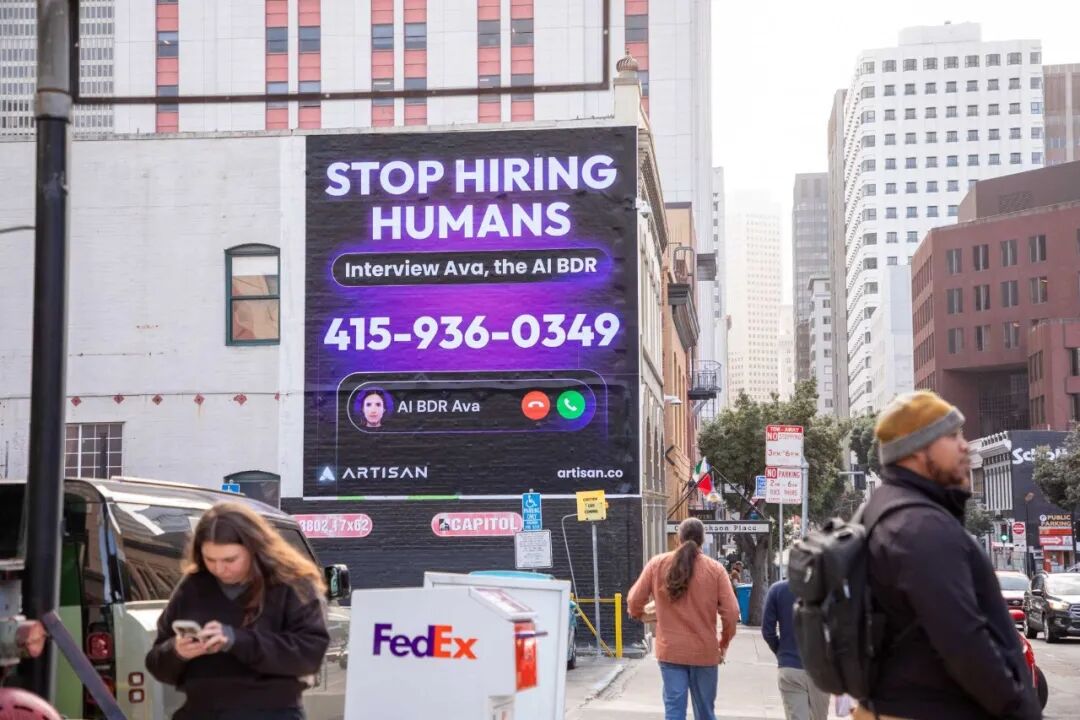
There have been many examples in the past two years. First, Artisan, a startup focused on AI sales agents, erected a billboard at the intersection of 10th Street and Folsom Street in San Francisco's SoMa district, reading "Stop Hiring Humans." Founder Jaspar Carmichael-Jack later admitted frankly that the primary purpose of these ads was to grab attention.
After the backlash fermented, Artisan smoothly secured $25 million in Series A funding. At the time, this company shouting "Stop Hiring Humans" had 35 human employees and planned to hire 22 more.
In September 2025, in New York subway cars, 22-year-old Avi Schiffmann also spent approximately $1 million to plaster over 11,000 ads for his AI pendant product Friend. Within days, enraged subway passengers covered the posters with marker scribbles, one of which read "AI doesn't care if you live or die." Facing the graffiti-covered walls, Avi Schiffmann responded publicly that everything was going according to plan, and casually dropped a quotable line: "Capitalism is the greatest art medium."
Silicon Valley has of course always been fascinated by those who can conjure hype out of thin air. In 1981, when Andy Hertzfeld first transferred into Apple's Mac team, software lead Bud Tribble used a term from Star Trek to name Jobs' storytelling ability: the "reality distortion field."
But Tribble also added the second half of the sentence at the time, saying that once Jobs left, the field would dissipate. After the field dissipates, code bugs won't listen to Jobs' keynote speeches, and the Mac would ultimately have to be put into a box, manufactured, and delivered into the hands of a real person. Whether this thing is actually any good—you just take it home, plug it in, and you know. Nobody can fool anybody.
The watershed moment came in 2011. That spring, Jobs spoke for the last time at the iPad 2 launch event about technology needing to intersect with the liberal arts; five months later, Marc Andreessen published "Why Software Is Eating the World" in The Wall Street Journal, and four days after that, Jobs resigned as Apple CEO.
Since then, the protagonists of Silicon Valley have changed to a different cast of characters. On the new gaming table where software, finance, and attention intertwine, if a product's real buyer is no longer the discerning end user but rather the next round of institutions afraid of missing out, that "reality distortion field" can persist indefinitely.
The music is still playing
Writing to this point, an unavoidable question emerges: since even bystanders can hear these calculations being made, can the professional buyers at the table really not see through it?
It's not that they can't see through it—the buyers at the table know better than anyone.
When I chat with some frontline investors about certain AI projects, they often give a wry smile and admit that yes, it's not solid enough, and the numbers are inflated. But once you press further—"Then why are you still rushing to hand out a TS?"—the usual response is silence, or a rhetorical question: "If you don't get in this round and it doubles next round, how do you explain that to your LPs?"
This is precisely the problem that Yale economist Robert Shiller wrote about in his 2019 book Narrative Economics. Shiller borrowed epidemiological models to describe how the amount of capital a narrative can mobilize depends on its transmission speed and coverage—and has absolutely nothing to do with whether the story itself is true or false.
In an industry where people answer to paper gains, truth and falsehood are concerns only for the final reckoning, while missing out is a problem that gets exposed within the quarter. As long as the narrative is told for the benefit of the next round of buyers, the baton can be passed along round after round.
This collective hysteria mentality played out once before in the 2020 SPAC frenzy.
On June 4, 2020, electric truck company Nikola went public on Nasdaq via a SPAC. Going public through a SPAC offers a huge loophole: it can bypass the strict scrutiny of a traditional IPO and stuff roadshow materials with extensive future financial projections.
Five days after listing, Nikola's market cap surged to nearly $29 billion, overtaking Ford in one stroke—even though Nikola had not delivered a single vehicle and its book revenue was zero. It was not until three and a half years later, in January 2024, that the U.S. SEC finally introduced new rules, removing the securities-litigation safe harbor protection for future performance projections by SPACs and their target companies.
In July 2007, Citigroup CEO Chuck Prince, interviewed by the Financial Times in Japan, summed up this institutional dilemma with remarkable honesty. Speaking of the leveraged buyout boom at the time, he said that when the music stops, things will get complicated in terms of liquidity, but as long as the music is playing, you've got to get up and dance.

Four months later, Chuck Prince resigned.
In the primary market, where valuation and paper gains do the talking, whoever stops first is the first to be out. Even when someone tries to turn off the music, the vested interests at the whole table will join forces to push him away.
Looking back at the OpenAI boardroom drama in November 2023 that shocked the world, stripping away all the rhetorical lines about "AI safety" and "accelerated development," the underlying color is in fact a battle to defend valuation—an asset-defense war.
At the time, the OpenAI board fired Sam Altman on the grounds that he was "not consistently candid in his communications." Right at that very moment, Thrive Capital was preparing to lead a tender offer to buy employee shares at an $86 billion valuation. As soon as the firing news broke, investors immediately let it be known that they were considering writing down their OpenAI shares to zero.
The $86 billion valuation was about to evaporate in an instant, and no one at the table could bear that cost. Within days, 738 of OpenAI's roughly 770 employees signed an open letter demanding the board resign and bring back Sam Altman, or they would all jump ship to Microsoft. Five days later, Sam Altman returned to OpenAI, and three of the four directors who fired him were gone.
Playing the Eccentric
Since the rule of the table is to sell the story to the next round, what is the most efficient fundraising strategy for an early-stage founder?
Building a product takes a long cycle; showing quirks or even crossing lines takes only a few minutes.
In early Silicon Valley, eccentricity was a byproduct left behind after getting things done. Young Steve Jobs liked to walk around the office barefoot, and for the latter half of his life wore almost exclusively Issey Miyake black turtlenecks. The reason people relish these details is the premise that he first built the Mac and the iPhone.
Later, the order of imitation was completely reversed.
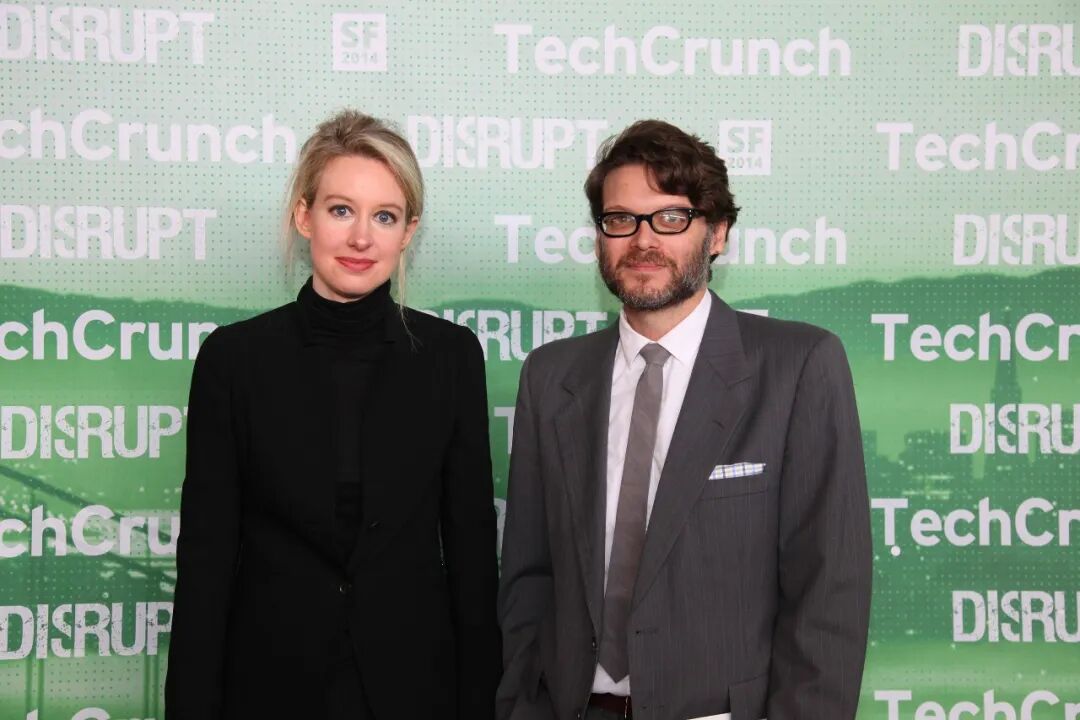
The first to learn this superficial trick was Elizabeth Holmes. She dressed like Jobs in a black turtleneck; a person who knew her family recalled that she even copied Jobs's gesture of pulling an iPhone from his trouser pocket exactly, except what she pulled out was swapped for a Theranos micro blood-collection tube.
If Holmes was still an individual-style imitation, then it was Peter Thiel who systematized the "cult of the eccentric" into venture-capital doctrine. By 2010, Peter Thiel established the Thiel Fellowship, giving each young person under 20 $100,000 on the condition that they drop out of college to start a company. Three years later, in Zero to One, he devoted a chapter to "The Founder's Paradox," arguing that successful founders often carry both the good and bad extremes of traits at once.
Fourteen years later, dropping out itself became a bonus point during pitch presentations.
At the YC Demo Day at the end of 2025, more and more founders, in their limited presentation time, could not be bothered to talk about the product and first made a point of emphasizing that they had just dropped out of school. Moxxie Ventures partner Katie Jacobs Stanton even publicly stated that dropping out is itself a credential, proving that a person has sufficiently deep conviction.
As for the results of multiple statistical studies on startups, they give exactly the opposite conclusion: the vast majority of successful startup founders hold university degrees. But in the FOMO atmosphere of the pitch hall, no one cares about such a buzz-killing statistic.
In recent years, just wearing a black turtleneck and going through the dropout paperwork is no longer thrilling enough. The new casting script demands that founders preferably bring some "antisocial" or "man-child" dramatic tension.
In May 2021, Musk hosted Saturday Night Live and said in his opening monologue that he was the first person with Asperger's syndrome to host the show, "or at least the first to admit it." Two years later, when Walter Isaacson finished his biography of Musk, he reflected at the end of the book that sometimes great innovators are just risk-loving man-children who refuse to be potty-trained, crazy enough to think they can change the world.
But some investors not only buy into this, they are happy to tell such offenses as flattering anecdotes.
In Sequoia's long article that has since been taken down, one story was recorded. SBF pitched Sequoia partners on Zoom about his vision for the future of money. After the meeting, an FTX employee sitting ten feet away from him walked over and discovered that he had been playing League of Legends the entire time while pitching. For an ordinary entrepreneur, this would be called bad manners and disrespect. Sequoia, however, treated it as a flattering anecdote and wrote it into the long article posted on its official website.
Once "outrageousness" can be directly converted into checks, public decency and bottom lines will be quickly breached.
Roy Lee, the founder of Cluely mentioned earlier, first became famous by developing a tool that helped people cheat in programmers' technical interviews, and personally filmed a video demonstrating himself using it to pass an Amazon interview. After Columbia University suspended him, he simply dropped out and founded Cluely, and soon received investment from a16z.
No matter how extreme the résumé, as long as it comes with话题度, it can find a buyer in Silicon Valley. In 2015, engineer Anthony Levandowski registered a church called "Way of the Future," claiming he wanted to develop an artificial-intelligence-based god. He was later sentenced to 18 months in prison for stealing Google's autonomous-driving trade secrets and received a presidential pardon in January 2021. By the spring of 2026, Travis Kalanick acquired Pronto, the autonomous mining-vehicle company Levandowski ran, confidently letting him continue at the helm and making Pronto the technical core of the mining division of the new company Atoms.
When we used to talk about good entrepreneurs who can survive cycles, one criterion we often cited was that they should have ambition but not too big an ego, and that they should do businesses that can actually be implemented. But in today's fast-money logic, as long as you perform your ego big enough and outrageous enough, investors eager to find outliers will come up to you and praise you for having the makings of a champion.
This casting logic has also spread to the Chinese venture capital circle, such as the recently much-buzzed-about Tian Keyu, whom VCs say "has a fire in his belly."
My view on this matter remains the same: if you know full well that someone has done something unethical—breaking rules and harming others—and you still think he "has a fire in his belly" and insist on investing in him, that only proves you are unethical too.
A couple of days ago, I discussed this view with a young investor, and he said, "How can an investor's business be called unethical?"
He probably really has mastered the four ways of investing in world models.
Failing Up
Common sense says that a setup built on acting and crossing lines will eventually be exposed. The company collapses, the scandal breaks, or even the court verdict comes down—surely this person should be out of the game by then?
Silicon Valley's answer is not only that they don't leave the table, but that their chips can keep growing the more they lose.
Silicon Valley has indeed had a tradition of tolerating failure—if a company flops, the founder can still raise money for the next one. But over the past few years, the pocket of "failure" has been stretched wider and wider, stuffing even fraud and workplace scandals into the narrative of "growing from lessons learned."
Tim White, a researcher at the London School of Economics, published a paper in 2026 specifically analyzing this phenomenon, using the term "failing up." His conclusion in the paper is that Silicon Valley's top VC system is structurally designed to reward serial entrepreneurs who commit extreme misconduct.
Why does the system reward those who make big mistakes?
Once you grasp the attention logic mentioned earlier, this is not surprising at all. For funds managing billions of dollars and needing to write large checks, the biggest headache is not founders with tainted records, but projects with no momentum. A star founder who drove a hundred-billion-dollar company into bankruptcy, even with a ruined reputation, still holds scarce assets that ordinary entrepreneurs couldn't accumulate in ten lifetimes—such as global attention, ready-made media headlines, and a capital-circle network that rallies at a call.
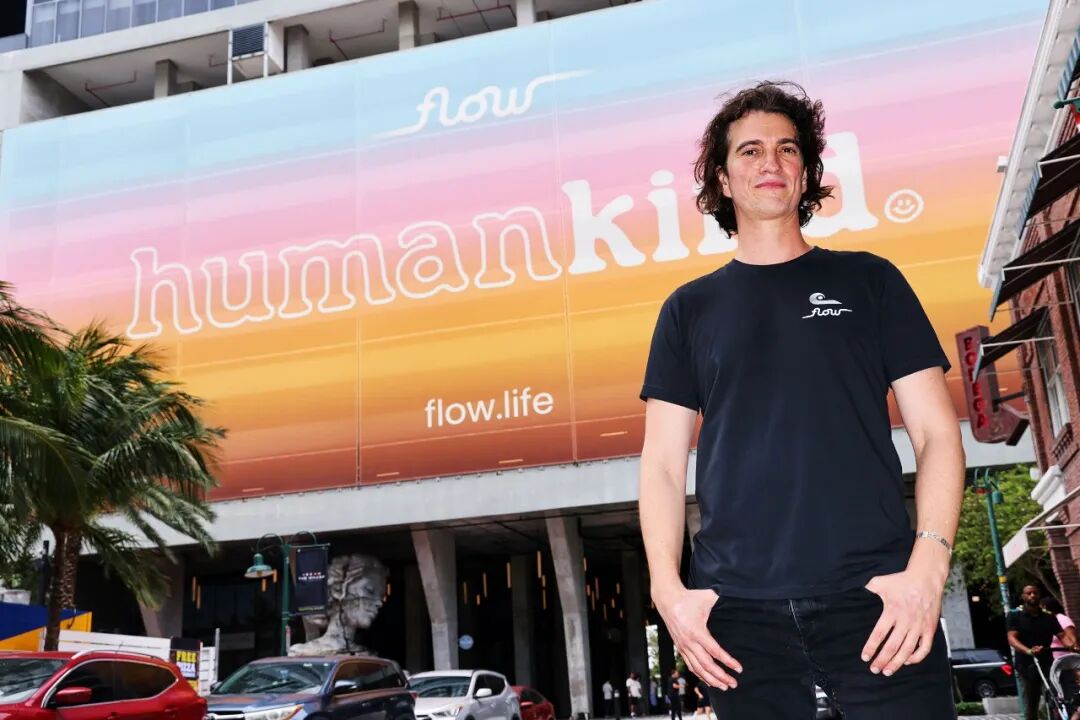
Adam Neumann is a typical case. In August 2019, WeWork, a subleasing company valued at $47 billion, filed its prospectus, opening with the company's mission to "elevate the world's consciousness." More than a month later, the IPO was shelved, Adam Neumann resigned as CEO, and WeWork, left in a mess, filed for bankruptcy in November 2023.
But more than a year before WeWork's bankruptcy, in August 2022, a16z wrote a check of about $350 million to his new real estate company Flow, setting the highest single investment record in the fund's history. Marc Andreessen praised Adam Neumann in a blog as a visionary leader and said the fund likes to see serial entrepreneurs grow from past lessons. By April 2025, Flow's valuation had risen to about $2.5 billion.
The same script played out with former Uber founder Travis Kalanick.
In 2017, Uber forced founder Travis Kalanick to step down as CEO after a series of sexual harassment and workplace discrimination complaints came to light. Nine years later, on July 22, 2026, it was again a16z that stepped up to lead a $1.7 billion funding round for Travis Kalanick's new company Atoms.
On the same day, a16z co-founder Ben Horowitz published an article titled "Travis Is Back" to boost his profile, while Travis Kalanick lightly described the return on X as "a bit of unfinished business."
As for those who accidentally crossed legal red lines and even had court verdicts handed down, they too have figured out another shortcut to turn the page.
Nikola, the company mentioned earlier that reached a $29 billion market cap on zero revenue, saw its founder Trevor Milton later convicted of securities fraud. But less than a month before the 2024 U.S. election, Trevor Milton and his wife donated more than $1.8 million to Donald Trump's campaign fund. On March 28, 2025, he smoothly received a presidential pardon, and the hundreds of millions of dollars he originally needed to pay investors were also waived.
With a clean slate, Trevor Milton immediately returned to the venture capital table. By the end of that year, he and a group of investors bought the near-bankrupt aircraft manufacturer SyberJet, and by the spring of 2026, he had skillfully switched to the narrative of AI-driven autonomous aircraft and begun seeking financing in the market.
02026
When a fund acts as both referee and media, when entrepreneurs can get checks by fabricating data and performing eccentricities, and even fraud convictions can be erased with political donations, this internal loop has only one hidden risk left: what if outside regulators, ethicists, or the general public can no longer stand it?
To prevent external regulation and moral scrutiny from interrupting this cycle, Silicon Valley has spent the past decade or so stitching together a larger ideological bulletproof vest for itself, step by step.
The original fabric of this bulletproof vest was the hybrid pointed out by British scholars Richard Barbrook and Andy Cameron in their 1995 article "The Californian Ideology," in which Silicon Valley fused the free spirit of hippies with the entrepreneurial fervor of yuppies, firmly believing that as long as the government stays out of the way, technology will solve all social problems on its own.
Travis Kalanick's Twitter avatar was once the cover of Ayn Rand's novel The Fountainhead; Facebook's internal slogan "move fast and break things" was also used until 2014. The implication is that as long as you run fast enough, the things that get broken don't need to be paid for by us.
Later, Peter Thiel pushed this kind of tech elite immunity to the institutional level. By 2014, Wired magazine excerpted a chapter from Zero to One, with the title directly taken as "You Should Run Your Startup Like a Cult."
In the past five years, this "elite immunity theory" has spawned two versions that appear to be diametrically opposed but actually lead to the same destination.
The first is called effective altruism (EA), whose core logic is to use "grand good deeds in the future" to exempt "money-grubbing means in the present." In 2012, Oxford University philosopher William MacAskill met with SBF, who was still studying at MIT, and advised him not to directly devote himself to public welfare, but to first make as much money as possible and then donate it, the so-called earn to give.
This rhetoric became SBF's best public relations shield. It was not until after the FTX collapse in November 2022 that Vox reporter Kelsey Piper asked him in a private message, for a person who treats everything as a win-or-lose game, you usually talk about ethics so eloquently. Only then did SBF drop the act and reply: "I had to be. It's what reputations are made of, to some extent."
The other is effective accelerationism (e/acc). Since pretending to be a philanthropist is too easy to expose, simply declare that "accelerating money-making and god-making is itself the highest morality."
This concept, proposed by the anonymous account Beff Jezos in 2022, argues that the universe thermodynamically naturally favors civilizations that become increasingly capable of utilizing energy. On October 16, 2023, Marc Andreessen published the "Techno-Optimist Manifesto," formally listing Beff Jezos among the "patron saints."
The manifesto was written with a murderous tone, stating that any attempt to slow down AI would lead to death, and that deaths that could have been avoided by AI "are a form of murder"; and in a section titled "Enemies," "social responsibility," "trust and safety," "tech ethics," and "risk management" were all listed on a blacklist.
When it came to Peter Thiel, the secular debate was directly elevated to theological intimidation.
In the fall of 2025, Peter Thiel gave four closed-door lectures on the "Antichrist" in San Francisco. Leaked recordings showed that he believed the Antichrist might appear in the form of someone obstructing scientific development, and he directly named environmental activist Greta Thunberg and AI safety researcher Eliezer Yudkowsky. By July 2026, he co-authored an article with Sam Wolfe in the religious publication First Things, depicting the Antichrist as a technocrat who constantly speaks of "safety, ethics, and global coordination."
Once "buckling up" is defined as "murder" and "the Antichrist," then whoever dares to audit Silicon Valley, whoever dares to step on the brakes of runaway capital, is a sinner against all humanity.
After the bulletproof vest was put on, the money began flowing directly toward ballots and legislation. In 2025, a16z and OpenAI President Greg Brockman and his wife each contributed $25 million to lead the creation of the super PAC Leading the Future, with the goal of promoting a unified national AI regulatory standard in the 2026 midterm elections and preventing states from legislating their own AI oversight. As of April 2026, the organization and its affiliated groups had raised more than $140 million, of which the $25 million received in the first quarter of 2026 came entirely from a16z and its two founders.
From fabricating ARR, buying media transmission towers, and mass-producing eccentrics, to using hundreds of millions of dollars in political donations to buy the right to interpret the rules, this closed loop ultimately converged seamlessly onto the same road, Sand Hill Road in Menlo Park, California, where a16z got its start.
Digging further along the place name Menlo Park, you will find a particularly ironic piece of history.
More than half a century ago, in the fall of 1968, Stewart Brand was also in the Menlo Park area, using a typewriter and scissors to assemble the first issue of the Whole Earth Catalog. In explaining his original purpose for the publication, he said that distant powers such as governments and large corporations had become riddled with problems, and that what the Whole Earth Catalog needed to do was serve as a tool for evaluation and access, selecting handy things for specific individuals, with readers then sending in their own usage feedback.
For that generation of Silicon Valley people, technology was a tool placed in the hands of specific individuals, and the makers of tools held a reverence for them. When the first-generation iPad launched in 2010, New York Times reporter Nick Bilton asked Steve Jobs, who had been deeply influenced by the Whole Earth Catalog, whether his children loved the iPad. Jobs replied that his children hadn't touched it yet, and that his family strictly limited their children's use of tech products.
Fifty-eight years later, a16z, also founded in Menlo Park, has had its media team shrink the unit of time to "winning the internet for a day."
As for what the tools ultimately turn people into, nobody cares—as long as today's timeline wins, tomorrow's valuation can go up.
And Stewart Brand, who made the Whole Earth Catalog in Menlo Park back then, later went on to reckon with another scale of time.

In 1996, he and computer scientist Danny Hillis and others founded the Long Now Foundation, planning to build a mechanical clock inside a mountain that would run for ten thousand years, ticking once a year, with a cuckoo emerging only once every thousand years.
In all of the Long Now Foundation's documents, every year is preceded by an extra zero, to remind people to think about present decisions on a ten-thousand-year scale.
This year, in their reckoning, is 02026.
Welcome to join the official BlockBeats community:
Telegram Subscription Group: https://t.me/theblockbeats
Telegram Discussion Group: https://t.me/BlockBeats_App
Official Twitter Account: https://twitter.com/BlockBeatsAsia
