TL;DR
Speculation is becoming a major investment theme for the coming decade. Historically, speculation has been driven by two forces: "build-oriented speculation" brought about by technological revolutions, and "lottery-style speculation" spawned by fiscal, monetary, and socioeconomic pressures. In the past, the two typically operated separately; now they are accelerating simultaneously.
AI is powering both speculation engines at once. On one hand, hundreds of billions of dollars in capital expenditure by tech giants is driving the buildout of computing power, electricity, and data centers, forming a technology investment boom reminiscent of the railway and internet eras; on the other hand, AI is also pushing up energy costs, intensifying fiscal and financing pressures, and dampening young people's employment prospects, indirectly reinforcing the motivation to seek high-risk, high-reward opportunities.
Cryptocurrency is becoming the infrastructure for speculative activity. If AI provides the rationale for speculation, then crypto technology provides the tools. Perpetual contracts, meme coins, prediction markets, and tokenized assets have dramatically lowered the barriers to creating and trading financial products, enabling a growing range of assets to trade around the clock and globally.
Speculative demand is crossing traditional asset classes. Sports betting, same-day expiry options, prediction markets, cryptocurrency, and social trading may appear to belong to different markets, but they actually reflect the same demand: investors want to convert their judgments about future events into tradable positions with potential returns. These activities are gradually converging onto the same set of trading platforms.
The core investment strategy is "buy the house, not the chips." Rather than betting on the next successful AI company, the next token to surge, or the next hot event, focus on platforms that can consistently generate revenue from trading activity. The report focuses on the business models and growth potential of trading venues such as Robinhood, Hyperliquid, Lighter, as well as Kalshi and Polymarket.
Trading platforms do not guarantee profits. Volume growth does not necessarily translate into profits; fee competition, regulatory risk, wash-trading incentives, and market cycles can all erode platform value. In particular, it is important to distinguish between trading platform equity and platform tokens: even if a token has a fee buyback mechanism, it is not equivalent to holding exchange shares.
The long-term opportunity lies in speculative infrastructure, not in any single market cycle. Historically, both the railway and internet bubbles caused massive capital losses, yet left behind infrastructure of lasting value. Delphi Digital believes that future speculative bubbles may still burst, but the matching, clearing, and distribution networks that survive are expected to become core assets that continuously capture trading demand.
The original text is as follows:
Speculation has historically been driven by two forces. Today, these two engines are running simultaneously with unprecedented intensity, and are being propelled by the same set of technologies.
In 1841, Scottish journalist Charles Mackay published Memoirs of Extraordinary Popular Delusions. The most widely circulated sentence in the book appears at the opening: "Men, it has been well said, think in herds; it will be seen that they go mad in herds, while they only recover their senses slowly, and one by one."
The book chronicled the Mississippi Bubble, the South Sea Bubble, the Dutch tulip mania, the witch hunts, the alchemists, and the Crusades. In the 185 years since, this sentence has been repeatedly used to describe one speculative frenzy after another—railway stocks, radio concept stocks, internet stocks, real estate, meme stocks, cryptocurrencies, and zero-day options.
Mackay's observation of herd behavior was accurate, but he misjudged its place in human society. He described group behavior as a brief frenzy that deviates from normal life, believing that people would fall into it and eventually return to reason.
But in markets, herd behavior itself is the norm. When no one knows what the future holds, prices are determined jointly by people who observe and second-guess one another. Since the birth of markets, this rule has never changed.
Financial journalist Edwin Lefèvre described this with less moralizing. In Reminiscences of a Stock Operator, his narrator, modeled on the legendary trader Jesse Livermore, said bluntly: "There is nothing new in Wall Street. There can't be because speculation is as old as the hills. Whatever happens in the stock market today has happened before and will happen again."
Financial instruments keep changing, but the human behavior surrounding them has remained essentially unchanged.
As long as people can buy and sell some kind of claim on future returns, speculation will exist. The real difference between eras lies in the intensity of speculation and in what people believe they are actually buying.
This article stems from a simple question: Is speculation a societal reaction to technological change, or a reaction to the decline of political and monetary order?
History shows that both factors can trigger speculation, and most famous speculative episodes have been driven primarily by one of these forces. Sometimes, a new technology makes future possibilities seem far broader than the present; sometimes, strained fiscal and political systems push the public into speculative trades designed and peddled by the system itself.
Today, these two forces are running at high speed simultaneously, and the same technology is powering both. This is precisely why we view speculation itself as an investable theme. Rather than betting directly on a speculative asset, it is better to hold platforms that provide matching and clearing services for these trades.
I. The Specter of Speculation
Benjamin Graham, Warren Buffett's teacher, learned the difference between investment and speculation at a painful cost.
From 1929 to 1932, the investment partnership he managed lost about 70%. For most of his subsequent career, he tried to stop people from casually applying the word "investment" to any asset they had just bought.
In 1934, Graham and David Dodd proposed a definition in Security Analysis that remains the classic standard for distinguishing investment from speculation: "An investment operation is one which, upon thorough analysis, promises safety of principal and an adequate return. Operations not meeting these requirements are speculative."
But Graham was well aware that Wall Street would never use these words strictly according to that standard. He later wrote: "In Wall Street's broad usage, everyone who buys or sells securities becomes an investor, regardless of what securities are bought or sold, for what purpose, at what price, or whether the transaction is for cash or on margin."
Still, Graham never regarded speculation as a sin. He wrote in The Intelligent Investor: "Pure speculation is neither illegal, nor immoral, nor fattening to the pocketbook for most people."
He further noted that a certain degree of speculation is both necessary and inevitable. After all, someone must bear the risks that cannot be fully eliminated through models. What he truly opposed was the confusion of concepts.
Wall Street trader Fred Schwed, who lost most of his wealth in the 1929 crash, summarized the distinction in two sentences in his 1940 book Where Are the Customers' Yachts?: "Speculation is an effort, probably unsuccessful, to turn a little money into a lot. Investment is an effort, which should be successful, to prevent a lot of money from becoming a little."
John Maynard Keynes himself speculated heavily with his personal funds. His focus was not on the moral attributes of speculation, but on its operating mechanism.
In Chapter 12 of The General Theory, Keynes compared professional investment to a beauty contest held by newspapers at the time: readers had to choose the six most beautiful faces from a hundred photos, and the winner was not the person who picked the objectively most beautiful faces, but the one whose choices came closest to the average choice of all contestants.
Keynes explained: "It is not a case of choosing those which, to the best of one's judgment, are really the prettiest, nor even those which average opinion genuinely thinks the prettiest. We have reached the third degree where we devote our intelligences to anticipating what average opinion expects the average opinion to be."
He added that some people even go to the fourth and fifth degrees of prediction. From this perspective, speculation is essentially about judging how others will judge, with asset cash flows being only one reference factor.
Yale University economist and Nobel laureate Robert Shiller later further explained how these expectations spread.
In Irrational Exuberance and Narrative Economics, he proposed that stories often spread faster than financial data. What truly drives asset prices is usually narratives about a "new era": housing prices can only go up; the internet will change everything; a currency that the government cannot arbitrarily print more of is better than fiat money.
Whether true or false, as long as a story is easy enough to retell, it has the potential to move prices.
George Soros, who rose to fame in 1992 by shorting the pound, built his career by trading on this feedback loop. He called this mechanism "Reflexivity."
In a 2009 speech, Soros noted: "Every bubble has two components: an underlying trend that prevails in reality and a misconception relating to that trend."
When the two reinforce each other, rising prices appear to become evidence supporting the original judgment. As Soros described it, the boom phase is "long and slow," while the crash phase is "short and steep, because forced liquidation of unsustainable positions further reinforces the decline."
Before the trend reverses, crowds are not as foolish as Mackay suggests. They are simply participating in a process that can continue to deliver returns for a period of time, and the returns are often quite substantial. Soros's own success is proof of this.
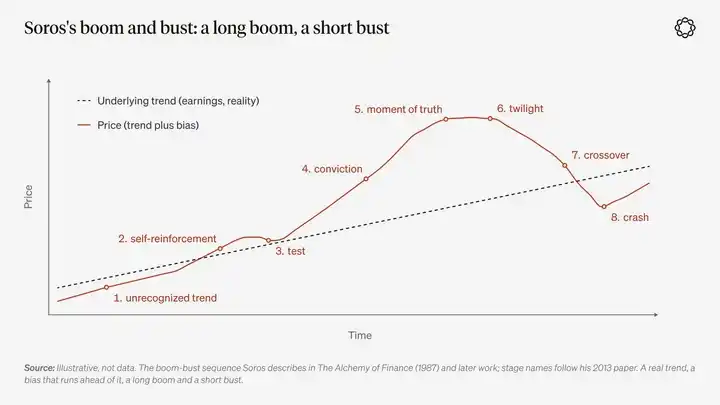
These four thinkers disagreed on many issues, but on crowd behavior, they ultimately reached conclusions that are closer to each other than their respective methodologies would suggest: short-term prices are determined by market participants' expectations of others' behavior. As long as this behavior continues to deliver returns, the crowd appears rational.
But none of them thoroughly answered one question: what initially drives crowd action?
II. Two Great Speculative Engines
A crowd needs a reason to act, and that reason usually comes from the gap between two worlds: the real world already reflected in asset prices, and the world that may emerge in the future.
Historically, this gap has formed mainly in two ways.
The first is technological change.
Railways dramatically reduced transportation and distance costs, electricity reorganized factory production, and today AI models capable of reading and writing are reshaping people's perception of the value of white-collar labor.
People disagree about when the change will occur and who will ultimately capture the new gains, and liquid markets are where these disagreements are priced and traded.
We can call this Construction Speculation.
Someone will eventually build an entirely new industrial landscape, and those who arrive first will gain status and returns, while capital often floods in rapidly but crudely. Fiber-optic networks were laid down exactly this way, and data centers are being built this way too. At the same time, a large amount of capital will also be destroyed in the process.
The second force comes from the political and monetary system.
When a country faces fiscal pressure, or when a policy regime has its own specific goals, it begins to sell some kind of bet to the public: converting war debt into corporate stock; buying real estate because homeownership is national policy; or holding any asset other than cash.
At the household level, this change manifests as: the normal path of life today no longer gives people confidence that they can have a decent life in the future. The real purchasing power of money seems to be declining faster than official data shows, and wage income can no longer be converted into a home at the same stage of life as it could for the previous generation.
We can call it Lottery Speculation.
At this point, patiently waiting sounds more and more like advice given by those who already own assets. The remaining option seems to be just a lottery ticket: if you hit an extremely low-probability huge payoff, life could change completely; and if you fail, the result is little different from the speculator's original state of life.
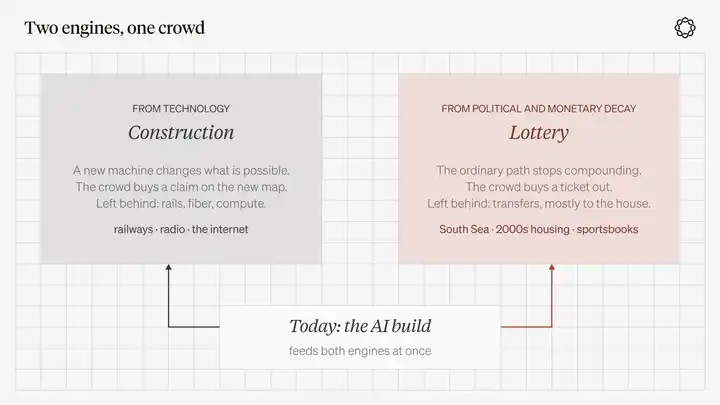
Chart description: These are two ways groups form a shared narrative. Similar behavior, yet different outcomes.
Neither concept is derogatory; they describe why people participate in speculation, not what assets they buy.
An 1845 railway stock mainly belongs to the construction narrative, but it also contains lottery-style dreams of sudden wealth. A sports parlay bet is essentially a lottery ticket, except it has learned to speak the language of financial markets. A stock index perpetual contract may belong to either of the two, depending on who the counterparty is and why they enter the market.
Mackay actually observed these two forces, but did not name them.
He opened his chapter on the Crusades by writing that every age has its own peculiar madness: "some scheme, project, or fantasy, by which people are drawn in because of the desire for profit, the need for excitement, or the sheer power of imitation. If none of these factors are present, then political or religious causes, or both together, will also drive people into some kind of madness."
The desire for profit around projects corresponds to construction speculation; the push of political forces corresponds to the second engine. Imitation is herd behavior itself, and it does not care which force originally started the whole process.
William Quinn and John Turner also proposed a similar division in their 2020 book Boom and Bust.
Their "bubble triangle" contains three elements: asset tradability, money and credit, and speculation. In addition, a bubble also needs a trigger, and this trigger is usually new technology or government policy.
According to their analysis, bubbles driven by bank financing usually cause the most severe damage, while bubbles triggered by technological progress are the most likely to leave something genuinely useful behind after they burst.
III. What Were Speculative Crowds in History Actually Doing?
If Lefèvre's "there is nothing new on Wall Street" is correct, then the most valuable way to study history is to identify the causes of each wave of speculative frenzy, examine what they ultimately left behind, and notice how rare it actually is for two major engines to run strong simultaneously.
Tulip Mania: An Emerging Trading Asset in a Wealthy Republic
The Dutch tulip mania of 1636 to 1637 is one of the most familiar financial bubble stories and one of the events historians have spent the most effort re-examining.
Historian Anne Goldgar found in her 2007 book Tulipmania that the main participants at the time were a small group of merchants and skilled craftsmen in Haarlem and Amsterdam, trading a luxury good among themselves.
She later said: "I didn't find anyone who went bankrupt because of it."
The damage from this frenzy was mainly concentrated at the level of trust and reputation. But three conditions did exist at the time: an emerging aesthetic consumer good, forward contracts on bulbs that had not yet been dug up, and a wealthy commercial republic with a well-developed legal mechanism capable of trading future promises.
Tulips were not a technological innovation, but novelty can be seen as a smaller branch of constructive speculation. A new commodity and a forward trading market were enough to spawn a speculative crowd in an environment where the political order was functioning normally.
Most phenomena called "bubbles" in normal bull markets are actually similar to this, and the actual damage caused is usually far less than later narratives have portrayed.

Caption: Semper Augustus, the most famous variety in the 1636–1637 tulip trade, image taken from a 17th-century tulip catalogue.
The South Sea Bubble and John Law: Packaging National Fiscal Debt as Stock
The situation in 1720 was completely different, and technology played almost no role. After the War of the Spanish Succession ended, both Britain and France were burdened with enormous debt that the existing tax systems could not easily service. Both countries tried to refinance their debt through trading companies.
In London, the South Sea Company proposed moving government debt off the public books through debt-to-equity conversion. Rising share prices made debt holders more willing to accept the swap, which further pushed up share prices and made the next round of debt conversion easier.
The South Sea Company's share price rose from about £128 in January of that year to around £1,000 in late June. During the summer suspension of stock transfer registrations, the market continued to trade through forward quotes. However, by autumn, the share price had given back most of its gains.
In Paris, John Law went further. He integrated a royal bank, a paper money system, and the Mississippi Company into a unified financial mechanism.
For several months, this mechanism appeared to have refinanced a country on the brink of fiscal collapse in the hands of a clever Scotsman. But ultimately, paper money must be redeemable for real value beyond paper itself, and cannot be sustained forever by issuing more paper money.
France suffered more severely from this crisis than Britain, because its monetary system was itself part of the entire speculative scheme.
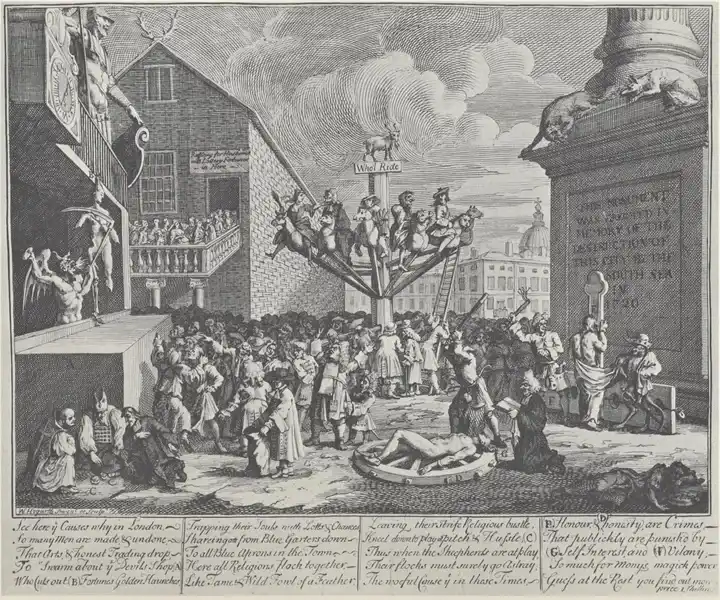
Caption: William Hogarth's "The South Sea Bubble" satirical print, created in 1721 and published in 1724. Speculators ride a carousel beneath a sign reading "Who'll go?", Evil whips Honor, Self-Interest binds Honesty to the wheel of torture, and the monument is rededicated to the damage the South Sea Company inflicted on the city.
This is the typical pattern of the second speculative engine. Public debt is converted into private profit opportunities, while the public is ultimately asked to bear the risk.
Housing policy in the 2000s enacted another version of this pattern through mortgages. The monetary narrative of cryptocurrency unfolds from the opposite direction: when official currency continues to depreciate, the market begins to rush to embrace another monetary unit.
Even without endorsing the quasi-religious narrative, it is not difficult to understand the structure behind it. When a group no longer trusts the official store of value, they will be willing to buy the story of a better alternative.
Railway Mania: Real Technology, Cheap Money, and a Permissive Parliament
Britain in the mid-1840s was the historical prototype for every subsequent technology speculation mania.
The steam locomotive was a real technology. As early as 1830, the Liverpool and Manchester Railway had already begun operating paid passenger services. Subsequently, money became increasingly cheap.
In 1844, the Bank of England cut interest rates from 4% to 2.5%; investors could subscribe for railway shares with only a small deposit; and the British Parliament approved new railways faster than engineers could complete route surveys.
Andrew Odlyzko, a mathematician who has long studied railway historical archives, found through statistical analysis that the mileage of new railways approved by the UK Parliament was 805 miles in 1844, increased to 2,700 miles in 1845, and further rose to 4,538 miles in 1846.
By 1847, the UK was spending approximately £44 million per year on railway construction, while the entire central government's annual budget at that time was only about £50 million.
In Dombey and Son, Dickens depicted an era saturated with railway elements: "Railway hotels, railway offices, railway lodging houses and boarding houses; railway plans, maps, landscape views, wrapping paper, bottles, sandwich boxes, and train timetables."
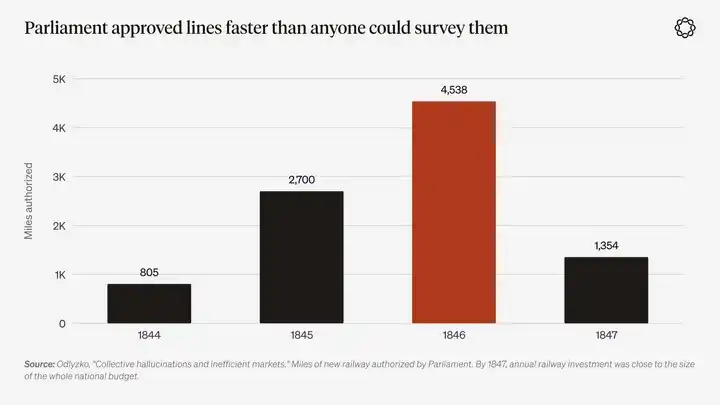
Chart caption: Mileage of new railways approved by the UK Parliament, data from Odlyzko's "Collective Hallucinations and Inefficient Markets." By 1847, annual railway investment had approached the entire central government budget.
Mackay's own role in this mania is a rather ironic episode in financial history.
Odlyzko re-examined the Glasgow Argus, which Mackay edited from 1844 to 1847, and found that the author of the most famous work on crowd madness was actually "one of the most enthusiastic promoters of Railway Mania."
In October 1845, when railway prices were near their peak, Mackay's newspaper was still telling readers: "Those who sound warnings are wrong; there is absolutely no reason to fear any legitimate railway speculation."
When Mackay revised his book in 1852, however, he mentioned the most severe speculative mania he had personally experienced in only a single footnote.
If someone who specializes in herd behavior could not see it clearly while in the middle of the herd, then others should not overestimate their own ability to identify crowd mania.
Odlyzko's other research conclusions are even more relevant today. In his words, railway shareholders ultimately "suffered extremely severe disappointment."
But the railway network was still built, and it left Britain with what Odlyzko calls "the best transportation infrastructure in the world." The waste of capital occurred mainly in the timing of investment and the choice of routes, rather than in creating worthless things out of thin air. This is precisely the classic form of constructive speculation.
For AI investment, the historical lesson is not that "railways ultimately succeeded, so one should buy AI labs."
The real lesson is: when a general-purpose technology, cheap money, and policymakers eager to provide political support for construction projects come together, they simultaneously create overcapacity and infrastructure networks that can be used for the long term.
The investment target you choose may become a winner, or it may ultimately go to zero, but the large-scale buildout itself will leave behind useful physical infrastructure.
The 1920s: A New Technology Boom Fueled by Borrowed Money
In the 1920s, the same speculative engine started up again, only with higher leverage.
Radio, automobiles, electrification, and mass industrial production were all real technological advances, just like railways. Radio Corporation of America (RCA) became the representative stock of that era's "new era" narrative. Today, a handful of memory chip and semiconductor companies, along with the frontier AI labs that support them, are playing a similar role.
Harvard economist John Kenneth Galbraith, when he wrote The Great Crash, 1929 a generation later, refused to attribute such a massive boom simply to a single Federal Reserve rate cut.
In his view, what mattered more was the social mood of the time: a widespread conviction that ordinary people deserved to become wealthy too. Decades later, he added two factors that had previously received little attention: "financial memory is extremely short," and "the false association of money with intelligence."
The fuel behind this frenzy was credit, and expensive credit at that. Brokerage loans exceeded $8.5 billion, and in March 1929, short-term call money rates briefly touched 20%.
People were willing to pay such high interest rates because they expected investment returns to reach several times the cost of borrowing. Investment trusts bought each other's shares and packaged this circular ownership as value creation.
Walter Bagehot, the Victorian-era editor of The Economist, had described the basic raw material of this phenomenon 70 years earlier: "At particular times a great deal of stupid people have a great deal of stupid money."
According to his explanation, this money begins searching for people who can devour it, a stage called "excess money"; when it finds its target, "speculation" takes shape; and when the money is ultimately devoured, it turns into "panic."
From September 1929 to July 1932, the Dow Jones Industrial Average plunged 89%.
Today, the equivalent of 1920s margin trading is a set of leveraged instruments that never call themselves loans: same-day expiry options, perpetual contract funding rate mechanisms, and ten-times leveraged positions that can be established with a few taps on a phone using collateral nominally belonging to cash.
After a bubble bursts, the official narrative usually needs to find a villain, whether short sellers, foreigners, or central bankers. Because admitting that the whole society was participating in a "beauty contest" is hard to reconcile with the notion that wealth can measure intelligence.
French thinker René Girard was particularly fascinated by mimetic behavior and built his theory of cultural mimesis around imitation and scapegoat mechanisms. Later, other scholars introduced this theory into economics.
Peter Thiel studied under Girard at Stanford University and became Facebook's first outside investor. He has also used Girard's theoretical framework to explain that investment. Boom-and-bust cycles fit this theory remarkably well.
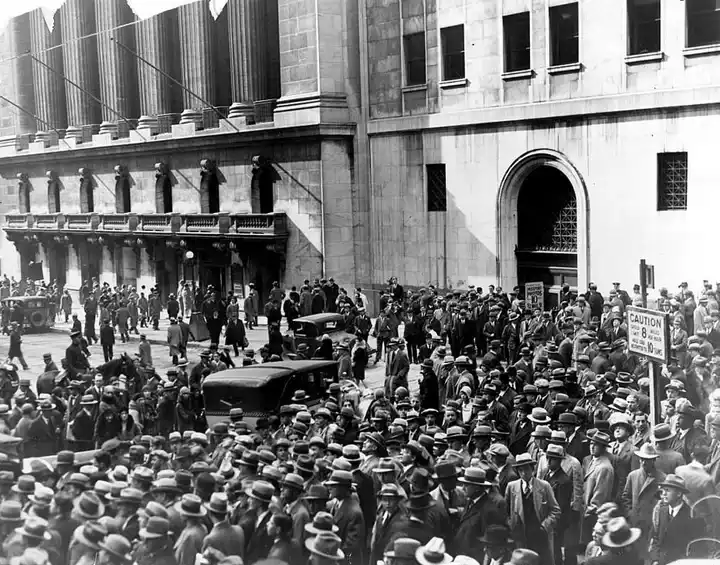
Caption: Crowds gathered outside the New York Stock Exchange after the 1929 crash.
The Internet Bubble and the Housing Bubble: Two Different Driving Forces
The Internet bubble of the late 1990s could be described as the railway mania entering the mouse era.
The Internet did permanently change the world, and the "new era" narrative described by Shiller drove Keynesian expectation games: market participants believed that others would also believe traditional valuation tools were no longer applicable.
From March 2000 to October 2002, the Nasdaq Composite fell 78%, and most listed companies eventually exited the market, but the fiber optic cables buried underground remained.
Amazon was a build-oriented project that successfully survived the lottery-style speculation phase. Pets.com was a lottery ticket sold using the same marketing rhetoric. During the bubble's development, the crowd could not distinguish between the two in real time. And this uncertainty is precisely the foundation on which the "beauty contest" can persist.
The housing boom that followed was driven by a different engine and continuously gained momentum through policy.
In Shiller's view, homeownership was shaped into a national development goal, a contagious social narrative that existed long before it was packaged into structured financial products.
After the dot-com bubble burst, the Federal Reserve eased monetary policy; government-backed mortgage institutions and political pressure combined to expand homebuying financing channels; banks and the shadow banking system took on substantial leverage.
From 2000 to the 2006 peak, U.S. national home prices rose about 85%, then fell 27%. This is the most typical case of Quinn and Turner's warning about bank financing bubble risks.
Crypto: Both Engines Present From the Start
As an asset, crypto has been driven by two speculative engines since its inception.
Bitcoin's founding narrative is essentially a protest against a monetary system that makes holding cash feel like continuously losing wealth. And stablecoins have become a way for residents of cities like Lagos and São Paulo to hold U.S. dollars without needing a U.S. bank account.
As early as May 2020, we noted: "The conditions for broad currency debasement are taking shape before our eyes."
By December of that year, we further called Bitcoin "arguably the asset with the most leveraged exposure to broad currency debasement."
Chainalysis in its latest annual report counted cross-border stablecoin fund flows at approximately $220 billion, up 78% year-over-year. Stablecoins now account for 96% of domestic peer-to-peer transfer value across countries.
And the underlying technology of crypto itself is also a build-out narrative. It carries approximately $300 billion in stablecoins and supports order-book trading systems that never close.
The same crypto asset ticker often carries both narratives. The debate over whether Bitcoin is a technology, a hedge, or a belief will never end, because the communities involved never need to choose among these explanations.
But for the core investment logic of this article, crypto's second role is more important: crypto itself is also a technology that manufactures speculative activity.
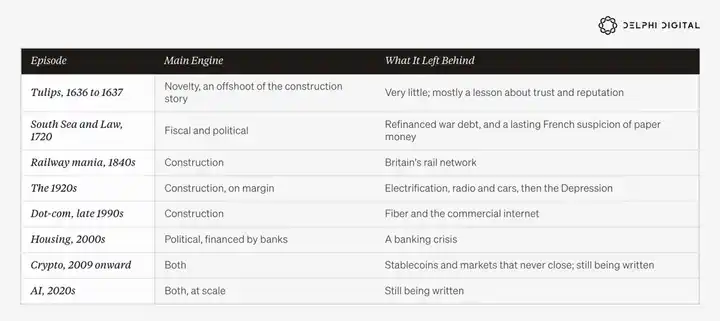
Looking back at the above history, each major speculative mania was primarily driven by one engine.
Tulips, railways, radio, and the internet were all build-out narratives occurring within generally functioning political and monetary systems. The boom of the 1920s relied on borrowed money to drive technological build-out and ultimately ended in a severe crisis.
The South Sea Bubble, John Law's financial system, and the real estate boom were all policy-driven narratives involving little in the way of major new technology.
In these cases, speculative opportunities were sold to the public from the top down, whether the state wanted to refinance government debt or the government wanted to raise homeownership rates.
Cryptocurrency is driven by both forces at once, but until recently its size relative to the overall economy remained small.
Today, two things have changed.
First, both engines are running strong simultaneously. Second, the political and monetary engines are no longer primarily driven from the top down; they are also being strongly driven from the grassroots household level, as more and more households no longer believe the traditional path of life advancement can work.
The second change is an important reason why speculative demand is so broad today.
IV. Two Speculative Engines Running Simultaneously
The Lottery-Type Engine: Housing, Debt, and Employment
After the 2008 financial crisis and again after the 2020 pandemic, policy sent two signals to an entire generation: the purchasing power of cash will steadily erode, and asset market declines will be treated as emergencies requiring public policy intervention.
Fiscal deficits are no longer an occasional condition but have become a normalized policy regime.
In fiscal year 2025, the U.S. federal fiscal deficit reached $1.8 trillion, about 5.8% of GDP, even though the U.S. economy was not in recession at the time. The Congressional Budget Office estimates that the fiscal deficit widened further to about $2 trillion in fiscal year 2026, which ends in September.
Annual net interest payments on U.S. federal debt have now reached about $1 trillion, exceeding defense spending.
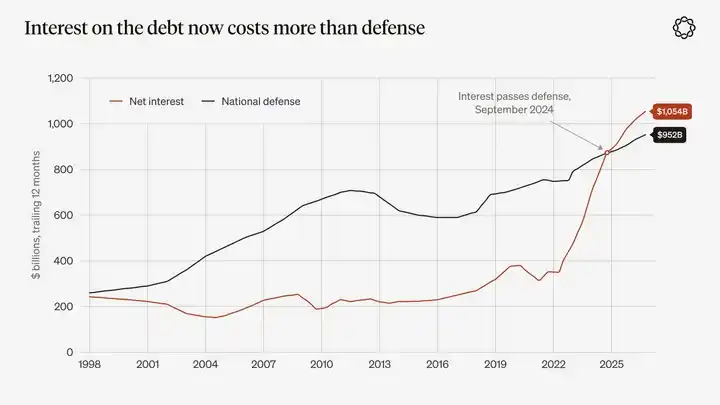
Chart description: U.S. federal government net interest payments and defense spending, trailing 12-month totals. Source: U.S. Treasury Monthly Treasury Statement. Net interest payments first exceeded defense spending in September 2024 and have remained above it since December 2024.
Throughout the 2010s, consumer prices remained broadly moderate, but excess liquidity flowed into asset markets: real estate, long-duration equities, and various scarce assets. After 2020, inflationary pressure appeared simultaneously in consumer goods and asset prices.
Land-use zoning restrictions and insufficient housing supply are important factors explaining the U.S. housing problem. Moreover, since 2008, real interest rates have not been near zero in every year.
But what this article really focuses on is: when wage income can no longer allow a family to buy their first home on the same timeline as the previous generation, what options do they have left?
The Pew Research Center's measurement method is the most intuitive.
From 1975 to 2000, for households headed by persons under age 40, the ratio of median home value to median household income remained at around 2.5 times for an extended period. This ratio reached 3.6 times at the peak of the real estate bubble in 2006, fell back to 2.9 times in 2019, rose again to 3.6 times in 2022, and still stood at 3.5 times in 2024.
The Harvard Joint Center for Housing Studies compared total household income with home sale prices and found that in 2024, the national median sale price of a single-family home in the United States was equivalent to 5 times the median household income. In San Jose, Los Angeles, San Francisco, and Honolulu, this ratio exceeded 10 times.
The latest survey by the National Association of Realtors shows that the share of first-time buyers in total home transactions fell to a record low of 21%, while the median age of first-time buyers rose to a record 40 years old.
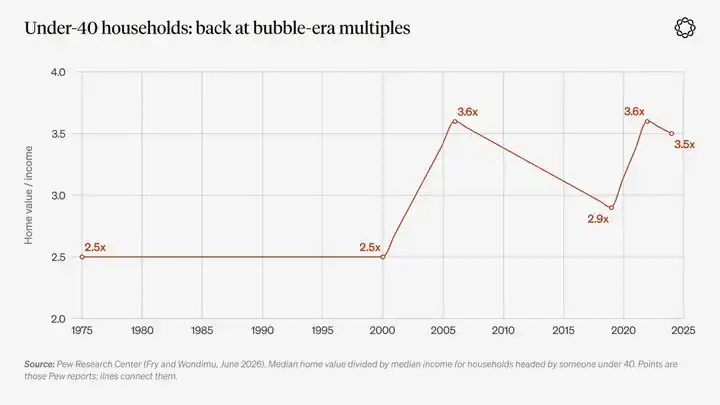
Chart description: Ratio of median home value to median income for households headed by persons under age 40. Source: Pew Research Center, Fry and Wondimu, June 2026.
At such price levels, the economic meaning of saving begins to change. For a family, zero dollars and $10,000 seem to make little difference, because in either case, it is not enough to pay a down payment. But between $10,000 and a home, there is still a huge gap.
In many ways, the old social contract of the past—work hard, accumulate savings, buy a home, and then grow wealth through asset appreciation—has been broken by political and monetary policy choices. This has also changed what ordinary people consider rational behavior.
Young people feel this most strongly, and among them, young men are flooding in large numbers into sports betting platforms, options trading apps, and prediction markets.
The Pew Research Center found that in the past year, 36% of men under age 30 participated in sports betting, compared with 22% of U.S. adults overall. A FINRA Foundation survey shows that among investors under age 35, 43% have traded options; among investors aged 55 and older, this proportion is only 10%.
Biological and cultural factors can explain some of the differences. Even before the current monetary system emerged, young men have always tended to take on higher risks. But the blockage of traditional asset accumulation paths is likely also one of the reasons for the rapid expansion of this behavior, alongside two other factors: the legalization of gambling and the proliferation of smartphones.
In May 2024, when the meme coin craze was at its peak, we described this phenomenon: a generation of young people "facing heavy debt, unattainable housing, and wages rapidly eroded by inflation" for whom "the only way to win this new wealth competition seems to be securing 100x returns."
When people are asked why they choose high-risk investments, their answers are quite direct.
A 2026 Northwestern Mutual study found that among Gen Z respondents attracted to high-risk assets, 80% said they participated because they felt their personal financial situation had fallen behind.
But this does not mean an entire generation has abandoned traditional wealth accumulation methods. The Urban Institute found that only 17% of Gen Z participated in sports betting over the past year, and most young people still use conventional methods to save.
However, this investment theme does not need to attract the vast majority. It only needs a minority of participants large enough, motivated enough, and all equipped with smartphones.
According to data from the American Gaming Association, legal sports betting wagers in the United States increased from $6.6 billion in 2018 to $166.9 billion in 2025.
In May 2018, the U.S. Supreme Court's ruling in Murphy v. NCAA changed the legal landscape for sports betting. Demand already existed, and the ruling provided a legal channel for that demand while creating a new source of tax revenue for state governments.
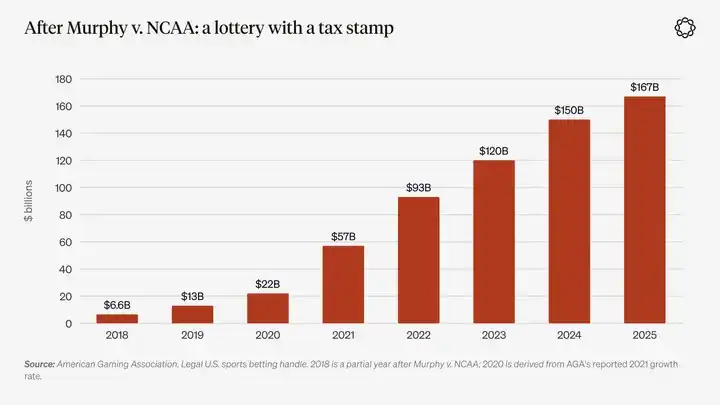
Chart description: Legal sports betting wagers in the United States, source: American Gaming Association. 2018 includes only partial-year data after the relevant ruling; 2020 data is estimated based on the association's published 2021 growth rate.
In the first half of this year, the monetary factor's push toward speculation weakened somewhat. But on August 19, the U.S. Treasury Department announced it would at least double the size of "liquidity support" buybacks of long-term Treasury bonds, reinforcing this factor once again.
On the day the news was announced, Delphi's Scott Freeman called the move: "The same consolidated balance sheet operation as quantitative easing, just executed through a different building."
In October 2025, a JPMorgan research report brought the term "debasement trade" into widespread circulation. A few days later, gold prices broke through $4,000 per ounce.
In fact, we had been discussing this trading logic since 2019. In our December macro outlook that year, we proposed that "a new round of global fiat currency debasement policy is in its early stages."
In January 2025, when gold prices approached $2,700 per ounce, we again called it "one of the most noteworthy charts right now."
In January 2026, gold prices peaked near $5,600 per ounce. Since then, gold has given back about a quarter of its gains, the Federal Reserve implemented its first rate hike since 2023, and the 10-year U.S. Treasury yield closed above 5.3% in early October, the highest level in more than two decades.
Holding cash can now once again earn a certain return, and those who interpreted the debasement trade as a one-way gold rally have also accepted the market correction.
But higher interest rates have not reopened the traditional ladder of wealth accumulation. For homebuyers facing home prices at 3.5 times household income, higher rates mean mortgages are even harder to afford.
Meanwhile, the U.S. economy is at full employment, yet the fiscal deficit remains close to 6% of GDP. The government now needs to refinance debt at higher interest rates, while rapidly expanding AI financing demands are competing for the same pool of savings.
Therefore, today's lottery-style speculation engine no longer relies primarily on gold, but is built more on housing, employment, and fiscal pressure. And AI is simultaneously affecting all three areas.
The Buildout Engine: The Largest Wave of Private Capital Construction in Decades
This decade's buildout narrative has a clear name: AI. Or should it now be called SI (Superintelligence)?
Regardless, Microsoft, Alphabet, Amazon, and Meta collectively spent approximately $416 billion in capital expenditures in 2025, up about two-thirds from 2024.
Based on the guidance issued by these four companies, their total capital expenditure for 2026 is projected to be between $720 billion and $745 billion, and that does not yet include Oracle's spending.
That scale is equivalent to roughly 2.3% of U.S. GDP, although some of the investment occurs overseas and a large amount of hardware must be imported. That ratio is more than double the roughly 1% of GDP seen at the peak of the telecom investment boom, and it is on the same order of magnitude as U.S. railway investment in the 1870s and 1880s. Today, what underpins this investment boom is mainly the balance sheets of four companies.
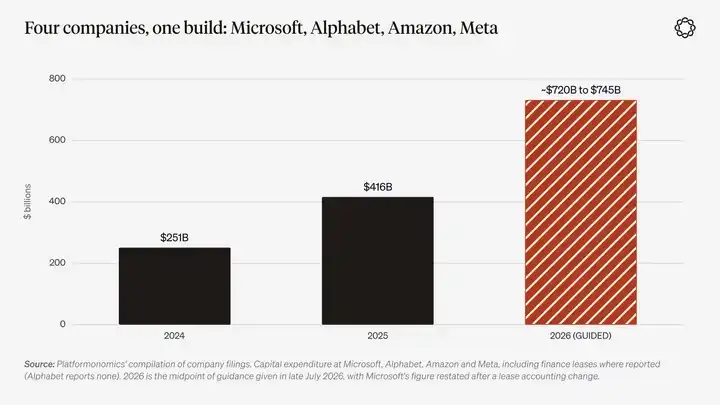
Chart note: Capital expenditure by Microsoft, Alphabet, Amazon and Meta, including disclosed finance lease spending. Data for 2024 and 2025 come from Platformonomics' aggregation of corporate financial reports; 2026 uses the midpoint of company guidance from late July of that year.
Economist Jason Furman calculated that in the first half of 2025, investment in information processing equipment and software contributed 92% of U.S. GDP growth. However, that figure is a gross contribution.
Because a large amount of hardware relies on imports, economists at Goldman Sachs and the Federal Reserve point out that after excluding imports, the net contribution is much smaller.
In any case, the scale of this construction wave is already large enough to force the entire economic system, the power grid and the government to allocate resources around it.
Soros might argue that there is indeed a real underlying trend here: the expansion of computing power and electricity infrastructure. But at the same time, there may also be a mistaken belief: the market believes that the relevant revenue will be realized on a timetable that matches asset depreciation.
Rising asset prices provide financing for more construction projects, and continuously increasing investment makes the original narrative look more credible.
In the end, most equity investments may prove as disappointing as railway stocks did in their day, but some of the infrastructure formed by capital expenditure will still remain for the long term, just as the railway network ultimately survived.
The most intuitive investment strategy is to directly hold the core assets in this construction wave, including power, chips, and ultimately the AI labs that survive.
From the perspective of what can remain after the boom ends, this approach is correct. We will also discuss this issue more directly in subsequent reports in our annual outlook series. But this strategy ignores the impact of the construction wave on all bystanders.
The more future possibilities a technology creates, the greater the demand for financial contracts that allow people to bet on different future outcomes.
Perpetual futures, same-day expiry options, and event contracts centered on chip stocks, interest rate decisions, and AI news are precisely how investors are coping with this uncertainty. After all, no one can know in advance which of the companies participating in AI infrastructure buildout today will become the next Amazon and which will become the next Pets.com.
Where Two Engines Intersect
In most speculative episodes of the past, the technology engine and the political engine largely ran on separate tracks. But today, the scale of the AI buildout wave is large enough to drive both simultaneously.
It works primarily through four channels: electricity bills, government, the bond market, and the job market.
The first channel is electricity bills.
In 2023, data centers accounted for about 4.4% of U.S. electricity consumption. Lawrence Berkeley National Laboratory currently projects that by 2030, this share will approach 12%.
The PJM grid covers 13 U.S. states and Washington, D.C., serving approximately 67 million people. The grid holds auctions every year to set prices for future generation capacity.
For the 2024/25 delivery year, the capacity market cleared at $28.92 per megawatt-day. For 2025/26, that price jumped to $269.92, and has since remained near the price cap of about $330.
PJM's independent market monitor noted that data centers alone contributed $9.3 billion in additional costs in the first round of sharp price increases.
Over the five years through March 2026, U.S. residential electricity prices cumulatively rose about 40%. Grid upgrades and fuel prices were the main drivers, with capacity market price increases accounting for a growing share.
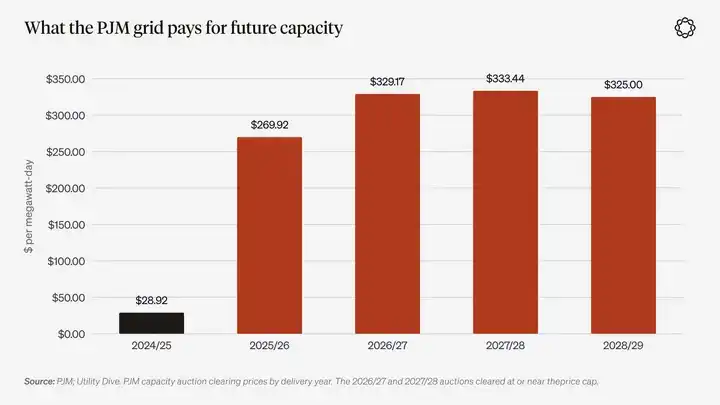
Chart description: PJM capacity market auction clearing prices by delivery year. The 2026/27, 2027/28, and 2028/29 years all reached the price cap. Source: PJM, Utility Dive.
The electricity bill issue quickly evolved into a political one.
In November 2025, New Jersey and Virginia elected governors who made electricity costs a core campaign issue. New Jersey Governor Mikie Sherrill pledged to declare a "utility cost emergency." Virginia Governor Abigail Spanberger pledged to require data centers to bear their own electricity costs.
In January of this year, the U.S. President posted that the American public should not "foot the bill" for this. Subsequently, Microsoft committed to fully covering its own electricity costs and reducing its use of local tax incentives.
In fiscal year 2025, Virginia's sales tax exemption for data centers cost the state $1.6 billion in tax revenue.
Local organizations opposing data center construction are found almost everywhere. According to Data Center Watch, in the first quarter of 2026 alone, data center projects that were blocked or delayed reached approximately $130 billion in scale.
On September 29, the U.S. Federal Energy Regulatory Commission (FERC) only partially approved PJM's backup proposal for procuring additional power for data centers and required modifications to the cost allocation mechanism.
The commission chairman stated that regulators "will not be forced to accept a procurement mechanism that is seriously flawed, hastily proposed at the last minute, and could have a multibillion-dollar impact on consumers."
The pattern that has emerged here is: the claim to returns belongs to private enterprises, but part of the costs of electricity, transmission lines, and even power plants ultimately enters public or quasi-public sector accounts and is paid through user electricity bills, tax breaks, and tax credits.
The narrative supporting this arrangement is that this infrastructure is necessary for national competition.
The South Sea Bubble was the exact opposite direction, packaging public debt into private equity and selling it to the public. But there is a clear family resemblance between the two: the private sector enjoys the potential returns, while the public sector's balance sheet provides support.
Real estate achieved this through mortgage loans, while AI has achieved a similar mechanism through the power grid.
Of course, this arrangement is encountering opposition. AEP in Ohio now requires large data centers to pay for at least 85% of their reserved capacity. Governors in the PJM region also want data centers to bear the cost of additional power supply.
Therefore, the current focus of debate is how much cost should be reallocated to data center operators.
The second channel is the change in the government's role.
The government is no longer just the regulator of the AI construction wave, but has begun to directly hold some of these assets.
In August 2025, the U.S. federal government acquired a 9.9% stake in Intel, with funding mainly coming from previously undisbursed CHIPS Act subsidies.
Nvidia and AMD agreed to pay the government a share of their China chip sales revenue in exchange for export licenses. The initial agreed ratio was 15%; when Nvidia's H200 was approved for export in December of that year, the ratio was raised to 25%.
The U.S. government described its "Genesis Mission" as "comparable to the Manhattan Project in urgency and ambition." The government also ordered an acceleration of approvals for large data centers.
In December 2025, the U.S. government began challenging state AI laws through judicial channels. Previously, the Senate had voted 99 to 1 to remove a provision pausing the implementation of state-level AI laws from the budget bill.
Meanwhile, an AI industry super PAC called Leading the Future was established, with initial funding exceeding $100 million. In just one House primary in New York State in June of this year, groups on both sides of the AI issue collectively spent more than $27 million.
When a government begins holding equity stakes in chipmakers and likens AI infrastructure buildout to the Manhattan Project, it is effectively sending a signal to the market: the government will not allow this round of buildout to fail.
This is almost equivalent to providing a policy put option protection for the construction-driven speculative narrative. At the same time, in every constituency with a data center, AI has become an issue that genuinely influences elections.
The third channel is the bond market.
As of early August 2026, large tech companies had issued approximately $220 billion in bonds that year, exceeding the full-year issuance volume of 2025.
Meta's $27 billion financing raised for the Hyperion data center is the largest private credit transaction in history, and it adopted a structure that is not recorded on Meta's balance sheet.
This autumn, as the U.S. 10-year Treasury yield rose above 5%, AI companies' borrowing demand became one of the factors cited by the market to explain the rise in yields.
In its May "Financial Stability Report," the Federal Reserve relayed market participants' concerns: "Capital expenditures are increasingly financed by debt, which is raising the leverage level of the financial system."
The private sector's AI investment boom and government debt are competing for the same pool of savings.
The fourth channel is wages and employment.
In August 2026, Erik Brynjolfsson of Stanford University and his co-authors updated their research paper "Canaries in the Coal Mine."
The study found that in occupations most exposed to AI, employment levels among young people aged 22 to 25 were 19% lower than they would have been had their employment growth kept pace with peers with lower AI exposure. The researchers emphasized that this is a descriptive finding, not proof of causality.
New York Fed data show that the unemployment rate for recent college graduates is 5.6%, compared with about 4.2% for all workers. This gap began widening as early as 2019, before the advent of ChatGPT, so AI is clearly not the whole story.
According to career consulting firm Challenger, Gray & Christmas, in the first nine months of 2026, companies cited AI as the reason for about 120,000 job cuts in layoff announcements, more than double the full-year total for 2025.
Of course, some of these companies were likely just repackaging routine layoffs as AI-driven restructuring.
In 2025, Anthropic CEO Dario Amodei warned that AI could eliminate half of entry-level white-collar jobs.
A Pew survey this summer showed that 73% of adults under 30 believe AI will mean fewer job opportunities.
No research has yet directly proven a link between AI-induced job anxiety and sports betting or same-day expiry options trading. Therefore, the connection proposed in this article is an argument built on multiple independent pieces of evidence, not a causal conclusion that has been directly confirmed.
Nevertheless, the evidence does point in the same direction.
On one hand, the AI buildout wave has given the market its grandest technology buildout narrative in decades; on the other hand, it is driving up household electricity bills, pushing governments to directly participate in equity investment and industrial policy, competing with the U.S. Treasury for savings funds, and leaving a 23-year-old worried about whether the entry-level jobs that should serve as the starting point of a career will still exist in the future.
In July this year, Delphi Ventures posed a question: who will bear the liabilities left behind by this aging and debt-laden world?
The answer they gave was: "The most obvious and most likely solution is a combination of currency devaluation and accelerated automation."
AI may be the first major technology boom in history to simultaneously power both lottery-style speculation and building-style speculation so directly.
Everything Converges on a Single Phone
One thing that was impossible in the 19th century was to place building-style investment bets and lottery-style speculation in the same venue. Railway prospectuses and betting shops existed in different buildings in different parts of the city.
But today, a 25-year-old can, between two phone notifications, bet separately on chipmakers, gold, football matches, and central bank rate decisions. In his experience, there is no essential difference between these four activities: all are about making a judgment on something and hoping that judgment ultimately pays off.
Financial products are also adapting to this demand.
In 2022, the Chicago Board Options Exchange (Cboe) completed the rollout of S&P 500 index options contracts expiring every trading day.
As a share of total SPX options volume, same-day expiring options (0DTE) rose from about 5% in 2016 to 45% in 2023, and reached 59% in 2025. In July 2026, that ratio set a single-month record of 66%.
According to Cboe's own estimates, individual traders contributed more than half of customer volume in such contracts.
Part of this growth is a mechanical result: when contracts expire every trading day, same-day expiring options naturally exist every day. But the reason Cboe added these expirations is precisely that there was sufficient market demand.
In June 2026, regulators also eliminated the $25,000 minimum account equity requirement for pattern day traders, further lowering the barrier to participation.
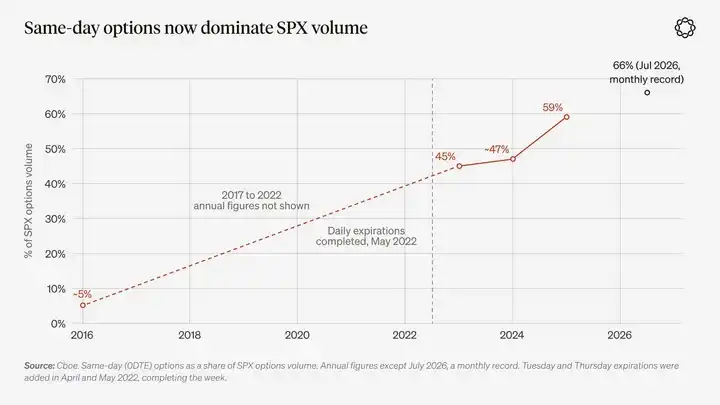
Chart caption: Same-day expiring options as a share of SPX options volume. Source: Cboe. Except for July 2026, which is a single-month
