AI financing has seen a string of positive developments, and US equities have rebounded accordingly. But capital's willingness to fund expansion and whether that expansion will ultimately generate sufficient returns remain two separate questions that need to be verified independently. In this market commentary, Stephen Innes points out that AI investment is entering a phase that places greater emphasis on financing conditions, execution capability, and return on capital.
Financing Eases Anxiety
After last week's selloff, the AI trade is heating up again. On Tuesday, the Nasdaq 100 rose 1.3%, and the Philadelphia Semiconductor Index gained 3.6%. Falling oil prices also supported risk appetite, and major stock indices recovered some previously lost technical levels.
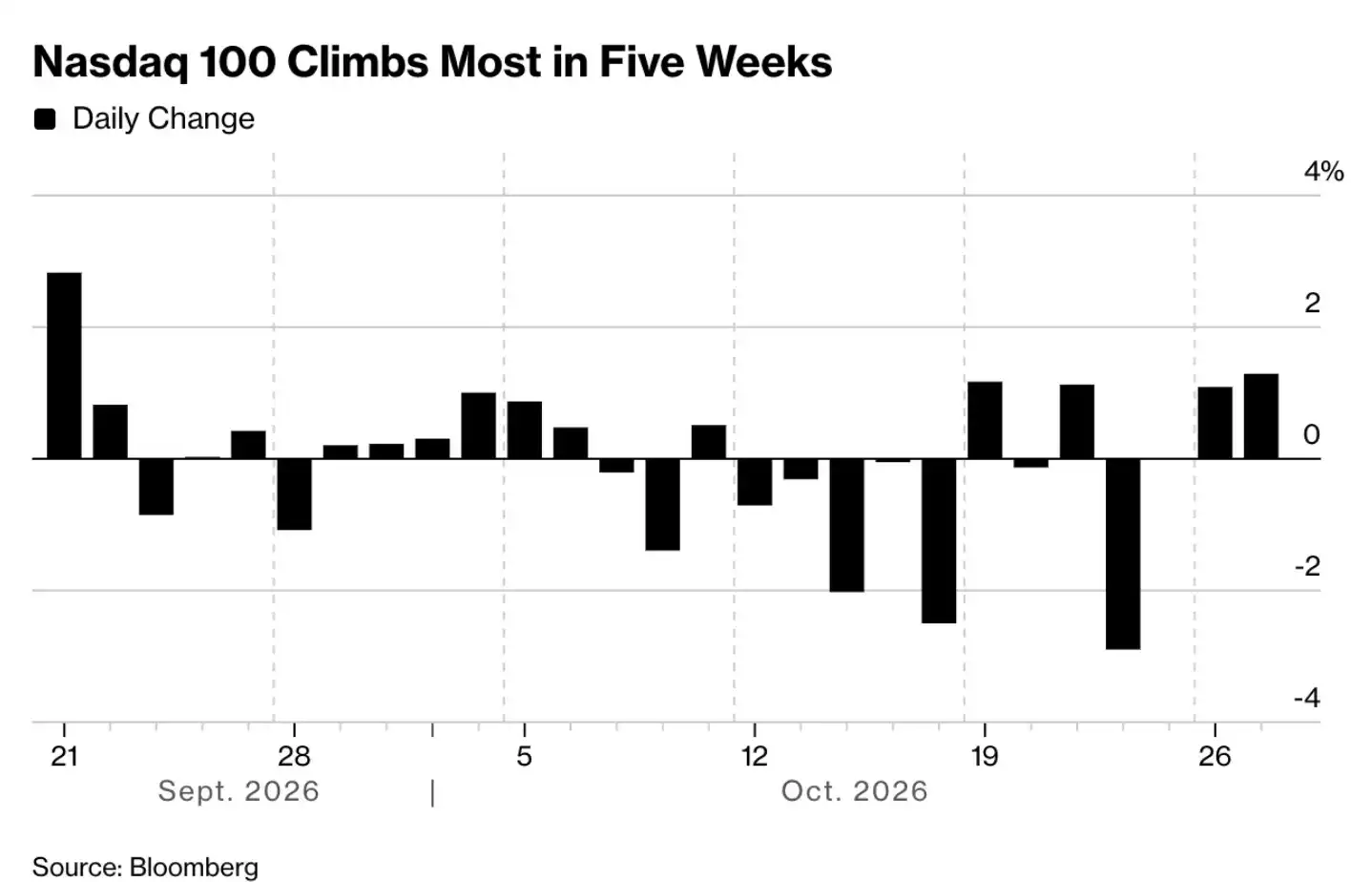
An important factor driving the sentiment recovery is the market's renewed confidence that AI infrastructure expansion can still secure financing.
Meta's $25 billion common stock offering was reportedly about five times oversubscribed. Broadcom's participation in a $63 billion financing arrangement, along with Anthropic's IPO application, also helped ease investor concerns about the AI industry's massive funding needs.
These developments indicate that capital markets remain willing to fund AI expansion. However, financing demand persists, and how much risk capital providers are willing to bear and what terms they demand are gradually becoming important variables shaping this market cycle.
The structure of the Broadcom deal is particularly noteworthy. According to company announcements, Bank of America, Blackstone, Citigroup, and Morgan Stanley have committed to providing financing for a newly established special purpose vehicle (SPV), which will purchase Broadcom AI accelerators and networking equipment and then lease them to Anthropic. Broadcom, in turn, provides residual value support for the portion equivalent to the first-lien financing amount. This means the financing arrangement incorporates a risk-sharing mechanism for the future value of the equipment.
Therefore, this transaction cannot simply be understood as Broadcom itself borrowing $63 billion, nor can the closing of financing be directly equated with proof that project returns have been validated.
In Innes's view, Meta's equity market fundraising and the introduction of large-scale structured financing for compute buildout together reflect a shift in the AI investment cycle: as buildout scale continues to expand, companies need to mobilize external capital more aggressively. Financing capability has thus become part of industry competition.
Earnings Must Answer the Return Question
A rebound in stock prices does not mean institutional capital has fully turned optimistic.
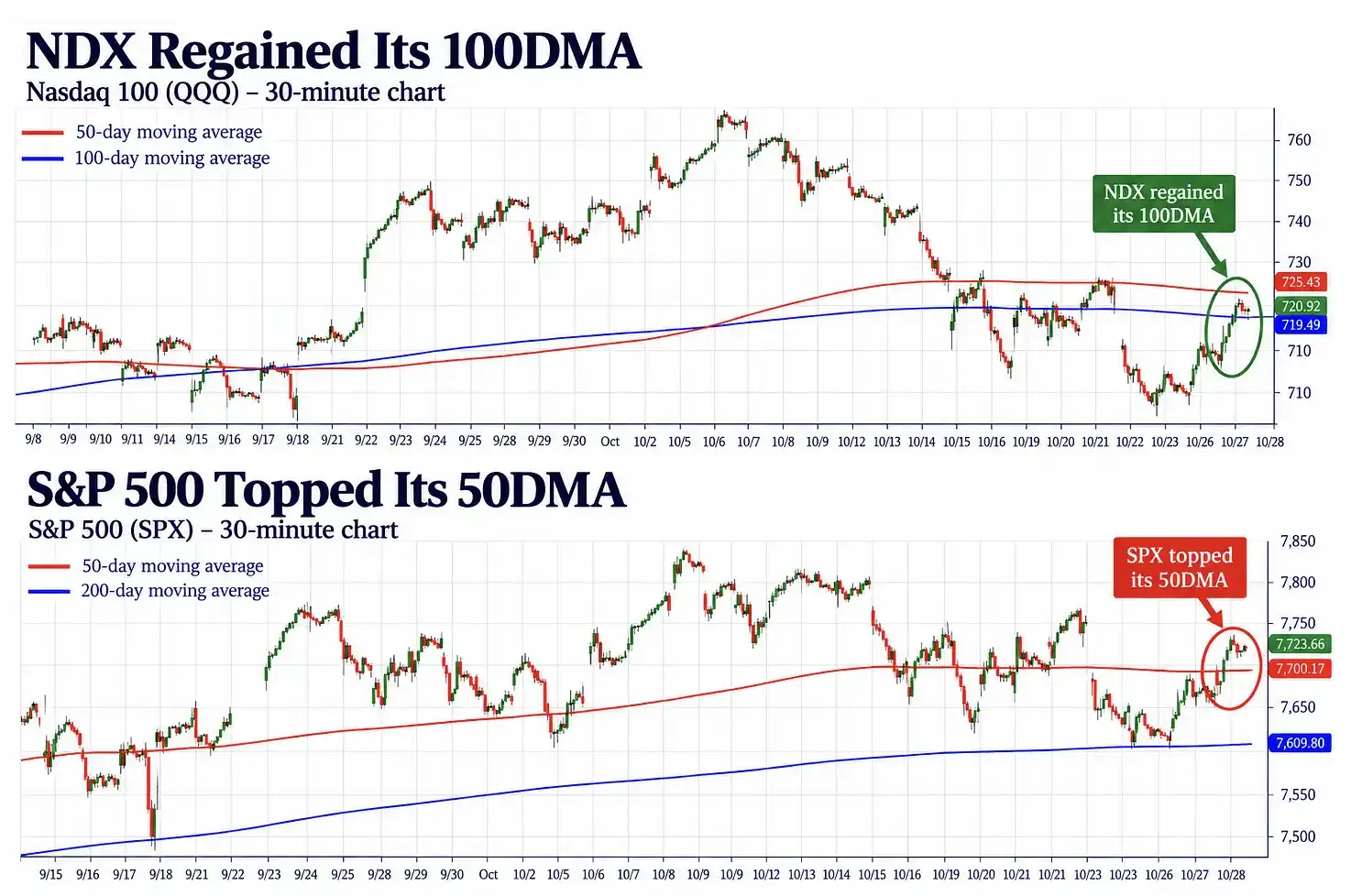
From a technical perspective, the Nasdaq 100-linked ETF QQQ has reclaimed its 100-day moving average, and the S&P 500 has also returned above its 50-day moving average. But price repair does not mean institutional capital has fully turned optimistic.
Innes cited observations from Goldman Sachs' trading desk, noting that overall trading activity remained light that day, with fund flows still skewed toward selling. Long-only institutional accounts continued to net sell communication services and macro products; hedge funds were slightly net buyers, but trading volumes were limited. Fundamental long/short strategies' risk exposure also remained near recent lows.
These observations correspond to the capital covered by the trading desk and cannot directly represent the entire market. However, they point to a notable divergence: prices are recovering, yet positioning remains cautious.
After a round of concentrated deleveraging, short covering and dip buying can drive a rebound. But for the rally to continue upward, stronger fundamental evidence is needed. Next, earnings reports and guidance from major cloud service providers such as Alphabet, Microsoft, and Amazon will bear this verification task.
The questions the market cares about are also changing. Whether AI demand is growing remains important, but investors also need to know whether that growth can generate returns sufficient to cover massive expenditures.
Capital expenditure (Capex)—investment in long-term assets such as building data centers and purchasing chips—consumes cash upfront; once equipment is put into use, depreciation continuously flows into costs. Compute utilization rates, service pricing, and customer demand then determine how much revenue and profit these assets can contribute. Only by combining these factors can a complete picture of investment returns be formed.
Therefore, even if the giants continue to raise AI spending, it may not be enough to drive stock prices. Investors also need to judge how long it will take for new investment to generate revenue, whether cash flow can keep up, and whether companies will need to continue financing in the future.
Innes's core judgment is: getting the AI adoption trend right and identifying who can earn enough profit from it increasingly need to be discussed separately.
The early AI rally focused more on technological breakthroughs and scarce resources; now, financing, construction execution, and return on capital are gaining greater weight. The industry outlook remains attractive, but financial constraints are hard to avoid.
The Fed affects the price of money
Whether AI companies can continue to raise financing also depends on funding costs across the entire market.
At the time of publication, the market widely expected the Federal Reserve to keep interest rates unchanged on October 28, but still believed there was a possibility of a rate hike in December. Therefore, the focus of this meeting fell more on the press conference of Fed Chair Kevin Warsh.
Innes believes that the resilience of economic data and inflation pressures that have not yet faded make it difficult for the Fed to clearly shift toward easing; but with the market already fully expecting a pause in rate hikes, immediate action could cause an unexpected shock.
Policy wording is therefore particularly important. If Warsh's remarks lead investors to lower expectations for subsequent rate hikes, tech stock valuations could gain support; if he emphasizes the need for further tightening, short-term U.S. Treasuries could be sold off, pushing yields higher.
Bond prices and yields usually move inversely. For tech companies, rising interest rates may both increase financing costs and reduce the present value of future profits. Companies whose valuations rely more on long-term growth are usually more sensitive to this.
The pullback in oil prices has temporarily eased some inflation concerns. On Tuesday, Brent crude closed below $114 per barrel, helped by market expectations for diplomatic progress in the Middle East. But Innes cautioned that tight physical supply and unresolved regional tensions mean this pullback may not be enough to establish a sustained downtrend.
He also observed that gold recovered above $4,050 per ounce, and Bitcoin found support near $80,000. In the earlier broad risk-off process, different assets were sold off together; the stabilization of these assets at least provides some signs that forced selling pressure has eased for now. However, a rebound in just a few asset classes is not enough to conclude that the market has entered a new phase.
Next, watch credit
The risk in this rebound may not necessarily first show up as a sharp drop in major stock indices.
One downside scenario proposed by Innes is: capital first flows out of the crowded AI sector into defensive industries and lower-volatility stocks, while major indices can still hold up for the time being; if financing conditions then tighten across a broader range of industries, the credit market may be the first to sound the alarm, and corporate earnings expectations would be revised down accordingly. After that, if multiple asset classes begin to fall in sync, systematic strategy deleveraging and portfolio risk reduction could further amplify pressure on the indices.
This is a risk transmission path that needs to be watched, not a result the author considers certain to happen.
As for Tuesday, the market did show improvement: concerns about AI financing eased somewhat, credit spreads narrowed, oil prices fell, and tech stocks recovered some ground. Narrower credit spreads mean investors are demanding less extra yield to hold corporate bonds relative to Treasuries, which usually reflects reduced concern about credit risk.
But these changes still need to be validated by earnings reports and subsequent financing conditions. If large cloud service providers can prove that spending growth is supported by corresponding revenue and cash flow, and if the Fed's remarks do not significantly push up rate expectations, the rebound may continue.
On the contrary, if earnings reports reveal a larger funding gap and the cost of corporate borrowing rises again, the current sentiment repair could still be challenged.
For the market ahead, the variables worth tracking are already very specific: whether the return on new investment becomes clearer, whether financing conditions remain stable, and whether credit pressure spreads beyond the AI industry.
Welcome to join the official BlockBeats community:
Telegram Subscription Group: https://t.me/theblockbeats
Telegram Discussion Group: https://t.me/BlockBeats_App
Official Twitter Account: https://twitter.com/BlockBeatsAsia
