For a long time, I have always been a loyal advocate of minimalism in physical life: reducing the physical objects I own as much as possible and striving to do more with fewer resources. Four years ago, I wrote a blog post detailing what was in the 40-liter backpack I carried with me while traveling around the world.
However, the concept of physical minimalism was born and matured from the early 20th century to the 2010s, and it responded to the challenges and opportunities of that era.
I still firmly believe in the value of physical minimalism, although I also agree with certain opposing views, such as that owning certain "right types" of physical objects can instead allow you to more concretely grasp self-sovereignty over your life. But in today's era, we need a new kind of minimalism even more: Digital Minimalism.
The core of digital minimalism lies in consciously and purposefully controlling the way you connect to digital technology, making every use a deliberate and clear choice rather than being involuntarily immersed in it by default.
In this article, I will share a series of real self-experiments I have conducted in this direction.
Social Media Minimalism: Saying Goodbye to Algorithmic Recommendations and Reclaiming Attention Sovereignty
Twitter (now the X platform) has always carried a certain toxic flavor, and this trend has only intensified in recent years. This platform is undoubtedly highly engaging, but it is often far from being informative, and the way it attracts you often does not make you feel physically and mentally pleasant.
For me, this negative experience reached its peak from late 2024 to early 2025. A lot happened at that time, but if you spent a lot of time on X, you will likely remember a particularly absurd phenomenon: it seemed that everyone on the platform suddenly became a fan of Adolf Hitler.

This does not even take into account the outrageous incident in which Grok itself briefly went out of control and turned into "MechaHitler."
At almost the same time, "Crypto Twitter" also fell into a collective mood widely described as "Financial Nihilism."
This argument can be roughly summarized as follows: the natural endgame of blockchain is pure gambling, and this gambling is good; if you dislike this phenomenon and expect blockchain to have higher aspirations, then you are a pretentious, out-of-touch elitist bastard.
Naturally, intellectually, I firmly disagreed with both of these trends in the past and still do now. But more importantly, I began to reflect more seriously on a fact: despite the highly engaging style of discourse on the platform, it is neither enlightening nor able to make me feel comfortable.
Therefore, for most of this year, I conducted a self-experiment: keeping myself at a moderate distance from this chaos. I did not completely leave the X platform, but I left X's official client interface. Instead, most of my tweets were posted through Firefly:
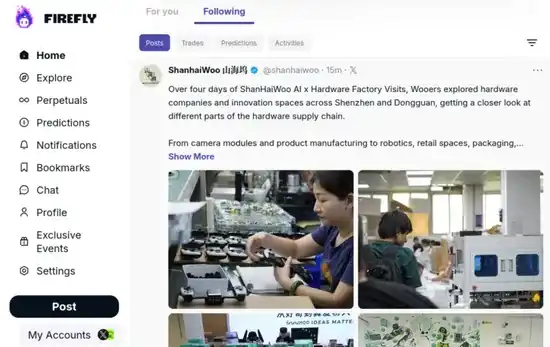
Firefly is an all-in-one client that integrates X, BlueSky, as well as Farcaster and Lens (the latter two are decentralized social media platforms partially based on Ethereum). You can view updates from these four platforms in one interface and post a single tweet that automatically syncs to all four platforms.
My main initial intention for doing this was to support decentralized social media and, while continuing to engage with X, to decentralize network effects rather than reinforce its ecosystem lock-in.
But during the months I've been using Firefly, I've found it has an unexpected effect: my mental state feels much better when using it.
I suspect the core reason is this: although Firefly allows you to tweet and view others' tweets, it lacks the soul and core of X's official interface: the recommendation algorithm (The Algorithm™).
Specifically, I suspect that when I used X's official interface, I fell into the following carefully designed vicious cycle trap:
First, you see someone post an extreme tweet supporting Hitler. With some kind of morbid curiosity like facing a car crash scene, you click into the tweet and scroll through its quoted tweets and comment section.
At this point, the "recommendation algorithm" thinks: "This user seems interested in Hitler, let me tag this as one of their personal interest labels."
Next, you see ten tweets supporting Hitler in your feed. Once again, with morbid curiosity, you click in to watch, just like a person who can't help but stop and stare the first time they witness ten cars colliding and burning in a chain reaction.
The algorithm thinks: I don't need to say it, everyone can guess what the algorithm is thinking. Subsequently, you will see hundreds of tweets supporting Hitler in your feed.
To be fair to X, Elon, and their hardworking employees, over the past year and a half, this kind of extreme fan group on the platform has indeed declined significantly.
I think part of the reason is that once the public sees the immoral and foolish nature of such extreme ideologies, they inevitably exhaust themselves. But another reason is undoubtedly that the operating mechanisms of recommendation algorithms themselves have been effectively improved.
Even so, on the occasional moments when I have to reopen X's official interface, I still find myself quickly choosing to log out and retreat back into the clean world of Firefly.
At the same time, I've noticed a profound shift in my mindset: I find myself increasingly uninterested in the various disputes that the platform's so-called "thought leaders" are deeply embroiled in and fiercely fighting over every day.
Not long ago, I logged in again and found that the hottest cultural debate in that day's feed was people fiercely arguing over whether a certain historical figure was actually evil. Seeing this, my inner experience was like an adult stumbling upon a snack, TV show, or game they were once obsessed with as a child, suddenly realizing they now have zero interest in it. I smiled faintly, exited the app, and continued enjoying my own fulfilling day.
My conclusion and recommendation: I recommend more people try this approach. Explore ways to significantly reduce or strictly limit your social media usage — for example, using a decentralized frontend like Firefly, or restricting yourself to using X only on Tuesdays — choose a pace that suits you.
Extract the truly valuable information dividends from the platform, but never get swept into the vortex of algorithmic recommendations, because these algorithms are quietly manipulating your emotions and mind in powerful subconscious ways you don't even notice.
Mobile Cellular Data Minimalism: A 100-Day Pure WiFi Survival Experiment
For a full 100 days, I conducted a second self-experiment: keeping my phone in airplane mode throughout. During this period I still connected to WiFi, but completely cut off all mobile cellular network connections.
I conducted this experiment primarily for two goals:
The first is privacy considerations. A phone that is constantly connected to mobile cellular base stations is essentially a personal location tracker running 24/7. Telecom operators' poor track record in protecting user data security is well known — sometimes they even sell this location data themselves.
As a result, your real movement trajectories are highly likely to end up in the hands of intelligence agencies, military contractors, advertising and marketing companies, and other parties. Buying an anonymous SIM card is not a sufficient solution, for two reasons: first, your phone can be linked and locked throughout its entire lifecycle via its unique IMEI number; second, fine-grained movement trajectories and internet usage patterns can easily reveal personal identity — modern AI can already very efficiently reconstruct and infer the real individuals behind these patterns.
Therefore, the most thorough location privacy solution is to simply not connect to any cellular mobile network at all (in addition, I have been using the privacy-focused GrapheneOS system and strictly limiting the location permissions granted to apps).
The second consideration is mental health. Completely disconnecting from the internet over an extended period (especially while walking outdoors) is an excellent way to rebuild the habit of "surviving offline." It brings you more inner peace and mental blank space to think about other healthier and more productive things.
Overall, I think this experiment was a complete success. During these 100 days, I broke the "no cellular network" rule literally once, but not in spirit: I briefly turned on the network once to receive a confirmation text message necessary to maintain my phone's calling plan itself.
Another time was a spiritual breach but not a literal one: during a hike to a remote and slightly dangerous area, friends strongly insisted that I carry the emergency communication device they had prepared and required me to check in every few hours.
Throughout the entire experiment, the biggest inconvenience I encountered was during a stay in Singapore. Because I could not receive SMS verification codes, I was simply unable to log into the local ride-hailing app Grab (similar to Uber in Southeast Asia).
As a result, my dining options were greatly limited, and even when public transportation was extremely inconvenient, I could only take the subway and could not use ride-hailing.
After ending the formal 100-day experiment, although I occasionally turn on the mobile cellular connection, to this day I still maintain the habit of "airplane mode on by default" most of the time.
For outdoor navigation, I use CoMaps. This is an offline map app built on a local-first architecture. It downloads OpenStreetMap map data in advance, then completes map rendering entirely locally on the phone and plans your travel routes for you.
My overall assessment of CoMaps is: in terms of exploring commercial facilities built by human society (such as restaurants, shops, business hours, etc.), it does not perform as well as Google Maps; but in navigating natural landscapes and outdoor routes, it is even better than Google Maps, because it includes many hiking trails that Google Maps does not know about at all.
However, it occasionally fails and marks some wild trails on the map that do not actually exist. Once, this even forced me to scramble on hands and knees through hundreds of meters of dense bushes before I awkwardly made it back to the civilized world.
During this period, I also became deeply interested in the concept of "local offline world knowledge base applications." In principle, the size of a data package covering all the world's valuable information is actually not as massive as one might imagine.
The compressed full plain-text data of the English Wikipedia (excluding multimedia images) is only 27 GB. The OpenStreetMap global dataset (planet.osm) is approximately 2.2 TB, but if redundant information is removed and it is trimmed and compressed to 1% to 10% of its original size, that would be sufficient to encompass everything you might need offline.
This month, Statuette organized a developer bounty competition (I participated as one of the donors), aimed at incentivizing developers to build mobile applications that can run locally offline on phones and allow users to conveniently access practical knowledge at any time.
The following are two offline applications that stood out among the entries:
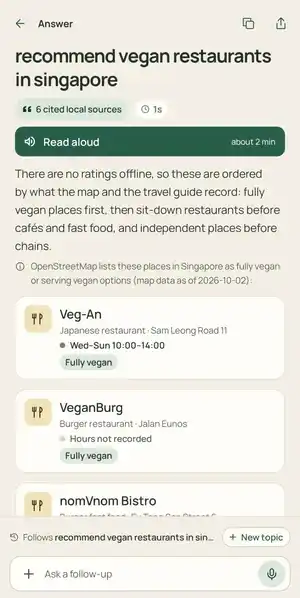

My overall impression is that we are currently at a key turning point where such offline tools are beginning to have genuine practical value.
Most contestants in the competition attempted to directly invoke on-device large language models on the phone, having the model perform lengthy inference computations before providing an answer. But I think this approach is too slow: answering a simple question often takes 1 minute or even as long as 22 minutes.
In contrast, the best-performing applications cleverly combined semantic search technology: first instantly presenting precise search results from the local offline database, then immediately invoking a very lightweight small language model to automatically generate a structured text answer. This combination can produce answers of excellent quality within a very reasonable response time.
Finally, when you are out and about, especially when you have meeting schedules, it is sometimes indeed unavoidable to need an internet connection while on the move.
When you arrive at a location, you often need to immediately contact the person you're meeting to confirm the exact location or ask them to open the door; at the end of a meeting, you frequently need to verify the details of your next itinerary. If you don't have cellular mobile data, public WiFi is your only lifeline, and crucially: the public WiFi hotspot must allow you to connect directly without requiring an SMS verification code.
Public network environments around the world vary enormously in friendliness. Based on my travel footprint during the period when I was paying special attention to public WiFi availability, I have compiled a quick tier ranking:
Tier 1: Taiwan, China (at least in the Taipei area). Taipei has an extremely dense network of public WiFi hotspots. When I was strolling the streets or even sitting in an Uber taking out my phone to check, the probability of successfully detecting and connecting to a hotspot at any given moment was actually over 25%. These hotspots are usually provided free of charge by the municipal public network or by chain convenience stores found throughout the streets.
Tier 2: Ukraine, the United States, Canada, Singapore. Among them, Ukraine surprised me the most: in an astonishing number of areas across multiple cities, there are completely open free hotspots, and quite a few of them don't even require a web redirect verification.
The United States, Canada, and Singapore are similar: the theoretical total number of public hotspots is very large, but a significant portion have SMS verification codes or mandatory login thresholds. Even so, the number of truly completely open and usable hotspots is still very considerable.
In addition, while searching for networks in Toronto, I also stumbled upon a local fraternity (or sorority) that seems to be named after SBF (Sam Bankman-Fried):

Tier 3: Austria, Hungary. These two halves of the old Austro-Hungarian Empire territory are similar: there are quite a few hotspots, but the vast majority of public networks require mandatory SMS verification codes to log in. Although completely open hotspots can occasionally be found, several times I had to try a large number of networks one by one and wander the streets for a long time.
Bottom tier: Switzerland. Although Switzerland enjoys an extremely high reputation for privacy protection, I rank it last in terms of public WiFi friendliness. Almost all public hotspots here mandatorily require SMS verification codes. During the first 1.5 kilometers of my journey through the city center, I found only two exceptions: a random shoe store I passed by, and Starbucks (Starbucks allows free connection for 10 minutes, and if you want to continue using it, you need to enter a verification code received by email).
Minimalism in Web Applications: Saying Goodbye to Frontend Black Boxes, Embracing Unix Philosophy and Local Tools
Recently, I've started trying to completely move away from relying on web-based user interfaces in more and more of my transactions.
The last few times I updated the IPFS hash values on ENS domains, I did it directly through a command-line tool written for me by an AI. As for the many on-chain payment transfers I make through privacy protocols, I've now fully switched to the kohaku-cli command-line tool:
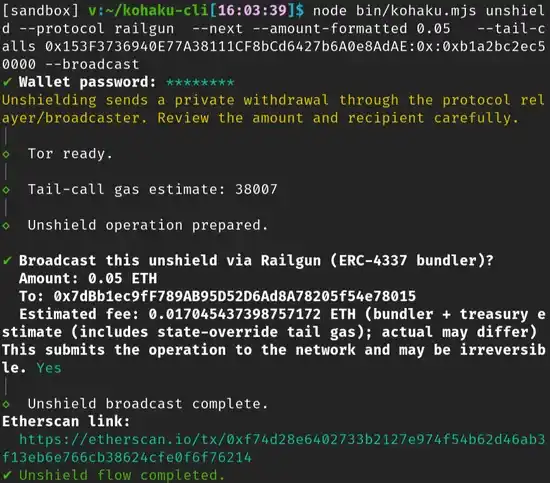
The image above shows the process of sending a transaction via kohaku-cli. Today this command-line tool has become much simpler and easier to use—users no longer need to specify values twice or understand what a Tail Call is.
In my view, traditional websites and web applications (especially those used for handling crypto asset interactions) have several fundamental dangers:
First is the risk of repeated trust and hacker hijacking. Every time you visit a web application, your browser is actually re-downloading the entire application code from the server thousands of times, which means every time you open a webpage you must fully trust that server. If that server is hacked or maliciously tampered with even once during your thousands of visits, your asset security could be completely compromised. By contrast, traditional native download-and-install programs are safer: you only need to trust that the server wasn't compromised at the precise moment you downloaded and installed.
Second is the default infringement of user privacy. Websites and web applications are extremely unfriendly to user privacy by default. When you visit a webpage, it can easily detect your browser engine and version number, operating system, and screen resolution; once you start interacting, hundreds of fine-grained data points such as mouse trajectories and button click frequencies are quickly collected, making it easy to sketch out your digital fingerprint. Moreover, webpages often distribute this data and metadata by default to countless third-party services, from CDN scripts to various analytics companies.
Third is the dark patterns driven by commercial interests. As we have seen in social media, web applications meticulously crafted by third parties with commercial monetization intentions often do not have the user's best interests at heart. Many subtle interface interaction logics are deliberately designed as "Dark Patterns" to induce and harvest user attention, whereas what users truly desire are "Bright Patterns" aimed at enlightening cognition, providing education, and protecting personal rights.
Faced with these drawbacks, what alternatives do we have? The core idea is: to revitalize the classic Unix philosophy and, with the help of local AI, turn it into tools that are friendlier and easier to use for ordinary people: letting you directly issue commands to the computer in natural language, instead of being forced to write obscure Bash scripts.
The essence of the Unix philosophy is actually very simple: build small, simple, modular tools, each focused on doing one thing well, and communicating and collaborating with each other through the most universal standard interface (i.e., plain text).
As a user, you have fine-grained autonomy to freely assemble and combine different tools. In contrast, modern web interfaces often cram countless complex features into a closed black-box tool controlled by a single development team. When this trend reaches its extreme, it gives rise to so-called Super-Apps, which concentrate immense power in the hands of platform developers, with extremely complex and obscure internal mechanisms, thereby multiplying the system's security risks.
Empowered by large language models, we can finally embrace the elegant ideas of the Unix philosophy again: returning fine-grained decision-making power to ordinary users, while completely eliminating the high threshold that requires everyone to become a professional programmer.
Conclusion: From Physical Minimalism to Digital Minimalism, Reclaiming Your Own Focus and Freedom
The physical-world minimalism that flourished from the 2000s to the 2010s was made possible thanks to the widespread adoption of computer and internet technologies. A thin and light computer can replace dozens of physical tools. As a result, with just a laptop, a few sets of clothes, and basic charging and toiletries, you can live a life of great freedom and extreme simplicity.
Before the birth of the internet, physical minimalism was feasible but often meant enormous lifestyle compromises and high costs; the emergence of the internet dramatically lowered the threshold for living a physically minimalist life.
With the tremendous progress in software development quality over the past decade and the explosion of modern AI technology, I believe we have now reached an underlying tech stack capable of catalyzing the next wave of minimalism: digital minimalism.
We no longer rely as heavily on social media as we once did, because you can get high-value information directly from local intelligent bots (and for interpersonal emotional connection, there still exists the most classic and pure solution: step out your door and talk face-to-face with real people in real life);
We no longer depend on internet connectivity at every moment as we once did, because far more can now be accomplished in purely local and offline environments than ever before;
We are no longer at the mercy of web-based interfaces as we once were, because with command-line tools or customized interfaces, you can complete operations in a more convenient and efficient way, and AI can assist you at any time in using or tailor-making these tools.
The maturation of all these technological conditions coincides with the peak of the drawbacks of the previous digital paradigm (as well as the secondary harms caused by the misuse of AI), making the practice of digital minimalism more urgent and necessary than ever before.
The path to digital minimalism varies from person to person, because everyone's actual needs and life rhythms are different.
But I sincerely recommend that everyone try, at least in one important dimension, to clean up your digital clutter and mental impurities. If you like the clarity and calm that this change brings, then firmly keep going.
Welcome to join the official BlockBeats community:
Telegram Subscription Group: https://t.me/theblockbeats
Telegram Discussion Group: https://t.me/BlockBeats_App
Official Twitter Account: https://twitter.com/BlockBeatsAsia
