On November 2, Anthropic filed an S-1/A amendment with the SEC, filling in two numbers left blank in the initial October 26 filing: third-quarter revenue of $16.956 billion for the period ended September 30, and compute and infrastructure purchase commitments totaling approximately $895.4 billion. In the same quarterly report, operating results swung from a $974 million profit in Q2 to a $567 million loss. The offering price and share count remain blank, ticker ANT.
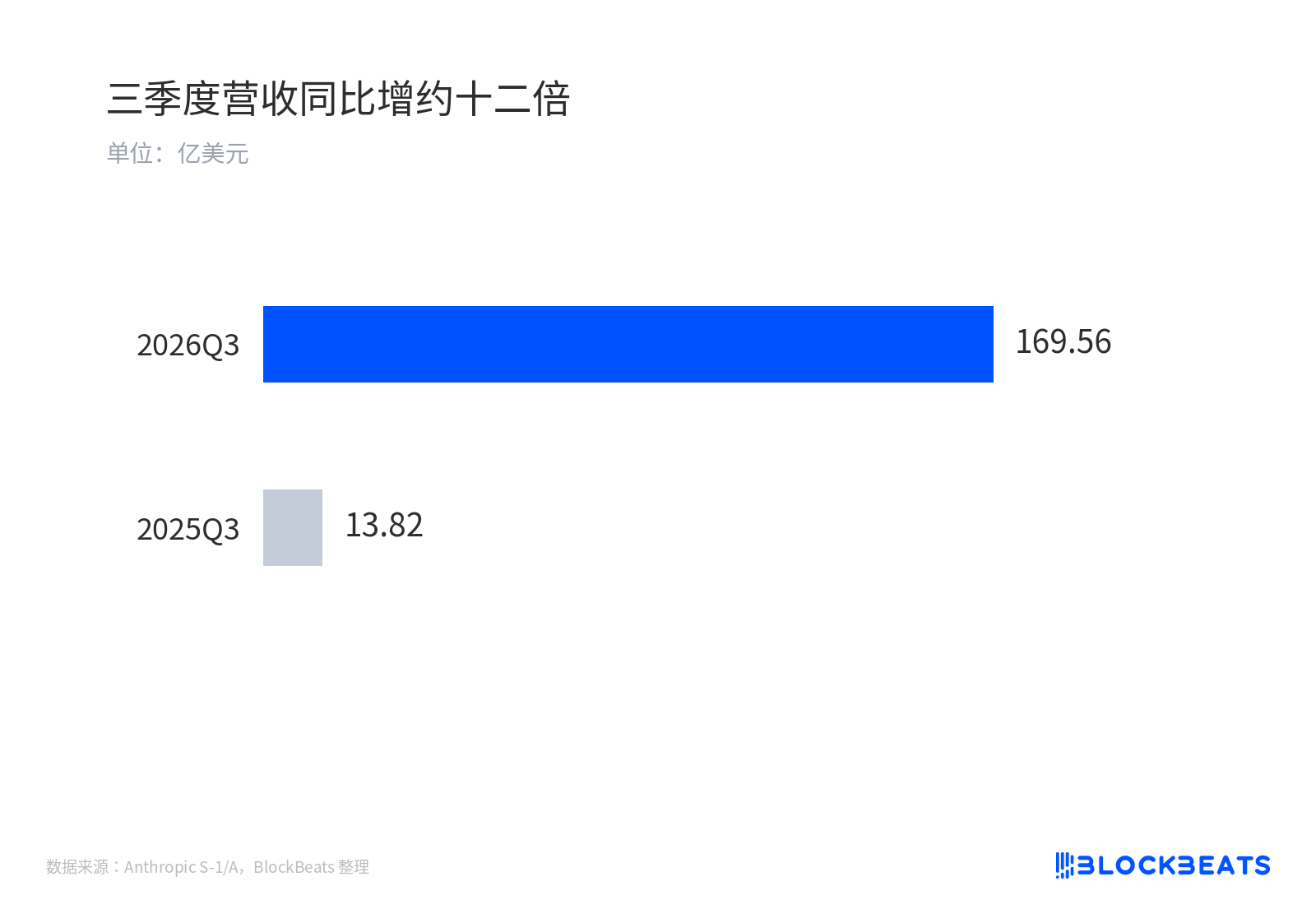
A company that rents compute, with profits capped by capacity first
Anthropic doesn't build data centers; its models run in facilities built by others, with compute purchased under contract. This makes its income statement extremely sensitive to capacity timing, and the lag in rack delivery feeds directly into gross margin.
Third-quarter compute and infrastructure costs were $9.863 billion, or 58% of revenue, up from 48% in Q2. Management's explanation is that long-term contracts typically lock in capacity 12 to 18 months in advance, demand grew faster, forcing spot purchases of roughly $5 billion in short-term higher-priced compute, plus about $2 billion in non-cash charges from a donation matching program, pushing operating profit into negative territory.
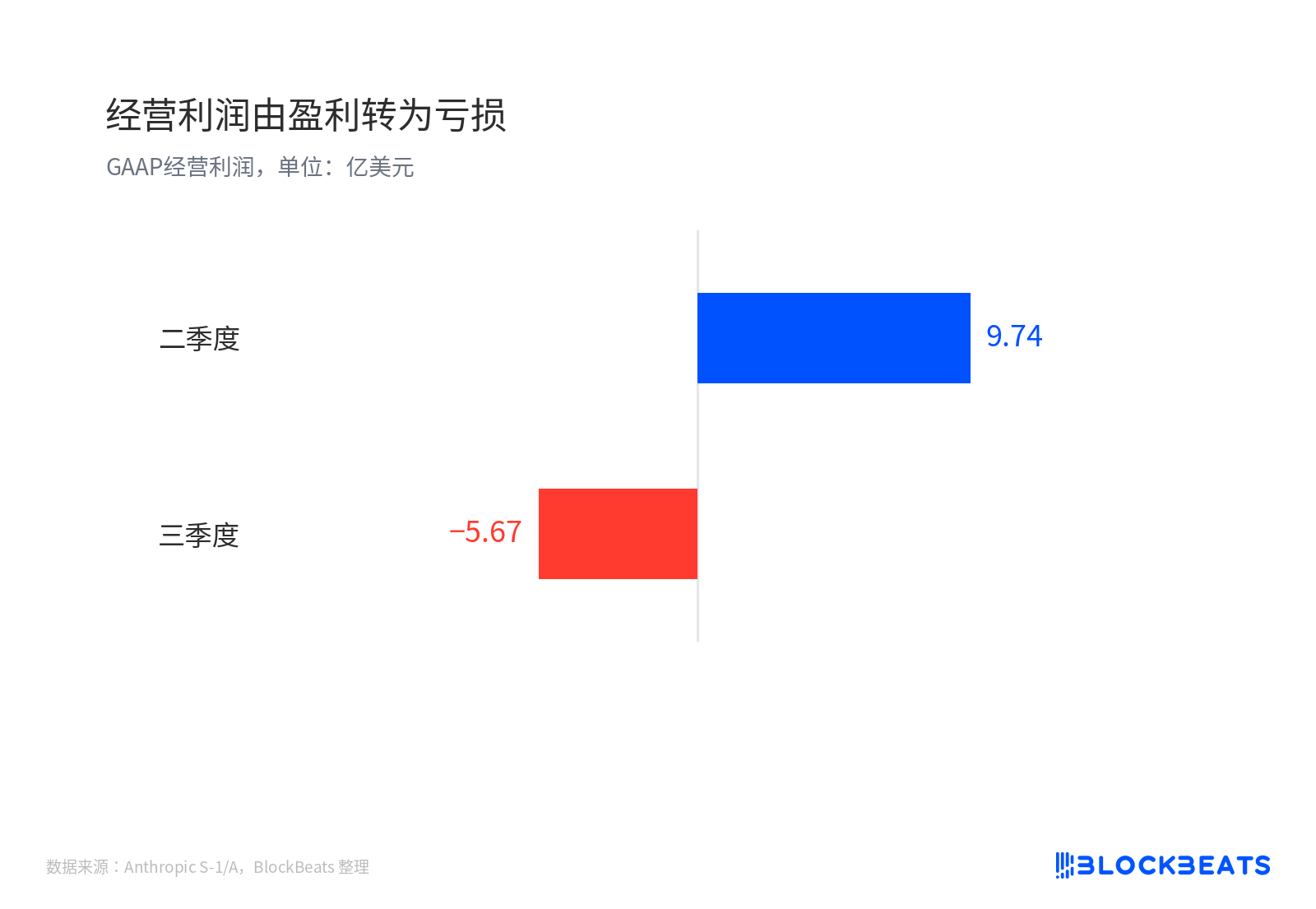
Under US GAAP, there's another side. Adjusted operating profit was $2.5 billion, a 15% margin, down from 19% in Q2. The gap between the GAAP loss and adjusted profit is about $3.067 billion, of which the company explained only about $2 billion, with the remainder not disclosed item by item.
A net book loss of $23.291 billion is more easily misread. Of that, $21.936 billion comes from fair value remeasurement of convertible notes, derivative liabilities, and SAFEs (simple agreements for future equity). As the company's valuation rises, these convertible instruments are marked higher and the loss grows, but cash has not decreased. Reading the net loss as a burn rate leads to the opposite conclusion.
$895.4 billion turns the IPO into a financing arrangement
The commitment table is the new information in this amended filing. The first version left the total blank; it is now spelled out at about $895.4 billion, almost entirely compute and infrastructure. About $447.5 billion is expected to occur by the end of 2030, $69.8 billion comes due within the following 12 months, and the rest largely falls between 2031 and 2045.
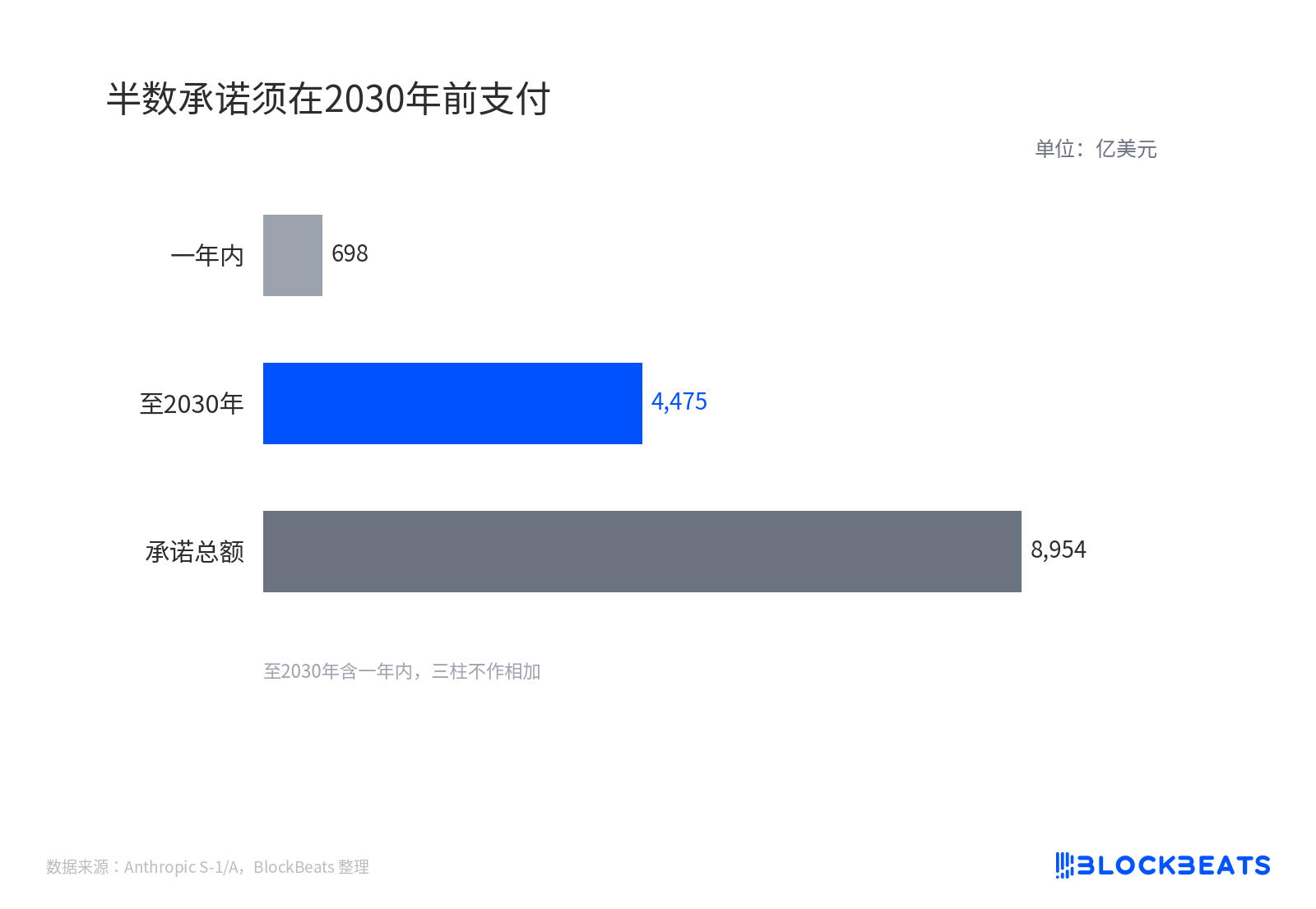
Of that, about $213.8 billion carries termination rights or conditions precedent, and a separate $150 billion to $175 billion compute arrangement with no fixed amount is excluded from the total. Most of this capacity has not yet been delivered, and most is not on the balance sheet. So-called take-or-pay means the minimum spend is due whether or not the racks arrive or are used.
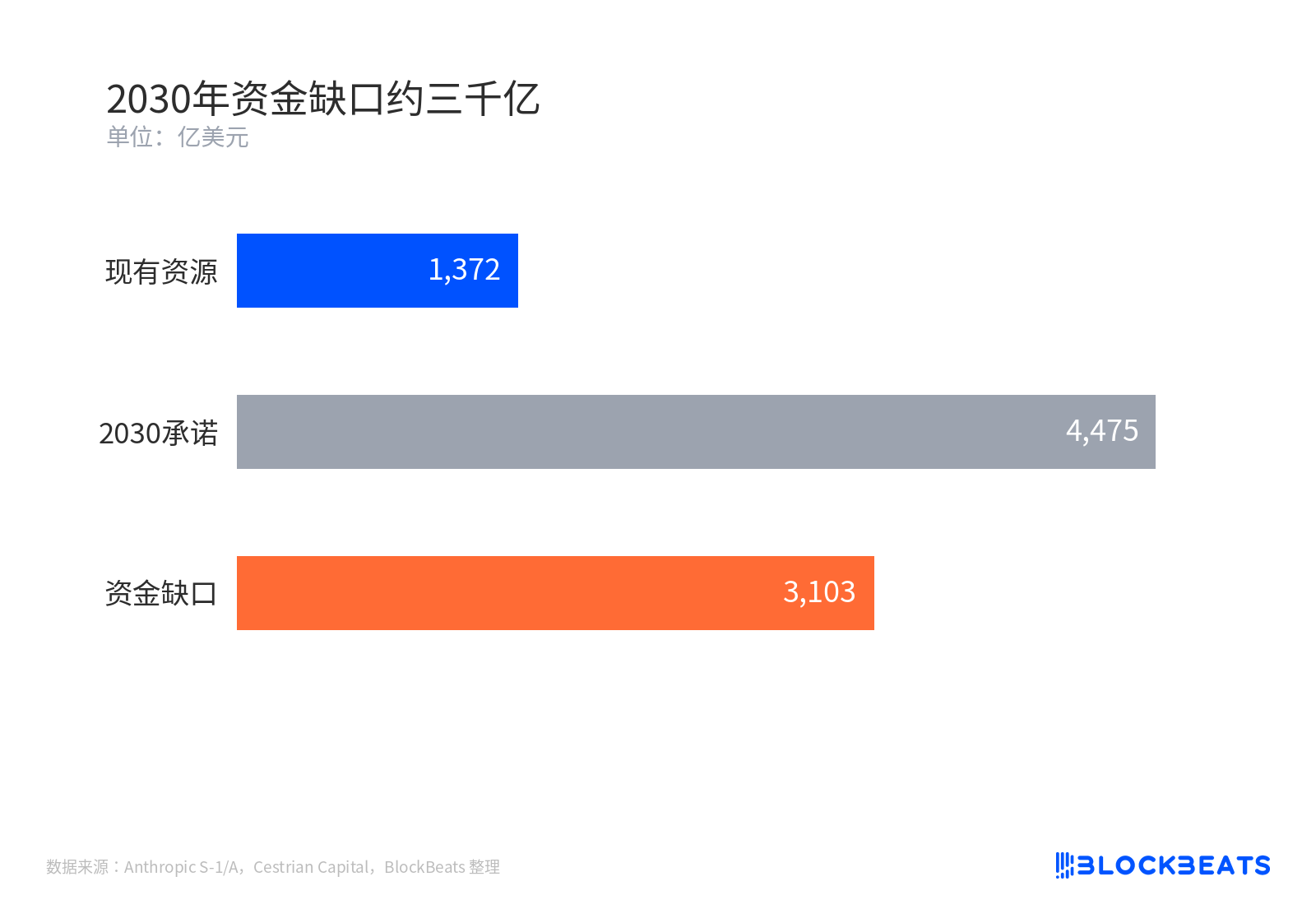
Against liquidity: $95.6 billion of cash and $36.3 billion of short-term investments as of September 30, about $14.8 billion of undrawn credit, and $6.569 billion of operating cash flow in the first nine months. The $69.8 billion due within 12 months is coverable, so "cannot pay now" does not hold; the pressure falls on the $447.5 billion before 2030.
Alex King of Cestrian Capital ran the numbers: relative to existing net liquid resources, the gap to 2030 is about $310.3 billion, and even counting partner financing there is still about $228.3 billion, with the pressure point roughly after September 2027. This calculation assumes commitments are paid in full and excludes operating cash flow, so it is conservative, but the direction of the conclusion holds. The IPO does not just price the valuation; it also opens an equity financing channel for future compute bills.
Supplier-side order visibility can be viewed separately: about $161.2 billion for Broadcom-related equipment leasing, at least about $121.3 billion for Google, at least $110 billion for Amazon, and at least $44.9 billion for Microsoft. These line items are not on the same basis as the $895.4 billion total and cannot be added together.
Three Interpretations: Management, Damodaran, and Cestrian
Management reads it as a one-time mismatch where demand exceeded signed capacity, with growth still strong. Quarterly revenue grew by $5.4 billion quarter-over-quarter, customers paying over $100,000 annually exceeded 11,900, and net revenue retention was approximately 900%.
Aswath Damodaran of New York University sits at the other end. According to his model, to support $1.475 trillion in equity value, the company needs to reach nearly $1 trillion in revenue by 2036, a 27.5% operating margin, and a 9.74% cost of capital. If pricing is significantly above that number, his choice is to stand aside. He has also publicly criticized the governance arrangement granting the founder's Class F shares a combined 50.1% voting power.
Cestrian sits at the table in between: commitments are executable, revenue is not.
The three interpretations are not mutually exclusive. Strong demand, locked-in costs, and real financing needs can all hold simultaneously; the disagreement is only over which item the market should discount.
Issue Price, Terminable Tranches, and Short-Term Premium Determine the Magnitude of Repricing
The issue price has not been set; institutional discussions center on a range of approximately $1.4 to $1.6 trillion, corresponding to 22 to 24 times Q3 annualized revenue. This multiple means the market is still pricing it as a growth stock, with cost constraints not reflected in the price. Once pricing lands at the upper end of the range, it amounts to discounting the $895.4 billion in commitments as certain revenue.
What determines how much of the $895.4 billion is hard liability is the $213.8 billion in terminable tranches. The more that can be returned, the further the pressure gauge can be pushed back; conversely, $447.5 billion is an unavoidable cash outlay.
The short-term premium is another valve. If another $5 billion-scale high-priced spot purchase occurs in Q4, the 15% adjusted margin cannot hold, and the "one-time" narrative fails accordingly. Quarter-over-quarter growth has already fallen from 144% in Q2 to 47%—whether this is a high base or a demand inflection point cannot be determined in a single quarter.
There is another variable written into the risk factors. The amended filing adds language on the Responsible Scaling Policy; the company states that internal estimates suggest future models may soon reach the policy's threshold for "significant AI-driven accelerated progress," thereby triggering a more comprehensive safety review, and current models have not been deemed to have crossed the line. This is standard forward-looking disclaimer language, but once triggered, it affects the pace of model releases—and this revenue curve is extremely sensitive to pace.
Welcome to join the official BlockBeats community:
Telegram Subscription Group: https://t.me/theblockbeats
Telegram Discussion Group: https://t.me/BlockBeats_App
Official Twitter Account: https://twitter.com/BlockBeatsAsia
