Block delivered earnings that exceeded its own expectations and once again raised its full-year guidance. The payments and financial services company's third-quarter gross profit grew 22%, with adjusted operating profit rising even more.
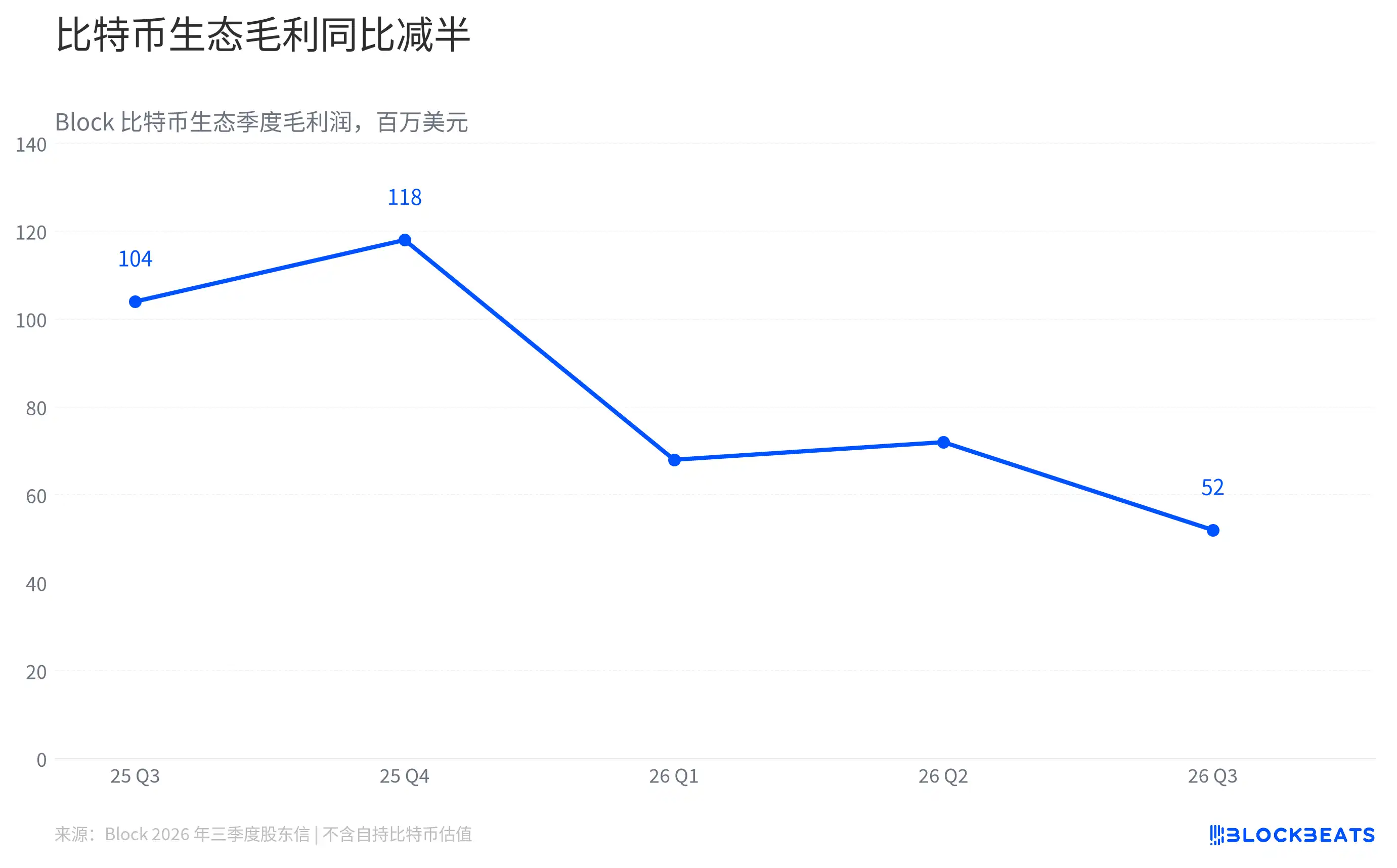
In this report card, however, the Bitcoin business headed the other way. According to Block's third-quarter shareholder letter, gross profit from the Bitcoin ecosystem halved year-over-year. It still brings the company substantial revenue, but it is no longer the engine of gross profit growth this quarter.
So where did the growth come from? The answer lies in Cash App's lending and consumer payments, and in the merchants served by Square.
Who filled the gap left by the Bitcoin business?
Block discloses two ways of looking at its business. One is by business segment, such as Cash App and Square; the other is by product category, such as commercial services, financial solutions, and the Bitcoin ecosystem. The two classifications overlap, so their figures cannot simply be added together.
By product category, financial solutions contributed slightly more gross profit increment than commercial services. Growth in both offset the decline in the Bitcoin ecosystem and pushed total gross profit higher.
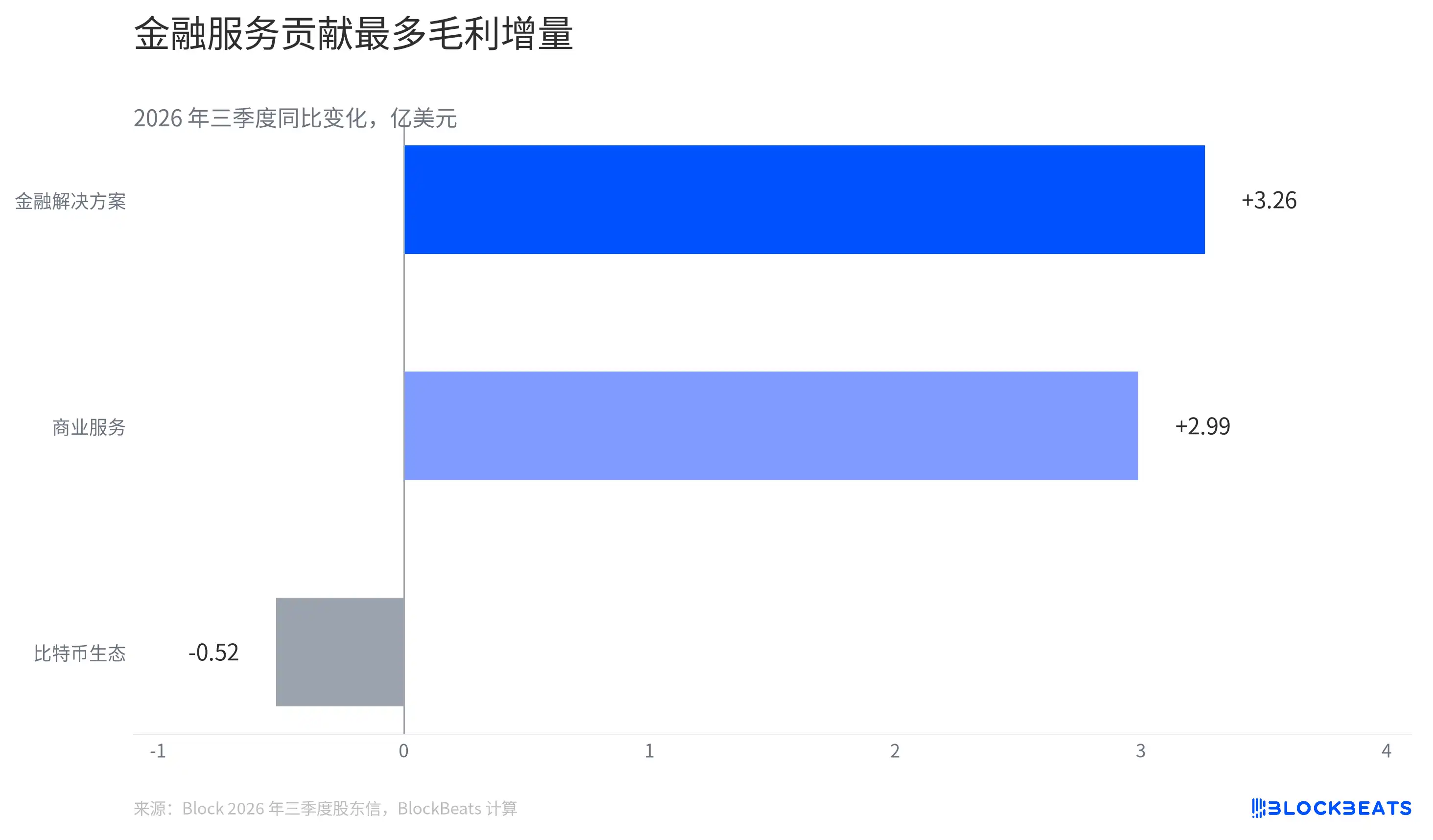
Financial solutions includes lending products such as Cash App Borrow, as well as instant deposits, interest on customer funds, and Square Loans. Block said in its shareholder letter that growth in this category was driven primarily by Cash App consumer loans.
Consumer lending continues to scale. The company disclosed that third-quarter originations reached $19 billion, up 40% year-over-year. This figure counts new originations during the quarter, not loan balances, and cannot be directly treated as revenue.
Commercial services covers Square payments, software, and hardware, as well as products such as Cash App Card, Cash App Pay, and buy now, pay later. Merchant collections, consumer card spending, and installment purchases all leave revenue across different products. The company said growth in Square payment volume and the Cash App business together drove gross profit in this category.
By segment, Cash App grew faster. Its third-quarter gross profit exceeded $2 billion, accounting for about two-thirds of Block's total gross profit. That ratio shows that to understand Block's growth, one cannot focus only on merchant payment terminals—one must also look at how consumers borrow, spend, and pay within Cash App.
However, the growth in loan volume has also brought another set of data that needs to be tracked. Block disclosed that transaction, loan, and consumer receivable losses rose 66% year-over-year, which the company attributed to loan volume growth and changes in product mix.
This loss line covers multiple businesses and is not equivalent to Cash App consumer loan charge-offs. The company said the variable profit margin on consumer loans was flat year-over-year and slightly improved from the prior quarter, but did not provide specific figures. Variable profit deducts processing costs and risk losses, but not financing costs. Based on these two growth rates alone, it is impossible to determine whether the loan charge-off rate has risen.
How fast are profits growing? It depends on which line you look at.
One of Block's most eye-catching figures is the 92% year-over-year increase in adjusted operating income. But operating income calculated under U.S. GAAP grew only 5%. Why do the two lines look so different for the same company?
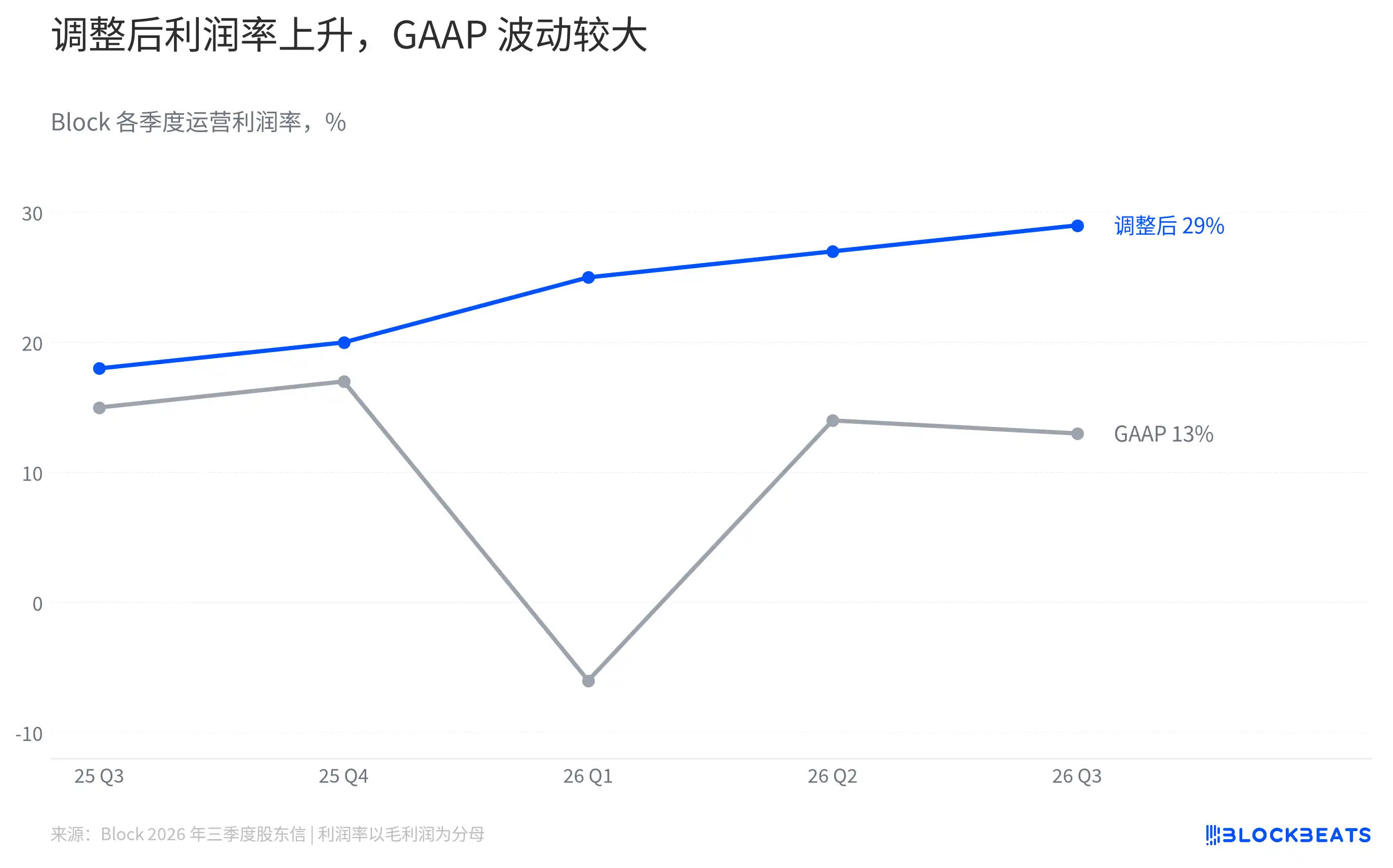
First, look at the denominator. Both margins in the chart use gross profit as the denominator, measuring how much is left after deducting the corresponding operating expenses for every dollar of gross profit earned. They are not traditional operating margins using total revenue as the denominator and cannot be directly compared with companies that use revenue as the denominator.
Next, look at the numerator. GAAP operating income reflects operating expenses in the accounting statements. Adjusted operating income, under the company's non-GAAP definition, adjusts for specific items such as restructuring and contingencies. The two answer different questions, and the adjusted figure does not mean the related expenses did not occur.
In the third quarter, GAAP operating income was approximately $428 million, while the adjusted figure was $923 million. The difference is close to the size of the former itself. Block's reconciliation table lists multiple adjustments, and readers need to examine the nature and amount of each item one by one; the entire difference cannot be attributed to a single cause.
Looking at the quarterly series, the adjusted margin continues to rise, while the accounting-basis curve fluctuates more. The former shows the adjusted operating performance as defined by the company, while the latter retains the expenses that entered the statements in the period. Only by looking at both lines together can one understand the speed of profit growth and its boundaries.
Bitcoin revenue is large, so why is gross profit so small?
Block's Bitcoin ecosystem revenue mainly includes businesses such as customers buying Bitcoin through Cash App. The company also incurs corresponding costs to obtain Bitcoin for customers, so the revenue figure cannot be directly treated as fees or profit.
In the third quarter, this business recorded approximately $1.8 billion in revenue, but gross profit was only $52 million. Based on the disclosed figures, less than $3 of gross profit was retained for every $100 of revenue. The company said the decline in gross profit was mainly due to a strategic reduction in fees for some Bitcoin transactions on Cash App.
Another Bitcoin-related figure appears in a completely different place. Block itself holds Bitcoin as a long-term investment, remeasured at fair value at the end of the quarter. Changes in the coin price are reflected in net income, but they are not gross profit from Bitcoin ecosystem transactions.
According to Block's third-quarter 10-Q, the company recognized approximately $230 million in Bitcoin investment remeasurement gains for the quarter, not losses. The company did not sell this portion of the investment during the same period, so this gain also does not represent coins already sold and cashed out.
By separating the two lines, the contrast in the financial report becomes clear. Gross profit from the customer-facing Bitcoin business is declining, the book value of the company's own Bitcoin holdings rose during the quarter, and payments and financial services contributed the main incremental gross profit.
Welcome to join the official BlockBeats community:
Telegram Subscription Group: https://t.me/theblockbeats
Telegram Discussion Group: https://t.me/BlockBeats_App
Official Twitter Account: https://twitter.com/BlockBeatsAsia
