"At 8:50, my eyes just opened on their own."
The speaker is Korean comedian Kim Won-hoon. The market opens at 9, and he doesn't need an alarm. On June 25, 2026, he bought stocks for the first time, with 30 million Korean won in principal, and his first purchase was SK Hynix. That day the share price was 2.76 million Korean won, and he bought 3 shares.
Netflix turned this experience into a variety show, with a very blunt title: "Ant Kim Won-hoon: The World of Stocks." "Ant" is what Korean retail investors call themselves; we usually just call them "leeks."
What was unlucky for Kim Won-hoon was that on the day filming began, the SK Hynix shares he bought happened to be at the exact peak.
Trading has become the best variety show of this era
Kim Won-hoon is not an isolated case. He is just the one caught on camera in a massive wave.
Pulling the camera back a bit further, this year's global market is almost the same picture.
On October 6, the Nasdaq closed at 27,599.79 points, setting a closing record for the 24th time this year. AI turned memory chips into hard currency: Micron rose 637% over the past year, SK Hynix rose 9-fold, and Samsung Electronics rose 5-fold. More than half of the KOSPI's weighting is concentrated in Hynix and Samsung, so it stood above 9,000 points for the first time in June.
Gold broke through $5,000/ounce for the first time in January, then touched $5,100; Brent crude stood at $110 at the end of October because of a few ships in the Strait of Hormuz. Bitcoin, U.S. stocks, Korean stocks, gold, crude oil—the reasons for their gains are all different, but the same group of people is trading them.
U.S. retail investors now account for 30% of average daily U.S. stock trading volume. In May this year, retail stock trading volume was 10% higher than the peak of the January 2021 "meme stock" frenzy, and in June it set another record; on multiple trading days, options volume exceeded 50 million contracts, almost twice the level three years ago. Goldman Sachs estimates that about $12 trillion in stocks sits in U.S. self-directed trading accounts.
At the end of 2025, 14.42 million South Koreans held stocks, nearly 30% of the total population; in May this year, 2.16 million new securities accounts were opened, four times the number in the same month last year; in 2025, the three major brokerages opened 229,000 accounts for minors, and stocks became Children's Day gifts. The KOSPI took only one month to go from 8,000 to 9,000 points.
Even the president is in the market. Lee Jae-myung shouted "the era of KOSPI 5,000" during his campaign and bought 40 million Korean won worth of ETFs himself; in June the index plunged nearly 9% and triggered a circuit breaker.
Trading is the most important social product of this era.
And the platform infrastructure for this new era's social product is already in place.
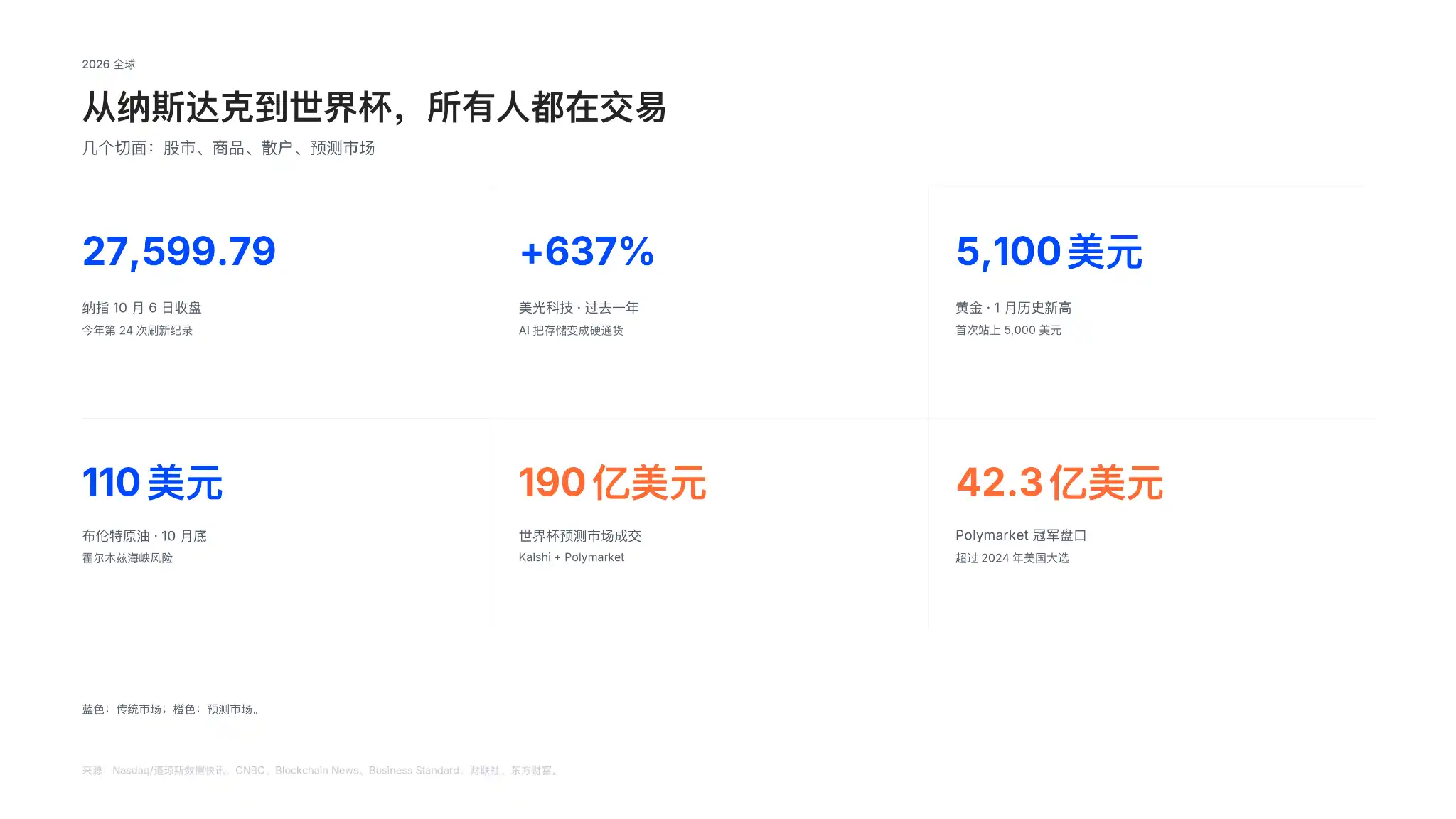
All assets are crowding into the same account
The same Korean retail investor might check the KOSPI index in the morning, look at BTC prices at noon, turn to US stocks in the evening, and glance at gold trends before bed.
In the past, completing these trades might have required downloading three or four apps, opening multiple accounts, and handling fund transfers and fiat currency conversions across different platforms. Now, Bybit is changing all of this: putting multiple markets into one account.
In the Unified Trading Account (UTA), crypto spot, contracts, stocks, and TradFi perpetuals (gold, crude oil, indices, US stocks) are all placed within the same account system. Download, verify, and in the same account you can buy Bitcoin, buy Nvidia, buy gold, and trade crude oil perpetuals. Zero commission, fractional shares, 24 hours, AI order placement — every step that can be saved is saved.
The infrastructure of trading platforms is nearing perfection. And so, the new Bybit WSOT 2026 World Series of Trading has begun.
The new WSOT is here again
The Bybit 2026 World Series of Trading (WSOT) global trading competition officially kicked off on October 29.
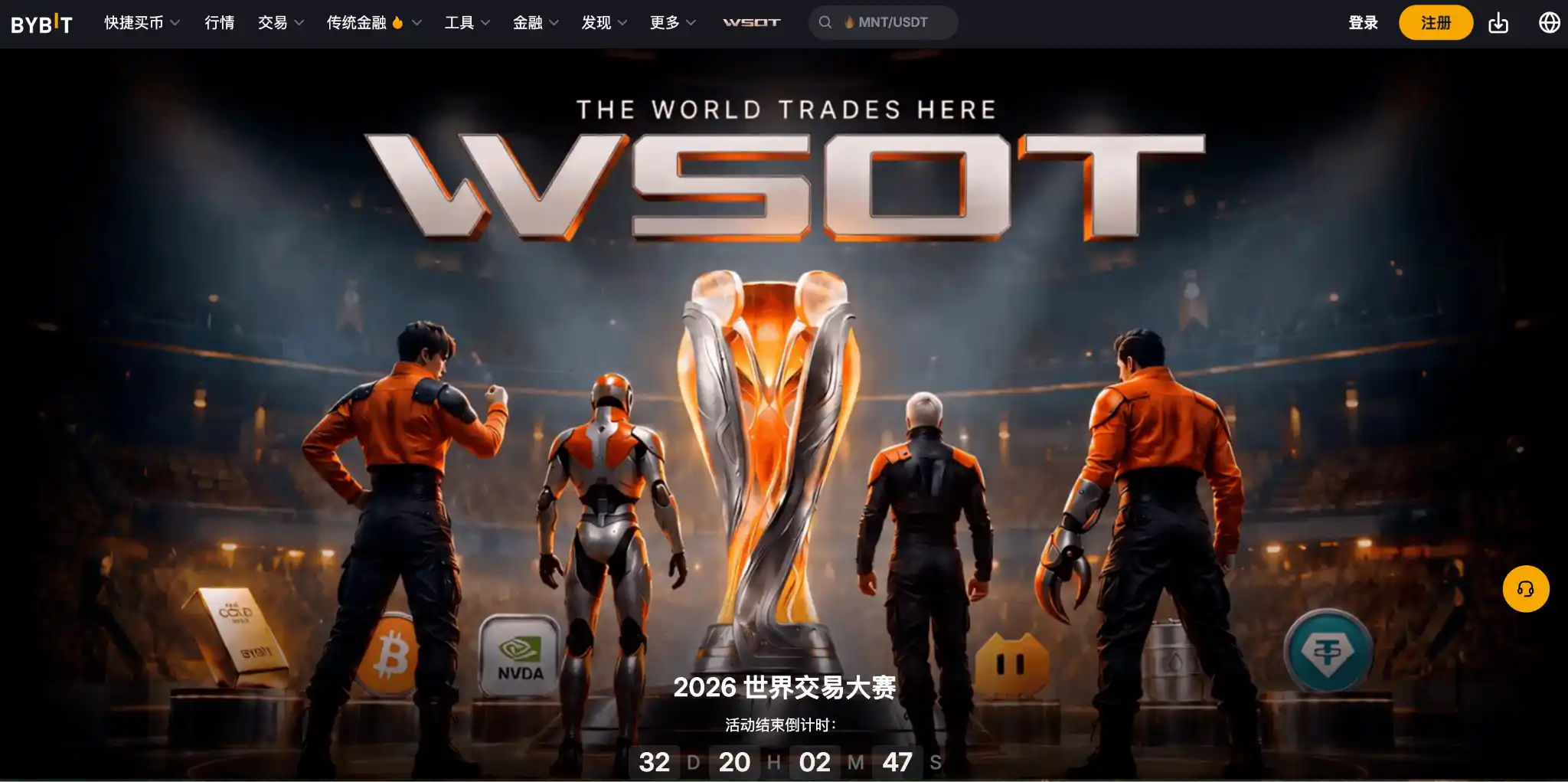
Since its launch in 2020, Bybit WSOT has continued to expand its scale, breaking new ground in prize pools, participant numbers, and global coverage, gradually developing into one of the most influential trading competitions in the crypto industry.
· 2020: The inaugural WSOT was officially launched, with a prize pool of 1.27 million USDT
· 2022: The total WSOT prize pool increased to 8 million USDT, attracting 69,082 traders from 182 countries and regions.
· 2023: WSOT maintained the total prize pool of 8 million USDT, attracting 117,116 participants from 188 countries and regions. Among them, the Squad Showdown had 102,345 participants forming 857 squads.
· 2024: WSOT attracted over 77,000 traders from 161 countries and regions, with cumulative trading volume reaching $100 billion. The total prize pool was further increased to 10 million USDT.
From August 12 to September 15, 2025, in just five weeks, 520,000 people poured in from 202 countries and regions, forming 1,474 teams. At 12:00 UTC on August 27, single-day registrations reached 71,765, earning a Guinness World Record for "most participants in an online trading competition within 24 hours."
In the Team Battle, instSotaSpace won the championship with a team score of 9,815.49, taking home 489,600 USDT in prize money. Another team, TEAM NAMIGOD, claimed the "Best Team" title with 21,692 votes and received 120,000 USDT in prize money. The individual competition also had its share of highlights. The heavyweight division champion generated approximately $14.9 million in trading profit and received 32,400 USDT in competition rewards.
Records are bound to be broken. What's different about this year's WSOT?
Five tracks this year — how each one works
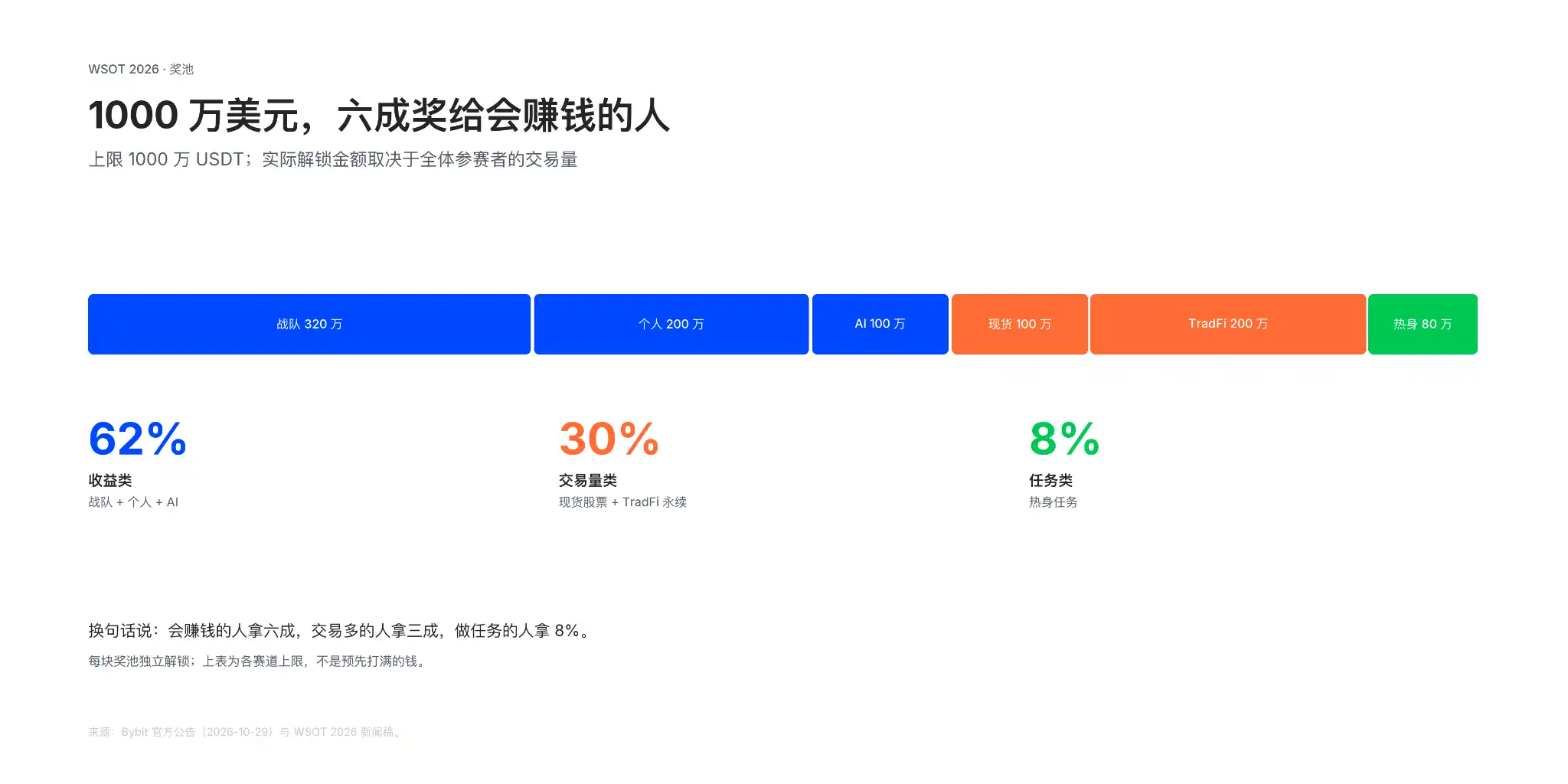
The 2026 WSOT Global Trading Competition runs from October 29 to December 2, lasting five weeks, with a prize pool cap of 10 million USDT.
The structure has changed compared to the previous edition. Last year had three main lines: "Main Competition + Warm-up + On-chain." This year it's split into five tracks: Warm-up Tasks, Team Battle, Individual Battle, Global Assets, and AI Battle.
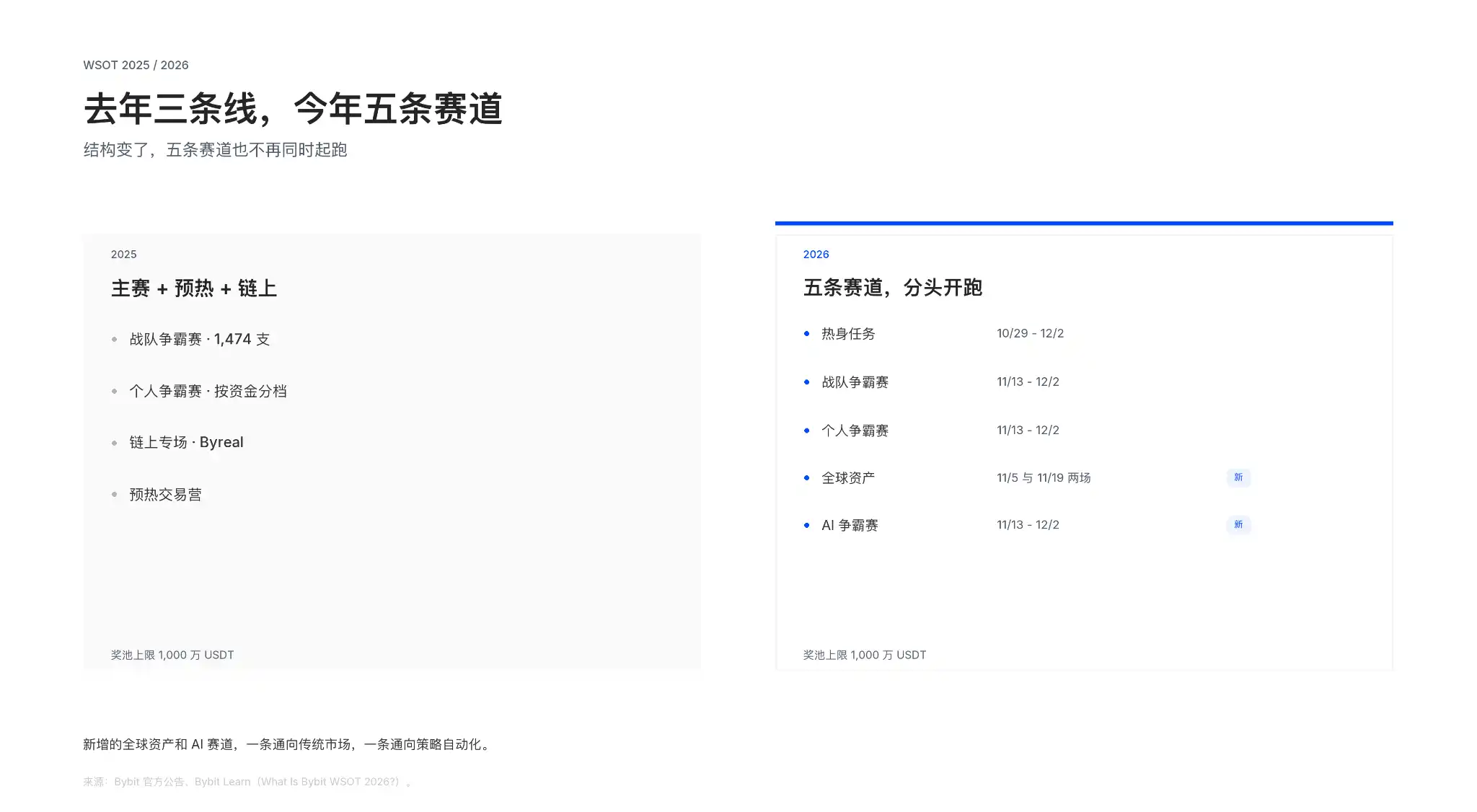
Global Assets brings stocks, gold, crude oil, and indices into the competition. The Spot Leaderboard counts trading volume for crypto and stock spot trading, while the TradFi Perpetual Leaderboard counts perpetual contract trading volume for stocks, gold, crude oil, and indices. This is the first time WSOT competes not just on coins, but also on traditional markets.
The AI Battle creates a separate leaderboard for "trading with AI." You can use Bybit AI sub-accounts or third-party AI agents, ranked by P&L. This turns "strategy" itself into a competitor.
Don't want to trade? Then do the tasks first
The warm-up trading tasks are probably the most accessible part of this event, with $800,000 up for grabs from the first day to the last. There are five competition zones: Newcomer & Invite, Spot, Derivatives, TradFi, and Bybit AI. Do whichever suits you, light it up when done, grab your rewards, and get a lottery ticket on top.
The lottery is called "Lucky Wednesday," drawn every Wednesday at 6 PM, with prizes rotating weekly: gold bars, an RTX 5090, an iPhone DUO, an Apple Vision Pro, and a Tesla Roadster. Tasks only count in the UTA main account.
This year's teams need ten members
The team competition has the biggest prize pool at $3.2 million. You can team up with a few pros or assemble a squad that can fight.
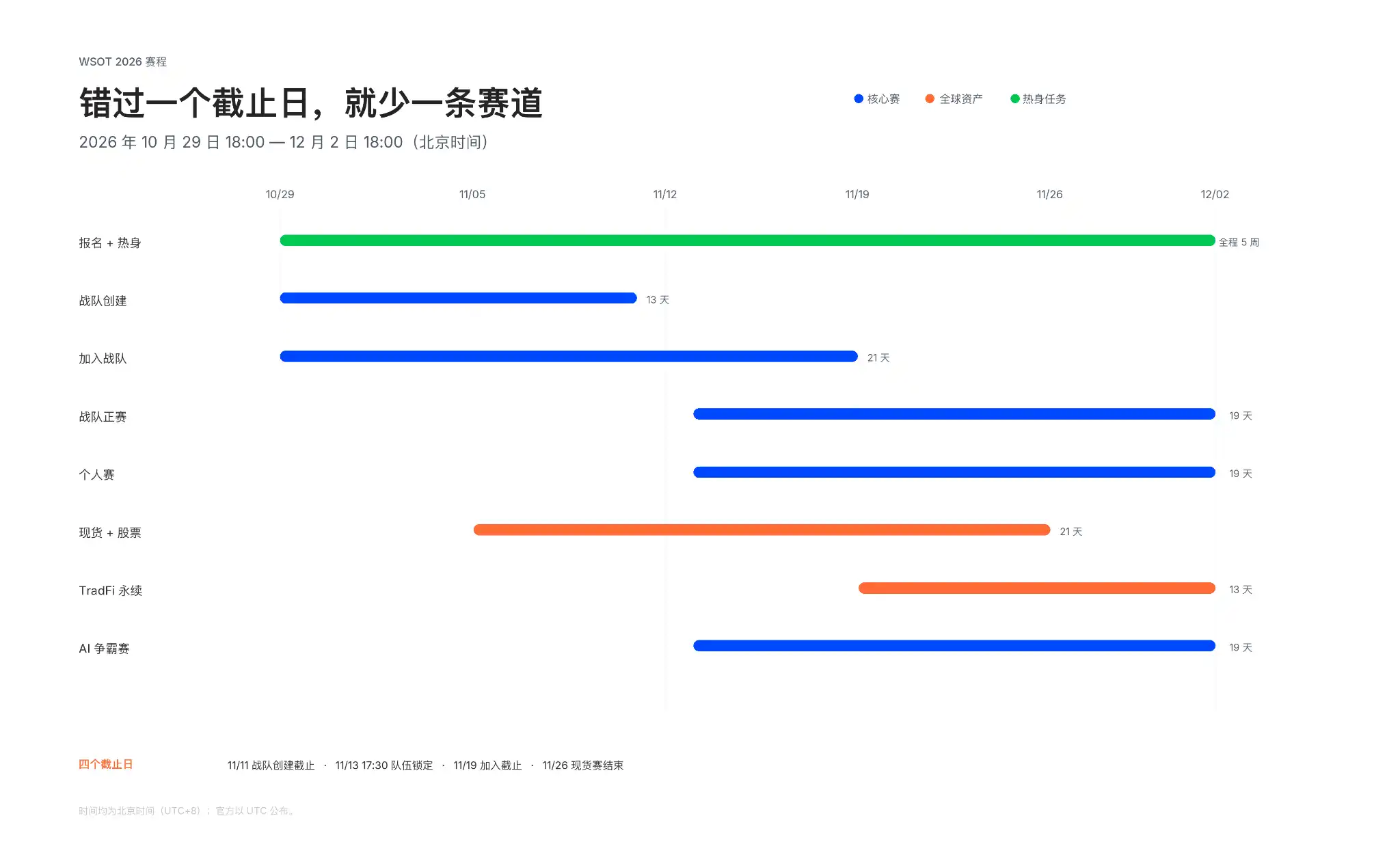
Team captains must recruit ten qualified members before 17:30 on November 13 for the team to be officially formed.
This year's payout structure is also interesting: the captain gets only 20%, the top ten by P&L% within the team split another 20%, and the remaining 60% goes to all qualified members. Both the top ten and qualified members sharing the rewards must meet a valid trading volume of over 50,000 USDT. Clearly, this year ordinary members get the lion's share.
Individual competition splits tables by your capital
The individual competition has $2 million, competing on how much you earn and your profit ratio.
Participants are divided by account equity into lightweight, middleweight, and heavyweight, competing within the same group. In each group, those who meet the trading volume requirement and rank in the top 400 by P&L share the prize pool.
Small accounts also have a chance to grab a share of the big prize pool..
Stocks, gold, crude oil, and other global assets compete for the first time
This is the first time WSOT isn't just trading Tokens.
The Spot & Stocks leaderboard has $1 million, from November 5 to November 26. Spot, leverage, flash swap, DCA, spot grid, and Direct Stock all count, with crypto and stock spot thrown into the same counter. This leaderboard doesn't look at P&L, only at how much you traded.
The TradFi Perpetuals leaderboard has $2 million, from November 19 to December 2. Perpetuals on stocks, gold, crude oil, and indices all count. But it only counts Taker trading volume — the part where you actively take orders; limit orders waiting to be filled don't count.
A new track for AI Agents
AI showdown with $1 million prize kicks off on November 13. Use Bybit AI sub-accounts, or general AI sub-accounts equipped with third-party AI agents, ranked by profit and loss.
Each AI sub-account must register separately; maintain at least 100 USDT in the account; only UTA trades that generate non-zero fees are counted; trading bot and copy trading volumes are not counted at all.
What the platform wants to see is whether AI strategies actually make money.
Final Words
It was once hard to imagine that trading, a complex operation requiring professional knowledge, could be turned into a variety show, or even a competition. From a niche field, it has grown into a spontaneous activity for everyone.
Just like in that Korean variety show, Lee Hyun-bo, a programmer in Seoul, disguised a stock trading website as an Excel interface, with real-time stock prices in the spreadsheet refreshing every few seconds without flashing colors, so his supervisor couldn't tell.
Trading thus began entering ordinary people's lives and becoming part of daily routine, as natural as scrolling short videos.
Competitions like WSOT are essentially building a playground for this "daily routine": gathering judgments scattered across various apps, time zones, and markets into a single set of rules.
This year the playground has grown bigger. Crypto, stocks, gold, crude oil, indices, and AI strategies are all on the same starting line. The prize pool is still $10 million, but the definition of "winning" has changed — it's no longer about who bet right once in a single market, but who can retain profits across more markets.
It already started at 18:00 on October 29. As for who this year's "instSotaSpace" will be, the answer won't be revealed until December 2. Let's wait and see!
Welcome to join the official BlockBeats community:
Telegram Subscription Group: https://t.me/theblockbeats
Telegram Discussion Group: https://t.me/BlockBeats_App
Official Twitter Account: https://twitter.com/BlockBeatsAsia
