Defensive stocks are becoming the new crowded trade
On November 5, U.S. stocks suffered a broad selloff, with almost nowhere to hide.
Tech and growth stocks came under heavier pressure, but the consumer sector still showed some relative resilience. The equal-weight consumer staples ETF (RSPS) fell 0.7%, and the equal-weight consumer discretionary ETF (RSPD) fell 2.5%. By style factor, low volatility and high dividend continued to lead, while momentum and growth factors lagged.
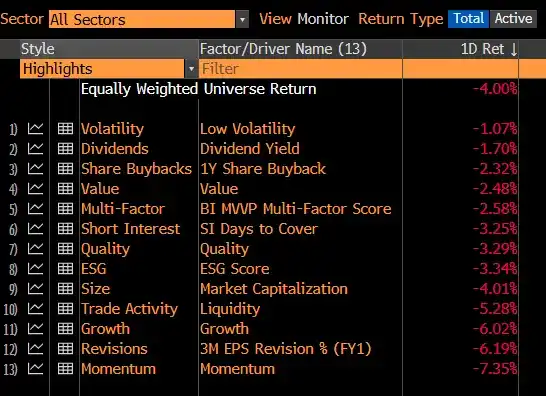
This divergence continues the typical recent market flow: investors are reducing exposure to AI, semiconductors, and high-valuation tech stocks while increasing allocations to low-volatility, high-dividend, and value sectors.
But as capital continues to pour in, a new contradiction is emerging in the market: the safe-haven trades originally used to hedge against tech stock risk may also generate new risks due to concentrated positioning.
This does not mean that the fundamentals of consumer stocks, value stocks, or low-volatility stocks have suddenly deteriorated, but rather that their short-term performance is increasingly influenced by capital flows and style factor positioning.
When a large number of investors buy the same type of assets for similar reasons, even if these assets themselves have strong safe-haven attributes, they may face concentrated selling pressure due to crowded trades.
For a period of time, the market's main problem was how to avoid the correction in AI and semiconductor sectors; but as capital rotation continues to deepen, the new problem has become: if safe-haven sectors have already absorbed a large amount of safe-haven capital, who will absorb these positions next?
Whether tech stocks rebound or continue to fall, safe-haven sectors may come under pressure
The biggest challenge facing safe-haven trades currently is that both trajectories for tech stocks could have a negative impact on them.
Scenario one: tech stocks rebound, capital exits safe-haven sectors.
For a period of time, investors have controlled portfolio risk by reducing AI and semiconductor holdings and increasing allocations to value and low-volatility stocks.
If tech stocks stage a significant rebound, especially if high-momentum stocks that previously faced concentrated reductions regain strength, investors may increase growth stock exposure again. This would put stocks that previously benefited from safe-haven rotation under pressure from capital flowing back.
Even if U.S. stocks rise overall, low-volatility, high-dividend, and value sectors may underperform the market due to a reversal in style rotation, and some crowded positions may even see absolute price declines.
Scenario two: tech stocks continue to fall, and the market enters a broader liquidity selloff.
If the AI and semiconductor sectors continue to weaken, the overall stock market decline may further broaden.
When investors face redemptions, margin pressure, or the need to reduce overall risk exposure, selling behavior may no longer be primarily based on corporate fundamentals, but instead shift toward selling assets that can be quickly liquidated.
In this case, consumer stocks, value stocks, and low-volatility stocks may also be sold. The earnings stability or valuation advantages of safe-haven stocks cannot guarantee that they will continue to receive capital support during a liquidity contraction phase.
The trigger mechanisms of the two scenarios are completely different, but both may ultimately lead to the same result: the safe-haven sectors that performed strongest previously become the target of capital outflows in the next phase.
Therefore, what warrants caution in this market cycle is not just a decline in tech stocks, but rather the excessive intensity of capital rotation between different styles, which exposes allocations originally intended to reduce risk to new trading risks.
The tech stock trading paradigm since 2023 may be changing
From a longer-term perspective, the dominant logic behind U.S. equity sector performance may also be shifting.
From 2023 to 2026, overweighting tech stocks had largely become the primary strategy for outperforming the market. The AI-related investment boom, earnings growth expectations, and concentrated capital inflows collectively propelled large-cap tech stocks to sustained market leadership.
In this environment, investors could generate excess returns through relatively concentrated tech allocations without needing large-scale cross-sector rotation. However, as AI capital expenditure, valuations, and the ability to deliver future earnings come under renewed scrutiny, capital is beginning to reassess the relative attractiveness of other sectors.
This means U.S. equities may be transitioning from a market structure highly concentrated in tech stocks toward broader sector diversification.
This structural shift may still have room to run and is not likely to end simply after short-term capital exits tech stocks. But structural trends and short-term trading opportunities are not the same thing.
Recently, the relative performance of value, low volatility, and high dividend factors has already shown significant changes. Even if investors remain bullish on sector diversification, they need to consider the crowding and reversal risks brought about by the excessive magnitude of prior rotation.
Against this backdrop, value factor ETFs (VLUE) and low volatility ETFs (USMV) can serve as tools for adjusting portfolio style exposure and managing volatility risk, but they cannot fully hedge against losses from liquidity-driven selling or safe-haven factor reversals.
Medium- to long-term sector diversification may remain a reasonable direction, but chasing safe-haven factors that have already significantly outperformed in the short term also carries risks.
Walleye shuts down equity long-short business, institutional position adjustments may bring additional selling pressure
Beyond sector rotation, hedge fund position adjustments may also become an important source of recent market volatility. Multi-manager hedge fund Walleye is gradually shutting down its internal equity long-short business. This change may be an early signal of broader structural adjustments beginning in the multi-manager equity investment space.
Traditional multi-manager platforms typically diversify risk through multiple independent investment teams, with each team trading according to its own strategy and risk budget. But when different teams hold similar stocks, rely on similar style factors, or simultaneously face large single-stock volatility, what was originally a diversified investment strategy may form highly correlated positions.
This structure does not necessarily expose problems when the market is stable, but during periods of violent rotation, risks can be rapidly amplified. For example, some stocks may simultaneously be viewed by multiple teams as low-volatility or value investment targets. Once related strategies begin to reduce risk exposure, selling pressure may concentrate.

If more multi-manager platforms undergo business adjustments, cut risk budgets, or unwind overlapping positions, the market may face additional short-term selling pressure.
It is worth noting that such selling pressure does not necessarily mean the operating conditions of the relevant companies have deteriorated, but may purely stem from institutions' need to adjust their portfolios.
Walleye's adjustment is not yet sufficient to prove that the entire multi-manager fund industry is concentratedly liquidating, but it reflects that extreme factor volatility and individual stock volatility are putting pressure on traditional long-short equity strategies.
In the long term, the clearing of crowded positions, the reduction of forced trading, and the decline in capital concentration among similar strategies may help improve market structure. In the short term, however, the adjustment process itself may exacerbate volatility.
Consumer Stock Divergence: Good Earnings May Not Be Enough to Withstand Selling Pressure
The performance of consumer stocks on November 5 further demonstrates the complex relationship between fundamentals and capital flows in the current market.
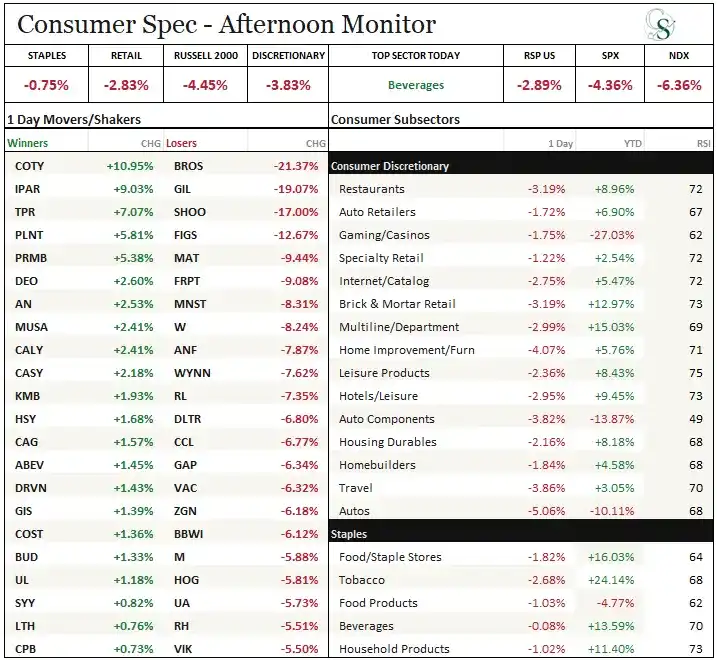
Some companies with higher earnings quality and clear growth momentum are still being sought after.
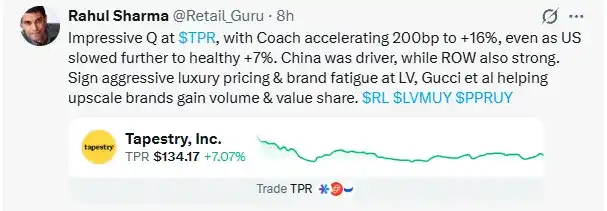
Tapestry (TPR) rose 7.1%. Sales of its Coach brand grew 16%, with international market growth of 30%, and the company simultaneously raised its full-year earnings per share guidance from $7.80 to $7.90 to $8.25 to $8.35.
Costco (COST) rose 1.4%, with October U.S. same-store sales excluding gasoline growing 8.1% and digital-related sales growing 22.6%.
Kimberly-Clark (KMB) rose 1.9%, with North American organic sales returning to positive growth of 0.3%, volume growth of 2%, while also benefiting from capital inflows into the low-volatility factor.
But not all consumer stocks with strong results can continue to rise.
Ralph Lauren (RL) fell 7.4%. The company's revenue reached $2.18 billion, with earnings per share of $4.64, above the market expectation of $4.25, and comparable sales in Asia achieved double-digit growth. However, its revenue growth guidance for the next quarter, excluding currency effects, was only 3% to 4%, slightly below the market expectation of 4.3%, insufficient to support previously high valuation expectations.
Zegna (ZGN) fell 6.2%. Organic sales grew 8.2%, above the market expectation of about 6.8%, but management only reiterated the lower end of its full-year guidance, with currency headwinds and weakness in the Thom Browne brand continuing to weigh on market sentiment.
Wayfair (W) fell 8.2%, completely erasing its post-earnings gains. The company's revenue grew 9.7%, U.S. revenue grew 11.4%, order volume grew 12.2%, and third-quarter margin reached its highest level for the same period since 2020, but these fundamental positives still failed to prevent a share price reversal.
Meanwhile, stocks with clearly weakening fundamentals came under greater selling pressure.
Dutch Bros (BROS) fell 21.4%, mainly because same-store sales growth slowed to 4.4% from 5.8% in the previous quarter, below market expectations.
Gildan (GIL) fell 19.1%, cut its full-year sales guidance by about 10%, lowered its earnings per share guidance from $4.65 to $4.75 to $3.70 to $3.80, and withdrew its financial targets for the next three years.
Steve Madden (SHOO) fell 17%. Although reported revenue grew 16%, all of the growth came from acquired businesses, while organic sales fell 14.8% due to tariff shocks and weak wholesale orders.
These performances reflect that the market is not only repricing companies' future earnings growth, but also assessing more strictly those stocks that already carry high expectations.
It is important to distinguish that not all consumer stock declines stem from a retreat in risk-averse trading. Some can be explained by weak earnings guidance, slowing sales growth, and valuation pressure.
But even companies that beat earnings expectations may be unable to withstand the impact of an overall decline in market risk appetite and capital flows.
This further increases the difficulty of avoiding market declines through simple sector rotation.
When the safe-haven trade itself becomes crowded, what is the market watching next?
The risks currently facing US equities are no longer just about whether AI and semiconductor sectors will continue to decline.
The tech-stock dominance of the past few years is being challenged, and the market has begun searching for broader sources of returns. But in this process, a massive concentration of capital flowing into value, low-volatility and high-dividend sectors has put the new safe-haven trades at risk of becoming crowded as well.
What needs to be watched next are changes at three levels.
First, whether tech stocks can stabilize, and whether a rebound will trigger capital flowing back from safe-haven sectors into growth stocks. If a clear style reversal emerges, the low-volatility and value stocks that have performed strongest recently could come under profit-taking pressure.
Second, whether the broader market decline further translates into liquidity pressure. If investors begin raising cash ratios through indiscriminate selling, then even stocks with solid fundamentals and reasonable valuations may be unable to avoid declines.
Finally, whether multi-manager hedge funds see more position adjustments. The business changes at Walleye may be an isolated institutional event, or they may be an early signal of broader strategy restructuring, and their subsequent development deserves attention.
The core issue revealed by this round of market adjustment is the distinction between the relative resilience of safe-haven assets and their absolute price risk.
Low-volatility, high-dividend and value sectors can reduce a portfolio's dependence on tech stocks, but when a large amount of capital adopts similar strategies, the safe-haven trade itself also creates new concentration risk.
A tech stock rebound could lead to safe-haven positions being withdrawn, while continued declines in tech stocks could force investors to sell safe-haven assets. This means market rotation is no longer simply about switching from one sector to another, but requires simultaneously assessing industry fundamentals, capital flows and position crowding.
In this environment, what is truly hard to avoid is not the decline of any particular sector, but the fact that when more and more investors choose the same safe-haven approach, the original safe harbor may also become the source of the next round of selling.
Welcome to join the official BlockBeats community:
Telegram Subscription Group: https://t.me/theblockbeats
Telegram Discussion Group: https://t.me/BlockBeats_App
Official Twitter Account: https://twitter.com/BlockBeatsAsia
