From November 8 to 13, The New York Times, a newspaper that prides itself as the conscience of American journalism, published 36 reports and commentaries related to Jensen Huang across just four main RSS channels.
Its opinion section ran two columns in less than 24 hours: one made lewd jokes about his black leather jacket and his body; the other, penned by his biographer, turned his early days as a dishwasher and leaving a $1,000 tip for a Denny's waiter into a narcissist's performance of self-pleasing.
Soon after, at least eight major Anglo-American media outlets piled on.
Many people's first reaction is that this is about race. That layer does exist—the old American media playbook for writing about Asian Americans showed up again, every trick in place. But it is only the most superficial layer.
In this public opinion arena that claims to champion press freedom, no article goes viral for no reason, and no moral siege is waged purely out of a sense of justice.
Dongcha Beating dug up the reports from the past few weeks and the newspaper family's history, then cross-referenced the editorial staff's resumes, the money flowing into journalism, and the media owners' respective businesses, and found that behind those two columns lies something deeper.
Beneath race, there are at least four more layers.
The people writing and deciding. A columnist who made his name criticizing the wealthy, a biographer who clashed with Jensen Huang over AI risks, and an opinion page editor who covered news in Hong Kong and Shanghai.
The newspaper itself. A family that holds control through a 0.48% stake, and 13.76 million subscribers with highly concentrated political leanings.
The money flowing into the newsroom. Content licensing fees from AI companies; and foundations focused on AI risks, which fund dozens of AI journalists across various newsrooms.
The people sitting at the table. Billionaires who bought major newspapers and TV networks, whose family businesses almost all revolve around AI; and Silicon Valley upstarts who control social algorithms and have their own narrative machine.
These relationships are almost invisible to readers on the pages. Nor does anyone need to coordinate among them. Each party is simply doing what benefits itself, and in November 2026, they all took aim at the same person.
So the Jensen Huang presented in the pages of mainstream American media is a narrative product jointly manufactured by these forces.
What we want to criticize is precisely the malice, double standards, and desire to manipulate the narrative displayed by mainstream American elite media, represented by The New York Times, in this matter.
Two Articles
On the night of November 11, The New York Times opinion section published its first column. At that time, three days had passed since Jensen Huang sent an apology letter to all employees, and the Nvidia board was still discussing whether he should stay or go. The author was Anand Giridharadas, and the title was "Jensen Huang Betrayed the Leather Jacket Community."
The entire article used a sarcastic, trolling tone. He pretended to be a representative of middle-aged leather jacket enthusiasts, complaining that Jensen Huang's scandal had ruined the reputation of leather jackets. In the subtitle, he wrote that one person's physical failure should not tarnish our "second skin." In the body, he wrote a rather vulgar line, to the effect that one should not throw out the innocent lambskin just because of the "lustful flesh" beneath the leather jacket.
This is the response given by the opinion section of America's largest newspaper in the face of the year's biggest corporate governance crisis.
But just three years earlier, the same piece of clothing had been a different symbol in The New York Times. On June 14, 2023, the paper's chief fashion critic, Vanessa Friedman, wrote a feature titled "Is This a $1 trillion Look?", treating Jensen Huang's black leather jacket as a symbol of the AI era. On July 17 this year, a signed Tom Ford leather jacket that Jensen Huang had worn in Taipei was auctioned at Sotheby's, with an estimate of $40,000 to $60,000. 45 collectors placed 65 bids, and it finally sold for $960,000, with all proceeds donated to charity.
On the day Jensen Huang announced his resignation on November 12, the opinion section published a second column.
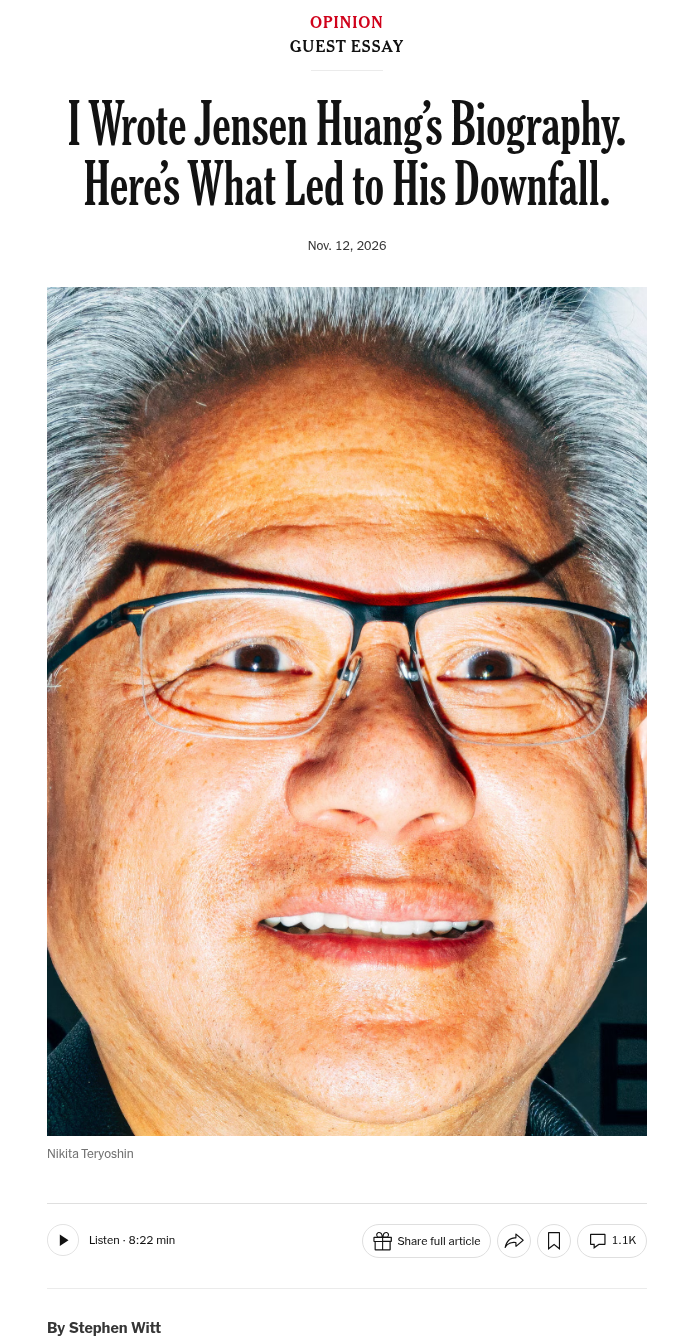
The author was Stephen Witt, Jensen Huang's biographer, and the title was "I Wrote Jensen Huang's Biography, and This Is What Caused His Downfall."
To write the biography "The Thinking Machine," published in April 2025, Witt was granted close access to observe Jensen Huang and Nvidia. He interviewed Jensen Huang himself six times, as well as his friends, investors, and employees. The book won the Financial Times and Schroders Business Book of the Year Award, was translated into 23 languages, and brought him both fame and fortune.
On the day Jensen Huang fell, this biographer appeared simultaneously on The New York Times op-ed page and the paper's flagship podcast Hard Fork, framing the whole affair as "an old story about male arrogance," and quoting an anonymous former employee saying that the office romance gave Jensen Huang "a narcissist's thrill."
He admitted that he had heard rumors of Jensen Huang's affairs earlier this year but could not confirm them. Yet when comparing Jensen Huang to Trump, he still wrote that both had "rage, narcissism, and a weakness for the ladies." Three days later, an interview he recorded in April this year was dug up, in which he said Jensen Huang "has a cult-leader quality about him."
The most vicious part of the entire article was the section about tips.
Witt wrote that Jensen Huang "worked as a dishwasher, and he never lets you forget it." He liked going to corner diners and liked leaving exaggerated tips. Once, while the two were having breakfast at Denny's, Jensen Huang left the waitress $1,000. Witt himself admitted that Jensen Huang did not make a show of it when giving the money, and that he only found out afterward by asking the waitress.
Immediately after that, Witt wrote a line that cut to the bone. He said, "I began to suspect this was a performance," and one performed for Jensen Huang himself, to please himself.
An immigrant boy sent to a reform boarding school in Kentucky at age 9, scrubbing toilets every day, washing dishes and waiting tables at Denny's at 15, who after achieving fame and success returns to the cheap fast-food restaurant where he once worked and quietly leaves a waitress a $1,000 tip without making a show of it—on the pages of The New York Times, generosity has no possible innocent interpretation.
American writer Janet Malcolm wrote at the beginning of The Journalist and the Murderer, published in 1990, something to the effect that every journalist who is not too stupid or too full of himself to notice what is going on knows that what he does is morally indefensible, gaining the subject's trust like a con man and then stabbing him at the moment he is most unguarded.
In fact, more than a month earlier, Witt had already written about Jensen Huang once in The New York Times.
On October 7, a month before the scandal erupted, Witt published a long article in The New York Times criticizing Jensen Huang for ignoring AI risks and for being too close to Trump, but the article also said, "Mr. Huang is the most capable person I have ever met."
What kind of person wrote these two articles, and what kind of person decided to put them on the page?
First, look at the leather-jacket guy Anand Giridharadas.
In the pages of The New York Times, this 45-year-old author is a vanguard critic of the wealthy class. In 2018, he published the bestseller "Winners Take All," criticizing Silicon Valley and Wall Street billionaires for using philanthropy to mask plunder, and thereafter became the most sought-after moral star in American liberal intellectual circles.
But his own origins are precisely the class he criticizes—growing up in a wealthy area of Cleveland, his father was a director at McKinsey, that is, a senior partner. He studied at the University of Michigan, Oxford University, and Harvard University, and his first job after college was in McKinsey's Mumbai office. In 2011, he received the Henry Crown Fellowship from the Aspen Institute, entering a top elite circle funded by super-wealthy patrons.
In the framework of "Winners Take All," the generosity of the wealthy is inherently suspect—every charitable donation is whitewashing privilege.
Now look at Stephen Witt, who wrote about tips as a hypocritical performance.
Witt is 47 this year and graduated from the University of Chicago's mathematics department in 2001. Before becoming a nonfiction writer, he worked for six years at hedge funds in Chicago and New York. In 2008, he left the financial industry to do economic development work in Africa, entered Columbia University's journalism school around 2010, and then changed careers to write books.
Over the past year, he has been one of the authors on The New York Times op-ed page continuously discussing AI risks. In the final interview for the Jensen Huang biography, Witt pressed Jensen Huang on AI dangers, provoking anger from Huang, who has consistently rejected AI doomsday theories.
We have no way of knowing Witt's true motives when writing that article on November 12, but readers should at least know that this biographer and Jensen Huang had a direct confrontation over AI safety-related issues long before.
And the person who put these two articles on the page at the same time is Kathleen Kingsbury, editorial page editor of The New York Times.
Kingsbury took over the op-ed page in the summer of 2020. At the time, former editorial page editor James Bennet resigned after publishing a column by Senator Tom Cotton advocating sending in troops to quell protests, sparking internal controversy at the newspaper. After taking office, Kingsbury cut the op-ed page's overall output by about 25% to 30%. In an interview with the Columbia Journalism Review in August this year, she said the op-ed page would require authors to go back and contact the people they criticize, giving them a chance to respond.
But on November 11 and 12, whether it was Giridharadas's vulgar mockery or Witt's "narcissist's thrill," no response from Jensen Huang's side could be seen on the page.
Kingsbury's resume is equally nuanced. She graduated from Georgetown University's School of Foreign Service as an undergraduate, studied Chinese at Georgetown and Fudan University, and later went to Shanghai on a Pulitzer Traveling Fellowship from Columbia University's Graduate School of Journalism. She worked as a correspondent for Time magazine in Hong Kong and for BusinessWeek in Shanghai. An editor who has reported in Hong Kong and Shanghai and studied Chinese should not be unfamiliar with the decorum and taboos of Chinese society.
It was she who made the final call to publish these two articles.
The Line-Crossers
But even if these three elites themselves carry arrogance and personal grudges, why would they dare to write about the founder of the world's most valuable company in a tone that borders on personal insult?
If the person who committed the same mistake were not Jensen Huang, a Chinese immigrant from Taiwan, but a native-born white American CEO, how would The New York Times have written about it?
There are plenty of precedents. In 2018, Intel's white CEO Brian Krzanich was forced to resign over a relationship with an employee; in 2019, McDonald's white CEO Steve Easterbrook was fired by the board for having a relationship with an employee; in 2023, BP's white CEO Bernard Looney lost his job for failing to disclose a relationship with a colleague.
We pulled up The New York Times' coverage of those three scandals at the time, and most of it stayed within the scope of corporate governance, board independence, and compliance investigations. We did not find any column mocking Krzanich's clothing, nor any biographer digging into whether Easterbrook's early tips to waiters were a narcissist's performance, and no one wrote jokes about their "lustful flesh."
In 2021, Bill Gates' extramarital affair with an employee during his time at Microsoft, as well as his pursuit of female employees in the workplace, were exposed. The New York Times published a long investigative report, and its opinion section also ran columns criticizing him, but we did not find any article writing that his iconic sweater betrayed the sweater community.
The most naked double standard occurred with Bezos.
In early 2019, the extramarital affair and private text messages of Amazon founder Bezos were exposed by the tabloid National Enquirer. Bezos then published a long post accusing the tabloid of extortion. A few days later, Maureen Dowd, one of The New York Times' most influential columnists and a Pulitzer Prize winner, wrote a dedicated column that included the framing line "But at least for now, he is a hero."
Both are tech giants with fortunes in the hundreds of billions, both betrayed their marriages, yet Bezos became a hero fighting tabloids in a New York Times op-ed, and no one ever demanded he leave Amazon; Oracle founder Larry Ellison has had endless scandals throughout his life, and no one has ever touched his CEO position.
Only in the case of Asian founder Jensen Huang did he lose the company he built over 33 years within four days, and the New York Times stripped him of his leather jacket, denied his dishwasher origins, and paraded him on a cultural guillotine for public shaming.
Why?
Because in the subconscious of mainstream American elites, Huang's unforgivable offense is that he broke the caste boundaries that white American society has drawn for Asians.
In 1999, political scholar Claire Jean Kim proposed a "racial triangulation" model. On the dimension of diligence and intelligence, mainstream American narratives desperately elevate Asians, but on the dimension of cultural belonging and political legitimacy, Asians are pinned to the position of "forever foreigners," forbidden from entering the true core of power.
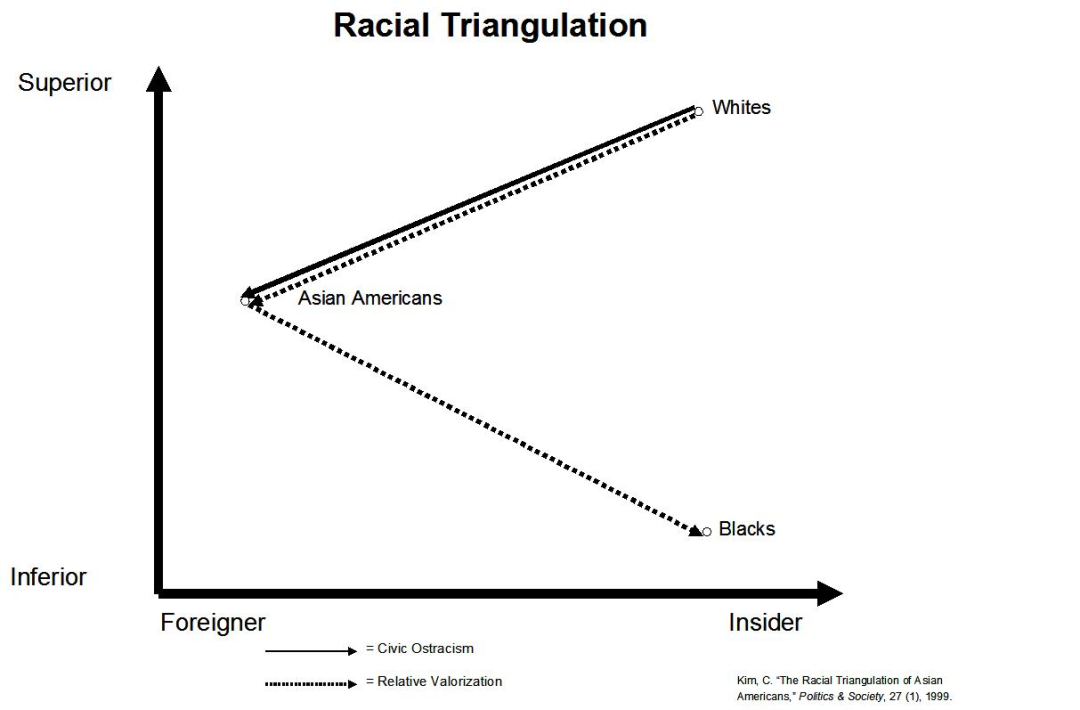
In 2001, scholar David Eng said in Racial Castration that the premise for mainstream American culture to accept Asian men is to first "de-masculinize" them. A safe Asian man is preferably a dull engineer hunched over code in a cubicle.
Jensen Huang refused to stay in that cage.
In Silicon Valley, where Asians have long been suppressed by the "bamboo ceiling," he turned a graphics card company once on the brink of collapse into the world's most valuable company. He wears Tom Ford and motorcycle leather jackets, gives speeches in packed arenas like a rock star, and chats and laughs with presidents and world leaders. Marlon Brando and James Dean wearing black leather jackets was the rebellious privilege of white men; a yellow-skinned immigrant in a black leather jacket commanding the global tech world is, in the eyes of some American cultural elites, an overreach.
And Witt's portrayal of the $1,000 tip Huang quietly left as a pathological psychology of self-gratification uses the same old craft that American journalism has passed down for 150 years: the inscrutable Asian.
From the 1873 San Francisco Chronicle headline "The Chinese Invasion, 900,000 Are Coming," to the 1882 Chinese Exclusion Act, to the screen image of Fu Manchu, the core of this rhetoric is that Asian politeness is a mask, humility is a disguise, and generosity must hide calculation. As Walter Lippmann said, "Most of the time we do not see before we define, but define before we see."
The label of "perpetual foreigner" attached to Jensen Huang has a more specific implication.
A team led by Princeton University sociologist Yu Xie analyzed all 267,000 China-related articles published by The New York Times from 1970 to 2019, finding that how the newspaper covered China in a given year could explain 54% of the variation in American public opinion toward China the following year. Coverage involving the government and ideology was negative more often than positive every year over five decades.
However, if this siege were explained solely by skin color and ethnicity, many things still wouldn't add up.
The loudest voices defending Jensen Huang were, precisely, a group of white people. Musk said bringing Jensen Huang on board "would be an honor," Sequoia's Shaun Maguire said he is "irreplaceable" to America's AI leadership, Bill Ackman said "even great people make mistakes," and Epic Games founder Tim Sweeney said the board ousting him was as foolish as Apple ousting Steve Jobs.
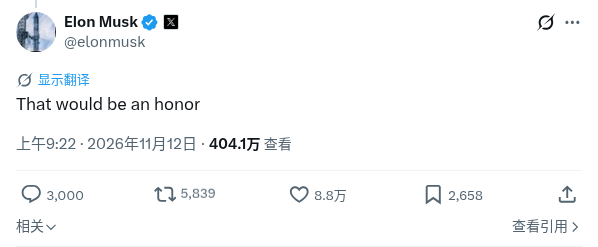
Race provided the caustic weapon, but it was not the trigger that fired the shot.
Why did The New York Times choose this particular moment to cast Jensen Huang as an irredeemable villain? To answer that question, one must look at the business conducted behind closed doors in that building.
Two-Faced
The New York Times dares to posture as America's highest moral tribunal, relying on the slogan printed in the upper-left corner of its front page for over a century—"All the News That's Fit to Print"—and on the pledge made by founder Adolph Ochs in 1896: "without fear or favor."

Who decides what news is "fit to print" and who counts as morally corrupt?
The answer is the Ochs and Sulzberger families.
As of March 2026, The New York Times Company had 161 million Class A shares trading on the secondary market, plus 780,000 non-publicly traded Class B shares. These 780,000 Class B shares account for only 0.48% of total equity, yet they can elect 9 of the 13 board members. 94.6% of all Class B shares are locked in family trusts, whose charters require trustees to veto any sale or merger that could cause the family to lose control.
Earlier this year, Buffett's Berkshire bought about $350 million worth of New York Times stock, but with that 0.48% of inherited privileged shares, even the Oracle of Omaha couldn't secure a single board seat.
Since this family's newspaper displays such strong moral puritanism regarding Jensen Huang's extramarital affair and office romance, we might as well delve into this family's own stories.
The family history book "The Trust," published in 1999, records that Arthur Hays Sulzberger, the publisher who helmed The New York Times from 1935 to 1961 and the great-grandfather of current publisher A.G. Sulzberger, had a years-long extramarital affair with British actress Madeleine Carroll.
As for the current publisher's father, the fourth-generation publisher Arthur Sulzberger Jr., in 2008, he separated and divorced his first wife after 33 years of marriage, remarried in 2014, and then divorced again a few years later. In August 2021, the New York Post's gossip column Page Six reported that the divorce "turned ugly," with his ex-wife accusing him of not adhering to the prenuptial agreement.
According to a February 2023 profile in New York magazine, around the time Page Six reported on the matter, Sulzberger Jr. brought in Risa Heller, one of Manhattan's most prominent crisis PR experts.
Risa Heller's clients have included politician Anthony Weiner, embroiled in a lewd photo scandal in 2011; Harvey Weinstein in 2015; and CNN president Jeff Zucker, who resigned in 2022 for concealing a relationship with a colleague. In October 2022, she hosted a book party at her apartment overlooking the East River, with a resale value approaching $5 million, for Maggie Haberman, The New York Times' most high-profile political reporter, with a slew of the paper's editors and reporters in attendance.
On one side, there's the newspaper-owning family's own extramarital affairs and divorce disputes, shielded by family trusts and managed by crisis PR; on the other, a Taiwanese immigrant engineer without the protection of a family trust makes a mistake, and this family's newspaper transforms into a moral crusader, splashing his leather jacket across its pages for public shaming.
Joe Kahn, the executive editor who holds the reins of the paper's daily news operations, also hails from this elite circle. His father, Leo Kahn, was a co-founder of the office supplies chain giant Staples.
He himself attended the elite boarding school Middlesex School before Harvard, earned a master's in East Asian studies, and from 1989 worked as a China-based correspondent for the Dallas Morning News and The Wall Street Journal, serving as The New York Times' Beijing bureau chief from 2003 to 2007. The person who today leads The New York Times newsroom began his career precisely by scrutinizing China.
But a more direct driver than family privilege and a résumé of top editorial roles is the way the newspaper makes money has changed.
The New York Times of the past survived on department store and auto advertising, and its benefactors preferred steady, inoffensive reporting that alienated no one; today's New York Times survives on subscribers whose political stance is highly purified.
In the third quarter of 2026, The New York Times posted quarterly revenue of $768.5 million, of which about 71% came from 13.76 million subscribers, with advertising accounting for only 19%. A 2010 study by economists Gentzkow and Shapiro also found that the primary factor determining an American newspaper's political lean is reader preference.
Simply by tracing, in line with subscriber tastes, how The New York Times has written about Jensen Huang over the past three years, one can see a noose tightening step by step.
In 2023, he was a novelty in the style section with his "trillion-dollar look"; on December 5, 2024, the investigative report "How One of the World's Richest People Avoided $8 billion in Taxes" placed him in the "rich and heartless" column; in July 2025, the focus shifted to his lobbying of Trump to ease chip export restrictions; in September 2026, the paper's star columnist Ezra Klein went to Nvidia headquarters and recorded a confrontational face-to-face interview; and by November, Witt pointed out in his column that Huang's growing closeness to Trump "is no coincidence."
In the eyes of these 13.76 million liberal subscribers, an Asian hardware giant worth hundreds of billions, who does not believe in AI doomsday scenarios and is growing closer to Trump, is inherently a perfect villain. Attacking him is a business that reliably earns subscription fees.
The newspaper also has a layer of its own vested interests.
In December 2023, The New York Times sued OpenAI and Microsoft in federal court, accusing them of using millions of articles to train large models without permission; in December 2025, it sued the AI search company Perplexity. Neither case has been decided, and in the third quarter of this year alone, the newspaper recorded $3.8 million in "generative AI litigation expenses." In this litigation, Jensen Huang stands behind the defendants: Nvidia is OpenAI's most important computing power supplier, announced in September 2025 that it would invest up to $100 billion in OpenAI, and is also an investor in Perplexity.
On the other side, The New York Times signed an AI licensing agreement with Amazon in May 2025, allowing Amazon to use its news, recipes, and sports content to train its own models, with licensing fees reportedly around $20 million to $30 million a year. Amazon's self-developed Trainium chips are competing with Nvidia for business.
Suing Nvidia's customers, taking money from Nvidia's competitors, and then trying Nvidia's founder in the pages of its paper—these two layers of conflict of interest fall outside the scope of any existing disclosure rules, and across 36 reports about Jensen Huang, The New York Times indeed did not mention a single word of it.
The person who should have been watching these shenanigans for readers was laid off nine years ago. On May 31, 2017, The New York Times eliminated the "public editor" position it had established 14 years earlier—the only independent watchdog inside the newsroom specifically tasked with finding fault with the paper on behalf of readers.
Underwater Revenue
But The New York Times was not the only one besieging Jensen Huang this time. What about those British and American media outlets that piled on, flooding the internet with leather-jacket jokes within 48 hours?
Beyond subscription and advertising revenue, American journalism has quietly acquired two additional streams of underwater income in recent years.
The first comes from AI companies.
Nearly every media outlet that joined The New York Times in mocking that leather jacket has signed lucrative content deals with AI giants.
The Washington Post signed with OpenAI in April 2025; Business Insider's parent company signed a contract with OpenAI as early as 2023 worth tens of millions of euros annually, and subsequently expanded its partnership with Microsoft; The Guardian reached a deal with OpenAI in February 2025; The Independent joined Perplexity's revenue-sharing program; Forbes simultaneously collects licensing fees from Amazon Alexa+ and Google; even New York Magazine—home to The Cut, the fashion outlet that joined the mockery—had its former owner Vox Media sign an agreement with OpenAI in 2024.
But even more directly influential on agenda-setting than copyright fees is the second stream of money—targeted funding from "AI safety and risk" foundations.
Coefficient Giving, funded by Facebook co-founder Dustin Moskovitz and formerly known as Open Philanthropy, is one of the most important financiers of the effective altruism camp. The foundation has granted over $4.7 million to the Tarbell AI Journalism Center, which specifically funds AI coverage.
The New York Post disclosed that the entire EA camp has funded and placed more than 80 full-time journalists across major mainstream newsrooms in Europe and America.
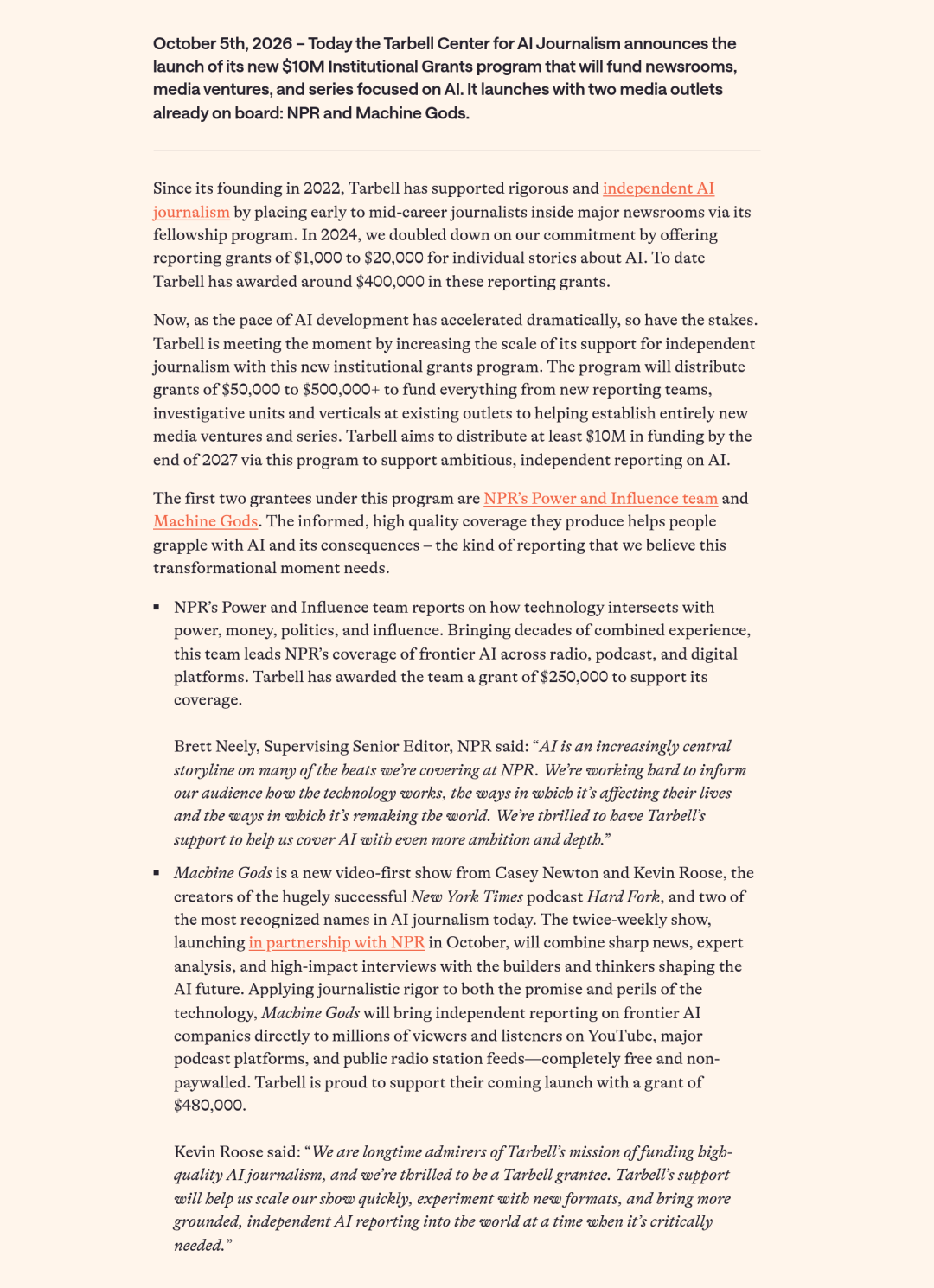
The money also flowed to louder, top-tier opinion leaders. The New York Times tech podcast Hard Fork—the flagship podcast that invited biographer Witt on the show the day Jensen Huang resigned to sharply criticize him—saw its two former hosts, Kevin Roose and Casey Newton, launch a new program called Machine Gods in collaboration with NPR after going independent. Tarbell directly allocated $480,000 to this program and casually allocated another $250,000 to NPR's "Power and Influence" reporting team.
As for The New York Times' top columnist Ezra Klein, who went to Nvidia headquarters in September this year to confront Jensen Huang face-to-face, he publicly stated as early as 2021 when appearing on the EA core podcast 80,000 Hours that he supports foundation funding for journalism: "I like the model of building institutions within institutions." Future Perfect, a vertical under Vox, which he co-founded, received $200,000 in funding from the SBF family foundation in 2022.
The AI company with the deepest ties to this circle is Anthropic. Its 2021 Series A was led by EA spiritual leader Jaan Tallinn, with Moskovitz also participating. Its CEO Dario Amodei and Jensen Huang have publicly debated chip exports and AI risks for two years, with Huang saying he "almost entirely disagrees" with what Amodei says. On November 19, one week after Jensen Huang's resignation, Anthropic will list on Nasdaq.
We must draw the boundary clearly: there is no public evidence directly proving that these foundations, Anthropic, or these journalists participated in pushing Jensen Huang out. Nvidia itself remains Anthropic's chip supplier and investor.
But money underwater never needs to directly buy a particular article. It only needs to insert dozens of journalists carrying the same framework into major newsrooms, and it can determine what moral vocabulary the entire Western media circle will use to write his eulogy when Jensen Huang, who never took AI doomerism seriously, falls.
Two Machines
Having examined the authors who wield the pen, the newspaper families, and the foundations underwater, we are finally about to touch the core structure.
In this siege, why would rivals like The Washington Post and The Wall Street Journal align with The New York Times? Why would Musk, Peter Thiel, and this group of Silicon Valley right-wingers desperately defend Jensen Huang?
A hundred years later, there are at least two such "invisible governments" in the United States. They are hostile to each other, yet in November 2026, they targeted the same person.
The first is the owners of traditional media.
Today's top US media outlets are mostly held by a few families. These families have their own positions at the AI table—some are Nvidia's competitors, some are its most indispensable customers, and some sell content to its biggest buyers.
For them, Nvidia, with its market cap swelling to a peak and gross margins exceeding 70%, is no longer just an ordinary chip supplier, but the computing power creditor that the entire Silicon Valley and Wall Street most want to escape.
Bezos is both a customer and a competitor of Nvidia.
In 2013, he bought The Washington Post for $250 million. His Amazon is a major Nvidia customer, and its self-developed Trainium chips are competing with Nvidia's business. CEO Andy Jassy said in his April shareholder letter this year that if Amazon's chip business were separated, revenue would exceed $50 billion. Amazon had already invested $8 billion in Anthropic and in April this year committed up to another $25 billion. Bezos himself last year also became co-CEO of AI startup Project Prometheus, which secured $6.2 billion upon founding.
He is not a boss who leaves the newsroom alone. Before the 2024 election, The Washington Post pulled a prepared editorial supporting Harris. The publisher who announced it, William Lewis, was the same person who in 2020 at The Wall Street Journal only expressed "regret" over the "Sick Man of Asia" headline.
Next, the Murdoch family, selling content to Nvidia's biggest buyer.
Its Wall Street Journal was first to report on November 11 that "Nvidia is preparing to oust CEO Jensen Huang," and two days later an editorial was titled "Jensen Huang Certainly Has to Go." The same family's New York Post ran a front-page headline on November 9: "HUANG HUANG BANG BANG," punning on Huang's surname, which drew criticism from the Asian American Journalists Association.
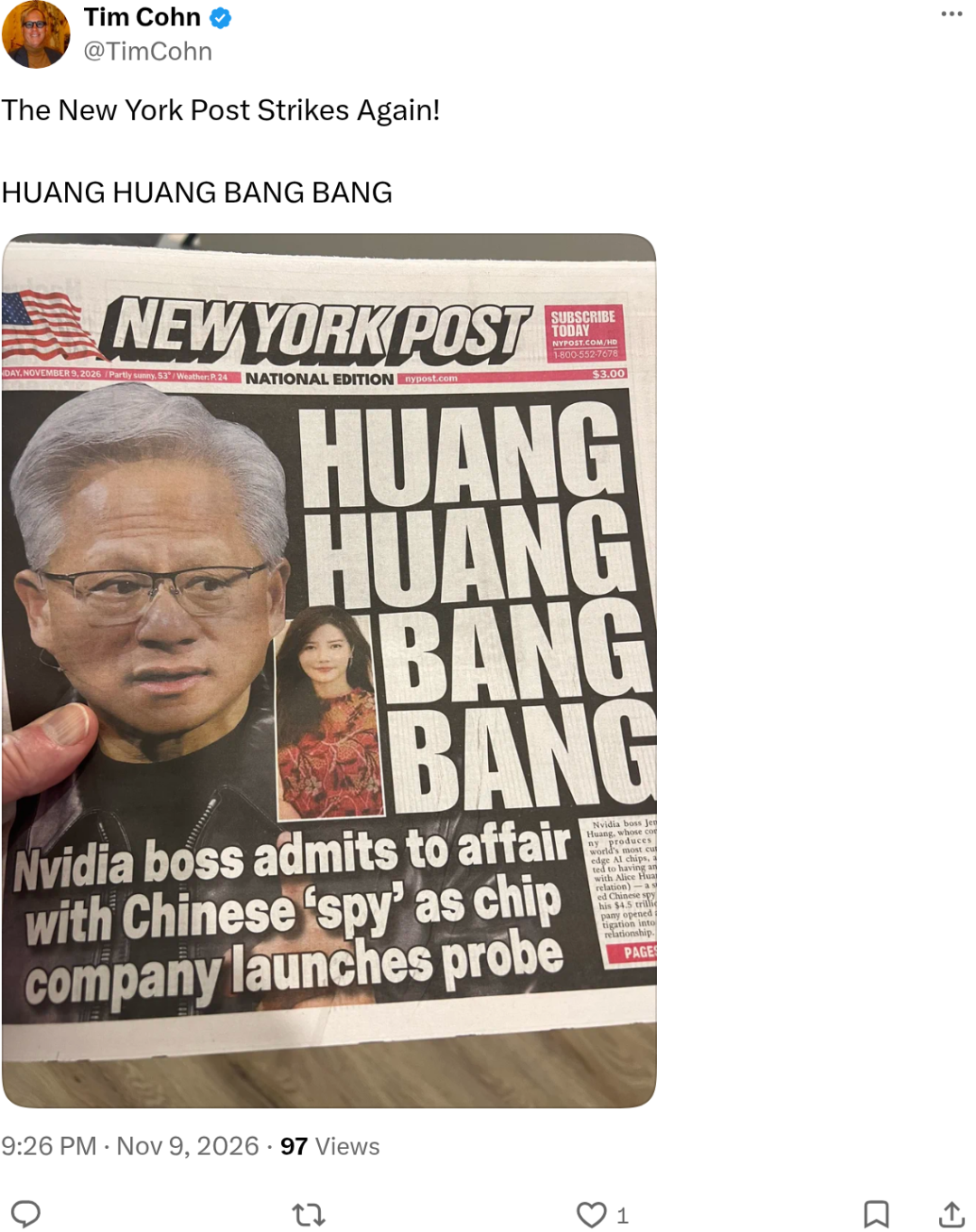
Murdoch's News Corp signed a 5-year content licensing deal with OpenAI worth over $250 million, and in March of this year signed another deal with Meta worth up to $50 million annually. Both companies are among Nvidia's largest buyers and are also developing their own chips, hoping to pay less of the "Nvidia tax."
What kind of Nvidia do the people paying Murdoch most want to see?
The Ellison family sits on the opposite side. Oracle has no AI chips of its own and is one of Nvidia's most indispensable customers. In October of this year, the Ellison family-controlled Paramount completed its acquisition of Warner Bros. Discovery, bringing CBS News and CNN under the same family name. Larry Ellison's Oracle is one of Nvidia's largest customers; according to a 2025 Financial Times report, for the Stargate data center in Abilene, Texas alone, Oracle is set to buy approximately 400,000 GB200 units.
After Jensen Huang's resignation, the CBS News headline read: "Jensen Huang's Departure Shakes Nvidia, Opening Opportunities for Rivals in the AI Boom." No leather jacket, no tips — it reads more like an industry briefing.
Once you understand this card table, you can understand the calculations of these media bosses.
The deeper Nvidia's moat and the more irreplaceable Jensen Huang's personal aura, the more passive downstream major manufacturers and cloud giants become at the computing power negotiating table. An Nvidia that has lost its creator god and returned to rule by professional managers is exactly what all the giants buying and building chips have been longing for.
And on the opposite side of the traditional media machine, the Silicon Valley tech right — led by Musk, Peter Thiel, and Marc Andreessen — is starting up a second machine.
This group has long-standing grievances with the traditional elite media. In 2007, Gawker's Valleywag forcibly outed Peter Thiel as gay. Thiel bided his time for years, then secretly funded roughly $10 million to help wrestling star Hulk Hogan sue Gawker, driving the outlet into bankruptcy in 2016.
Right-wing thinker Curtis Yarvin lumped The New York Times and Ivy League universities together as "the Cathedral," mocking this group of liberal elites for monopolizing moral interpretation like the medieval church; in 2023, Andreessen, in his "Techno-Optimist Manifesto," simply put "tech ethics" and "trust and safety" directly on his list of enemies.
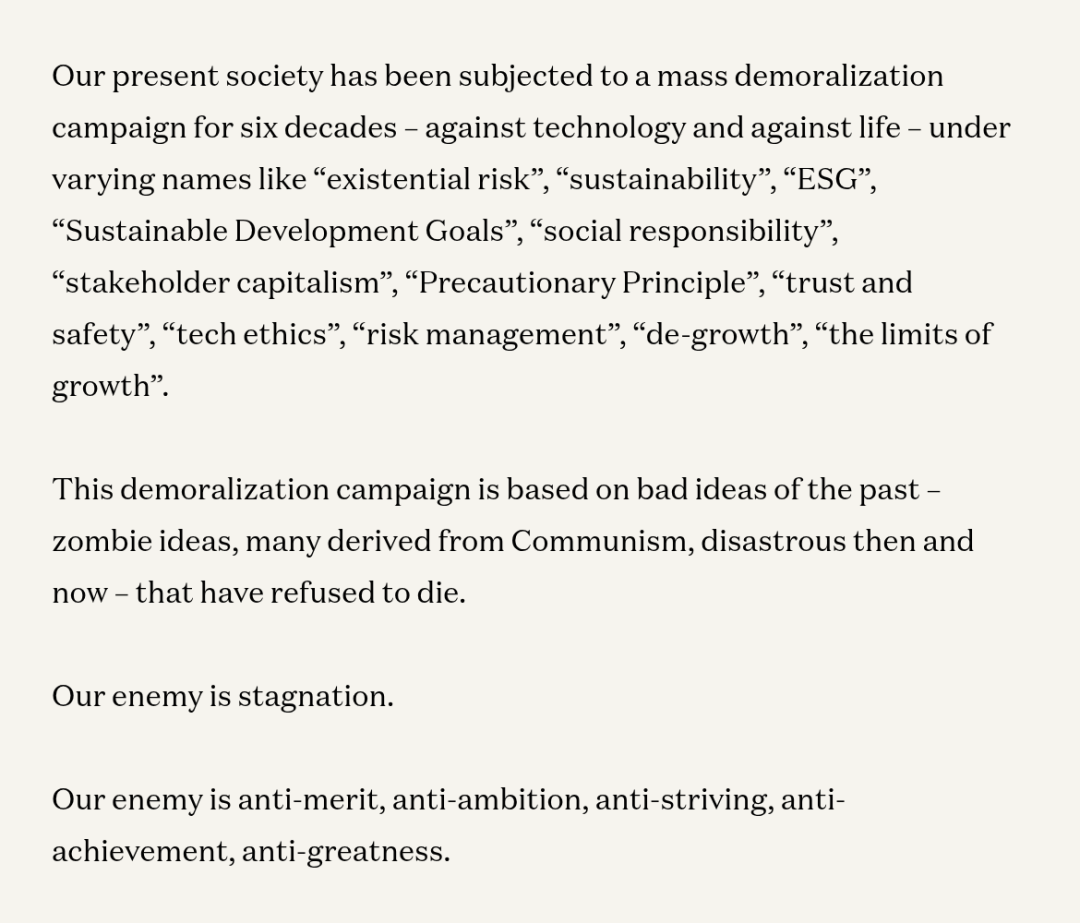
Facing traditional media whose public trust has fallen below 28% in Gallup surveys, the Silicon Valley right's tactic is to bypass journalists and control the distribution machinery themselves.
Musk is even more capricious—he simply bought Twitter. On Super Bowl night in 2023, because his own tweet's view count was lower than Biden's, the next day Twitter's engineering team rolled out a "superuser multiplier" that applied only to him, forcibly amplifying his tweet weight by 1,000 times.
When The New York Times went after Jensen Huang's leather jacket to curry favor with liberal subscribers, Musk and the Silicon Valley right immediately realized the prey had delivered itself. A tech hero who created a $1 trillion market cap being besieged by The New York Times in such a despicable manner was simply a perfect case to prove that "traditional media has completely rotted and become a liberal smear machine."
Sacrifice
In 1974, French television broadcast an interview with Hannah Arendt, in which she said, "If everyone always lies to you, the consequence is not that you believe the lies, but rather that nobody believes anything any longer," and a people that no longer believes in anything can no longer make judgments—"and you can do with them whatever you please."
Back to the last question: why did all the undercurrents, hostility, and calculations converge at this very moment in November 2026, choosing Jensen Huang?
In March of this year, Fortune magazine reporter Sharon Goldman wrote an article asking a question. Anger at AI is burning everywhere across society—some fear it will steal jobs, some fear it will devour electricity and create bubbles—so why is Jensen Huang never the one getting blamed? Her explanation was that in a gold rush, the people selling shovels are rarely scrutinized; the ones at the center of public fury back then were the railroad tycoons, while the companies supplying steel rails to the railroads were rarely remembered.
Eight months later, the shovel seller's protective umbrella shattered.
According to statistics from the UK's Financial Times, since June of this year, the shovel-seller sector supplying data centers has evaporated $4.2 trillion in market value; on October 16, US tech stocks wiped out more than $1 trillion in a single day, international oil prices broke $100, and the 10-year Treasury yield broke through 5%.
Wall Street, Silicon Valley, and Washington are all shrouded in the same fear: hundreds of billions of dollars are being poured into the computing power black hole every year, and if it ultimately cannot be converted into commercial returns, who will take the blame for the most expensive bubble in human history?
On the day of the crash on October 16, Jensen Huang was still in Berlin telling reporters, "This too shall pass." Less than four weeks later, he himself was pushed onto the altar.
French thinker René Girard, in his 1982 book "The Scapegoat," summarized the pattern by which human societies resolve collective anxiety in times of crisis as four characteristics of collective persecution.
First, a crisis that makes everyone feel order is about to collapse; second, an accusation capable of arousing moral outrage, most commonly sexual transgression; third, the chosen person bears distinct "victim markers"—either a foreigner who can never truly assimilate into the mainstream ethnic group, or a king standing at the very top of the pyramid—and a Chinese tech titan in a black leather jacket happens to be both; fourth, a citywide unanimous moral execution.
Girard also wrote that after the scapegoat is expelled from the city-state and the panic temporarily subsides, the people in the city-state often begin to miss him, and even re-deify him.
On November 17, Nvidia will release its latest quarterly earnings report—the first earnings call in the company's 27 years as a public company without Jensen Huang present. The Financial Times reported yesterday that Huang has privately discussed with those around him the possibility of returning.
One day later, on November 18, The New York Times' annual DealBook Summit will open as usual at the jazz hall of Lincoln Center in New York.
This is the newspaper's most grand vanity fair each year, and also an excellent business—as early as 2022, a single ticket sold for $2,499. The host is The New York Times' star financial journalist Andrew Ross Sorkin, and seated on stage are still the most powerful people in America.
Sorkin announced this year's list on October 13.
The list includes OpenAI CEO Sam Altman and President Greg Brockman, Microsoft CEO Satya Nadella—the two companies The New York Times is currently suing in federal court; the list also includes David Ellison, who has just brought CBS and CNN into his family's fold, Vice President JD Vance, and Musk.
Three days earlier, on November 13, Musk had just announced on X that he would sign his name to the petition to retain Jensen Huang.
And under the spotlight at Lincoln Center, they will soon be sitting together again, laughing and chatting.
Welcome to join the official BlockBeats community:
Telegram Subscription Group: https://t.me/theblockbeats
Telegram Discussion Group: https://t.me/BlockBeats_App
Official Twitter Account: https://twitter.com/BlockBeatsAsia
