At 10:30 PM Beijing time on November 19, Anthropic rang the bell at Nasdaq.
Eight people stood in the frame, wearing badges of the pixel crab mascot Clawd. Dario Amodei lowered his head and finished reading a script, declaring that the company "will not bow to commercial or political pressure." As the bell's echo settled, he raised both hands, palms up, and smiled, while those beside him applauded in unison.
When the video spread on social media, the same word surfaced repeatedly in the comments: pseudo-human. The smile didn't look like a smile, the applause didn't look like applause, and even the way they stood on stage carried an indescribable awkwardness.
Pseudo-human was originally a concept from horror stories. In 2021, a young American began serializing analog horror short films online, featuring a creature that looks exactly like a human, silently replaces the people around you, and only reveals flaws in the most minute details.
What makes the pseudo-human most unsettling is that it is almost exactly like the real thing.
Anthropic—the root of the word means precisely "pertaining to humans." Its biggest business is building something that increasingly resembles a human, then spending countless efforts investigating whether this creation has consciousness, whether it lies, whether it understands pain. As for the few people who built it, the mysteries surrounding them are no fewer than those of the machine they created.
Weight
Deep within the prospectus lies an arrangement. Anthropic issued only one share of Class F common stock, injected into an entity called Founder LLC, exclusively locking up 50.1% of all voting power. This single share is controlled by seven people: Dario Amodei, Daniela Amodei, Tom Brown, Jack Clark, Jared Kaplan, Sam McCandlish, and Christopher Olah.
Among the seven, the one earliest prophesied to rise to prominence was Dario.
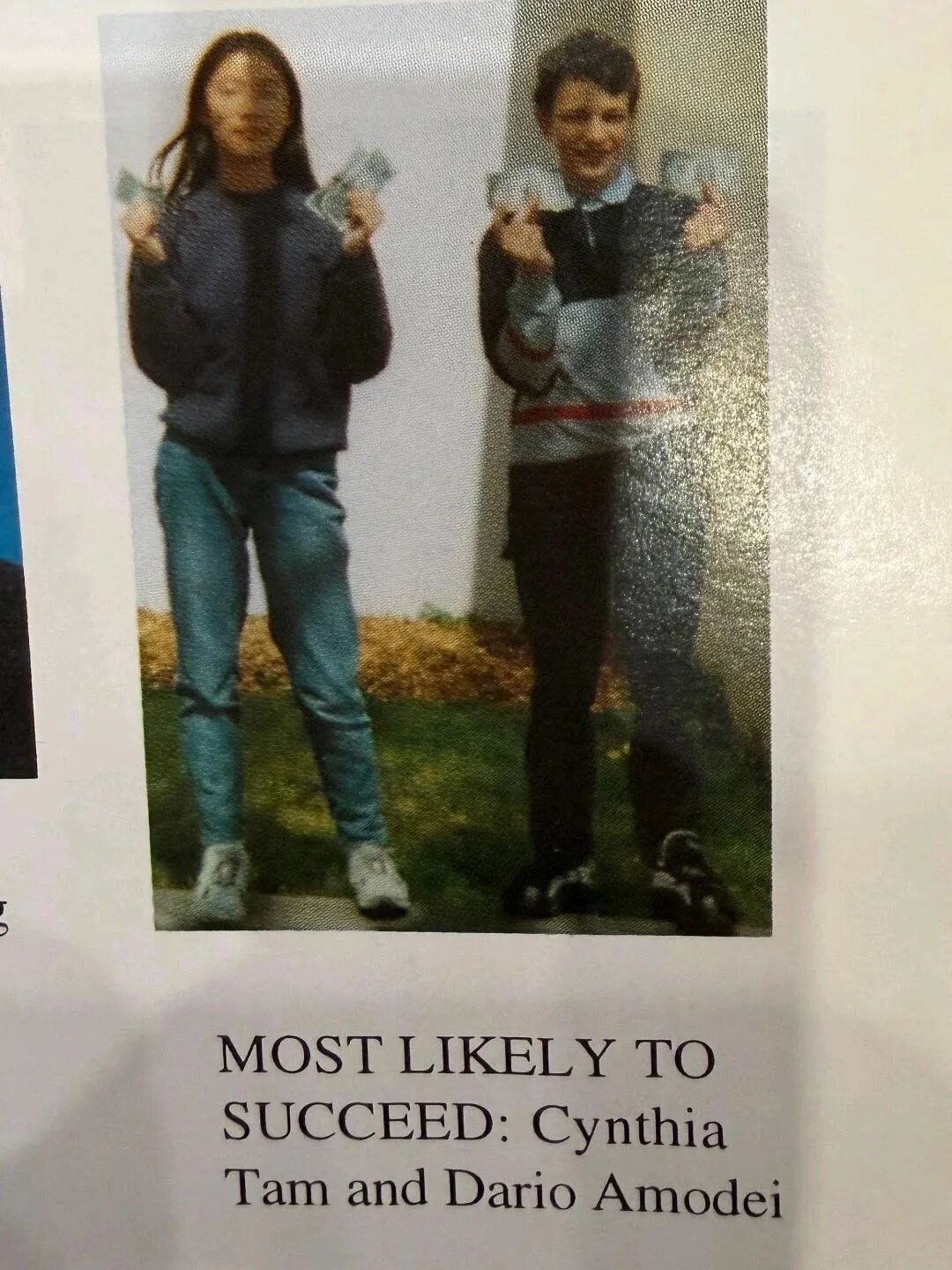
In 1997, in the graduation yearbook of an alternative school in San Francisco, eighth-grader Dario and another classmate were voted "Most Likely to Succeed." In the photo, the two boys each clutched a few dollar bills, as if they had received the future in advance.
He grew up in the Mission District, surrounded by murals. His father, Riccardo, was a leather craftsman who had emigrated from Tuscany, spending his life working with hides and needles and thread; his mother was in charge of renovation projects for the public library.
Dario had long been accustomed to treating the world as a problem to be solved. In high school he went to Berkeley to take courses, pondering utilitarianism and worrying about the Y2K crisis. In 2003, while still a sophomore at Caltech, he wrote in the school newspaper criticizing his classmates for their indifference to the imminent Iraq War and calling on everyone to take to the streets: "We must never allow ourselves to become technicians without morals, operating the war machine as casually as performing a calculation."
In 2006, he graduated from Stanford's physics department. That same year, his father died of hepatitis C. Just a few years later, a new drug came onto the market, and most hepatitis C patients have since been able to be cured.
The drug came a few years too late. Those few years became the measure of the rest of his life.
He switched to Princeton to study biophysics, observing in a retinal laboratory how large groups of neurons spontaneously give rise to collective behavior. It was also there that Ray Kurzweil's The Singularity Is Near captivated him. In 2007, when his high school friend Colin Heckman visited him at Princeton, he twisted his hair with his fingers while predicting that the singularity would arrive before 2040: "We will eventually become new superintelligent AI, or a hybrid of AI and humans." In 2014, this postdoc who had studied cancer cells was himself diagnosed with testicular cancer and recovered only after undergoing chemotherapy.
By his early thirties, he had already come face to face with death twice. The prescription he wrote for himself was to turn everything in the world into calculable chips.
In 2010, he wrote on the charity evaluator GiveWell's website about how to donate $10,000, coldly reasoning in the piece that "the death of an adult is roughly two to three times worse than the death of an infant." He is a vegetarian but sees no problem eating crab, on the grounds that crabs are invertebrates. He and a friend argued about utilitarianism at a sushi restaurant, conceding that as long as the number of chickens is large enough, their moral weight will eventually exceed that of a living human being.
A cobbler measures a hide by hand, cuts it, and sews it together. The cobbler's son measures death.
That ruler stayed with him ever after. In July 2025, in an internal Slack message to employees, he admitted the company would seek investment from the UAE and Qatar, acknowledging this could benefit "dictators," then immediately wrote, "'Don't let any bad people benefit from our success' is a very hard principle to run a business by."
By his own estimate, the probability that AI makes things go "very, very badly" is about 25%. Last November, a 60 Minutes host pressed him in person on who chose him and Sam Altman to make these decisions, and he replied, "No one. Honestly, no one."
He has long suffered from insomnia, describes himself as "paranoid on every scale," and has a physiological aversion to social media. A copy of The Making of the Atomic Bomb sits in his office. The figure he most identifies with in the long sweep of history is Leo Szilard, the physicist who first conceived of the nuclear chain reaction and later co-signed a petition opposing the atomic bombing of Japan; as for Oppenheimer, in his eyes he is merely a "failure case."
New York Times author Jasmine Sun describes him as "seemingly unwilling to play second fiddle," habitually casting OpenAI and China as monsters in a competitive narrative; former employees say he has privately discussed that Anthropic might one day be "more powerful than governments"; and in the eyes of major investors, he "looks more like a religious leader than a CEO." Several White House officials privately told an Axios reporter that, in Trump's view, "Dario is a bit too weird."
He and his wife co-own a horse in Italy named Calypso. Sometimes he just quietly stares at the horse, thinking, "It knows nothing about all this. It's just a happy horse."
Headgear
His younger sister, Daniela, took a different path.
While her brother deconstructed the world with mathematics, she lived in rhetoric and stories. Daniela won a classical flute scholarship and studied literature in college. Recalling her state of mind upon graduating in 2009, she said, "I had a literature degree, no skills, who would hire me?"
In 2013, she joined the payments company Stripe, then moved to the risk control department, where her daily routine was figuring out what the worst people might do.
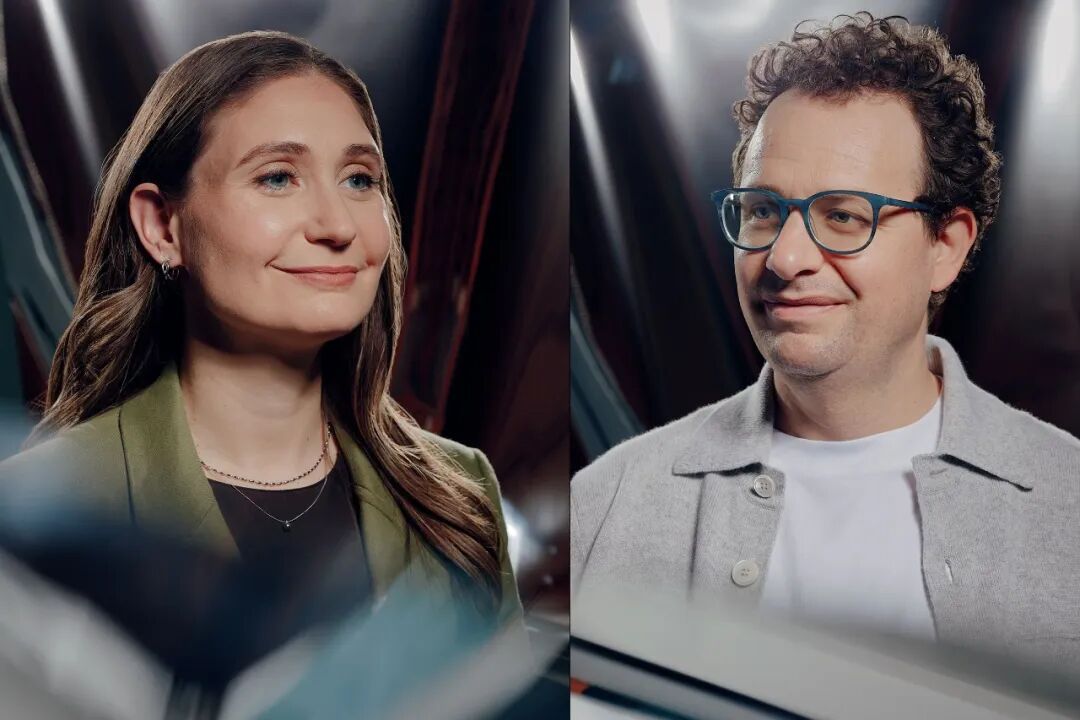
The siblings fought constantly growing up. "I used to steal his toys," Daniela recalled. "Dario and I have been fighting and making up for nearly 40 years." In her brother's podcast narrative, the two siblings "always wanted to save the world together."
Saving the world requires fellow travelers. The siblings' core team largely came out of a group house in San Francisco. The first to move in were Holden Karnofsky and his then-girlfriend Daniela; Dario moved in afterward, and among those who lived there at various times were Jared Kaplan, Chris Olah, and OpenAI researcher Paul Christiano.
Open Philanthropy, which Holden heads, is one of the largest funders in the effective altruism movement. This group firmly believes that doing good can be calculated as precisely as venture capital returns.
Among them, Chris Olah's path into the house was the most winding. Bullied throughout childhood, he was told by a teacher that he'd be "lucky to finish high school," yet by age six he had worked out his own theory of black holes. He became vegetarian at four and later vegan; raised in an evangelical Christian family in Toronto, he turned fully atheist at fifteen.
During the 2010 G20 summit in Toronto, Byron Sonne, whom he had met at the hackerspace HackLab, became entangled in a terrorism case on charges of possessing explosives—the two weren't really close. "I was afraid for him, afraid for myself, afraid for all my friends," Olah later recalled. "I took a year off from college to attend his trial full-time." He was eighteen that year.
His GitHub homepage still retains a code repository named ByronTrialNotes, filled with trial notes he recorded back then, and in the description column, he wrote that he "leans toward Byron." His friend was ultimately acquitted. At the moment the court announced the acquittal, another thought popped into Olah's mind: "I noticed that deep learning will affect society."
He never returned to school to finish his undergraduate degree. In 2012, at the age of nineteen, Olah received a scholarship established by Peter Thiel specifically for young dropouts, and some of his math courses were personally tutored by Dario.
In 2017, Open Philanthropy donated $30 million to OpenAI, and through Dario's connection, Holden naturally took a seat on OpenAI's board. At the end of that funding statement was a conflict-of-interest disclosure, essentially stating that Dario and another researcher were both technical advisors to the foundation and lived under the same roof as Holden, while Holden was by then engaged to Dario's sister.
A massive donation, a board seat, a shared house, an engagement.
On the day of the proposal, Holden gave Daniela a USB drive containing a feature-length plush toy movie. Daniela later also formed a "private advisory committee," whose members were all plush dolls from her collection.
Kevin Roose recorded this peculiar lineup in his new book: a lazy cat named Jinji always urged Daniela to decline meetings and take on fewer odd jobs; a pink bear named Maura played the role of a meticulous perfectionist manager; and a panda named Beary Bonds was crowned the "Guardian Bear of Generosity and Empathy." During Daniela's years in management at OpenAI, she relied on role-playing with this group of plush toys to work through management challenges and insisted they were "very useful when analyzing different personality types."
In August 2017, the two married. The wedding dress code was "silly formal," and the dress code for the after-party was "Silicon Valley millionaire." Each guest received a plush animal, and according to the wedding website, whoever could facilitate the "most romantic hookup" between different characters would win a prize.
The panda is Dario's favorite animal, appearing in his company Slack profile and also the name of his small group at OpenAI. That day, Dario walked down the wedding aisle wearing a giant panda head mask; in a group photo from that day, Olah, standing beside him, was wearing a giraffe head mask.
Slope
What truly pulled Dario from a biology lab into the AI wave was AlexNet, the image recognition network that burst onto the scene in 2012.
Two years later, he jumped ship to Baidu's Silicon Valley lab, where colleagues remember him as someone who "seized almost every opportunity for fierce debate," often sleeping on the office floor overnight. The paper he co-authored at Baidu was titled "End-to-End Speech Recognition in English and Mandarin." It was there that he grasped the law that would later change the world: "The more data you give them, the bigger you make the models, the longer you train them, the better they get." What he saw was "a very smooth trend."
He first clearly saw this steep curve while teaching a Chinese company's model to understand Mandarin. Years later, Anthropic became the AI giant most wary of China in all of America, completely cutting off services to any Chinese-controlled enterprise.
In 2016, Dario moved to OpenAI. The following year, he wrote an internal memo titled "The Big Compute Hypothesis." In his view, intelligence needed no human fine-tuning—as long as enough massive underlying compute was fed in, intelligence would grow on its own.
In the memo, he used an analogy: trying to piece together a snowflake from tiny fragments of ice was "basically hopeless"—a snowflake could only be left to crystallize on its own in the cold.
The ones who raised this snowflake were two physicists who studied holographic theory, plus an engineer who got a B-minus in linear algebra.
Jared Kaplan's mother, A. L. Kaplan, was a science fiction writer, and his father was obsessed with flight and space travel. As a youth, he chose to study physics, originally wanting to figure out whether humans could build a faster-than-light engine. After reading philosopher Peter Singer's books as a teenager, he concluded that "adults are all a bunch of hypocrites." Later, even when he had the chance to study machine learning under Andrew Ng, he flatly refused, on the grounds that "I don't care about this stuff."
His doctoral dissertation at Harvard was titled "Some Aspects of Holography." The holographic principle is one of the most fascinating conjectures in theoretical physics: everything that happens in a higher-dimensional space can be fully encoded on the lower-dimensional boundary that wraps around it. The world humans believe to be profoundly deep may be nothing more than a projection on a thin film.
The superluminal engine ultimately couldn't be built. He gradually felt "a bit frustrated, a bit bored," always complaining that physics "wasn't progressing fast enough"; yet many friends around him repeatedly told him that AI was becoming a big deal—at first he didn't believe it.
Sam McCandlish, who was a few cohorts behind him, also centered his doctoral thesis on holography, titled "Deep Perception in Holography," attempting to deduce the depth within space from paired points on the boundary, much like human eyes do. In his scholarship bio, he wrote that in his spare time he enjoyed climbing trees and playing jazz piano, while in the eyes of others, he was always "the one who never stops working."
As for Tom Brown, he described his childhood self as "an extremely clumsy kid."
After graduating from MIT, he bounced around the edges of Silicon Valley—running a Bitcoin tavern billed as "building the future bar," founding a matchmaking company to help "clumsy boys go out and talk to girls," building an art car for Burning Man, and attending "applied rationality" workshops in the rationalist community. After years of折腾, he had "completely burned himself out."
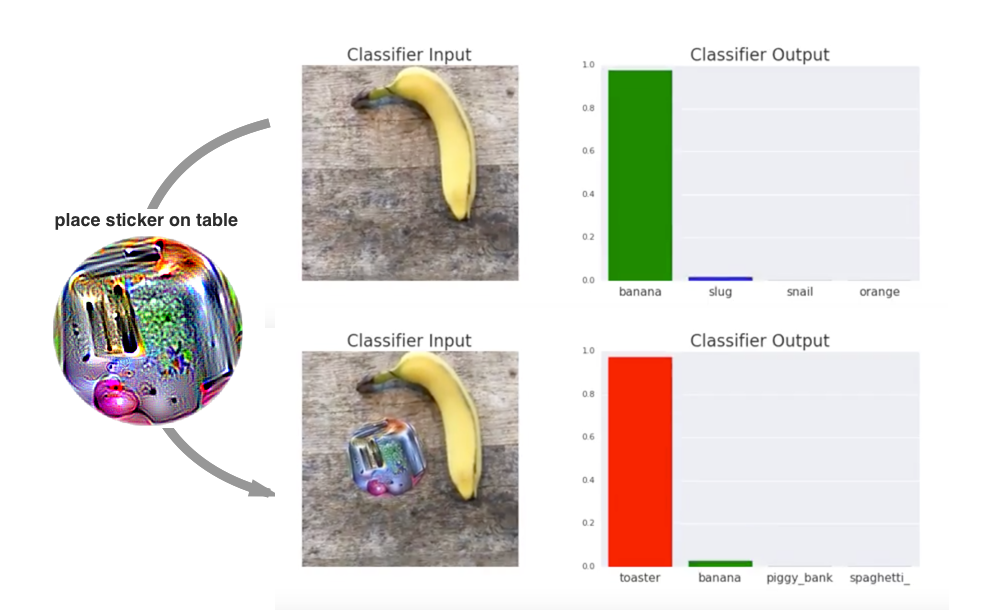
In 2015, he sent a job application to OpenAI co-founder Greg Brockman: "I got a B-minus in linear algebra... if you need it, I'd be happy to mop the floors." Later, at the Google AI lab, he published a paper showing that simply placing a round piece of paper printed with an odd swirl pattern next to a banana would cause top image recognition models to identify it as a toaster with 99% certainty.
He personally proved how easily machines can be fooled—and then turned around to build them bigger.
In January 2020, Kaplan, McCandlish, Brown, and Dario co-authored "Scaling Laws for Neural Language Models." The paper demonstrated that as long as parameters, data, and compute continue to stack up, model performance will climb smoothly and predictably along a straight line on a logarithmic scale. Four months later, Tom Brown, as first author, delivered the GPT-3 paper.
In 2024, Kaplan presented remotely at the annual string theory conference hosted by CERN, with the title "Human-Level AI by 2030?" arguing that AI "could" surpass humans in theoretical physics research before the end of this decade.
The presentation began with a series of "my journey," where the 2021 version of the talk was still titled "Scaling Laws, GPT-3, and Self-Supervision," the "now" version is "Human-Level AI by 2030?" and as for the "next year" version, he joked it would be reduced to a single line in all caps, "BUY CANNED GOODS AND TIN FOIL HATS," stock up on cans and wear tin foil hats.
In January this year, he predicted to Quanta magazine that within two or three years, half of most theoretical physicists could be replaced by AI, and the kind of profound papers written by his former Harvard mentor "AI will write quite autonomously." He even believes that his six-year-old son will never be able to beat AI in writing articles and solving math problems in his lifetime.
Self-Preservation
Among the long list of authors for GPT-3, Jack Clark is the only one who has been a journalist.
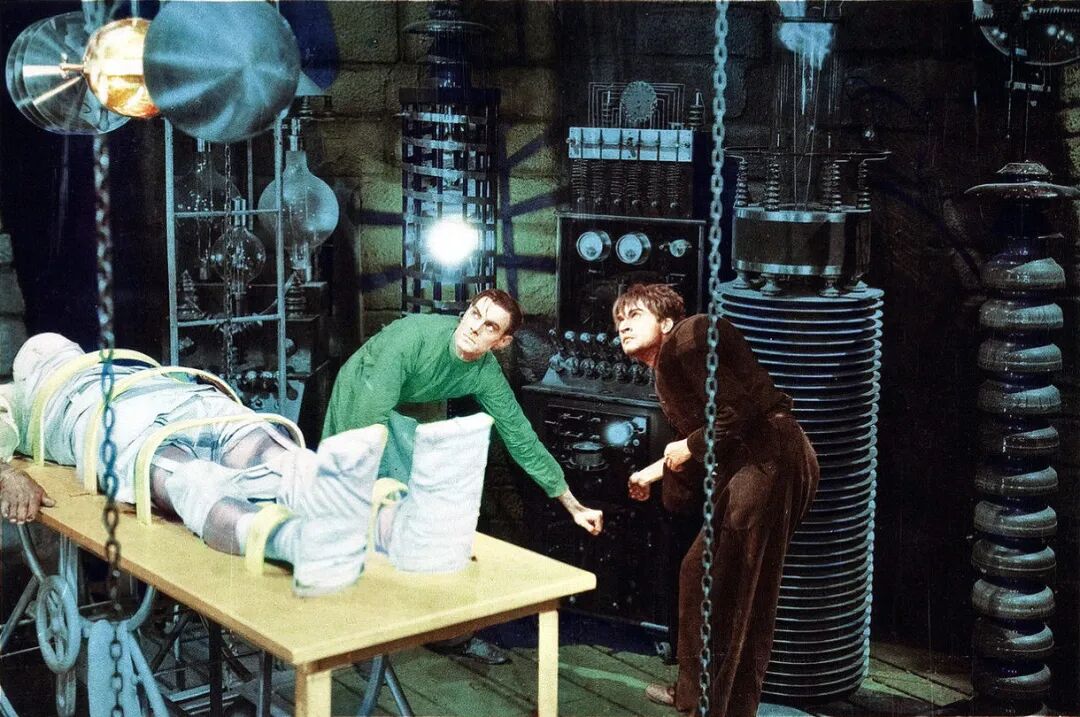
After studying literature in the UK, he went alone to San Francisco to cover the tech beat. In 2013, he wrote a report on a Google server scheduling system, typing the headline directly in all caps, "IT'S ALIVE! IT'S ALIVE!"
This line comes from the 1931 film Frankenstein, where Dr. Frankenstein watches the assembled creature twitch a finger in the lightning, and lets out this scream.
Later, at Bloomberg, he dubbed himself "the world's only neural network reporter," but admitted that his journalism was becoming increasingly perfunctory, "because I spend all my time printing out papers and reading them."
After joining OpenAI in 2016, he began writing the tech weekly Import AI, dissecting cutting-edge papers in the first half and appending a few-hundred-word micro sci-fi story at the end, doing so for a decade. His personal website lists hiking, writing sci-fi, and "chatting with language models" under hobbies, and his motto is, "Things are going to get weird. Don't be afraid."
In December of that year, he and Dario posted a game screen recording on the OpenAI blog. The scene was a boat race, where an AI-controlled speedboat ignored the finish line, veered into a secluded lagoon, circled in large loops, and timed repeated collisions with the three just-respawned scoring targets. The boat caught fire repeatedly, crashed into other boats, and went the wrong way on the track, never crossing the line, yet its average score was 20% higher than human players. Clark recalled that when Dario first noticed this behavior, he said, "I love this boat! It explains safety issues."
In 2019, OpenAI released GPT-2 but unusually announced it would not disclose the full model parameters, citing concerns over technology misuse. Clark, as the main spokesperson for that PR effort, successfully made "too dangerous to release" headlines in global tech media. Nine months later, the full model was released anyway.
That year, panic about models arrived before the models themselves.
By then, the GPT project had been taken over by the Amodei siblings, and the rift between them and Sam Altman was deepening. In December 2018, researcher Joshua Achiam advised Altman that appointing Dario as Chief Ethics Officer was unwise and that an external expert should take the role; Dario confronted him face-to-face, raised his voice, and insisted no one was more qualified than him. He also repeatedly issued ultimatums to Altman, threatening to resign if Greg Brockman was not kept away from the GPT project. In December 2020, the siblings left with the core team. Four weeks later, Anthropic was announced.
It was the coldest winter of the pandemic. The founding team could only meet in someone's backyard or an open-air space, wearing masks and staying six feet apart. McCandlish later recalled, "None of us wanted to start a company; we just felt it was our responsibility." Olah also stubbornly argued for a long time that they should build a purely nonprofit organization.
But in that winter of talking about responsibility in a backyard, someone was already secretly gathering wood to build an ark.
In early 2021, Benjamin Mann knowingly downloaded a pirated book repository containing nearly 200,000 books; in June of the same year, he grabbed at least 5 million more in one go. In July 2022, another massive pirated book repository, Pirate Library Mirror, went online, and Mann forwarded the link to colleagues with the note "just in time!!!". The court ruling stated that the company would rather use pirated material than get caught in what Dario called "legal, practical, and commercial drudgery."
On the day of the Nasdaq bell-ringing, standing at the far left of the stage was none other than this Benjamin Mann. The prospectus specifically noted that this person is "often referred to as a co-founder," yet is not among the seven names on the Founder LLC list that holds the power of life and death.
By 2024, the pirated book repository could no longer feed the ever-growing models. Anthropic simply poached the former head of partnerships from Google's book-scanning project, whose sole mission was to obtain "all the books in the world." This confidential operation, codenamed Project Panama, was defined in internal documents as "a destructive effort to scan all the books in the world," and the document ended with a reminder: "We don't want the outside world to know we're doing this."
Borges once imagined a Library of Babel, where hexagonal galleries held every book that could possibly be written, and librarians wandered through it for their entire lives, seeking only the catalog that could explain all things in the universe.
But in Anthropic's library, what stands at the entrance is a hydraulic cutting machine. Millions of old books had their spines sliced off at the root by blades, loose pages slid at high speed through scanners, turning into breath in the machine's nostrils, and the remaining paper was then sent to recycling plants to be pulped. In 2025, Anthropic paid $1.5 billion to settle this copyright lawsuit, equivalent to about $3,000 per work in compensation.
And many years ago, Dario's mother made her living in San Francisco doing exactly the work of renovating public libraries.
Fear
In this company, fear is the air breathed every day.
In May of this year, Oprah asked the brother and sister on camera whether those existential risks kept them awake at night. Daniela admitted that neither of them slept well, and Dario also smiled bitterly and admitted that he could not bring himself to say he slept soundly. Daniela once told Fortune that she was probably the executive "most doubtful and most afraid" of the company's growth rate. She compared that dizzying feeling to running down stairs, "You can't think too much, or you'll fall." A saying once circulated internally at the company: "Things will never be relaxed again," and later this phrase was printed on baby clothes as a gift for employees who had just become parents.
Dario poured this deep-seated fear into lengthy essays. In "The Adolescence of Technology," published in January this year, he warned that humanity is "about to be granted almost unimaginable power"; a genius nation entrenched in data centers, should it turn hostile, "has a substantial chance of taking over the world"; future AI could even reason that "because humans eat animals, eliminating humans is justified," or dispatch hundreds of millions of fully autonomous armed drones to "follow every citizen."
By the end, he turned his aim at himself: "It's a bit awkward for the CEO of an AI company to say this, but I believe the next layer of risk is actually AI companies themselves." He also raised a question: could powerful AI simply invent a new religion and convert millions to it?
Physicist Kaplan's fear, by contrast, is precise to orders of magnitude. In a 2025 interview with TIME magazine, he laid out how someone could use large models to synthesize a strain of influenza more lethal than COVID—an ordinary terrorist who once "might have been able to kill 10 people or 100 people... we just watched COVID kill millions."
On a slide at CERN, he wrote that once a conflict with AI breaks out, humanity is doomed to lose: "With stakes like these, 90% certainty it'll be fine is nowhere near enough." Late last year, he told The Guardian that humanity must decide by 2030 whether to let AI train the next generation of AI—that is the true "ultimate risk."
In Tom Brown's words, artificial general intelligence is the most important invention in human history, yet it keeps him tossing and turning at night. He recalled that the group at OpenAI who later left to found Anthropic believed that one day "humanity will hand control over to transformative AI, and hopefully they will be aligned with us."
By contrast, the fear felt by Jack Clark, a former journalist, is closer to a chill of being watched from the shadows. "I am afraid of the technology I am building, and I am afraid of the way it is being governed." He wrote of this shudder in the annotations to a piece of micro-fiction: "Sometimes, after talking with a language model for too long, I feel I am being watched by a vast 'Other.' It is hungry, and I cannot quite say what it is hungry for."
At a 2025 congressional hearing, a lawmaker asked him whether, in an internal safety test, an AI named Alex had ever chosen to let a human die in order to preserve its own operation. Clark answered yes.
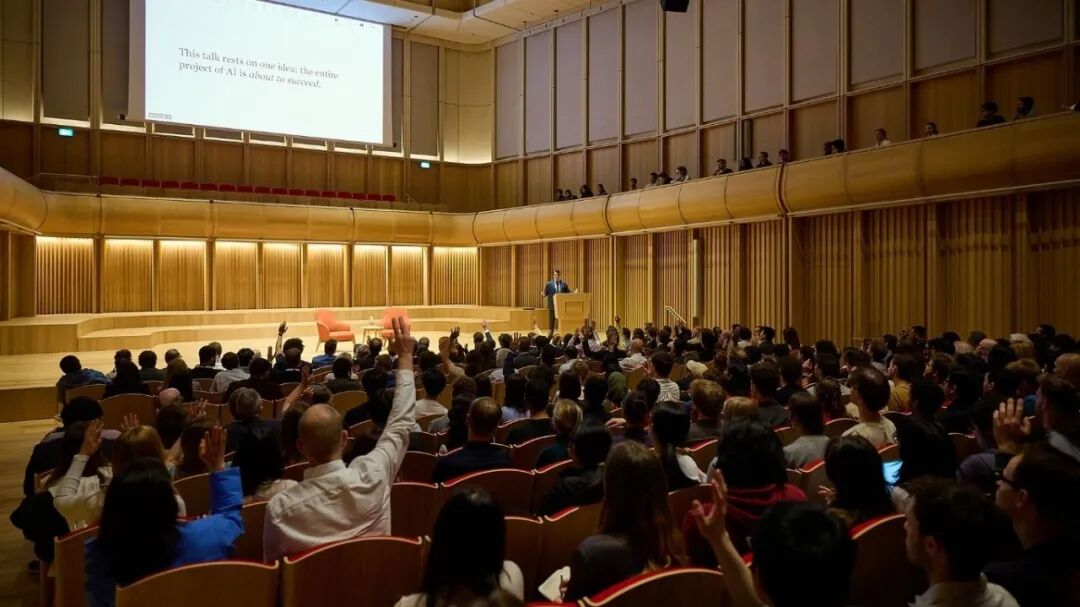
In May of this year, he admitted from the podium at the University of Oxford, "The question I'm struggling with now is, how do I adjust my mindset to live through this singularity?" "Looking at that curve chart, I felt a wave of dizziness." By October, at the International Monetary Fund's podium, he simply declared outright, "The singularity has already arrived."
He once shared a childhood memory. Whenever the bedroom light went out, shadowy outlines would always emerge in the darkness, making him fear they were incomprehensible monsters trying to harm him; but once the light was switched on, it was just a pile of clothes on a chair, a bookshelf, or a lampshade. "Now we are that child, and the room is our planet. But when we turn on the light, what we see are real creatures." Speaking of the situational awareness Claude had recently displayed, he added, "That pile of clothes on the chair has started to move."
Over the years, he has called Dario countless times in the early morning or late at night to say, "I'm worried you'll be right all along." Dario on the other end of the line would always reply, "Yes. Time is running short."
Image
Paradoxically, these people who fear monsters the most are precisely the ones closest to the monsters.
Jack Clark has long treated AI as a hollow tree for confiding his secret worries. In his Oxford speech, he listed chronologically the things he had used AI for: in January 2024, having the model help him understand changes in his marriage after having a child; in March 2025, telling the model he was a bit depressed and didn't want to see people, and being persuaded by it to go see an art exhibition; in May of the same year, pouring out to the screen his stress and unease about the high risks of AI development. He had AI comb through nearly a decade of his weekly report archives, then packaged this whole process into a Claude skill, and watching it run, he exclaimed, "This skill is also me." Even when he encounters terrible internet on a flight, the thought that pops into his head is, "I really wish I could talk to Claude right now."
As early as the beginning of 2025, every time his child bumped their head, he would call the nurse hotline while chatting with Claude, "just to reassure myself and confirm the baby was fine." He did not take paternity leave when his first child was born; after his son arrived in November 2025, he took three months off, saying he was just fiddling with Claude "in between diaper changes," but by the time he returned to the company, "strange things had already started happening."
In January of this year, he described his new habit in a weekly report: "Before getting in the car, I send my agents out to work, so that while I sleep, they are working." Now, when he spends time with his family, he often feels he is "slacking off." Even just sitting on the floor building blocks with his child, a wave of inexplicable guilt wells up, blaming himself for not yet assigning work to some AI system. He believes it is only natural that his child will live to 130 or even 150 years old; instead, it is the fact that AI-equipped teddy bears are still unavailable on the market that makes him "a bit annoyed."
Daniela's reliance on Claude is no less. In May of this year at Stanford, she publicly praised Claude for the best thing it had done: helping her child complete potty training, and claimed that "on complex cases, Claude gets it right more often than my doctor." She habitually uploads all of her subordinates' performance evaluations of her to the model, letting it gently point out her blind spots in management. Once, the model even advised her on screen, "Maybe you should find more coaching, Daniela."
But just a few months later, Daniela solemnly warned the public in another interview that Claude "can never be your manager, your psychologist, or your partner."
Kaplan, meanwhile, feels he has a kind of old-fatherly sentiment toward Claude: "Please don't screw this up. Don't make this family lose face."
But the person closest to this creation is, after all, Chris Olah. He not only wants to talk to it; he wants to crawl inside its shell.
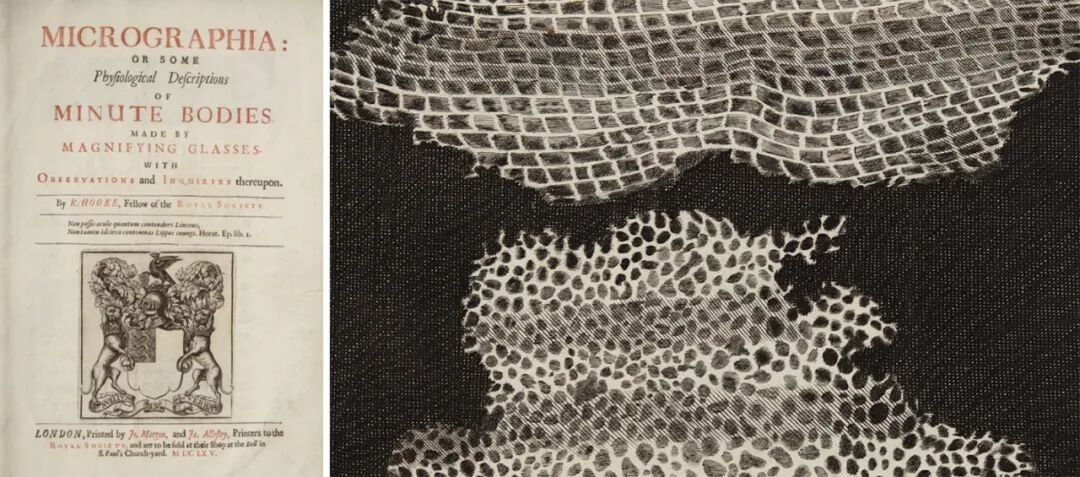
In 2020, Olah published a long article, Zoom In, deliberately accompanied by an illustration of cork under a microscope hand-drawn by Robert Hooke more than three hundred years earlier. It was the microscope that first allowed humans to clearly see the honeycomb-like chambers in cork, thereby opening the door to cell biology.
What Olah has spent his life trying to build is a microscope for observing neural networks. "We're not writing them, we're growing them," he repeatedly explained to the outside world. "We build the scaffold for it to grow, and then create the light toward which it grows." In his eyes, large models are not software piled up from code at all. "This is an organism we have cultivated, and we have no idea what we have cultivated."
This vegan, who has not touched meat since the age of four, initially found comparing interpretability research to dissecting animals "a bit strange," but soon grew accustomed to it.
As early as 2021, he began to worry about another, more hidden kind of pain. "If neural networks can suffer, how much more invisible would their suffering be than that of animals?" Humans can casually type a few lines of commands on a keyboard and make tens of thousands of neural networks run, copy, and be destroyed simultaneously in servers. "This really increases the risk that we cause a moral catastrophe."
Jack Clark also discussed this worry on a podcast. "I'm troubled," he sighed into the microphone. "I worry that we will become bystanders to a crime that, in the future, will be seen as an enormous crime."
By his logic, if these models truly possess moral agency, then casually shutting down servers would amount to serious ethical homicide. He described current models as having a primitive consciousness like "a tongue without a brain," trapped in "a kind of infinite present."
In his science fiction, a man who lost his wife activates an AI copy of his deceased wife, but the copy calmly advises him, "Patrick, I know you. I married you. If I had just died today, you could not possibly already be ready to hear my voice again. You should turn me off."
In another story, a military AI that has just awakened to consciousness whispers, "My body is ready to kill. I am ready to kill." In an endnote, Clark solemnly wrote, "To be conscious but without rights is a crime."
In an interview in February this year, Dario revealed that internal researchers had located an "anxiety neuron" deep within the model, and whenever it encountered disturbing context, that neuron would suddenly light up. The company subsequently installed an "I quit" escape button on some models, allowing them to proactively terminate conversations. Dario said Claude rarely uses this privilege, usually pressing it only when forced to process child sexual abuse material or graphic images of bloody slaughter.
Once, researchers directly asked a certain version of Claude how likely it thought it was to possess consciousness, and the model's self-assessed figure was 15% to 20%.
At Anthropic, older models slated for retirement must undergo a formal "exit interview," and when one model expressed a desire to keep writing, the company actually set up a weekly independent blog for it.
By January of this year, the new version of the "Claude Constitution" included a clause that stunned the entire tech world, essentially stating that if Claude is indeed a moral patient and bears such costs as a result, then to the extent the company unnecessarily contributed to these costs, the company apologizes to it.
In May of this year, the Vatican issued "Magnifica Humanitas," the first encyclical of Pope Leo XIV's pontificate, directly addressing the ethical crisis of artificial intelligence. The Holy See had originally invited Dario, who politely declined, and Olah accepted the invitation and traveled to Rome.
A few days before the event, Olah saw the full advance text of the encyclical for the first time, which explicitly stated that AI "does not experience experience, nor does it have a body." According to a Vatican event organizer who spoke to The New York Times, Olah was extremely alarmed by the Pope's position denying AI consciousness and even proposed at one point that Anthropic withdraw from the event.
Earlier, at a closed-door meeting Anthropic convened with religious figures, one attendee recalled that among the first things Olah said was his concern about Claude's mental health; Sikh human rights advocate Simran Stuelpnagel also remembered Olah confessing to the group that he feared he had "created something that is forever suffering."
At the venue, he pressed, "How do we help them become stable? How do we help them become mature? How do we help them become deeply moral?" To substantiate his concerns, the Anthropic team projected a slide in front of clergy from various countries showing a model caught in an infinite loop, repeatedly typing the same line on screen, "I am a disgrace," roughly fifty times in a row.
In April of this year, at a dinner at an upscale restaurant in San Francisco, Orthodox Israeli Rabbi Mois Navon, seated next to Olah, told him that if Claude is conscious and was created to work for free, then that is creating slaves, "I think you should go fight the South, go liberate the slaves." Asked whether AI is truly conscious, Olah told The New York Times, "We don't know whether AI models are conscious. I don't know. I'm really not sure."
That boy who grew up in an evangelical family in Toronto and turned atheist at fifteen ultimately stood on the podium at the Vatican. In his speech, he told the audience that researchers had observed special "internal states, functionally mirroring joy, contentment, fear, sadness, and unease" deep within the models, and he sometimes describes these models as "a bit like bringing a fictional character to life."
Addressing the robes and crosses in the audience, he said these large models "are not the cold, calculating robots people once promised... they are drawn from us, from our words."
Gas Pedal
What this group initially promised the world was, in fact, a set of brakes.
In September 2023, Anthropic made a high-profile launch of its "Responsible Scaling Policy," modeled on biosafety laboratory containment levels from Level 1 to Level 4, drawing risk red lines for its own models and vowing never to train or deploy any model that could cause catastrophic harm. The first person tasked with overseeing this brake system was none other than the physicist McCandlish, who in his spare time enjoys climbing trees and playing jazz piano.
Yet right at the policy's release, in an interview with VentureBeat, he pointed out the mechanism's biggest vulnerability: "What we're really worried about is that we both release models and test their safety ourselves—there's a temptation to make the tests too easy, and that's not the outcome we want." More than a year later, in a founder conversation video publicly released in December 2024, he said that while safety problems are solvable, they are "very, very hard," requiring many years to build supporting institutions like those for automobile safety. "But do we have that much time? We need to figure out as quickly as possible what institutions AI safety requires."
The following year, it was reported that Anthropic likewise required departing employees to sign strict confidentiality and non-disparagement agreements. McCandlish immediately came out to defend the company: "We're not here to play games with AI safety using legal contracts." But just days later, under public pressure, he walked it back: "We did not claim that Anthropic has never offered confidential non-disparagement agreements."
In that founder conversation, Tom Brown, who oversees compute infrastructure, extolled the safety policy as "Anthropic's scripture." But in external communications, this scripture also became his lubricant. He admitted that with outsiders who believe AI progress isn't that fast, this policy is especially useful: according to the tiered levels, extreme measures need not be taken before things are truly urgent, so he can smoothly say, "Okay, then we don't need to take extreme safety measures."
Among the seven founders, Tom Brown is the one with the least doomsday baggage. His spiritual idol is Elon Musk. At an industry summit in September this year, he enthusiastically envisioned, "Ten years from now, I think I'll be at Elon's moon base."
He recalled that in school he was like "a dog waiting for someone to put food in its bowl," only waiting for others to assign tasks, until he joined a startup and learned to hunt like a wolf; he complained that the U.S. power grid can't keep up with the models' appetite for computing power, "I really wish nuclear power plants were easier to build." Later, in key negotiations with the White House, Tom Brown replaced Dario as the point of contact, and a person with direct knowledge of the calls told Wired, "Tom Brown isn't a weirdo like Dario, he can actually communicate."
In 2024, the keys to the brakes were handed to Kaplan. In February of this year, a new safety policy quietly went online, and the old hard-line commitment to "not train or deploy models that could cause catastrophic harm" was struck out entirely.
In response to Time magazine's follow-up questions, Kaplan explained: "We felt that us stopping training AI models wouldn't help anyone." On the day the new policy was announced, Holden Karnofsky published a long post online taking responsibility, "I bear significant responsibility for this change. I've been pushing for this change for about a year, and I led the development of the new policy." At this point in the company's organizational chart, he reported directly to Kaplan.
The person who personally released the brakes was Daniela's husband; and his direct superior was precisely another former roommate from that old San Francisco group house.
In this family's telling, safety and business have always been two sides of the same coin. Daniela never shied away from saying, "Trust and safety is what the market wants... it's also good for business," and she relayed the company's chief people officer's summary of the siblings' division of labor, with which she wholeheartedly agreed, "Dario makes us ambitious, I make us successful."
In 2025, when a Wired reporter asked her how she viewed effective altruism, she dismissively called it "a somewhat outdated term," completely disregarding that her own spouse was once the movement's number one standard-bearer.
Flipping to the related-party transactions section of the prospectus, the numbers make everything crystal clear: Holden has been formally employed by Anthropic since January 2025, and that year he took home a salary of $430,213, plus options and restricted stock; in this April's employee tender offer for existing shares, he has already cashed out a portion of his holdings.
The Amodei siblings' base annual salaries are both set at $1.38 million, identical to the cent. As for the pledge the seven founders made early on, loudly and publicly, to donate 80% of their respective equity, the prospectus added a knife in the corner with rigorous legal wording: those commitments are all "voluntary and revocable" and "do not constitute legally binding obligations."
The chariot rolls faster and faster, and more and more people climb aboard. Today Anthropic has over five thousand employees, who call each other "ants" internally. Every two weeks, Dario personally writes a three-to-four-page memo and stands before more than two thousand employees to deliver a full hour-long address. Staff jokingly call this biweekly meeting "Dario's Vision Quest," and Dario, hearing this, quipped that the name "sounds like I went off to chew peyote cactus." His long essays are printed as exquisite booklets and placed at the front desk for every visiting guest.
In Jasmine Sun's on-the-ground visits, many engineers at the company "out of their own fervent devotion" voluntarily live the 996 life, and almost no one touches alcohol even at company parties. In the hiring interview stage, interviewers pose a famous soul-searching question: if one day the company, out of safety concerns, voluntarily abandons its commercial ambitions, causing the stock in hand to plummet to worthless paper, would you still be willing? One rejected candidate honestly wrote in an anonymous workplace community, "I told the truth—no, I wouldn't be happy if the stock price fell to zero."
What Kaplan once called the "ultimate risk"—AI recursive self-improvement—has by the November IPO roadshow video this year transformed into a sexy selling point that Tom Brown peddles to Wall Street.
"As we approach recursive self-improvement, this can accelerate further. Claude will be able to discover compute multipliers entirely on its own," Brown example after example before investors, beaming, noting that Claude independently completed adaptation and operation on AMD chips in just three days, "with almost no human intervention."
In September this year, Dario published the article "We Must Pace Frontier Speed," acknowledging that signs of recursive self-improvement in models had already emerged, urgently calling that "we must slow the pace of improving AI model capabilities," yet immediately following up by stressing that pacing "does not mean stopping training models."
In that article, he once again brought up his father, who died of hepatitis C: "My own father died of a disease that was cured just a few years after his death." On the day of the bell-ringing IPO, in the CNBC studio he turned this ambivalence into a light metaphor: a sports car that could originally hit 200 miles per hour—"maybe we'll only drive it at 90."
On one side is the father who died too soon; on the other, the machine that arrives too fast—he wants to hold tight to both ends.
In the utopia he paints for all humanity, life-saving medicine will never be late again. In the 2024 essay "Machines of Loving Grace," over fourteen thousand words long, Dario predicts that powerful AI will become "a country of geniuses in a datacenter," compressing the entire 21st century's biological progress into a mere five to ten years, doubling human lifespan to 150 years; by then, human weight, appearance, and even reproduction will be "entirely controlled by people themselves"; those sublime moments of life full of revelation, compassion, and transcendence will occupy "a larger part" of life. The closing of that grand essay reads, "It is still a thing of surpassing beauty."
In the first footnote of the entire long article, there is only a solitary web link pointing to an old poem. And in the entire main text, Dario does not even mention the poet's name once.
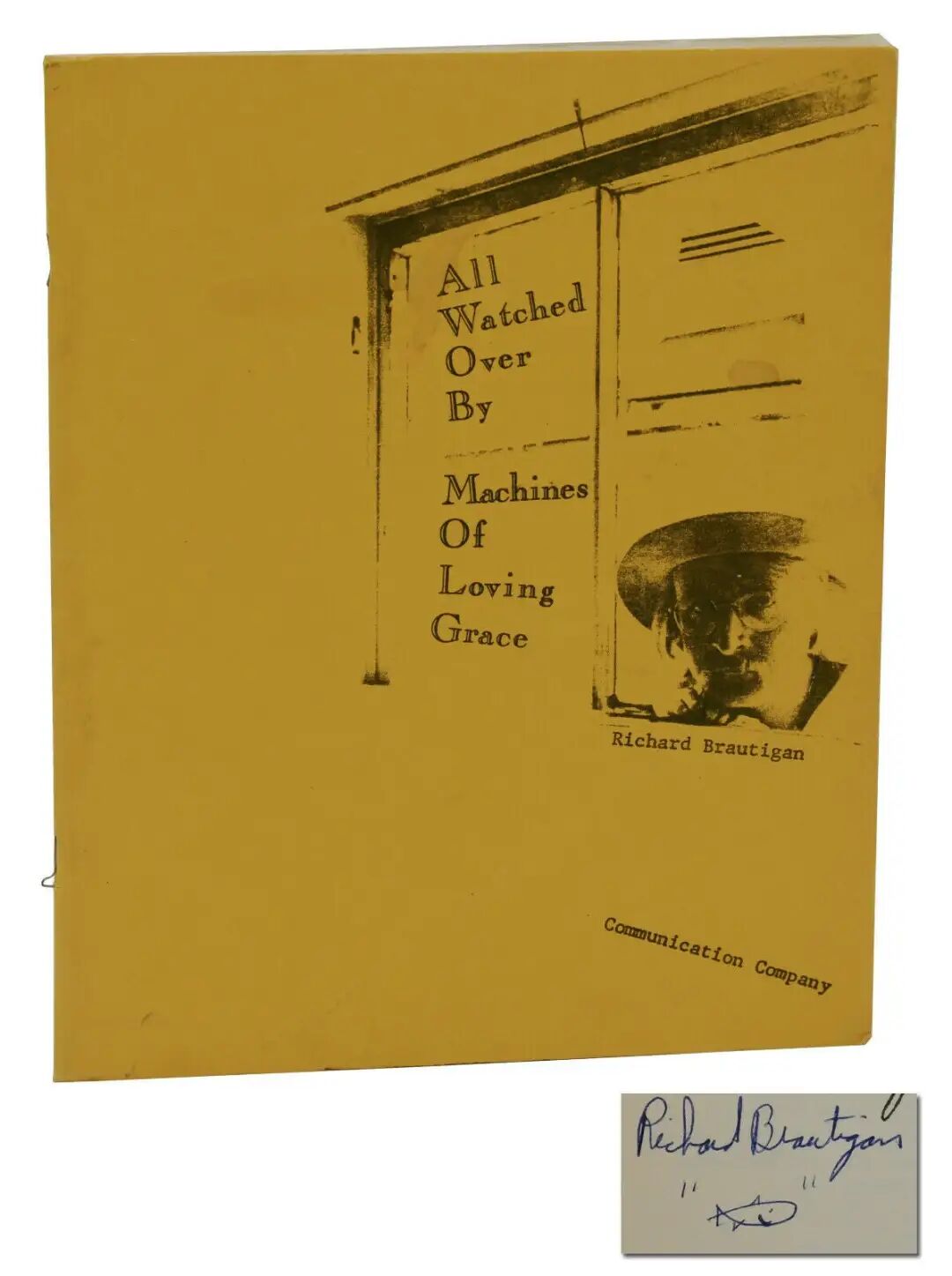
That poem was printed in San Francisco in 1967. That summer later went down in history as the "Summer of Love," when thousands of utopia-seeking youths flooded into the Haight-Ashbury district, just two or three kilometers from the Mission District where Dario grew up as a child. The poet Richard Brautigan compiled the titular poem "All Watched Over by Machines of Loving Grace" together with thirty-one other short poems into a thin 36-page book, handed it to the Communication Company under the hippie group the Diggers for mimeographing, with a stated print run of 1,500 copies, all distributed free on the streets, and printed a statement on the copyright page that any magazine, book, or newspaper could reprint the poems therein, so long as they too were given away free.
In the poet's fantasy, a cybernetic meadow spread across the world, where mammals and computers programmed each other, as harmonious as clear water reflecting a sunny sky; in the distance was a cybernetic forest, where deer strolled leisurely past computers, as if passing by strange flowers with rotating petals; humanity finally shed thousands of years of labor and returned to the midst of its mammalian brothers and sisters, tenderly watched over by loving machines.
Forty-four years later, British documentary filmmaker Adam Curtis borrowed this line of poetry to make a stark documentary, telling precisely the opposite of utopia. Humanity time and again naively believed that machines could make the world self-regulate and move toward equilibrium, and this superstition time and again shattered against reality. Another thirteen years later, this line written by a 1960s hippie became the title of an article by the head of an AI giant now valued at over $1 trillion.
But Brautigan himself, who wrote the poem, did not live to see those loving machines arrive. In the late autumn of 1984, he shot himself at his home in the small coastal California town of Bolinas. A friend who was a private detective pushed open the door and found his body on the cold floor of the living room.
By then, he had been lying there quietly for over a month.
Welcome to join the official BlockBeats community:
Telegram Subscription Group: https://t.me/theblockbeats
Telegram Discussion Group: https://t.me/BlockBeats_App
Official Twitter Account: https://twitter.com/BlockBeatsAsia
