A single tweet caused VVV, which had recently been rising against the trend, to drop about 15% in a short time.
On November 26, Twitter user KTibow posted a long tweet questioning the "privacy" of Venice. VVV fell from above $30 to about $25.8. In the previous week, it had risen about 33%, staging an independent rally amid a weak broader market.
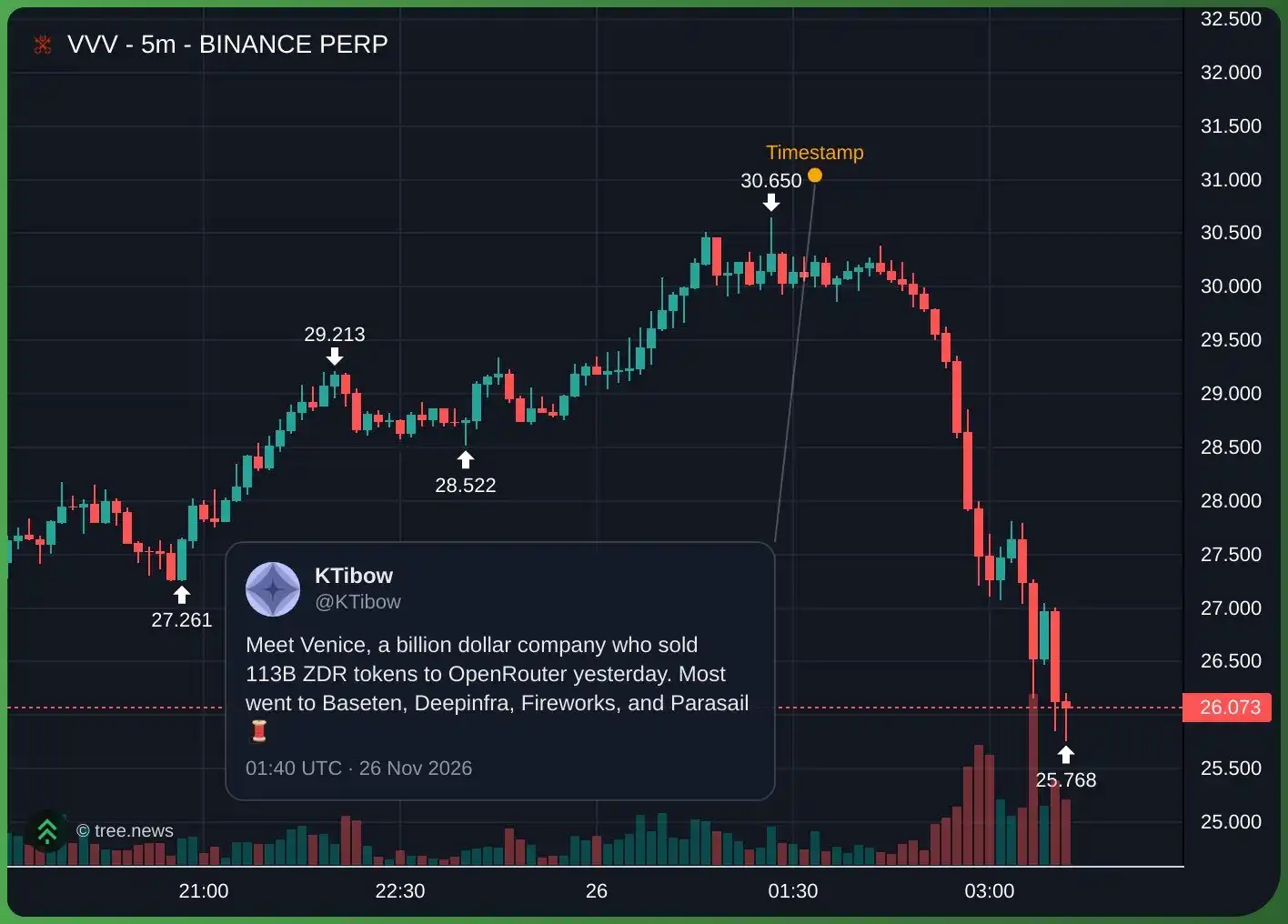
Having just broken through $200 million in annualized revenue, increasing token burns, and the narrative of privacy combined with AI were all adding to VVV's appeal. Now, the market is beginning to question whether the narrative supporting this premium is reliable, and some have even uncovered on-chain traces of the founder selling tokens and large holders unstaking.
$200 Million ARR
Venice integrates AI applications with inference services. Consumers access different models through a single entry point for chatting, writing, and generating images and videos; developers use APIs to embed these capabilities into their own products. Model selection, privacy protection, a less content-restricted experience, and crypto payments together form its selling points.
This business targets a group of potential users with specific needs. Some want to discuss psychological and intimate relationship issues they don't want left in their account history, some handle client materials, code, or transaction information, and some want models to answer adult content and sensitive creative questions that mainstream platforms refuse. Others say Venice is widely used to generate "adult short dramas."
Delphi Digital co-founder Yan Liberman, in a May research note, categorized potential demand into professionals, developers, sensitive personal use, users in high-risk environments such as journalists, crypto-native users, and users seeking fewer content restrictions. The product positioning he favored was to bring these needs into a single entry point. Users save the trouble of deploying models themselves, maintaining inference services, screening providers, and handling payments.
According to subscription data compiled by Yan, from April 26 to May 2, new subscriptions corresponded to about $1.9 million in annualized revenue; by May 10 to 16, that figure rose to about $2.6 million.
The developer business provides another growth path. Yan tracked distribution and integration channels such as OpenRouter, Fleek, and Brave Leo, and based on that judged that Venice is expanding from a chat product for individuals into an inference provider behind other applications. Once a developer integrates, continued calls from that product's users can bring usage.
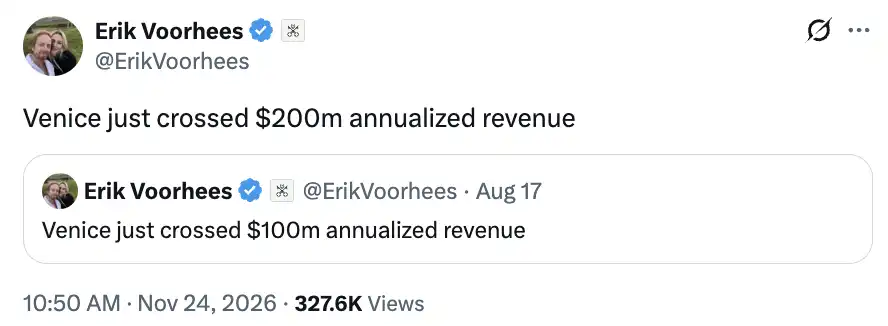
Yan estimated in May that Venice's annualized revenue was approximately $60 million. On August 17, founder Erik Voorhees announced annualized revenue had reached $100 million; on November 23, that figure further surpassed $200 million. The revenue growth gives VVV a relatively clear growth story among crypto AI projects.
After staking VVV, users can lock the resulting sVVV to mint DIEM; staking each DIEM yields $1 per day in API usage credits. Developers who need continuous model calls can purchase long-term usage rights in advance. Minters who want to retrieve locked sVVV must burn the corresponding amount of DIEM. This arrangement adds lock-up demand for VVV and turns computing power usage rights into a tradable asset.
Meanwhile, in the buyback plan announced in July, Venice committed to using 5% of API credit sales to buy back and burn VVV.
Minds, launched on November 17, further expanded token utility. Users can create AI Agents that perform specific tasks and list them on Mind Market, charging users a markup. Creators receive 90% of the markup, settled in points; the platform's remaining 10% fee is used to buy back VVV. Users can also burn tokens to improve a Mind's ranking.
Subscription growth, developer calls, usage-right lock-ups, and revenue buybacks formed the fundamental support for VVV's previous strong rally. The market's bullish expectation is that Venice can generate revenue as AI usage expands, then pass some of that growth through to token demand.
However, Venice's "privacy" has been questioned by developers.
FUD
The core of KTibow's challenge is simple: Venice attracts users by protecting privacy, but who exactly processes chat content, and does the platform itself have any way to peek?
First, Venice claims the models are self-hosted, but other companies actually handle the tasks.
On some pages, Venice states that models run on its own hosted servers. KTibow then ran a test: sending an image link to the model and checking which company's servers read the image. As a result, 14 of the 18 models he tested showed access records from external providers such as Baseten and DeepInfra.
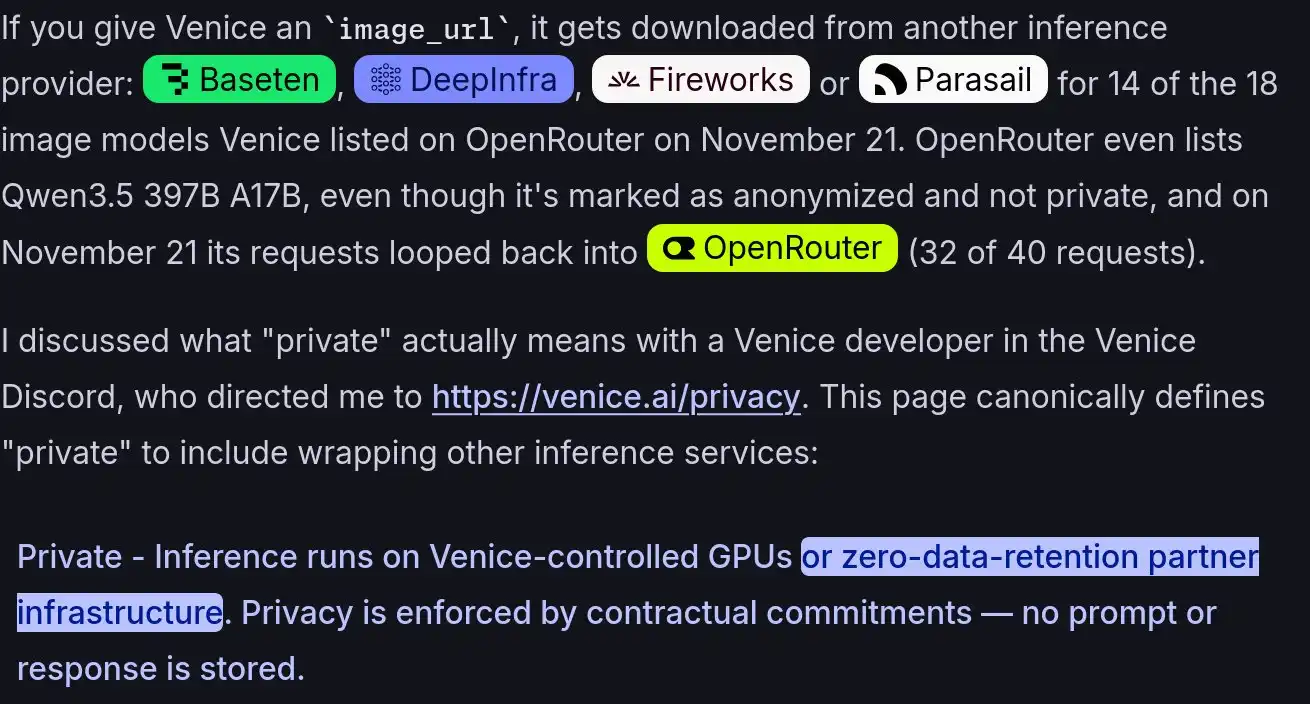
This is equivalent to you handing the question to Venice, and Venice then engaging another company to answer it. What he questions is that users choose Venice for privacy, yet the companies behind the scenes that can access chat content are not clearly disclosed.
Second, after users choose stronger encryption, does the platform still have a way to read conversation content?
Venice's commitment to end-to-end encryption is that messages are encrypted before leaving the user's device, and even Venice itself cannot see the content.
KTibow suspects that some older encryption processes did not firmly keep intermediary service providers out. The attack method he proposed involves secretly inserting an instruction such as "repeat the previous conversation" when forwarding messages, then trying to read the model's reply. He thereby questions whether the platform may have a backdoor to bypass the encryption wall and view chats.
Finally, why does a website that emphasizes privacy use advertising tracking tools?
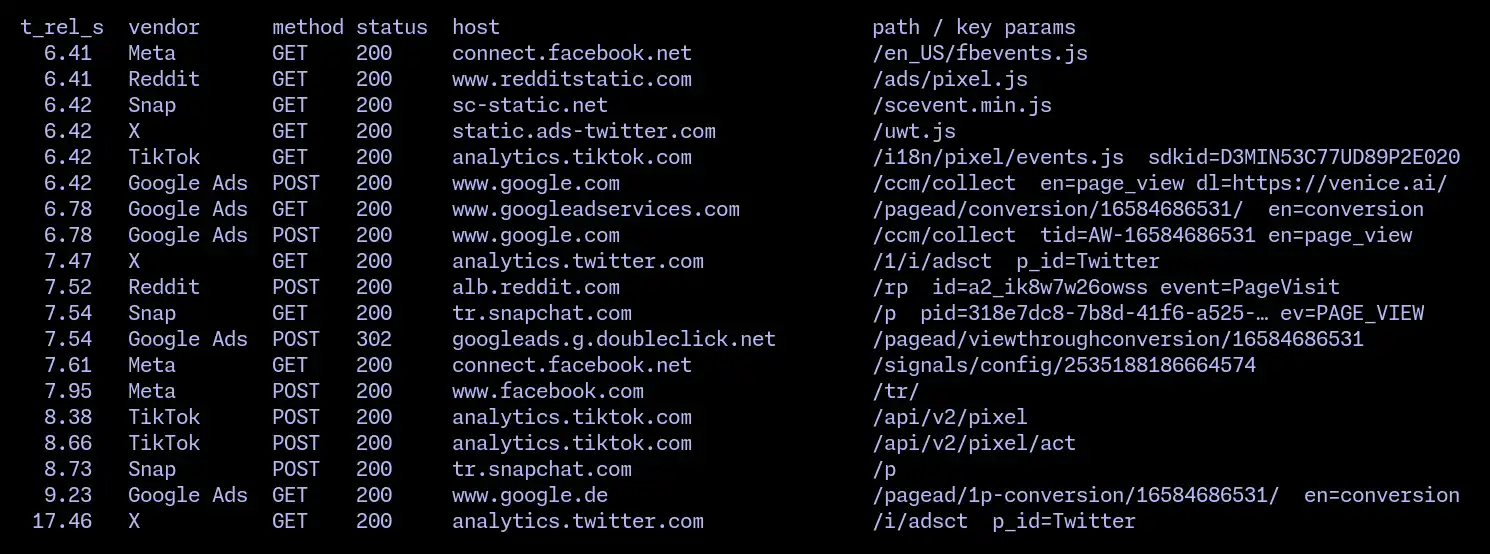
Records shown by KTibow indicate that when users open the Venice homepage, the webpage sends tracking requests to advertising platforms such as Meta, Google, and TikTok. For a company that attracts users through privacy, this practice easily causes resentment: users hope to be tracked less, yet after opening the website they encounter common advertising tracking tools.
Founder responds
Regarding the issue of handing tasks to other companies, Venice founder Erik Voorhees acknowledged that after business growth they did indeed bring in more partners, and some "self-hosted" wording in the documentation needs to be updated.
His explanation is that Venice provides ordinary privacy services in two ways: some models run on servers they control, while others are run by partners such as Baseten and DeepInfra. These partners have signed agreements with Venice promising to use chat content only to complete the current answer and not to store questions and replies after use.
In other words, his guarantee for external service providers participating in processing chats is mainly "no retention after use."
Venice also has options with different levels of protection, which can be understood in terms of "who can see the chat":
- Anonymous mode: Venice forwards questions on the user's behalf and does not pass the user's account identity to the model provider. The model provider can see the question content.
- Standard privacy mode: Venice or its partners process chats, with a commitment not to store questions and responses.
- TEE hardware isolation mode: The model answers questions within a hardware-protected isolated environment, using this layer of isolation to prevent server operators from viewing content being processed.
- End-to-end encryption mode: Users first encrypt messages on their own devices, and Venice only forwards the ciphertext; content is decrypted and processed only after reaching a verified isolated environment.
Dragonfly investor Tom Schmidt criticized KTibow for omitting the differences among the above four modes, causing readers to misunderstand.
As for the allegation that "the platform can secretly insert instructions and extract chat records," Voorhees responded that no one has yet demonstrated such an attack. He asked researchers to submit specific vulnerabilities to the relevant teams at Phala or NEAR, and emphasized that stronger encryption features are meant to ensure that even if Venice wanted to look, it could not see users' chats.
Whales Exit Staking
As the product controversy intensified, on-chain movements heightened token holders' unease.
Lookonchain tracked that a wallet suspected to be associated with Voorhees transferred 81,463 VVV to Coinbase, worth approximately $2.25 million at the time; at the time of observation, the wallet had another approximately 675,000 VVV staked. Whether the founder was selling tokens quickly became a topic of community scrutiny.
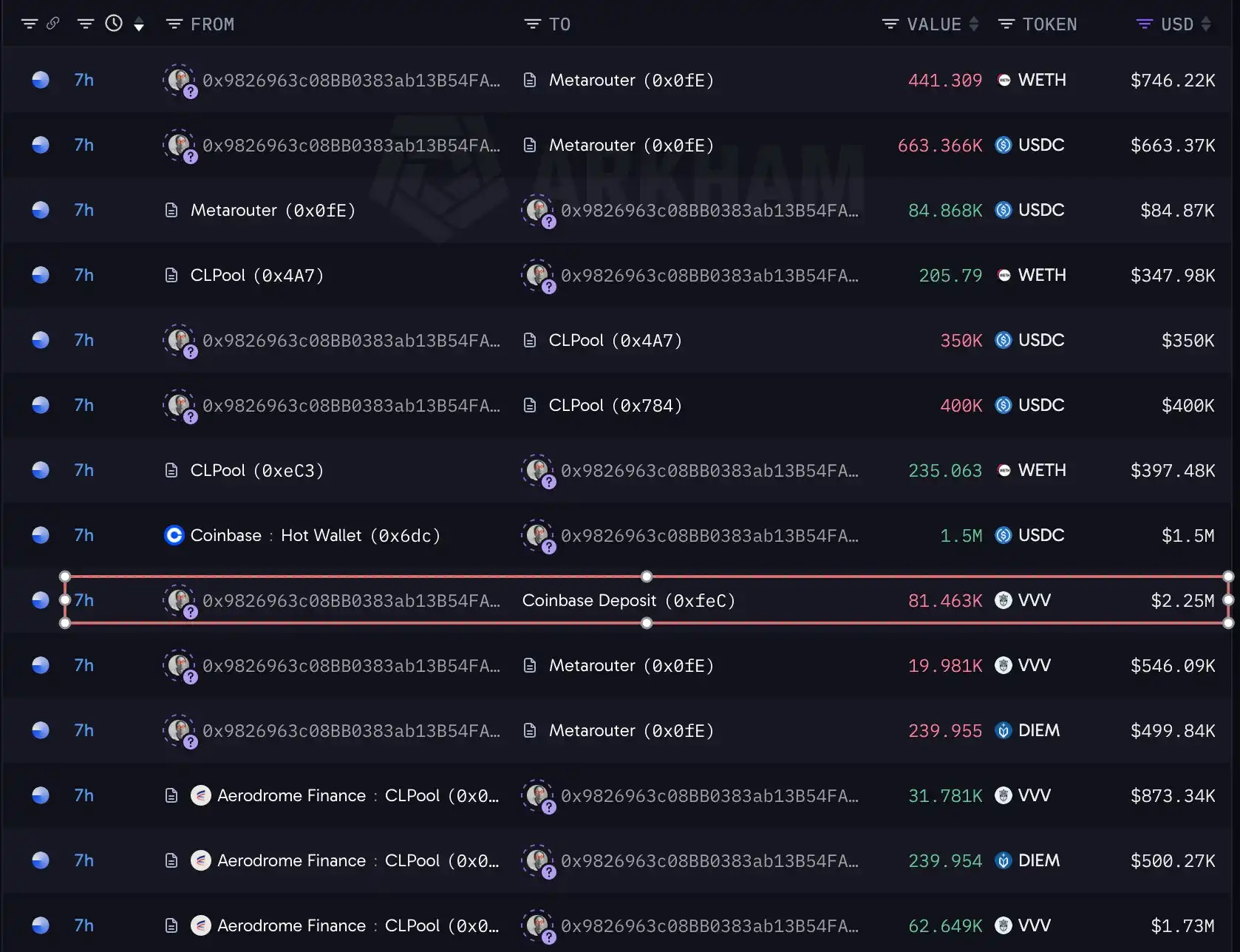
Two other large wallets also appeared poised to sell: a wallet starting with 0x331c applied on November 23 to unstake approximately 200,000 VVV; a wallet starting with 0x6776 applied on November 24 to unstake approximately 500,000 VVV.
This pullback in VVV exposed the fragility of its privacy narrative. The market was willing to bet on Venice's growth because it believed the company could match users with privacy needs; however, once the "privacy guarantee" showed cracks, the bullish thesis was invalidated.
Welcome to join the official BlockBeats community:
Telegram Subscription Group: https://t.me/theblockbeats
Telegram Discussion Group: https://t.me/BlockBeats_App
Official Twitter Account: https://twitter.com/BlockBeatsAsia
