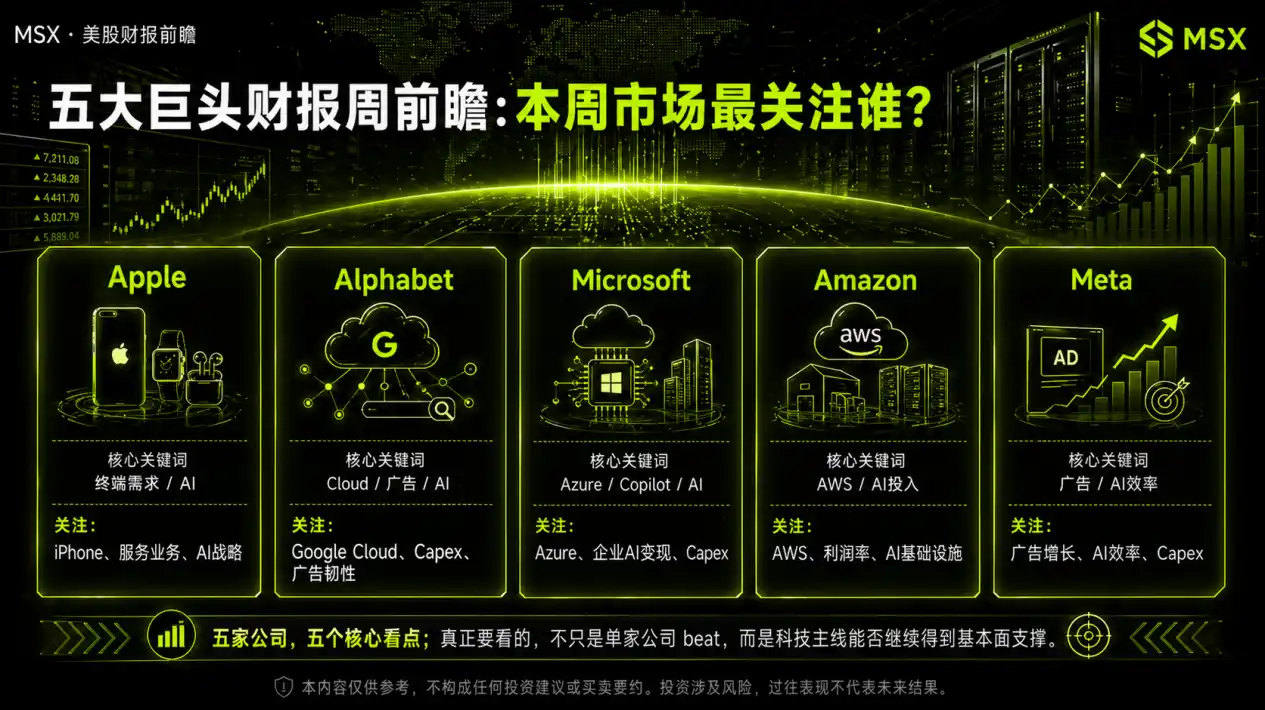
This week, the US stock market will face a truly meaningful "core asset test week." Microsoft, Google, Amazon, Meta will all release their earnings reports on April 29 after market close, while Apple will announce its latest performance on April 30 after market close. Since these five companies cover almost all of the current most important technology storylines, such as cloud computing, advertising, consumer electronics, e-commerce, enterprise software, and AI infrastructure, the impact of their earnings reports is not only on the individual stocks themselves, but also on what the entire Nasdaq and the tech sector will be willing to trade next.
If the market's main storyline over the past few months were to be condensed into one sentence, it would be: the big players continue to increase their investment in AI, and the market continues to revalue the valuations of tech leaders. However, the issue is that once valuations have risen to this level, the market is no longer satisfied with just the fact that "companies are investing in AI," but is starting to ask more practical questions: Is this investment continuing to drive cloud business growth? Is it improving advertising efficiency? Is it supporting end-user demand? And most importantly, is it starting to more clearly translate into revenue, profit, and future guidance.
In the last quarter, Microsoft provided revenue guidance for this quarter with a mid-range of around $81.2 billion, with Azure growth guidance of 37% to 38%; Alphabet has already set its 2026 capital expenditure plan at $175 billion to $185 billion; Amazon expects capital expenditures of around $200 billion in 2026; and Meta has raised its 2026 capital expenditure target to $115 billion to $135 billion. These numbers themselves indicate that the real theme of this round of earnings reports is still "whether high investment can continue to be supported by the market."
Part I: What the Market Really Wants to Confirm in This Round of Earnings Reports
1. Will the Big Players Continue to Invest in AI?
Because the valuation of many AI infrastructure chains is fundamentally based on the assumption that Microsoft, Google, Amazon, Meta, and other super buyers will continue to place orders, expand data centers, and procure computing power, networks, and power infrastructure. If the management teams release any cautious capital expenditure signals during the earnings call, the impact will not only be on themselves but on the entire AI industry chain.
2. Can the Cloud and Advertising Cash Machines Remain Stable?
Microsoft Azure, Google Cloud, and AWS provide the most direct window into observing enterprise IT spending and AI demand; while Google and Meta's advertising businesses represent the core cash flow resilience of internet platforms. If the cloud and advertising remain stable, the market will continue to believe that even with high capital expenditures, tech giants still have the ability to support future investment with mature businesses.
3. Is AI still a story, or has it already started turning into profit?
All five companies are talking about AI, but they validate AI in different ways: Microsoft focuses on enterprise customer payments, Google focuses on cloud and search, Amazon focuses on AWS and in-house chip synergy, Meta focuses on ad efficiency, and Apple focuses on end-user access and ecosystem position. It is precisely because of these different approaches that this round of earnings reports is particularly noteworthy.
II. What Questions Do the Five Tech Giants Need to Answer?
1. Microsoft: The primary question to address is not growth, but how far AI commercialization has progressed
Among the five tech giants, Microsoft is most like the "model room" in this AI cycle. The reason why the market has been willing to continue to give Microsoft a premium over the past year is not only because it is a leader in the cloud, but also because it is considered the company most likely to be the first to truly turn AI into a business. With Copilot embedded in Office, development tools, and enterprise workflows, coupled with Azure as the underlying cloud platform, Microsoft's advantage lies in its ability to not only provide modeling capabilities but also directly reach the most willing-to-pay enterprise customers.
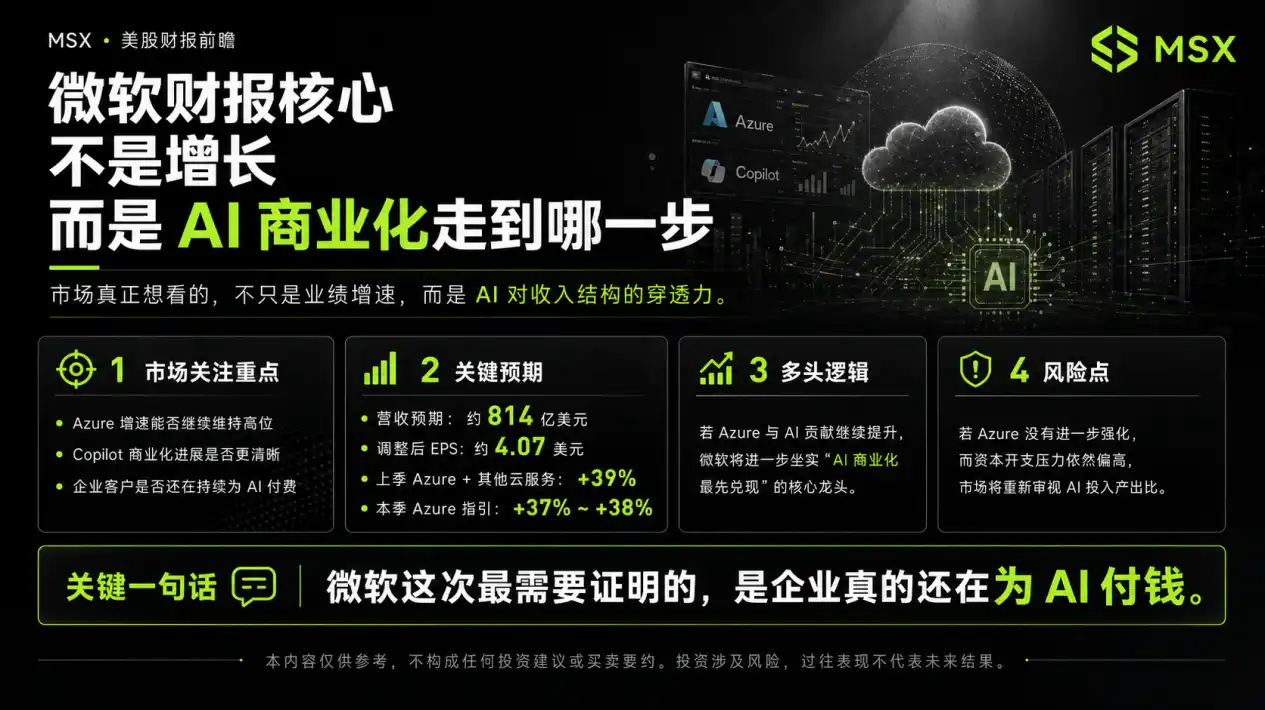
Therefore, the most important aspect of this Microsoft earnings report is not just revenue growth rate, but whether the "penetration" of AI into its revenue structure continues to strengthen. The market currently expects revenue of around $81.4 billion and adjusted EPS of $4.07 for the third quarter of FY2026, while Microsoft's revenue guidance range for the previous quarter was $80.65 billion to $81.75 billion, which is in line with market expectations.
What is really worth watching is whether Azure's growth rate can continue to stay in a higher range and whether AI products like Copilot have shown clearer progress in commercialization. Last quarter, Microsoft disclosed a 39% growth in Azure and other cloud service revenue and provided a growth guidance of 37% to 38% for this quarter, indicating that the core expectation of the market for this earnings report is not "whether there is growth" but "whether AI is still driving accelerated growth."
If Microsoft can once again prove that enterprise customers have not cut their budgets for AI tools, and that Azure's contribution to AI is still increasing, then the market will see it as the key leader in "the earliest realization of AI commercialization," and related enterprise software, cloud, and data center chains will continue to benefit. Conversely, if Azure does not further strengthen and capital expenditure pressure remains high, then the market will refocus on the return on investment.
In other words, the most critical aspect of this Microsoft earnings report is not to prove how important AI is, but to prove that: enterprises are indeed still paying for AI.
2. Google: Just Wrapped Up Cloud Next, Now It's Report Card Time
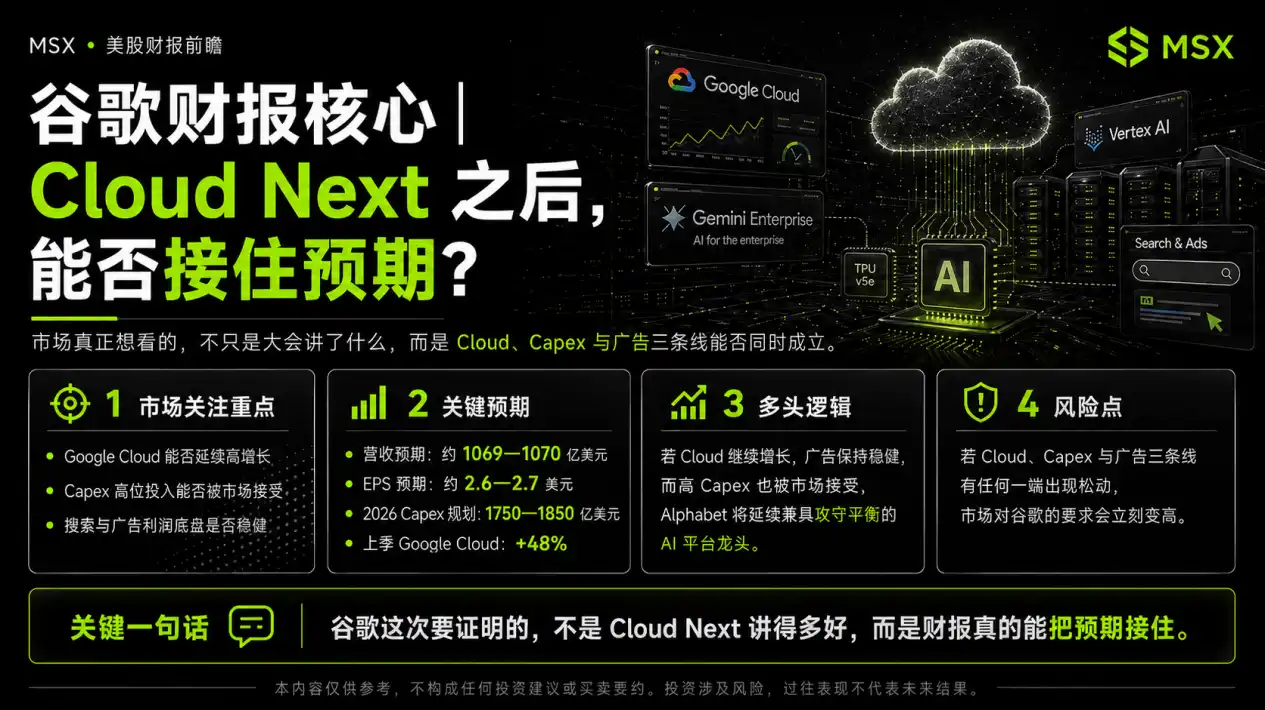
Compared to Microsoft, Google's current situation is more like a "hosted a conference first, then took a quiz" scenario. Just after Cloud Next 2026 concluded, Google made many significant announcements during the event about AI agents, Gemini Enterprise, Vertex AI, TPUs, and infrastructure investments, causing the market to raise its expectations for Google Cloud. However, while the conference presented a vision, the financial report will show the reality. The most crucial pressure on Alphabet's financial report this time comes from the need to quickly turn the "story" into "numbers."
Google's uniqueness lies in the fact that it is not just a cloud company or merely an advertising company; it straddles two major lines: Google Cloud and AI infrastructure on one side, and the mature cash cow of search and advertising on the other. The market's current consensus is roughly Q1 revenue of $106.9 billion to $107.0 billion and an EPS of around $2.73. However, more critical than just revenue and EPS is whether three things can simultaneously hold true: Google Cloud continues to grow, capital expenditures remain high, and search advertising stays robust. In February of this year, Alphabet explicitly outlined a capital expenditure plan of $175 billion to $185 billion for 2026; last quarter, Google Cloud's revenue grew by 48% to $17.7 billion, with an annualized run rate exceeding $70 billion and a growing backlog of orders. In essence, the market has already priced in the idea that "Cloud is strong, and AI investment is aggressive."
Therefore, Google's real test this time is not whether Cloud can grow but whether it can maintain its profit base in search and advertising while continuing to make substantial investments. If all three fronts remain stable, Alphabet may likely be redefined by the market as the leading AI platform with the most balanced offense and defense. However, if there is any slack in Cloud, Capex, or advertising, market expectations will immediately rise.
What this Google financial report represents is not whether a single business segment has exceeded expectations but rather whether, after Cloud Next, the financials can live up to the hype.
3. Amazon: The Real Challenge Isn't AWS, But "Both Investing and Profiting"
The challenge of Amazon's latest financial report is different from that of Microsoft and Google. Of course, the market will look at AWS, but just looking at AWS is actually not enough, because Amazon is not a single cloud platform company. It carries the lines of retail, e-commerce, logistics, advertising, and cash flow. In other words, while the market looks at Microsoft and Google more in terms of AI and enterprise demand, looking at Amazon is to see if a company can continue to bet on the future while not sacrificing the current quality of profitability.
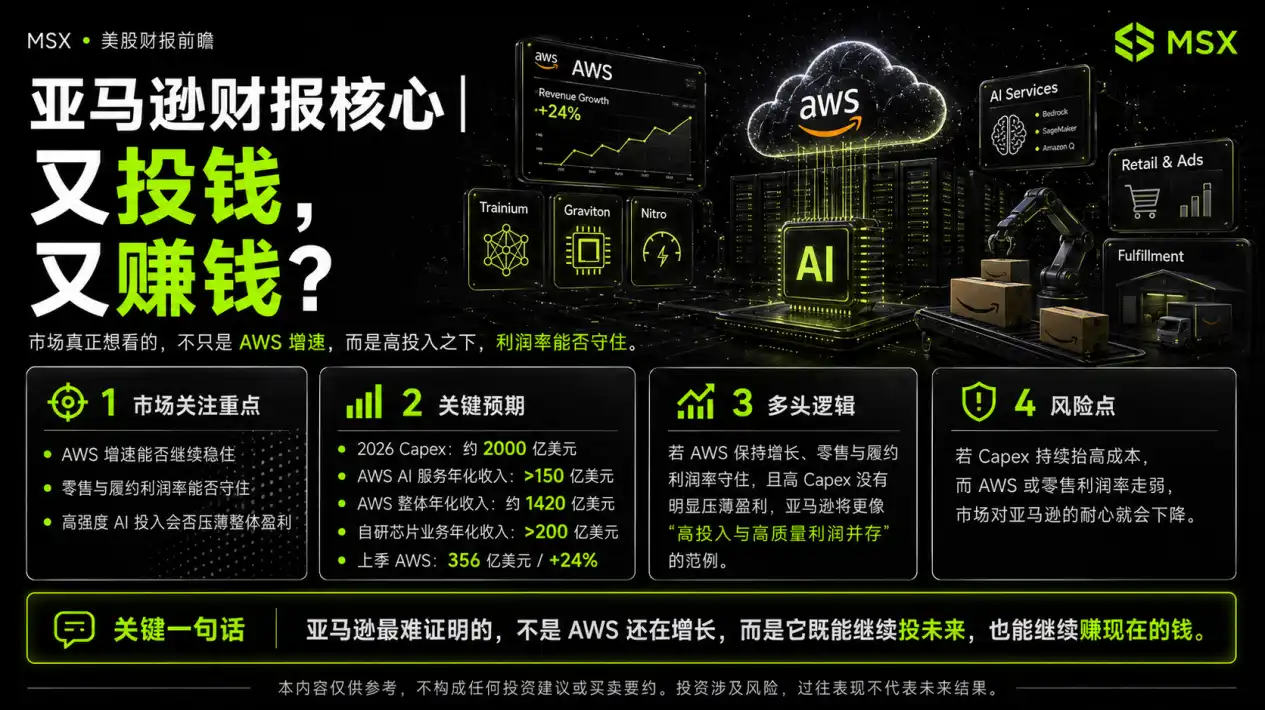
From the disclosed information, Amazon's investment in AI is very aggressive. The company clearly stated in its fourth-quarter earnings report in February that its 2026 capital expenditure is expected to be around $200 billion, mainly invested in AI infrastructure. CEO Andy Jassy later supplemented in a shareholder letter, revealing that AWS's AI service's annualized revenue run rate has exceeded $15 billion, while AWS's overall annualized revenue run rate is about $142 billion. At the same time, the annualized revenue run rate of self-developed chip-related businesses such as Trainium, Graviton, and Nitro has exceeded $20 billion. This indicates that Amazon is now talking not only about "we are also doing AI" but "we hope AI will become the core engine of AWS's next round of growth."
However, the issue is that Amazon cannot only talk about the future. AWS is its growth and profit engine, but retail and fulfillment systems determine whether the overall profit margin can be maintained. AWS revenue in the last quarter increased by 24% year-on-year to $35.6 billion, with full-year AWS revenue reaching $128.7 billion. The company gave an operating profit guidance for the first quarter of $16.5 billion to $21.5 billion, with the midpoint not being aggressive. This means that this time the market is not only looking at AWS's growth rate itself but a more realistic issue: will high-intensity AI investment once again squeeze the profit margin? If the answer is no, Amazon will be seen as an example of "high investment and high-quality profits can coexist"; if the answer begins to blur, then the market's patience with it will also decrease.
Amazon's real challenge is not to prove that AWS is still growing but to prove that it can both continue to invest in the future and continue to make money now.
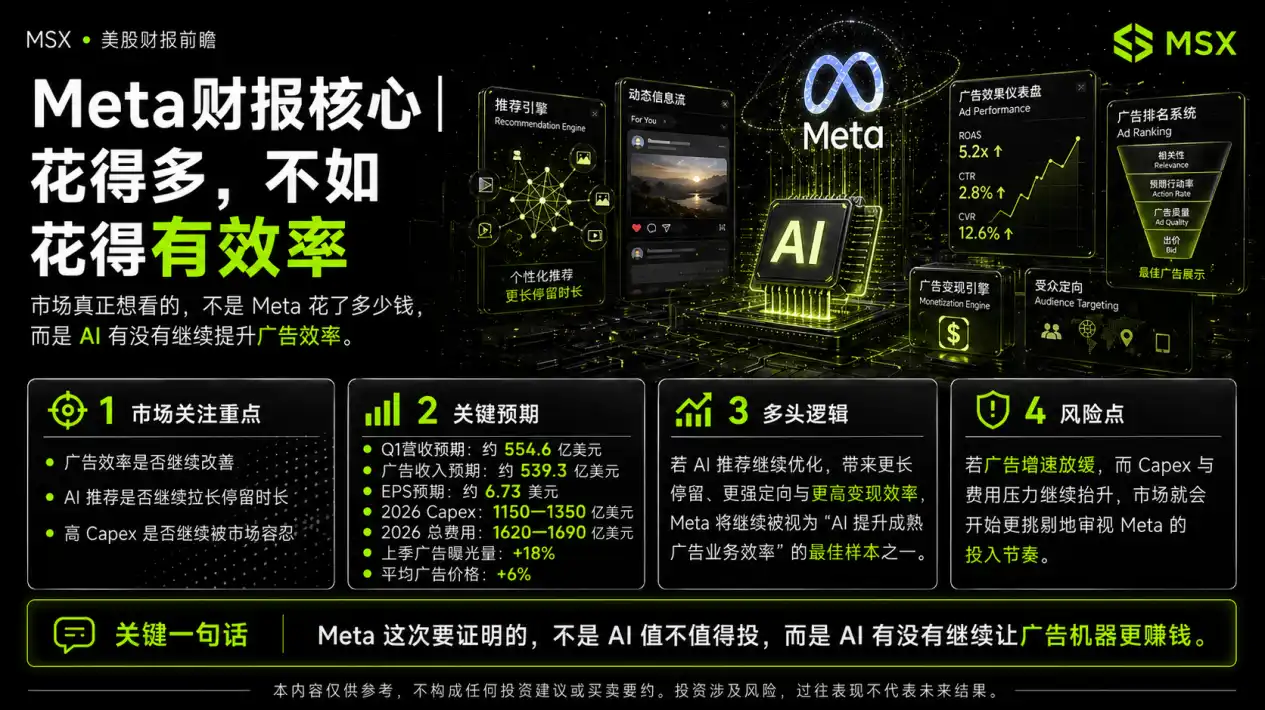
4. Meta: The Market is Willing to Keep Buying, Not Because It Spends a Lot, But Because It Spends Efficiently
Among the five tech giants, Meta's logic is the easiest to misjudge. At first glance, Meta, like others, is also dramatically increasing its capital expenditures. However, the reason the market is still willing to give it a high valuation is not because it also has a bunch of AI product launches, but because it has repeatedly proven that AI can indeed directly improve its most core business—advertising. For Meta, AI is not a distant new story but more like an ongoing "efficiency revolution."
Based on the last quarter's financial report, Meta's advertising business remains the foundation for all its AI investments. In the fourth quarter of 2025, Meta's ad impressions grew by 18% year-over-year, average ad prices increased by 6%, and the full-year capital expenditure reached $72.2 billion. At the same time, the company has further raised its 2026 capital expenditure to $115 billion to $135 billion, with the total expense guidance also increasing to $162 billion to $169 billion. This means that what investors really need to observe now is not how much money Meta spent, but whether this money continues to bring stronger recommendation capabilities, longer user engagement, better ad targeting, and higher ad monetization efficiency.
Leading up to the financial report, the mainstream market expectations were roughly Meta's first-quarter revenue of $554.6 billion, advertising revenue of $539.3 billion, and EPS of $6.73. These numbers are certainly important, but what truly determines market sentiment is the underlying logic chain: AI recommendation optimization → increased user engagement → improved ad efficiency → increased ad revenue → market's continued tolerance for high Capex. If this chain continues to hold, Meta will continue to be seen as one of the best examples of "AI enhancing mature business efficiency"; conversely, if ad growth slows down while capital expenditure pressure increases, the market will start scrutinizing its investment pace more critically.
In other words, Meta's financial report this time is not answering the question of "Is AI worth investing in?" but rather answering: Is AI continuing to make this ad machine more profitable.
5. Apple: The Market Doesn't Demand Its Radicalness, Just Confirmation It's Not Falling Behind
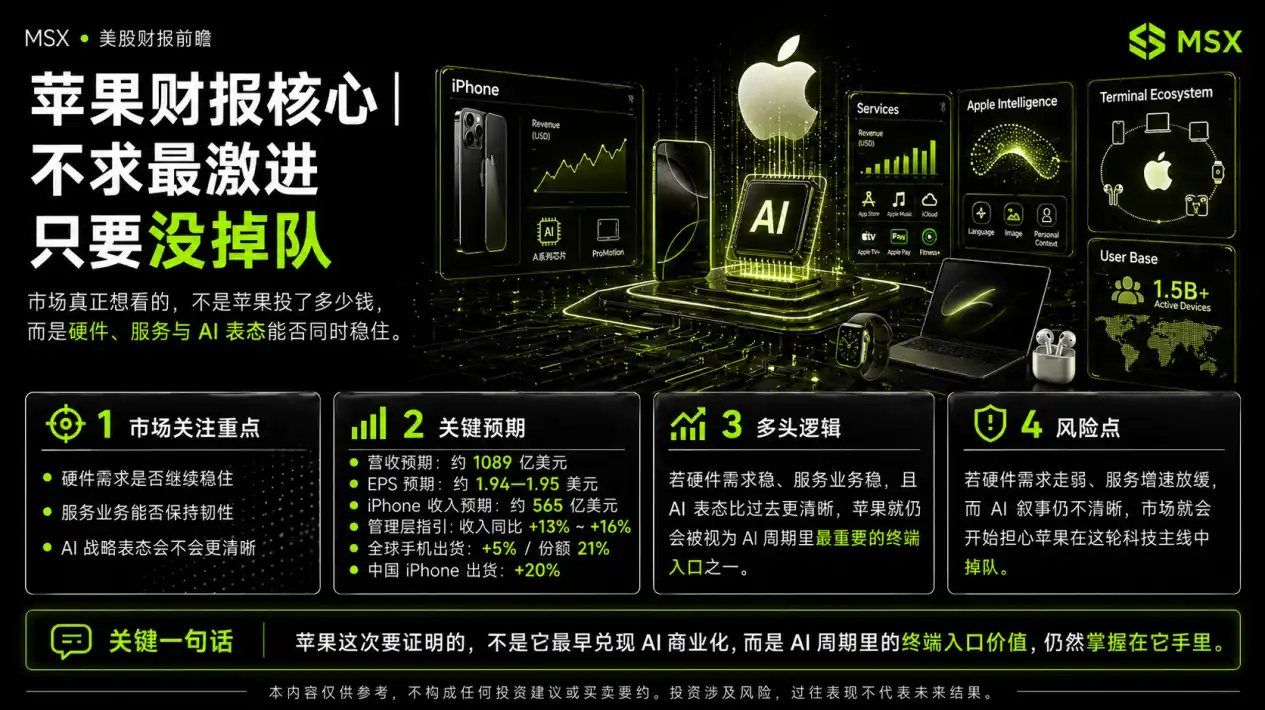
If the first four companies are to some extent revolving around "AI investment and commercialization," then Apple's logic is completely different. The market does not expect Apple's financial report this time to tell the most radical AI story, nor will it measure it by "how much Capex you invested." The most crucial question for Apple is only one: in this AI cycle, is it still firmly holding onto the most critical endpoint entry.
That is why the highlight of Apple this time will fall on a more subtle combination: hardware demand, service business, AI strategic clarity. Apple's guidance given in the January quarterly report indicated revenue growth of 13% to 16% for this quarter; based on this guidance, revenue is roughly expected to fall in the $107.8 billion to $110.7 billion range. The mainstream market consensus currently expects revenue of around $108.9 billion, EPS of $1.94 to $1.95; S&P Global's preview also shows the market expects about $56.5 billion in iPhone revenue this quarter. Meanwhile, Apple's global smartphone shipments in the first quarter of 2026 increased by 5% year-over-year, capturing 21% of the market share in the first quarter; in the Chinese market, iPhone shipments also grew by 20% year-over-year. This indicates that at least before the financial report, the market did not see any significant signs of Apple's terminal demand slowing down.
Therefore, Apple's real focus this time is not whether it will emphasize AI investment as loudly as Microsoft or Google, but whether it can continue to prove that even in an AI cycle that is not the most aggressive, it still has the most important end-to-end ecosystem, the strongest user base, and the most stable high-quality source of profit. As long as hardware demand remains stable, the service business is stable, and AI positioning is clearer than in the past, the market will not easily exclude Apple from this round of tech mainstream.
What Apple represents is not the earliest realization of AI commercialization, but rather: in the AI cycle, the value of the end user entry point is still in its hands.
III. Putting Five Companies Together, the Market is Actually Conducting a "Cross Validation"
If we only look at individual companies, this week is certainly five separate earnings reports; but if we put them together, we will see that the market is actually conducting a larger cross validation. Microsoft is looking at whether AI has already formed an enterprise payment loop; Google is looking at whether the conference narrative can quickly translate into a dual realization of Cloud and advertising; Amazon is looking at whether high investment can coexist with high-quality profits; Meta is looking at whether AI can continue to enhance mature business efficiency; and Apple is looking at whether the end user entry point and ecosystem position remain solid.
What seems to be five different threads are actually all pointing to the same question: whether the current tech leaders' high valuations are based on real achievements or still largely on expectations. If the answers provided by the five companies are mostly positive, the market will be more willing to continue driving up AI, cloud, advertising platforms, and end-to-end ecosystem-related directions; but if differentiation is significant, the market will shift from "generally raising valuations" back to "only rewarding the strongest performers."
IV. After Earnings Reports, What Might the Market Reprice?
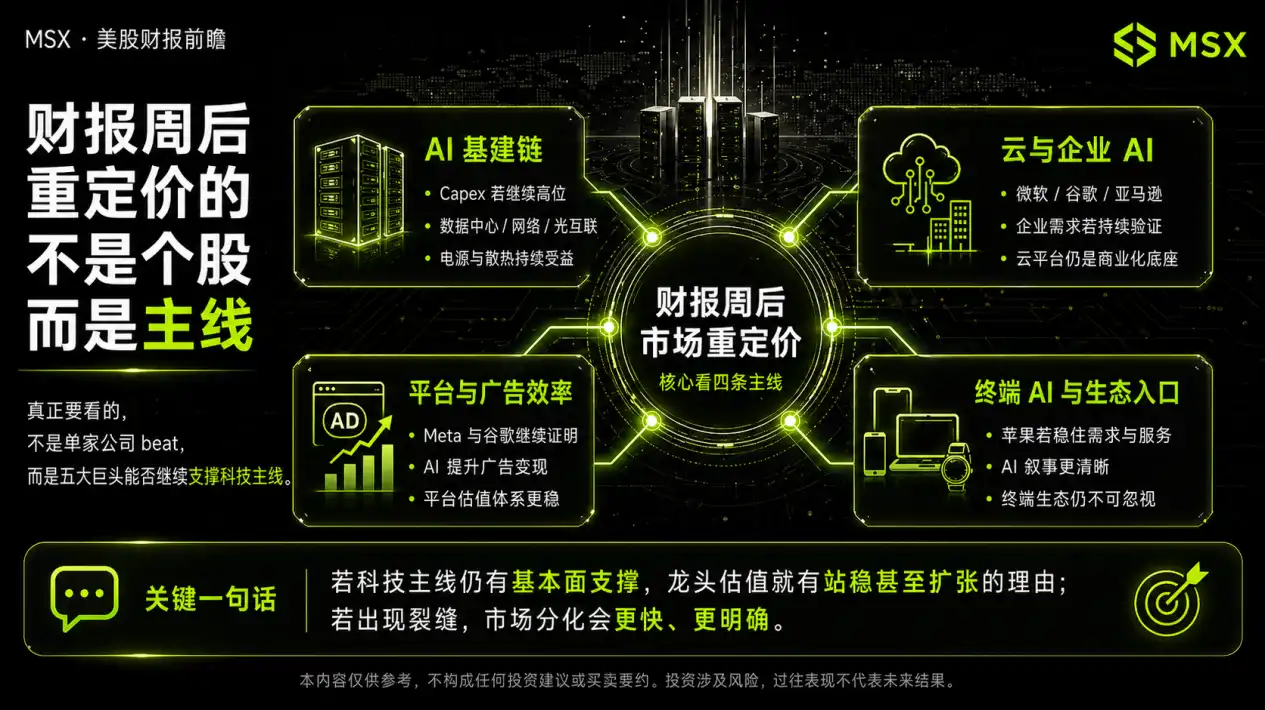
After earnings report week, what the market is most likely to reprice is not a single company, but several major themes.
The first theme is, of course, the AI infrastructure chain: if the capital expenditure of major companies continues to remain high, directions such as data centers, networks, optical interconnects, power supply, and cooling will continue to receive fundamental support.
The second theme is Cloud and Enterprise AI: as long as Microsoft, Google, and Amazon continue to prove that enterprise demand is still there, the market will continue to see cloud platforms as the core infrastructure for AI commercialization.
The third theme is Internet platforms and advertising efficiency: if Meta and Google continue to prove that AI is improving advertising monetization efficiency, then the valuation system for platform-based internet companies will also become more stable.
Lastly, it's about Terminal AI and Ecosystem Entry: How Apple stabilizes its demand and service business while providing a clearer AI narrative. The terminal ecosystem will still be a crucial part of the market.
Therefore, what is truly worth watching this week is not which company individually beat expectations, but whether these five companies together can continue to prove one thing: behind this tech trend, there is still a solid fundamental supporting it. If the answer is yes, then there is still a reason for the valuation of tech leaders to stand firm or even expand. If cracks start to show in the answer, then the market will begin to differentiate faster and more clearly.
5. How to Trade on MSX?
Step 1: Connect Wallet and Log In
1. Open msx.com.
2. Click on the "Connect Wallet" button in the top right corner.
3. Choose the supported wallet network to log in. Currently supported networks are: Solana, BNB Chain, Ethereum, Base.
4. After confirming in the wallet pop-up, you can complete the login process without providing any additional information.
Notice:
• Wallet addresses on different chains will be recognized as separate accounts, with balances, positions, and transaction records not being shared.
• It is recommended to select the primary network to use when logging in for the first time and try to keep it consistent.
Step 2: Deposit Funds
After logging in, click on "Deposit Now" in the top right corner of the homepage. The system provides two ways: Quick Deposit and Normal Deposit.
Quick Deposit:
1. Select "Quick Deposit".
2. Choose the token: USDT or USDC.
3. Enter the deposit amount and confirm the payment.
4. Sign and confirm in the wallet pop-up.
5. Once the on-chain confirmation is completed, the funds will be credited to your account.
Tips:
• Quick Deposit will by default use the wallet network you connected to during login and does not support manual switching.
• Please ensure there is enough Gas in your wallet.
Normal Deposit:
1. Select "Normal Deposit".
2. Choose the deposit token and network.
3. Copy the deposit address or scan the QR code.
4. Transfer funds from another wallet or exchange to that address.
5. The record can be viewed in the "Deposit History" after it arrives.
Tip:
• Please make sure the network and address match.
• Do not deposit unsupported currencies.
• On-chain confirmation time is generally 3–15 minutes.
Step 3: Enter the RWA Trading Section
After depositing, enter the "RWA" trading section.
MSX currently offers two types: Spot and Futures, covering tokenized assets such as US stocks and major indices.
Step 4: Place a Spot Order
1. Go to the "RWA Spot" page.
2. Search for the asset name or code, e.g., TSLA.M, NVDA.M, AAPL.M.
3. Choose order type: Market Order or Limit Order.
4. Enter price and quantity.
5. Check the "Terms of Use" agreement, click Buy or Sell.
6. After placing the order, you can view the order status in "Open Orders" or "Order History."
Additional:
• Spot supports individual US stocks, index-based assets, and some leveraged products.
• The platform offers pre-market, intraday, and after-hours trading.
• Orders cannot be placed or executed during weekends and US market holidays.
• Lower liquidity may be encountered in pre-market and after-hours trading, leading to slippage or delays.
Step 5: Place a Futures Order
1. Enter the RWA Futures section.
2. Choose the asset to trade.
3. Select the trading direction: Long or Short.
4. Set leverage, supporting up to 20x.
5. Set Take Profit / Stop Loss / Auto Liquidation as needed.
6. Confirm and submit the order.
Note:
• RWA Futures use a dynamic margin system and auto-liquidation mechanism.
• When the account's margin ratio falls below the system's maintenance margin requirement, automatic liquidation occurs.
• Deposited USDT and USDC are collectively counted towards the USD total margin.
Welcome to join the official BlockBeats community:
Telegram Subscription Group: https://t.me/theblockbeats
Telegram Discussion Group: https://t.me/BlockBeats_App
Official Twitter Account: https://twitter.com/BlockBeatsAsia
