Editor's Note: While the U.S. stock market continues to hit new all-time highs, consumer sentiment has plummeted to a record low. This seemingly contradictory data is highlighting the most typical structural division in the American economy.
This article attempts to explain not whether the "stock market has decoupled from the fundamentals," but rather what the basis is for the narrative of "the American consumer is still strong" when asset prices are rising while ordinary households feel a downturn. The author points out that there may be sample biases in consumer sentiment surveys, but the more critical issue is that the U.S. economy is becoming increasingly "K-shaped": those holding stocks, real estate, and financial assets continue to benefit as asset prices rise, while those without investment assets are further left behind in the face of inflation, food, and energy price pressures.
This also explains why overall consumption data still appears robust. The top 10% of U.S. consumers have already contributed nearly half of the consumption expenditure, and the continued consumption of asset holders, high-income groups, and wealthy retirees is masking the weakening reality of most households. In other words, the U.S. economy is not lacking resilience; it's just that this resilience is becoming more concentrated among a few.
The subdued consumer sentiment may be a contrarian indicator for investors; however, for ordinary people without assets, a rising stock market does not necessarily mean an improvement in life. The real issue is that the same mechanisms driving up asset prices may also continue to exacerbate the pressure on the asset-less group. This is the sharpest contradiction in the current U.S. economy: the more the market prospers, the more pronounced the differentiation may become.
The following is the original article:
To Investors:
One of the most perplexing charts in the financial market is perhaps the one that overlays consumer sentiment with the trend of the U.S. stock market. In recent times, the U.S. stock market has been hitting new all-time highs almost every day, but consumer sentiment has been consistently declining, dropping to its lowest level on record.
How could these two things be happening simultaneously?
Firstly, the quality of the University of Michigan Consumer Sentiment Survey has significantly declined. In the past, the survey respondents were roughly 50% Republicans and 50% Democrats, but this has changed in the past three years. As the survey has moved online, there has been a shift in the sample structure: now, about two-thirds of respondents are Democrats and one-third are Republicans.
Considering that Democrats currently have a significantly more pessimistic view of the economy, this oversampling of a particular political camp will magnify negative sentiments in the survey results more than before.
That being said, I personally believe that a large part of the American population does hold a negative view of the economy and their own financial situation. They are grappling with currency devaluation and the pressure brought on by high inflation in recent years. Food and gas bills keep piling up, while wage increases cannot keep up with price hikes.
Secondly, those holding stocks will be pleased with the stock market's rise; however, those without investment assets will only feel further left behind as stock prices soar. Fortunately, about 60% of Americans directly or indirectly own stocks, so a significant portion of the population does benefit from the rise in asset prices.
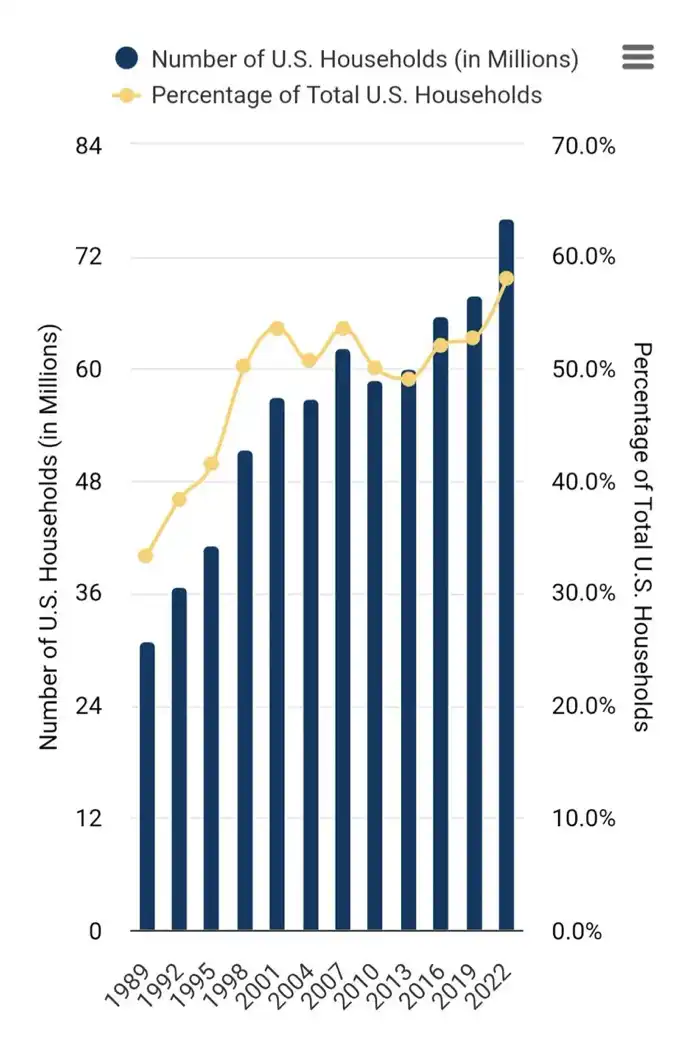
But there are still 40% of Americans who do not benefit from this. These people usually do not appear on national television programs, nor do they express their views on X or Substack, let alone accurately describe their financial distress in the language familiar to economists or investors.
This is why the gap between stock market performance and consumer confidence continues to widen.
Some may argue that consumers say one thing but act differently in terms of actual consumption behavior. To some extent, this is true because consumer spending in the U.S. is indeed still growing. However, the detail lies in this: today, the top 10% of U.S. consumers account for 50% of national consumer spending.
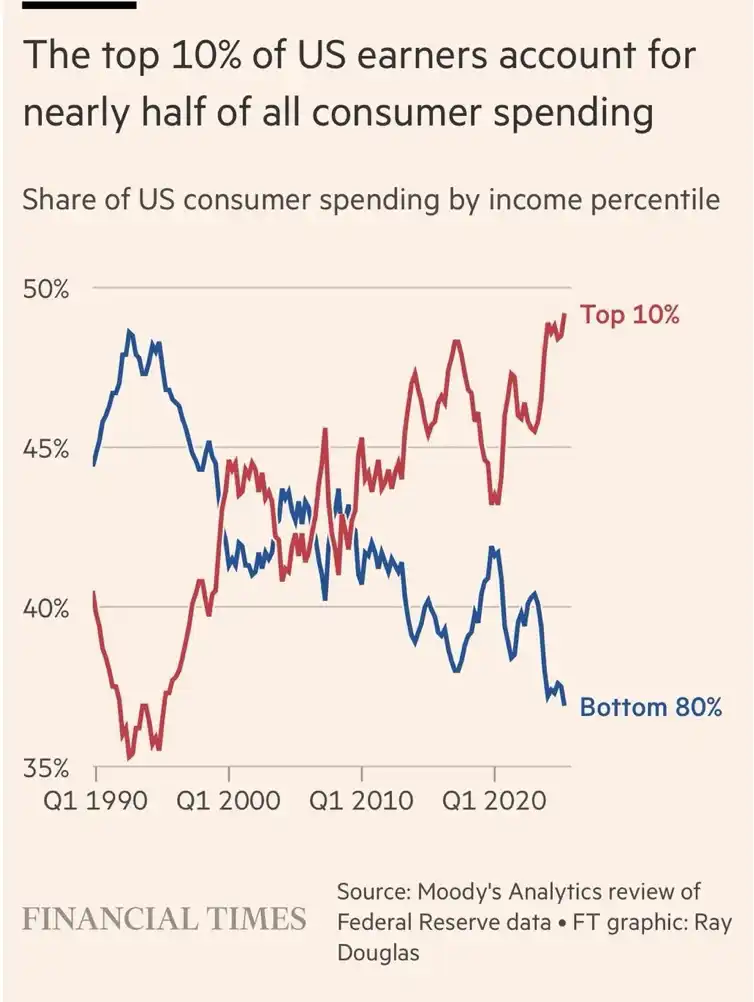
As my friend SightBringer wrote:
"The U.S. consumer economy is increasingly resembling a demand engine driven by luxury goods and the high-income population, enveloped by a fragile mass market shell. The graph is brutal because it shows the hollowing out of the consumption base. The top 10% of people now support nearly half of consumer spending, while the share of the bottom 80% is declining.
This means that from the aggregate data, U.S. consumers still appear resilient, but most households are actually weakening. The overall consumption is still holding up because asset holders, high earners, and affluent retirees continue to spend."
By delving into the data, you will see an increasingly apparent "K-shaped economy" in consumer spending. This makes the situation complex and perplexing, but linking it to the decline in consumer confidence provides a reasonable explanation.
However, for investors, I also have some good news. Creative Planning CEO Peter Mallouk pointed out that very low consumer confidence survey results are often a "very good contrarian indicator." He said, "The worse people feel about the future, the better the stock market tends to perform afterward."
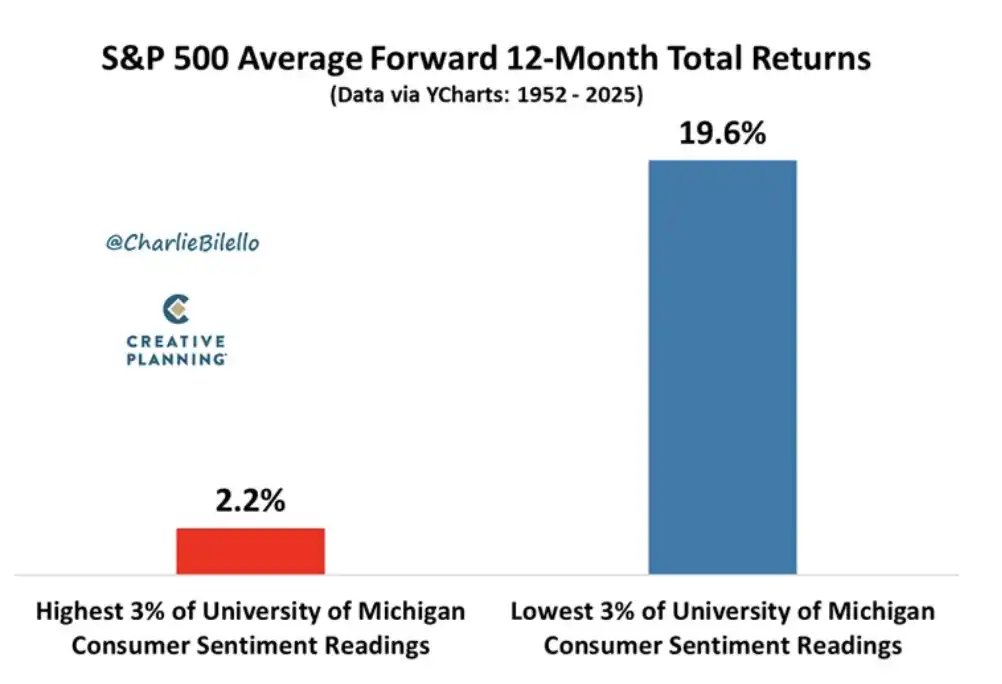
When the University of Michigan Consumer Confidence Index fell into the historically lowest 3% range, the S&P 500 Index saw a 19.6% return over the following 12 months. Considering the significant divergence that has already occurred between the stock market and consumer confidence, this should provide some comfort to investors. However, the continued strength of the U.S. economy may not necessarily help the bottom 40% of Americans—who do not have investment assets but are still facing the impact of rising prices.
This is the most profound dichotomy of our time.
The rich are getting richer, while others are being further left behind. The factors driving asset price increases are precisely punishing those who need breathing room the most. If you want to know what decisions the Federal Reserve, the Treasury Department, or Washington will ultimately make, just look at which class of people is making those decisions.
The wealthy and powerful are doing their best to deal with the situation using the tools at their disposal. They will strive to show empathy and will look at the data as much as possible. I truly believe that these individuals want to do the right thing and help as many people as possible.
The problem is they cannot serve two masters at once. Therefore, wealthy asset holders will continue to prevail, while others will continue to fall behind. The only thing you can do is make sure you are on the right side. Because time is ticking, asset prices are still rising, and inflation is consuming more victims.
Wishing you a pleasant day today. Let's chat again next time.
Welcome to join the official BlockBeats community:
Telegram Subscription Group: https://t.me/theblockbeats
Telegram Discussion Group: https://t.me/BlockBeats_App
Official Twitter Account: https://twitter.com/BlockBeatsAsia
