Fear of downside risk in the market has almost disappeared, and a core pricing mechanism in the options market is failing.
Goldman Sachs derivatives strategist Brian Garrett pointed out in a recent weekend report that the skew of the S&P 500 options has dropped to an 18-month low. The pricing probability of a 10% decline and a 10% surge is nearly the same, both around 8%—a phenomenon directly characterized by the Goldman Sachs volatility team as "Skew Malfunction."
Meanwhile, the Goldman Sachs Panic Index closed at single digits, hitting a two-year low, indicating that the market's demand for hedging against tail risks has dropped to extremely low levels.
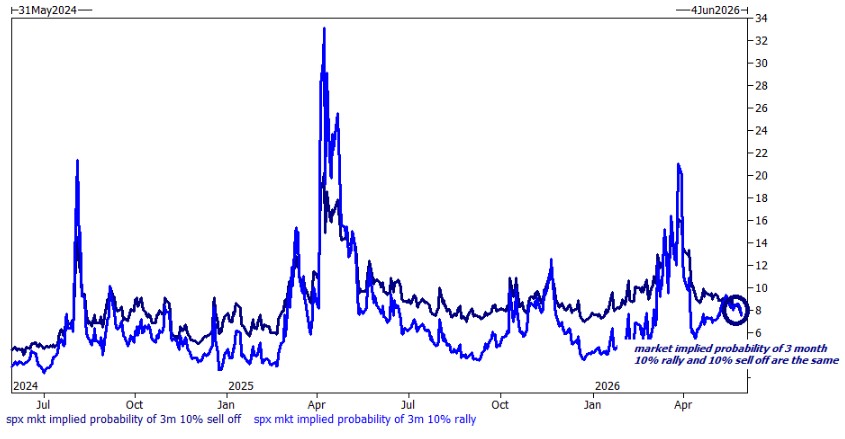
This signal comes against the backdrop of the ongoing frenzy in the US stock market. The S&P 500 index has hit a new all-time high roughly every five trading days this year, and Micron's stock price broke above $1000 for the first time post-market on Sunday.
Garrett admitted that the internal discussions within the team have evolved from March's "let it stop" to May's "is this still going up?" However, his own stance is shifting from cautiously bullish to increasingly pessimistic, and he has clearly outlined multiple bearish reasons.
Three Major Bearish Signals Emerge, Cracks Between Market Sentiment and Fundamentals
Garrett outlined three main concerns in the current market.
Firstly, the market's breadth of leadership has narrowed significantly. The top ten weighted stocks in the S&P 500 currently account for 40% of the index weight, and the last four record highs have all occurred with negative overall market breadth—a phenomenon that has never occurred before.
Secondly, there is a high level of thematic concentration. Excluding AI-related stocks from the S&P 500 this year has caused the index to lag the overall index by as much as 700 basis points.
Thirdly, the price trend is eerily similar to historical highs. Garrett pointed out that the price action in 2026 closely mirrors the price pattern from late 1998 to 1999.
Despite the prevalence of bearish voices in headlines and social media, Garrett emphasized that this concern is not reflected in the pricing of the options market—at least the fear of downside risk is almost non-existent.
Skew Breakdown: Downside Hedging Cost Drops to Historic Low
The Goldman Sachs Volatility Team has provided three key observations from the options market perspective.
First, the S&P 500 volatility skew has dropped to an 18-month low, a trend driven by two forces: the put wing of options being unusually cheap, while the call wing is relatively expensive.
Second, the Goldman Sachs Panic Index closed in single digits last Friday, hitting a two-year low. This index combines VVIX, VIX, Skew, and the two-year percentile rank of at-the-money volatility.
Third, and most importantly, the market has priced the probability of a 10% decline and a 10% advance as completely equal, both around 8%. This means the options market no longer assigns additional premium to downside risk, indicating that the protective function of Skew has effectively ceased.
Garrett pointed out that the direct implication of these phenomena is that the current hedging cost is extremely low for investors looking to hedge correlation risk.
Low-Cost Hedging Coupled with Right Tail Positioning
Based on the above assessment, Garrett has provided several specific trading recommendations.
For investors who are bullish on market style rotation and believe the market will move from concentration to dispersion, Goldman Sachs recommends buying RSP (Equal Weight S&P 500 ETF) outperformance options relative to SPX. The 1-month 100% outperformance option cost is around 145 basis points. They also recommend buying VIX call options as a hedge tool, noting that the term structure is very flat from August onwards, with VVIX closing at 86.
For investors seeking simple downside protection, Garrett suggests directly buying S&P 500 put options—given the current low put skew, the payout structure is quite attractive.
Furthermore, Goldman Sachs also recommends longing Bitcoin ETF volatility and conducting Delta-neutral hedging. Garrett points out that Bitcoin has historically behaved like a "leveraged version of the Nasdaq," but its current pricing is at a two-year low, approximately 10 volatility points lower than SMH.
Fund Flows: Hedge Funds Net Bought for Two Consecutive Weeks, Single Stock ETF Size Doubles
According to the latest Goldman Sachs Prime Brokerage data, hedge funds have been net buyers for two consecutive weeks at the fastest pace this year, mainly reflecting long positions increasing and macro shorts covering.
Significant industry rotation at play: Financial stocks (down 6% year-to-date) saw net inflows, while industrial stocks (up 11.5% year-to-date) experienced net outflows.
On the futures side, end-user positions have rebounded to near 2024 highs. The Goldman Sachs team specifically noted that leveraged ETFs are mechanically expanding their balance sheet size; CTA strategies are currently positioned close to neutral, but systematic strategies exhibit significant asymmetry to the left tail—an estimated $12 billion in buys in a flat one-month scenario, and about $100 billion in sells in a one-month downturn scenario.
Of note, the assets under management for global leveraged and inverse single-stock ETFs have surpassed $60 billion, doubling in size in two months, highlighting the growing significance of this niche market.
Welcome to join the official BlockBeats community:
Telegram Subscription Group: https://t.me/theblockbeats
Telegram Discussion Group: https://t.me/BlockBeats_App
Official Twitter Account: https://twitter.com/BlockBeatsAsia
