In this White House administration, resides a stock market wizard.
According to newly disclosed financial documents, Trump completed 3642 stock trades in the first quarter of this year, averaging about 58 trades per trading day. This frequency far exceeds that of most professional fund managers.
If it were just about frequent trading, this matter would not be enough to attract market attention.
What has truly sparked Wall Street's discussion is another set of increasingly hard-to-ignore data: in the past year, publicly praised by Trump, are now showing a more and more apparent overlap between the companies he praises, his holdings, government industrial policies, and federal funding flows.
Perhaps the most impressive was last year when Trump turned the White House South Lawn into a Tesla product launch event. In front of the media cameras, he sat in a Model S, calling Tesla a "great product" and praising the Cybertruck for having the "coolest design."
This was followed by a series of companies such as Dell, Intel, Micron, Nvidia, IBM, Apple, Thermo Fisher, among others, sequentially entering his public praise list.
Some companies experienced significant stock price movements after being named; some companies had positions established in Trump's account before the praise; and some companies simultaneously received government contracts, subsidies, export licenses, or other policy support.
When these events occur individually, they may just be coincidences. But as more and more coincidences point to the same group of companies, we can't help but wonder: Is Trump truly supporting American manufacturing and the technology industry, or is he shaping a "Presidential Blue Chip" list of his own?
And if this pattern does exist, the market's most pressing question is: Who will be the next one singled out by the White House?
Common Threads Among Trump's Recommended Companies
Starting from the performance in March 2025, where the White House South Lawn turned into a Tesla showroom, until May 2026, nine publicly traded companies have been publicly named or endorsed by Trump, with a sharp increase in density in 2026, with Dell and Intel being the most typical.
On February 10th of this year, Trump's account took positions ranging from $1 million to $5 million, on May 8th, he publicly urged people at the White House to "buy a Dell, they are great," and on that day, Dell's stock price rose by about 14% intraday. Prior to this, the Dell family had already committed $6.25 billion to the "Trump accounts."
Intel is another typical example. In August 2025, the Trump administration converted the $8.9 billion subsidy owed to Intel under the "Chip and Science Act" into equity at $20.47 per share, acquiring approximately 9.9% of the company. As a result, the U.S. government became Intel's largest shareholder, and the community promptly referred to it as a "U.S. state-owned enterprise." In early March 2026, six months later, his personal account also appeared in Intel. Subsidy-to-equity conversion, government backing, personal holdings, and public endorsements all became catalysts for Intel.
Another landmark moment was Palantir (PLTR). On April 10, he endorsed the company on Truth Social by adding its ticker symbol, stating that it had "proven to possess strong combat capabilities and equipment," making him the first sitting president to do so.
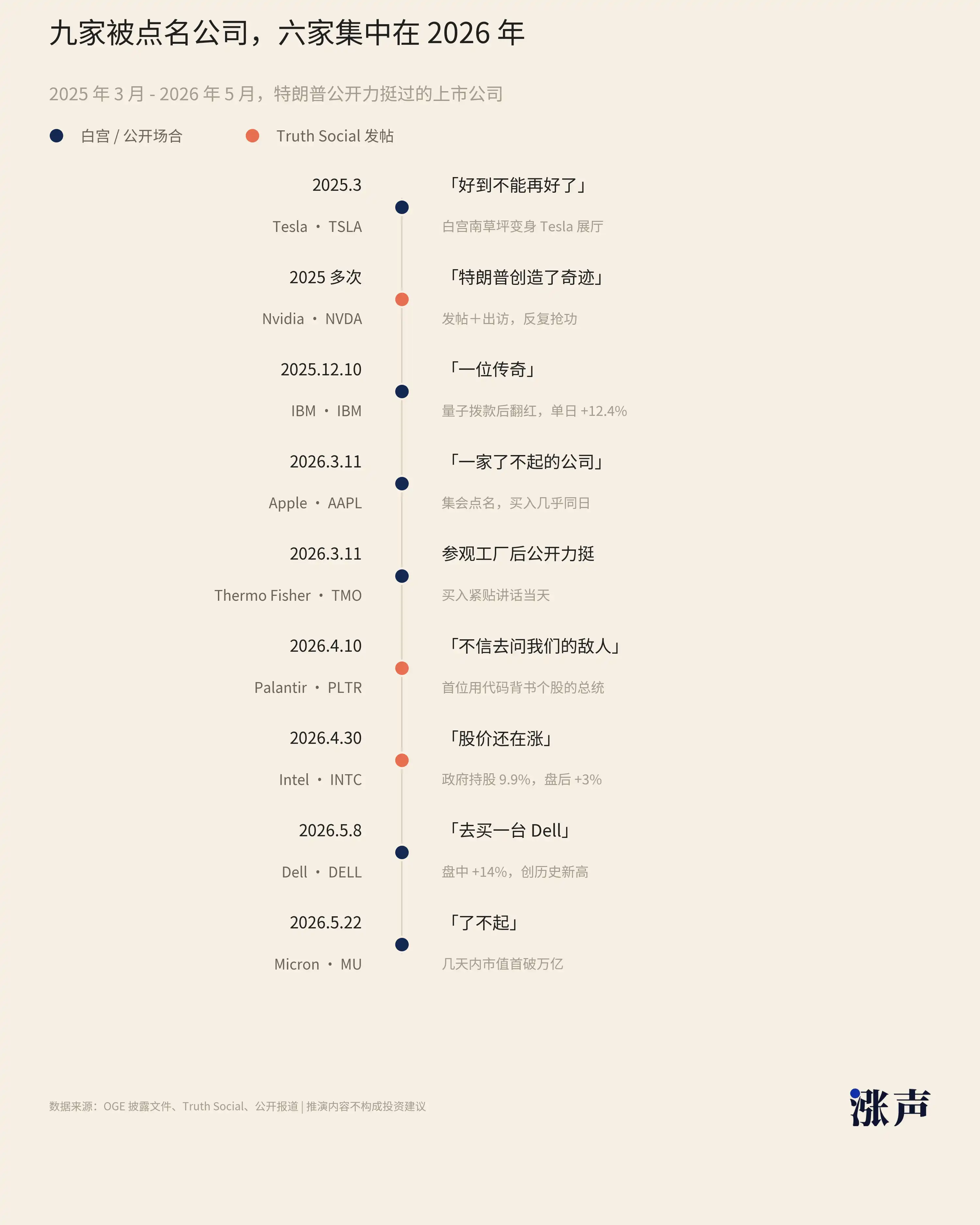
If we expand the scope from Trump's personal holdings to publicly endorsed listed companies, we will find that the number far exceeds the few well-known tech giants. Based on public speeches, White House events, and Truth Social posts, Trump has explicitly praised at least 9 publicly traded companies over the past year, causing brief stock price surges, including Intel, Dell, Micron, Palantir, IBM, Apple, Thermo Fisher Scientific, Tesla, and Nvidia.
Their commonalities were summarized by the Law and Motion editors:
First and foremost, they are almost all part of the narratives of "AI New Technology," "U.S. Leading Manufacturing," and "Reshoring of Production Capacity."
These companies are highly concentrated in the AI computing power and semiconductor chain. Intel, Micron, Nvidia, and AMD are chipmakers, Dell provides computing hardware, IBM works on quantum computing, and Palantir offers AI software.
Secondly, each of the mentioned companies has a vested interest interface directly accessible to the government. For example, Intel is 9.9% government-owned, Palantir is a major federal contractor, IBM and Intel receive funding from the CHIPS Act, Nvidia and AMD benefit from relaxed export licenses to China, Dell secured a $9.7 billion Pentagon contract on May 27 shortly after the praise. Apple received accolades for committing to U.S. investment and manufacturing iPhone glass in a Kentucky factory, Intel and Micron have domestic fabs, Dell assembles AI servers in the U.S., IBM operates a quantum foundry in Albany, and on the day Tesla was praised, Musk pledged on the spot to double U.S. production. Trump rarely praises purely overseas capacity; instead, he praises the act of "bringing production lines back to America" itself.
To some extent, the narratives of these companies have all been packaged and elevated to the level of "national security" and "competition with China." Chips are the bottleneck, quantum is about cybersecurity. Of course, the premise of being named usually starts with the CEO presenting the initial token of allegiance.
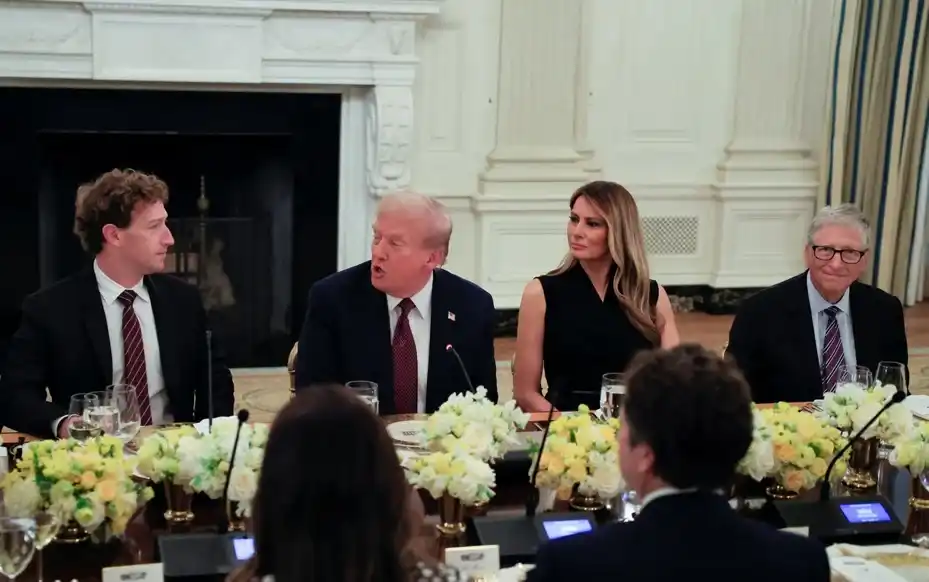
First and foremost, all the benefits come from having the "right connections." These CEOs have generally openly expressed goodwill towards Trump or have personal relationships with him.
Hwang Yoon-ho followed him on his overseas visits, publicly thanked him, the Dell family donated $6.25 billion to "Trump accounts," Oracle's Larry Ellison has been a longtime supporter, deeply involved in the Stargate and TikTok deals, Musk was an ally during the time he was called out, and Arvind Krishna was named in person in the room.
Although the official stance from the palace is that the president's assets are held in trust managed by his children, operated independently by a third party, and Trump himself is not involved in specific transactions, we can indeed observe that the timing of Trump's calls for actions and his personal holdings and trades overlap.
For example, Palantir made intensive purchases in March, and a few weeks later Trump called them out on Truth Social; Dell bought between 1 million and 5 million shares on February 10th, on the same month Trump made the public callout in May; Apple and Thermo Fisher purchased and publicly boasted almost on the same day.
If these patterns are correct, then predicting Trump's next callout shouldn't be difficult.
Who Might Be the Next One to Be Called Out
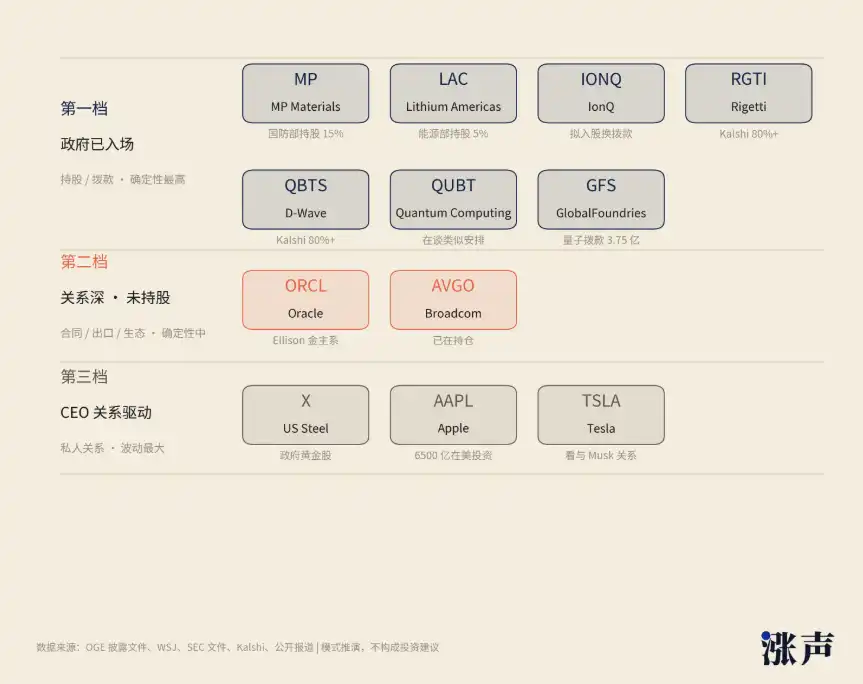
First and most likely group would be the companies that the government has already entered: MP Materials (MP), Lithium Americas (LAC), IonQ (IONQ), Rigetti (RGTI), D-Wave (QBTS), and so on.
MP Materials is currently one of the core rare earth magnet suppliers in the United States. Its main business is rare earth mining and separation processing, which is ultimately used in the manufacturing of permanent magnet materials, directly entering fighter jets, electric vehicles, and missile systems.
In other words, it is not a "resource company," but rather a part of the defense supply chain.
By July 2025, the U.S. Department of Defense had acquired approximately 15% equity through equity and related arrangements, transforming it from a regular publicly traded company into a somewhat "quasi-strategic asset." More importantly, this action took place before Intel's government investment.
However, what is interesting in the market is that, compared to Intel, which is frequently discussed, MP has been relatively low-key, and has not even been explicitly mentioned in the political narrative. This "already in but not yet told" status itself constitutes a form of lagged pricing.
Lithium Americas is a typical lithium resource development company, with its core asset being the Thacker Pass lithium project in Nevada, USA, one of the largest known lithium resources in North America. The strategic significance of lithium needs no explanation: electric vehicles, battery energy storage, and military energy systems all rely on it.
The U.S. Department of Energy indirectly holds approximately 5% equity through warrants and a project structure and has about 5% economic interest in the Thacker Pass project. At the same time, the project is tied to General Motors (GM), forming a three-party structure of "government + industry + publicly traded company."
More importantly, the U.S. Department of Energy explicitly defines Thacker Pass as a "national security-level strategic lithium asset" in its documents.
Furthermore, according to The Wall Street Journal, several companies, including IonQ, Rigetti, and D-Wave, are in discussions to receive at least $10 million in funding support through "government investment or quasi-equity arrangements." Quantum Computing (QUBT) and Atom Computing are also included in similar frameworks.
These quantum computing sectors are currently in a very early stage, but what makes them special is that they naturally fall at the intersection of national security and basic research.
Expanding the timeline, the U.S. government had previously initiated a quantum technology support program of around $2 billion, with IBM receiving about $1 billion, GlobalFoundries (GFS) around $375 million, and the remaining funds allocated to various labs and companies.
IBM has already gone through a full round of market trading, and the next step naturally would be for more "pure" quantum targets. Interestingly, the market has actually priced ahead of it. In the market on Kalshi betting on "which companies the government will invest in this year," the probability for Rigetti and D-Wave has already been bet above 80%.
GlobalFoundries (GFS) is worth mentioning separately. Not only did it receive the $3.75 billion quantum grant, but it is also a domestic U.S. wafer fab, holding both chip and onshore manufacturing capabilities. It is the most suitable company to be mentioned in a "U.S. Semiconductor Manufacturing" event.
In addition to companies that have already received government funding and have a structure that aligns perfectly with the initiative, there are also some companies with deep government relationships that have not yet received explicit equity but are noteworthy.
However, this latter group is more likely to be mentioned through contracts, exports, or ecosystem contributions, and the endorsements may not be as direct as the previous public announcements.
Oracle (ORCL) may be one of the best-positioned in this category, with Ellison's personal relationships, involvement in the Stargate initiative, the TikTok deal, and the existing positions in his personal portfolio. All soft conditions are met; only a formal public endorsement is pending. Similarly, Broadcom (AVGO), as a core supplier of custom AI chips and data center construction, has long been part of the holdings.
Furthermore, some companies are primarily driven by the CEO's personal relationships. The line of US Steel (X) deserves particular attention. In the Nippon Steel acquisition case, the government obtained a stronger "golden share" than ordinary stock, and the narrative of "protecting American steel" can be reinvoked at any time. While Apple has already been mentioned, its $650 billion commitment to U.S. investments is a reusable talking point, making a repeated mention quite probable. As for Tesla, it depends on the extent of the repair in relations between the company and Musk, making it the most volatile entry on this list.
It should be noted that the above is a deductive pattern based on publicly disclosed industrial policies and ownership clues, rather than definitive predictions, and does not constitute any investment advice. These targets themselves carry a high political premium, which can swing in both directions. It can drive stock prices up after a single post, but it can also push valuations down when the political winds change.
After all, relying solely on the "White House Stock Oracle" for endorsements would lead to a very fragile uptick in stock prices.

Welcome to join the official BlockBeats community:
Telegram Subscription Group: https://t.me/theblockbeats
Telegram Discussion Group: https://t.me/BlockBeats_App
Official Twitter Account: https://twitter.com/BlockBeatsAsia
