Every bear market cycle quietly reshapes the listing logic of centralized exchanges (CEX). As liquidity tightens and retail interest wanes, each listing decision by a trading platform becomes more cautious, making it more signal-worthy.
We systematically tracked the new listings from 2026 to mid-May for six major first-tier spot exchanges—Coinbase, Binance Spot, ByBit, OKX, Bithumb, Upbit—and Binance Perpetual, with a total of 207 listing records covering 92 unique tokens.
The data clearly reveals a core fact: Listing is a highly structured validation and liquidity transfer path.
Who first discovered and priced the project? Who took on and amplified liquidity in the middle stage? Who completed market coverage at the end? Different exchanges play distinct roles in this chain. A token's journey from its initial listing to being accepted by Binance Spot often goes through multiple rounds of validation by different trading platforms. This report will dissect this listing path from three core dimensions:
· Landscape and Path: The differentiated listing roles of each exchange and the circulation rules of tokens among different exchanges
· Binance Perp Screening Logic: What kind of tokens are more likely to enter Binance Perpetual
· Price Impact: How the listing timing determines investors' entry positions and the actual return differences after listing on different exchanges
For projects, understanding this path means a more accurate and efficient listing strategy; for investors, identifying position differences in the path may be one of the most important sources of Alpha in 2026.
2026 CEX Listing Landscape and Path
Overview of Listings on Various Exchanges
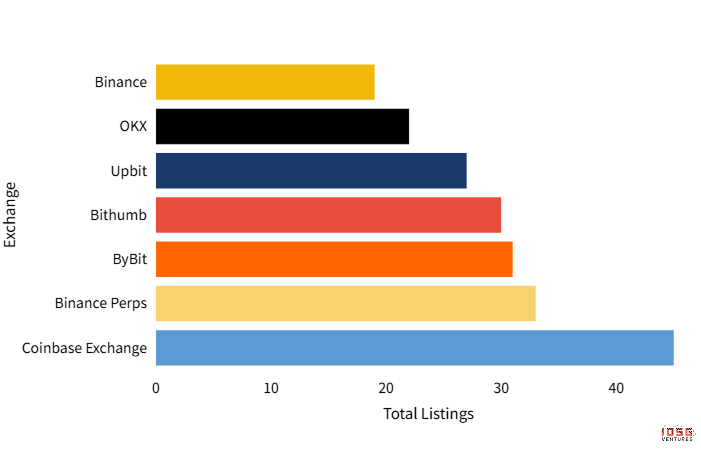
From 2026 to present, we have tracked the new listings data of six top-tier spot exchanges: Coinbase, Binance Spot, ByBit, OKX, Bithumb, Upbit, and Binance Perp, totaling 207 listing records covering 92 unique tokens.
The number of listings varies significantly across exchanges. Coinbase leads with 45 new listings, followed by Binance Perp (33) and ByBit (31). Bithumb (30) and Upbit (27) are in the second tier, OKX listed 22 tokens, while Binance Spot only launched 19 tokens, the lowest among all observed exchanges.
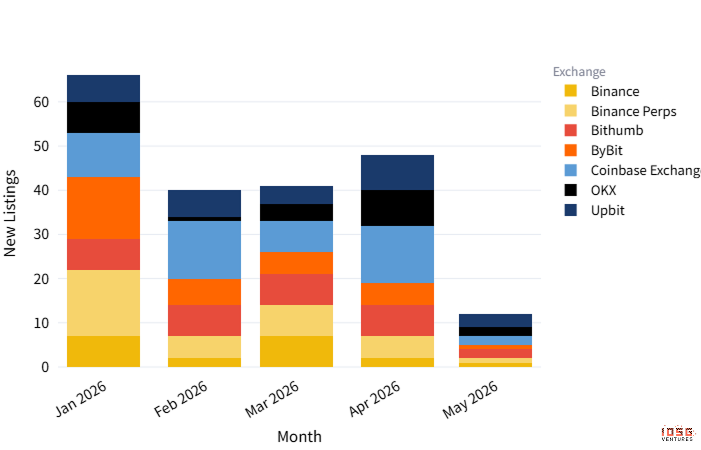
Looking at the monthly trends, January saw the peak of listings for the year. Binance Perp listed 15 tokens in a single month, ByBit listed 14. Starting from February, the overall pace slowed significantly, with exchanges listing an average of 5-8 tokens per month, entering a more cautious and stable selection phase.
Coinbase, on the other hand, demonstrated a listing pace that diverged from other exchanges, with two concentrated listing peaks in February and April (13 tokens each month), showcasing its independently rapid listing decision-making.
Mere differences in quantity only reflect surface-level activity. More importantly, the profound differentiation in listing timing and roles among different exchanges will be further dissected in subsequent sections.
Listing Role Differentiation: Discoverers, Filters, and Validators
Among tokens listed on multiple exchanges, there is a significant chronological order.
We define the earliest listed exchange among our tracking range as the "Discoverer", with others defined as "Followers".
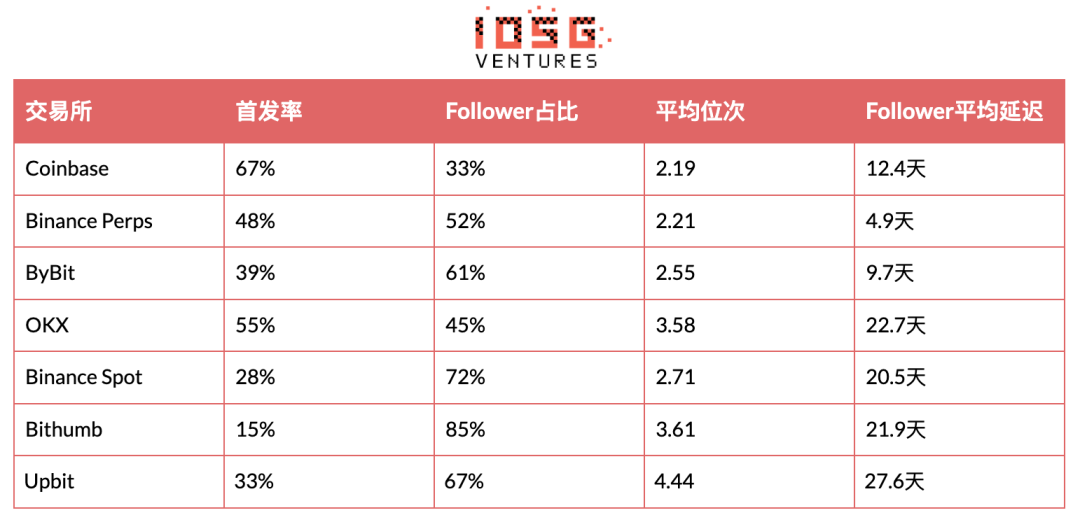
Coinbase has been the most prominent Discoverer in 2026, with 67% of tokens listed on the exchange being Discoverers within the tracked exchanges, taking on the role of the market's first-round price discovery. ByBit (Discovery rate of 39%) and Binance Perps (Discovery rate of 48%) also maintain high activity, often listing the same token intensively in the same week, collectively forming the first tier of new project listings.
The South Korean exchanges (Bithumb and Upbit) are systematically positioned at the end of the listing path. Bithumb has a Follower rate as high as 85%, Upbit has an average ranking of 4.44, and there is a high probability of being the last one to list among all exchanges, with an average delay of about 28 days from the first exchange.
This is closely related to the lengthy Korean regulatory review process and the local exchanges' preference to introduce projects only after gaining widespread consensus.
Binance has internally established a clear funnel-shaped division of labor: Binance Perps actively list in half of the cases, while the other half quickly follow suit after the spot listing (with an average of only 4.9 days), making it the fastest responder among all exchanges.
Its main role is to quickly test liquidity and market demand through the futures market. Meanwhile, Binance Spot has the fewest listings (only 19) with a first listing rate of only 28%, showing a clear tendency to wait for market validation before listing at the right time.
OKX demonstrates a strong ability to independently select projects, with a first listing rate of 55%, but a relatively restrained overall number of listings (22 projects), with an average ranking of 3.58, indicating a higher screening threshold and a more cautious strategy.
Listing Path Paradigm
Looking at the tokens that are listed on three or more exchanges, the listing order shows a highly stable tiered pattern: Early discoverers represented by Coinbase and ByBit lead the initial listings, followed swiftly by Binance Perps for rapid validation within days, then Binance Spot selectively lists to confirm, while OKX, Bithumb, and Upbit mainly provide supplementary coverage in the later stages of the path.
Case Study: ROBO (Fabric Protocol)
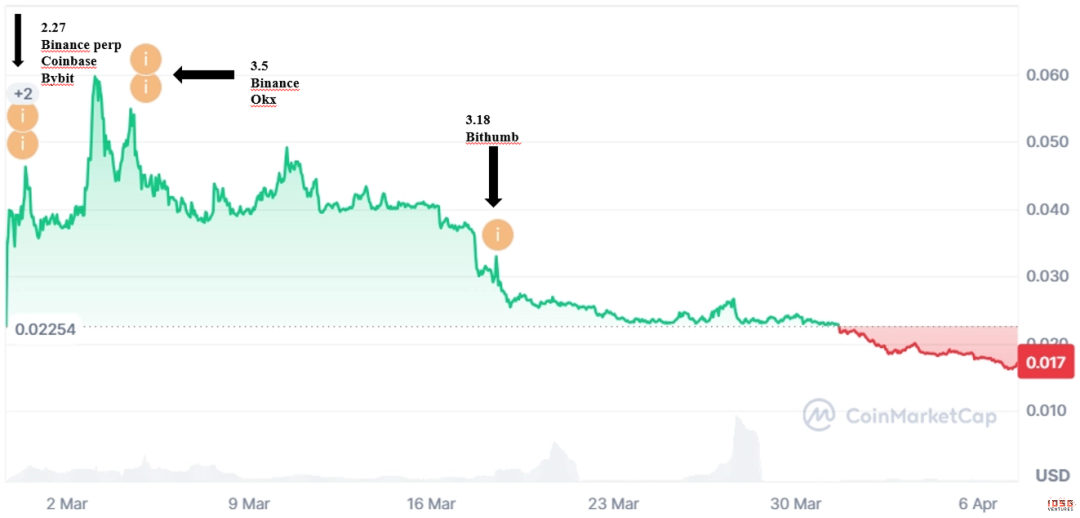
On February 27, the DePIN project Fabric Protocol (ROBO) debuted on Binance Perp, followed by listings on Coinbase and ByBit on the same day. The opening price was $0.022, with an initial-day surge of over 80%. The next day's opening price rose to $0.0405, nearly doubling from the listing price.
The project was led by Pantera Capital with a $20 million investment, focusing on the integration of blockchain and the robotic economy. Leveraging the hype around Kaito's public sale and the "AI + Robotics" narrative, it quickly gained market attention.
On March 5, Binance Spot officially listed ROBO, reaching a same-day price of $0.0493. This marked the peak price for ROBO throughout the cycle. When OKX entered the market, the opening price was lower than the Binance Spot price. On March 18, Bithumb was listed with a price of $0.0303, causing a brief spike but eventually leading to a continuous decline in the token's price, which is now below the initial listing price.
From the initial launch to Bithumb's listing, ROBO took only about 20 days to complete a typical 2026 coin listing path:
Binance Perps, Coinbase, and ByBit Initial Launch → OKX and Binance Spot Confirmation at the Peak → Korean Exchange FOMO Buy-in.
ROBO is not an isolated case. In the first five months of 2026, a total of 28 tokens were listed on three or more exchanges. The ranking distribution of these cross-exchange cases follows a pattern highly consistent with ROBO's. Although the specific order may vary slightly due to project attributes, the overall path structure is stable and predictable.
This path clearly reflects the differing risk preferences of various exchanges: Coinbase, ByBit, and Binance Perps tend to aggressively occupy the early window, Binance Spot emphasizes post-verification security, while Korean exchanges and OKX prefer to enter after market consensus has been established.
Binance Perps Listing Criteria
As a key entry point for the derivatives market, Binance Perps' listing decision directly impacts the inflow direction of a significant amount of leveraged capital.
By analyzing 33 Perps listing cases, we can clearly extract Binance's core logic for screening tokens in a bear market environment.
Leading Signal: Coinbase and ByBit Listing
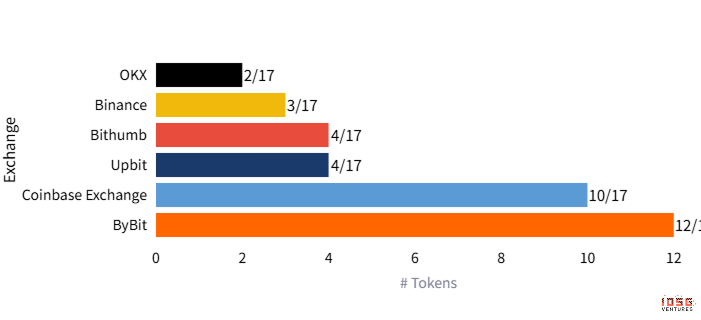
Among the 33 tokens added to Binance Perpetual Futures, 17 were first listed on other spot exchanges before being included in Perps.
Tracking these tokens reveals that Coinbase and ByBit serve as the primary precursors to Perps.
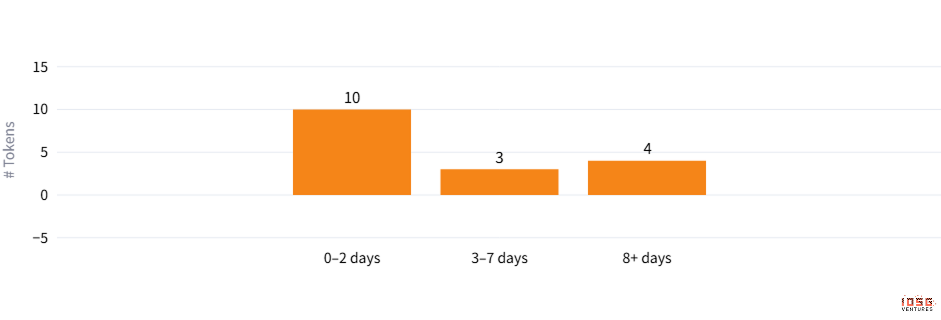
Among these, ByBit listed before Perps in 71% of cases, while Coinbase did so in 59% of cases. More importantly is the response time: out of 17 follow-up listings, 10 tokens were listed on Perps 0-2 days after their spot listing, with an average delay of only 4.9 days.
This rapid follow-up speed indicates that Binance Perps closely monitor the listing dynamics of Coinbase and ByBit, using them as essential decision-making references.
Looking at a larger sample, 75% of tokens listed on Coinbase eventually join Binance Perps, while ByBit accounts for 70%.
When a token is supported by both Coinbase and ByBit and demonstrates relatively stable price performance, it is highly likely to land on Binance Perps within a week. This is currently one of the strongest and most observable precursory signals in the market.
Price Performance is the Core Criterion for Selection
Projects listed after opening on Coinbase and ByBit generally have a starting Fully Diluted Valuation (FDV) above $100 million, where the FDV itself is not a differentiating factor. What truly determines entry into Perps is the post-listing price performance.
From the perspective of tokens that have been listed on Coinbase and ByBit but have not entered Perpetuals (Perps), there are mainly three types of characteristics:
· The first type is projects whose prices have continued to weaken after listing and lack market enthusiasm;
· The second type is meme coins with strong speculative attributes (such as WHITEWHALE, ELON), with Binance's screening of such tokens being significantly stricter than ByBit's;
· The third type is tokens that have not passed through Binance Alpha. Alpha, as a pre-screening channel within the Binance ecosystem, is an important prerequisite for entering Perpetuals.
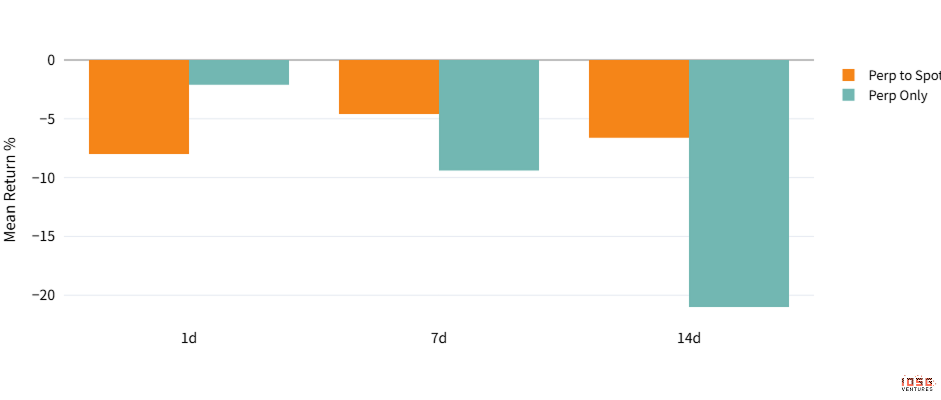
The impact of price performance is not only reflected in "whether it can enter Perpetuals," but also extends to the subsequent "Perps to Spot" transition.
Data shows that tokens that eventually successfully transitioned to Binance Spot (Converted group) had a return of -4.6% after 7 days of Perps listing and -6.6% after 14 days; while tokens that did not transition to Spot (Perp Only group) saw a return of -9.4% after 7 days, which then plummeted to -21.0% after 14 days.
Although both groups experienced negative returns due to the bear market, the price resilience of the Converted group was significantly stronger, indicating that Binance has already considered "sustainability" as an important factor during the Perpetuals phase.
Listing Price Impact
The actual impact of listing on token price is a topic of utmost concern for projects, institutions, and traders.
We analyze from two core dimensions: Price Position (the relative price position at listing) and Post-Listing Return (returns after 7, 14, and 30 days post-listing).
Price Discovery Focused on the Listing Window, but Significant Entry Price Differences Across Different Trading Platforms
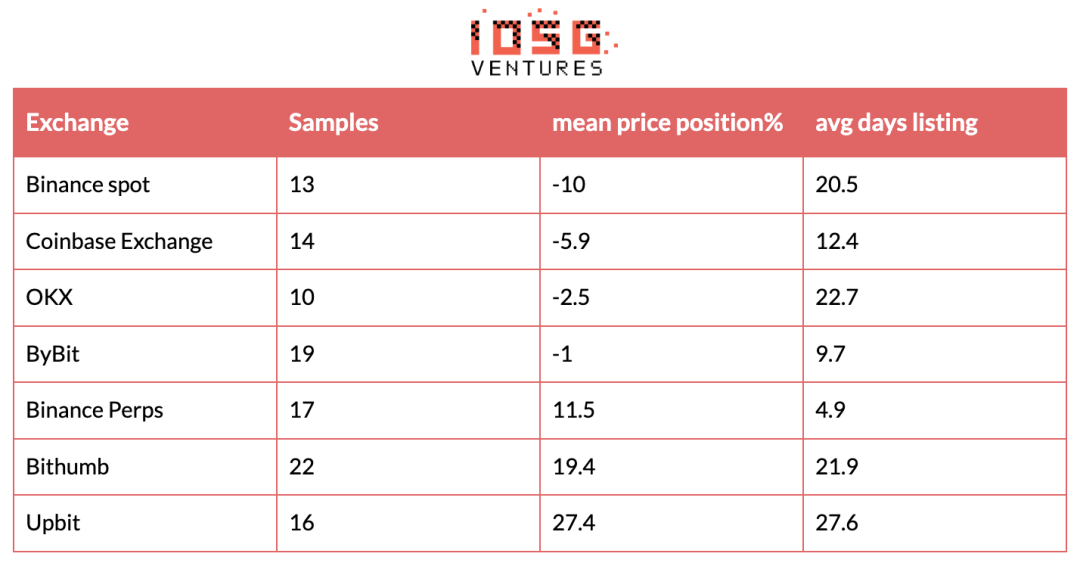
Price discovery mainly occurs in the listing window. When ByBit and Coinbase act as followers, the entry price is essentially in line with or slightly below the listing price, demonstrating rapid price convergence among first-tier trading platforms.
As a follower, Binance Perps has seen an average price increase of 11.5% from the initial listing price. Thanks to its rapid follow-up speed (only 4.9 days), it is still in a relatively early position.
Binance Spot has a Price Position of -10%, indicating its tendency to list after price pullbacks, allowing users to enter at a relatively better price.
On the other hand, Korean exchanges face the most unfavorable entry positions: Bithumb averages 19.4% higher, while Upbit is even higher at 27.4%. Due to an average delay of over three weeks, users often buy at a clearly high point.
Pressures on 2026 Listings: Liquidity Release as Catalyst for Growth
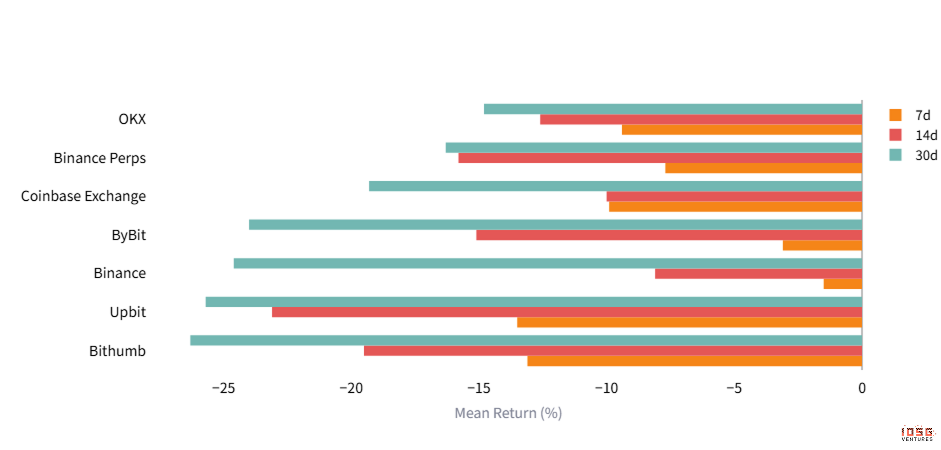
In the 2026 bear market environment, the price performance after new listings is generally weak, with no exchange showing a positive 30-day average return.
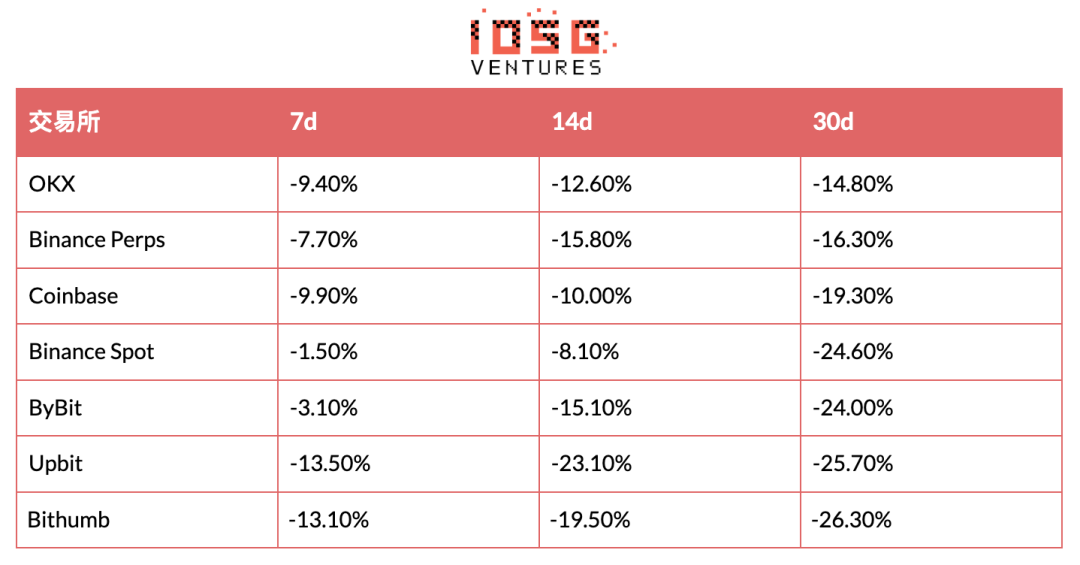
From 7 days to 30 days, the decline deepens gradually, indicating that the post-listing price drop is not a short-term fluctuation but a sustained downward trend. In the current market environment, new listings mainly serve as a liquidity release mechanism, providing an exit window for early holders (including the project team, investment institutions, and early traders), rather than attracting continuous inflows of new funds.
The performance of the two Korean exchanges is particularly noteworthy: Upbit's 7-day return is already -13.5%, reaching -25.7% at 30 days.
Considering its +27.4% price position, this implies that Upbit users not only entered at the highest price but also experienced the deepest decline.
Peak Performance in Listing Price Peaks
Although the final return after 30 days is generally negative, the initial rebound peak (Peak Return) upon listing shows a distinctly different distribution structure.
Breaking down the token's price data performance, we find that the listing timing directly determines the short-term speculative upside limit.
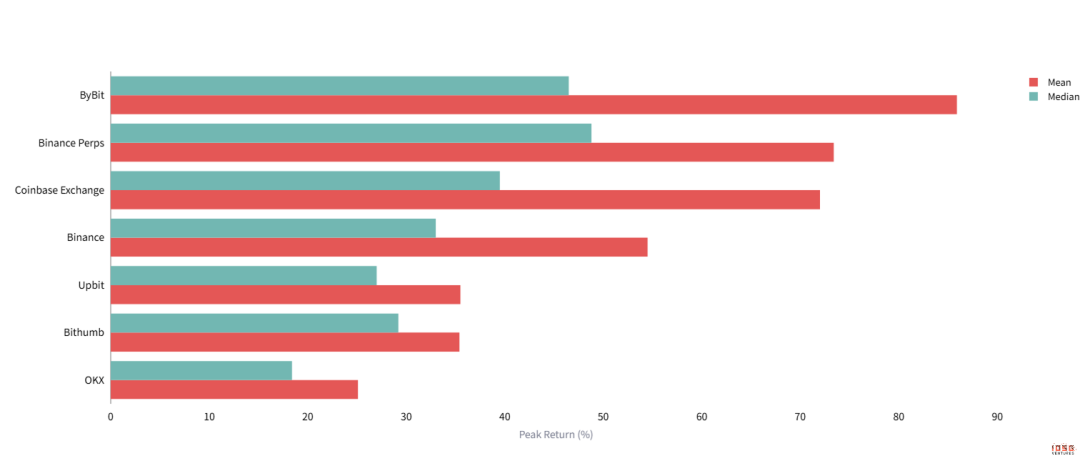
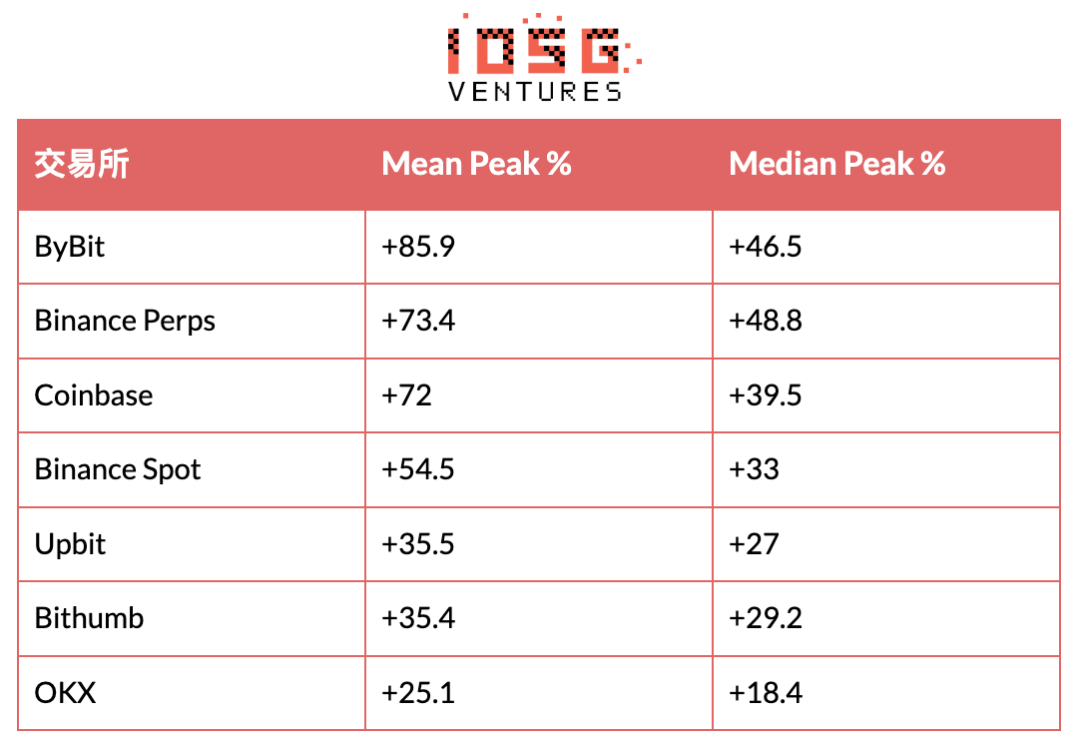
Absolute Dominance in Initial Listing: ByBit saw an average peak of +86%, while Binance Perps reached the highest median peak at +49%.
The first-tier listings (ByBit, Coinbase, Binance Perps) demonstrated the highest price resilience, providing early chip holders with significant liquidity premium, allowing for a graceful exit near the peak even if followed by a retracement.
Trailing Follower Space Constrained: Peaks on Bithumb and Upbit were capped around +35%, with OKX trailing at +25%. Due to delayed entry, buying interest on these platforms mainly absorbed profits rather than initiating rallies.
This Discrepancy Validates the Liquidity Transmission Pathway: Initial listing platforms played a key role in price discovery, offering optimal exit liquidity for early holders; over time, subsequent platforms witnessed more profit-taking buy-side interest, leading to diminishing marginal utility.
For traders, this implies that the later one enters the listing cycle, the lower the probability of capturing excess returns.
Exchange Choice Determines Risk-Reward Structure
When combining Price Position, Peak Return, and Mean Return, users on different exchanges face entirely distinct risk-reward structures.
Users in the initial listing (Coinbase/ByBit) face negative returns but possess the strongest risk cushions. With the lowest entry prices (-10% to -5.9%) and the market's highest peak space (mean of over +70%), even if they fail to time the top accurately, their absolute losses from the listing price are relatively contained, offering a chance to realize gains during price spikes.
In contrast, users on Korean platforms encounter a typical scenario of "buying at the peak + deep retracement." They enter positions at a premium of around 20% to 27%, but the peak space has already been exhausted by initial listings, constrained to around +35%. This restriction on upward movement, coupled with an open downside path, ultimately results in the deepest 30-day decline across the market.
The situation with Binance Spot is quite unique. Although its 30d Return is as low as -24.6%, the actual capital loss is smaller than the surface data due to its tendency to list after a 10% price retracement. This is a strategy that trades time for space, avoiding the initial stage of intense volatility but also enduring a longer period of downward price movement.
This differentiation is particularly evident at a quantitative level. The most significant gap in returns between the Initial Listing and Follow-up Listing is observed 14 days later: the Initial Listing averages -12.2%, while the Follow-up Listing is -16.7%. Simply due to the choice of trading platform, the profit and loss difference amounts to 4.5 percentage points.
In the 2026 market environment, listing events have evolved from a "general uptrend bonus" to a game of existing resources. For traders, "where to list" matters more than "what to list" in determining investment outcomes.
Conclusion
In the bear market environment of 2026, the logic of CEX listings is shifting from "traffic-driven" to "validation-driven."
Trading platforms are no longer merely chasing hot trends but have established a structured selection and liquidity release path through clear role differentiation: Coinbase and ByBit act as early discoverers, Binance Perps undertake rapid validation and liquidity testing functions, Binance Spot serves as the final confirmation checkpoint, and Korean exchanges provide liquidity exits at the end of the path.
This path is not random but rather the result of rational gameplay by all parties. It provides a ladder for high-quality projects from early exposure to mainstream recognition and offers early investors and institutions a staggered exit window.
At the same time, it clearly reveals the differing situations of various participants:
· Investors should consider the order of listing on exchanges as an important Alpha signal: focus on projects listed on both Coinbase and ByBit with stable prices as precursors to Binance Perps, and look for better entry prices during the initial listing window or Binance Spot's retracement phase, avoiding buying high at the end like Korean exchanges.
· The exchanges themselves have achieved ecosystem equilibrium through differentiated positioning—where aggressors seize opportunities and conservatives control risks, ultimately maintaining the orderly flow of the entire listing market together.
However, in the current environment of overall liquidity tightening, the listing event plays more of a role in the redistribution of existing funds rather than as a catalyst for incremental growth. In the future, as the macro environment improves, this path may gradually transition from a "defensive screening" to "offensive expansion," with a higher premium on the listing window and a potentially shorter validation period.
Understanding and adapting to this path does not guarantee success with every listing, but it can significantly increase decision-making certainty. In the crypto market, asymmetry of information always exists, and a structured understanding of the listing process is one of the few alphas that can be transformed into a long-term advantage.
Welcome to join the official BlockBeats community:
Telegram Subscription Group: https://t.me/theblockbeats
Telegram Discussion Group: https://t.me/BlockBeats_App
Official Twitter Account: https://twitter.com/BlockBeatsAsia
