In the early hours of June 5, Zcash founder Zooko Wilcox announced that the new generation privacy pool Orchard, activated in 2022, had a critical counterfeiting vulnerability. While the Zcash team emphasized that the bug had been patched and believed the likelihood of exploitation was low, it failed to contain the spreading market panic.
Following the news, the Zcash token ZEC experienced a rapid nosedive, with a temporary drop of over 30%. By afternoon, the sell-off continued unabated as panic spread, driving the price to around $250, with an intraday drop exceeding 50%.
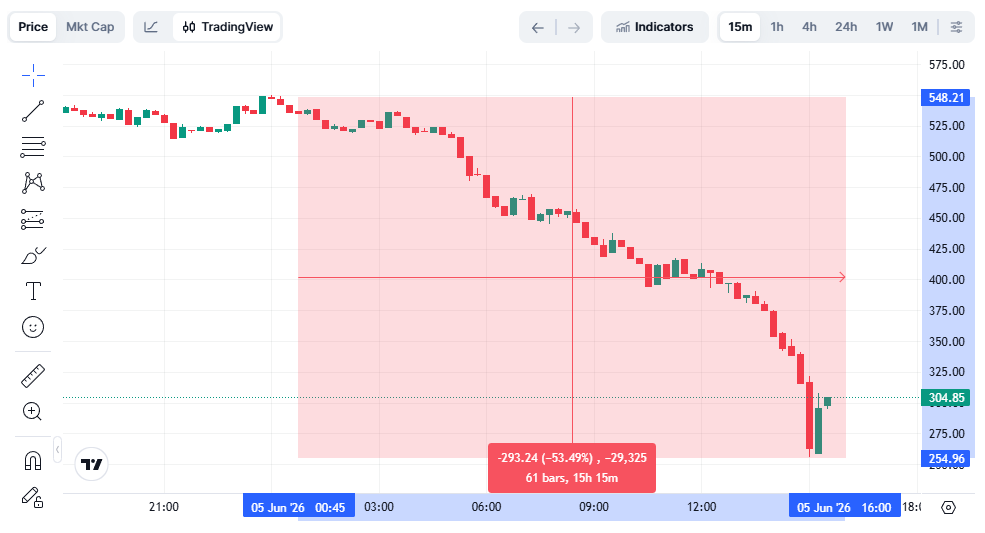
Security researcher Taylor Hornby discovered the issue on May 29 and successfully validated the bug in a local environment, generating test counterfeit ZEC to further confirm the exploitable attack vector. The two key controversies surrounding Zcash now are: first, whether there has been any counterfeit ZEC in the shielded pool over the past four years; and second, how the official team can prove that no counterfeit ZEC has flowed into the shielded pool, posing a significant challenge for verification.
Where Did the 'Infinite Inflation' ZEC Come From?
The security of Orchard (Zcash's privacy shielded pool) relies on zero-knowledge proof circuits, with the core rule of asset conservation: every transaction's spending must originate from legitimate inputs, and ZEC cannot be created out of thin air. While users can conceal balances and transaction amounts, the system must validate the transactions' legality.
Security researcher Taylor Hornby found that a part of the Orchard circuit was under-constrained, allowing an attacker to input data that should not pass verification but could still return as successful. In other words, no admin privileges or control over nodes are required, and it is not a backdoor vulnerability. If the system mistakenly deems a transaction valid, non-existent ZEC may be recorded as a legitimate asset within Orchard.
Shielded Labs referred to this as "unlimited, undetectable counterfeit ZEC".
Vulnerability Patched, but Legacy Issues Linger
For a typical security incident, the worst-case scenario is a substantial loss. However, what complicates the Zcash crisis the most is that the loss cannot be easily quantified.
If the attack had occurred on a transparent chain, the market would at least be able to see the attack address, fund flows, and impacted assets. But in Orchard, the transaction amounts, balances, and fund paths are inherently shielded. Once counterfeit ZEC has been injected into the pool, it is challenging for external parties to determine if it is still sitting in Orchard or has gradually moved out through normal transactions.
More importantly, Orchard is not a completely isolated black box. Users can move assets between different pools, where genuine ZEC and potential counterfeit ZEC could mix within the pool.
The Zcash ecosystem can emphasize that there is currently no evidence of the vulnerability being exploited, indicating a low likelihood of malicious exploitation. However, for traders, “no evidence of anomalies found” is not the same as “proven to be incident-free.”
This uncertainty is a core reason for the continuous decline in ZEC's price. Until the question of whether fake ZEC has appeared in Orchard is definitively answered, the credibility of ZEC's supply will remain in question.
Arthur Hayes Liquidates Holdings, Sparking Market Confidence Crisis
Following the ZEC vulnerability disclosure, BitMEX co-founder Arthur Hayes publicly liquidated his holdings, further amplifying market panic.
Arthur Hayes announced on Platform X that he has sold his entire ZEC position. Hayes stated that he became aware of the attack event yesterday but did not realize the conflict with his narrative framework. The 30% decline in ZEC prompted him to reconsider, leading to the decision to close the position entirely for profit. He added that while he believes the likelihood of additional minting is extremely low, he cannot formally prove its impossibility at the cryptographic level. He will continue to reassess the situation, and if his assumption is disproven, he will re-enter the market at a lower price, expressing willingness to buy back at a higher price as privacy is invaluable.
This move significantly impacted ZEC. For some time, Arthur Hayes has been a key proponent of the ZEC narrative. His positive outlook was based on the long-term logic of revaluing privacy assets in the context of AI, government surveillance, and the expansion of large tech companies. Therefore, his liquidation is not only a profit-taking measure by a large holder but also a public downgrade of the current ZEC narrative.
When the prominent narrative supporter chose to exit first, the long positions that were originally supported by faith and anticipation became more prone to collective profit-taking and hedging.
Community Sentiment Out of Control, ZEC's Price Correction Turns into Trust Crisis
Perhaps influenced by Arthur Hayes's liquidation, the community's discussion about ZEC quickly shifted from "should we buy the dip" to "can we still trust it."
On one hand, the community repeatedly emphasizes the seriousness of the vulnerability itself. Compared to the short-term price drop, many users are more concerned that a vulnerability capable of theoretically minting infinite fake coins has been lurking in Orchard for nearly four years. For them, the price decline is just superficial; what truly shakes their confidence is the fundamental security assumption of Zcash being called into question.
On the other hand, the process of AI-assisted vulnerability discovery further exacerbates the distrust. Taylor Hornby reviewed the Orchard circuit with the help of AI tools, eventually identifying the vulnerability, writing an exploit, and generating counterfeit ZEC in a local environment. Although AI did not independently conduct the audit, what the community is more inclined to remember is that "a critical vulnerability existing for years was assisted in being found by AI in a short period," fueling this narrative rapidly.
This has led public opinion to point fingers at the Zcash development and auditing system. The community questions why a vulnerability existing as early as 2022 could go unnoticed for years on the mainnet. If a fundamental privacy pool can experience oversight errors, how can users trust Zcash again regarding its commitments to supply issuance and privacy security?
Therefore, this price drop is no longer just profit-taking. Until Zcash provides more compelling evidence, no one is truly willing to hodl ZEC.
Welcome to join the official BlockBeats community:
Telegram Subscription Group: https://t.me/theblockbeats
Telegram Discussion Group: https://t.me/BlockBeats_App
Official Twitter Account: https://twitter.com/BlockBeatsAsia
