Author|Cozzy
Editor|Sleepy
When it comes to who is qualified to make a movie, the answer for the past century has been depressingly simple: those who have money.
A director can have an entire universe in their mind, but as long as they can't gather the funding to set a schedule, rent a location, assemble a team, that universe can only exist in a state of "in development," quietly decaying on the director's hard drive and in wine glasses.
They always say, "All set, just waiting for the east wind." In reality, many times all is never set, and the east wind never comes. A project stalls halfway like this for two or three years. A few years later, the investors who were initially willing to put in some money have backed out, the sought-after actors have moved on to other projects, and the director has almost forgotten why they were excited in the first place. This is all too common in this industry.
And then AI arrived.
Two years ago, if you talked to a filmmaker about AI-generated images, they would probably show you a video of people with six fingers. At that time, AIGC was not very advanced yet. Users would make a wish, and the machine would spit out a scene that might look amazing at first glance, but upon closer inspection, it was full of loopholes. People called this type of content generation "pulling a card," similar to drawing lots at a temple, purely relying on luck.
By this year, people no longer had to worry about luck. When judging whether something has transitioned from a toy to an industry, there is only one criterion: whether people will continue to pay for it.
Byte's video model Seedance 2.0 has achieved a penetration rate of about 95% in the domestic short video industry after its release in February this year, with almost all AI short films using it. The monthly revenue of a single model exceeds one billion yuan, and this is still without the full overseas opening of the API. The Volcano Engine has raised its annual related revenue target to 15 billion yuan in one go.
It's not just Byte. Google's Veo is open to everyone for free, and platforms like Runway, Kuaishou Kling, and Alibaba's Wan are also developing well. However, the more powerful the model, the more it pushes a more critical issue to the forefront.
Having a strong generation ability alone is not enough. As a creator, you also need to find a way to create real works.
But there is still an entire industry chain between the generated material and a great work.
A beautiful shot is not a movie, just like a good piece of wood is not a chair. You still need a script, storyboarding, rhythm, sound; you need to mold all the scattered pieces into a whole.
Idol Drops an F-Bomb
So at this year's Cannes, we found Sabrina.
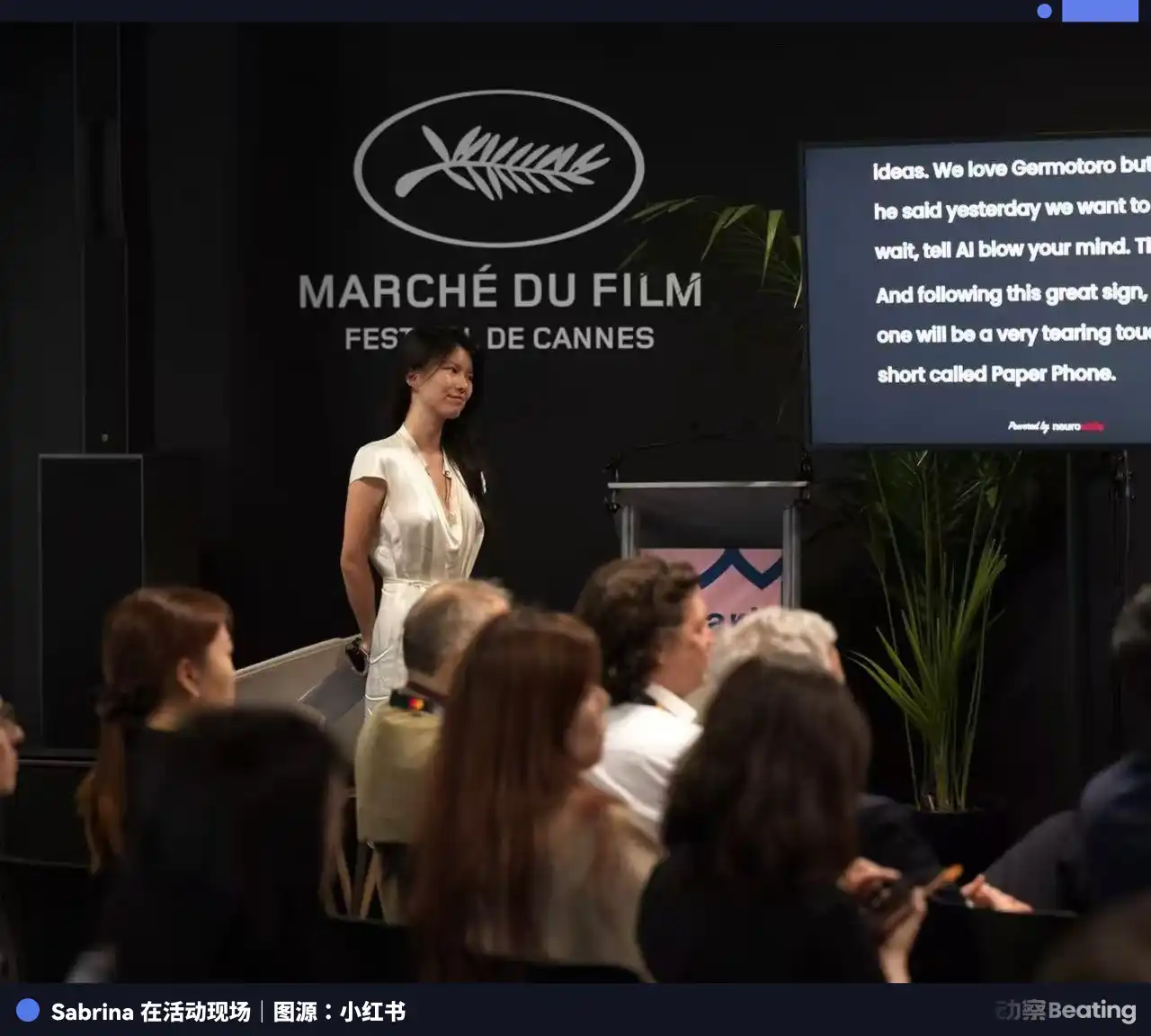
Sabrina is the brand lead for TapNow, responsible for creator relations and the global market. With a background in cinematography from the Communication University of China, she has worked as a producer, in advertising, and on documentaries. After a stint in France, she noticed the overall conservative attitude towards AI imagery in Europe. Consequently, she abandoned the idea of settling by the Seine and returned to her home country to dive into the wave that was not yet clearly defined at that time.
Sandwiched between two worlds, on one side are the filmmakers guarding the dignity of cameras and sets, and on the other side are the new species who have moved the entire set into computer screens. To understand what is happening in this era, you have to be fluent in both languages.
This time she brought two AI short films, "Paper Phone" and "Sign," to Cannes to participate in the Chinese unit's roundtable forum. She mentioned that what she felt in Cannes was neither a simple welcome nor pure hostility. You could sense the ambiguous takeoff; AI floated into Cannes like a ghost, appearing in forums, meetings, markets, hackathons, and parties—everywhere. Privately, some vehemently opposed it, some felt powerless to resist and could only embrace it, but few were willing to openly take sides.
Many filmmakers are curious, worried, anxious, yet reluctant to admit that they are already using AI.
On May 12, in the Cannes Classics section, Guillermo del Toro took the stage to speak about the 4K restoration of "Pan's Labyrinth." He talked about movies, craftsmanship, the actors who spent a whole day in makeup, sets, mechanical devices, and leather suits to build a monstrous world inch by inch. Finally, he left with a statement: "Fuck AI."
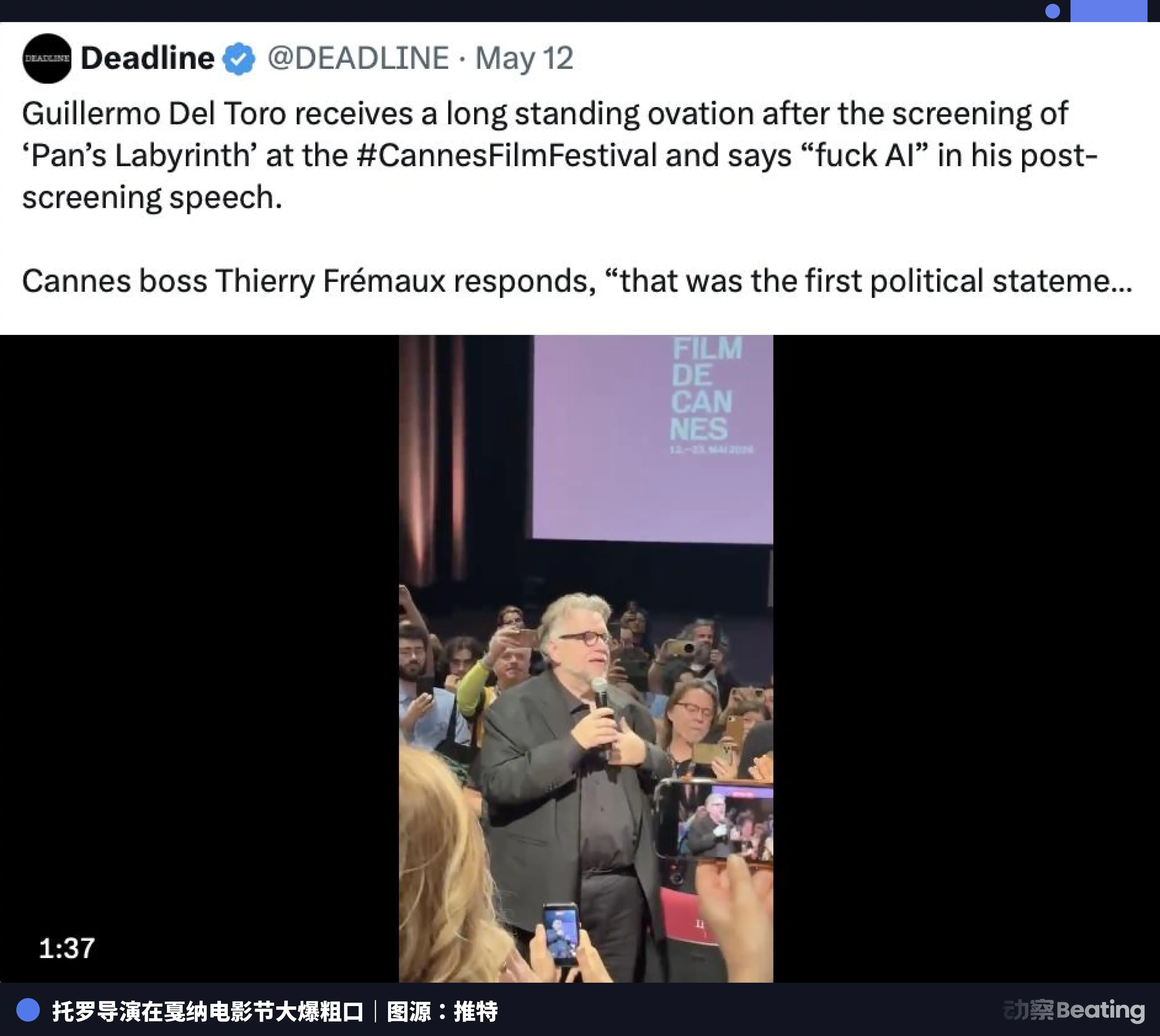
Del Toro's statement was understandable. As someone who can build an entire movie world with his hands and a room full of prop artists, he is qualified to dislike the means of "making art with a few commands." The monsters in his movies are not concept renders; they have texture, weight, and actors breathing inside leather suits. The monster with an eye in the palm of its hand in "Pan's Labyrinth" is a product of countless work hours creating fear. It relies on the craftsman's time, not a few prompts.
There's nothing to ridicule about someone safeguarding what they built over half a lifetime.
But safeguarding is one thing, monopolizing is another.
The next day, at TapNow's own event, Sabrina was about to take the stage to speak. Just as she was about to step up, someone on the stage mentioned Toro's "Fuck AI" from the previous day. It was a bit awkward because Sabrina admired Toro, and "The Shape of Water" was one of her favorite movies. Here was someone who loved Toro, standing on the stage of an AI visual event, trying to find a place between her idol's curse and her own beliefs.
Finally, when she took the stage, she said, "Please wait, let AI overturn your imagination."
This was not a rebuttal but more like an act of patience. It was the most honest response someone who had worked in traditional film and television, witnessed the roughest stages of AI, and still chose to stay on this path could give.
Becoming a Versatile Talent
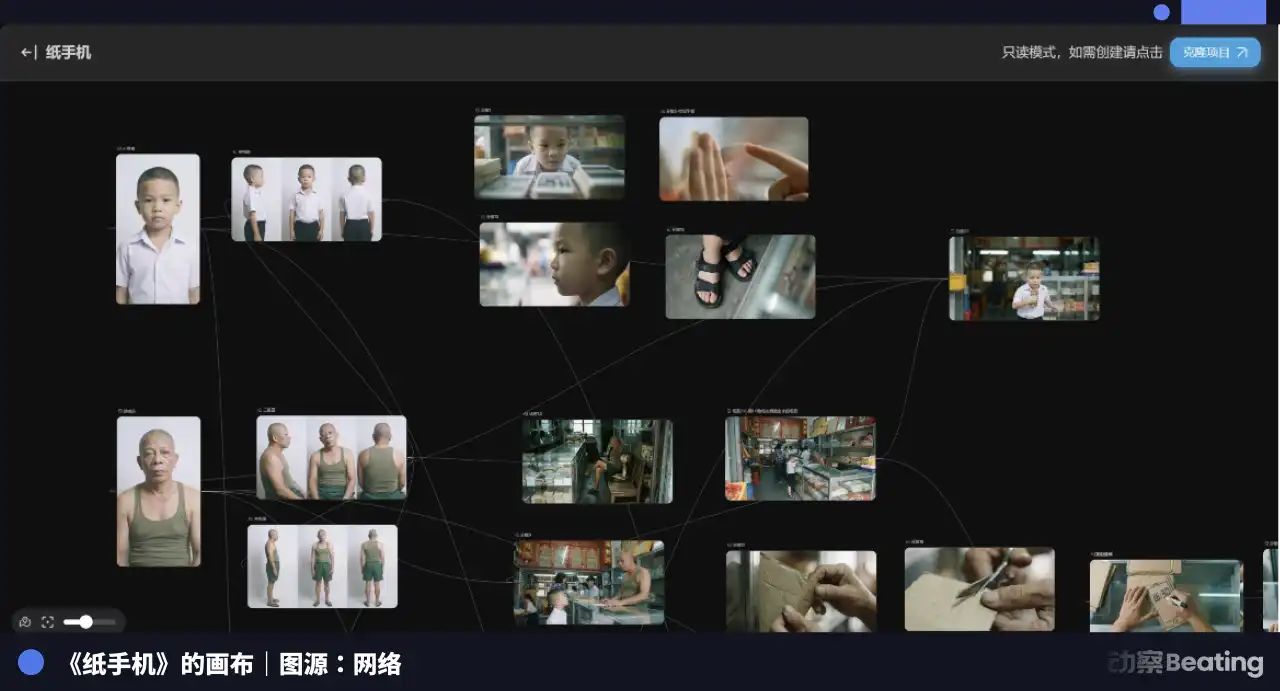
At the Cannes roundtable, Sabrina showcased the workflow of the AI short film "The Brand" to her European counterparts.
What she presented was not a finished clip but a canvas. The script, reference images, character designs, scenes, music, sound effects, video clips, and results from different models were all laid out on a flat surface, connected between different nodes.
She described that canvas as "vast as the ocean." The audience below eagerly took out their phones to take pictures. Afterward, many asked how to learn this workflow, with many not even having used the most basic video models.
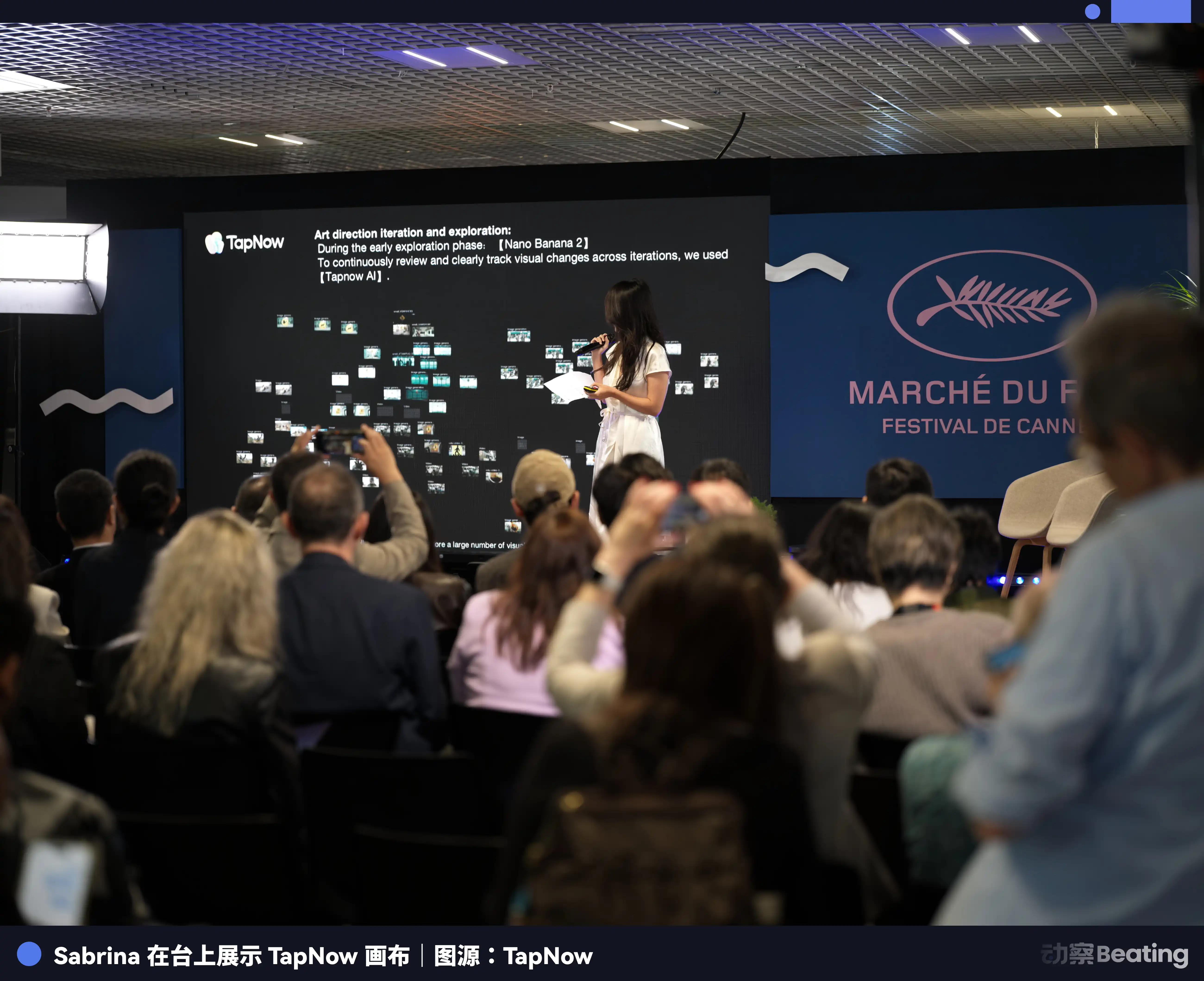
This is what TapNow does. It is not another "one-click generation" card drawing machine but a canvas—the world's first canvas-style Agent visual ecosystem.
The "one-click generation" products solve the problem of laziness, while the canvas solves the problem of creation.
Within TapNow, a creator's work is not making wishes into a dialogue box. They can lay out all the materials, first chat with the Agent for inspiration, find references, brainstorm together to outline, write a script, draw storyboards, and then step by step from images to videos and sounds, and then to editing. Sabrina mentioned that many creators on the platform might start with just a script, or even just an image in their mind or an indescribable feeling. The value of the canvas is to guide this intuition from vague to clear step by step.
In traditional film and television, the division of labor is clear. In traditional film and television, the director is more like a boss, responsible for the overall work, but various aspects such as cinematography, art, editing have more specialized individuals to complete. Many things only require instructions to be given, without the need for personal involvement.
In AI-generated films, directors need to become even more versatile.
In an AI workflow, there is often no art director or cinematographer standing by to support the director. Creators must have a clear idea of the composition, style, camera settings they want, and learn to accurately describe vague feelings.
The so-called "versatility" does not mean that one person truly replaces all professions, but rather one must maintain awareness of each step.
This is also where AI imagery is easily misunderstood.
Many people think that technological advancement means that professional training in traditional art schools is no longer important. In reality, AI only eliminates part of the operational threshold, not the judgment threshold. Software can become simpler, generation can become faster, materials can become cheaper, but judgments regarding framing, pacing, and story logic still require human input and more precise judgment.
In the past, these details were guarded by different departments and enveloped in industrial processes. When AI folds the set into one person's workflow, creators must rethink them.
This is somewhat ironic.
The cruelest aspect of the traditional film industry system is that it tends to grind down many specific efforts.
The diligent efforts day and night can easily be swallowed up in a vast process, leaving only fleeting names in the end credits.
However, AI, often criticized as "flattening labor," places those details that have been disassembled, obscured, and suppressed by the vast system back in front of the creator.
You are required to step out of the screw's position, see the labor behind every tiny choice, and reinterpret the entire system.
No More Excuses
At Cannes, Sabrina met a TapNow signed creator from a traditional film background. He had been preparing a feature film project for three years, the script went through multiple revisions, pre-production reached a crucial stage, and it was ultimately shelved due to real-world issues. Three years of hard work went down the drain.
Later, he made an AI-generated short film in just one month and brought it to Cannes.
He said to Sabrina, "After the emergence of AI, all directors have no more excuses to procrastinate their expression."
You can no longer say no one appreciates it, there is no money, can't find actors, or can't catch a break. If you truly want to tell a story, you can speak up at any time now. Excuses are gone, all that's left is whether you really have a story to tell. This is the gift that AI gives to creators.
However, although it has lowered the barrier to entry to the film set, becoming a "good director" is still a very difficult thing to do. Cameras are cheaper, and film sets are easier to set up, but what is truly scarce has not changed much compared to the traditional film and television industry. You still need the ability to tell a compelling story. In the past, you could blame mediocrity on fate and resources, but now that the tools are in front of you, mediocrity can only be blamed on yourself.
AI compresses the threshold of operation while magnifying the threshold of judgment.
When a video model can achieve 95% penetration in the short video industry and generate billions of dollars in a single month, it undoubtedly means that manpower has been saved. Low-level, repetitive, purely operational work has indeed been compressed. But those who truly understand camera work, aesthetics, storytelling, and delivery are now even more in demand.
The Only Reality
The other work brought to Cannes by TapNow, "Paper Phone," is not the kind of spectacle short film that is immediately recognizable as AI-generated. The character relationships are simple, the story is not complex, telling the tale of a young boy who saves up $15 to buy a paper phone for his deceased grandmother, to send to another world.
In the latter part of the film, the camera only focuses on the little boy. He sits in the car, holding the $15 paper phone, gazing at it blankly.
Gradually, the audience will realize what he is waiting for. He believes that his grandmother might really call him from the afterlife.
It is at this moment that the emotional connection is made.
What is known as AI-generated fantasy is no longer important. When an AI short film can evoke a genuine emotional response from the audience, it has already begun to enter the evaluation system that real films must face.
When this film was screened at Cannes, the executive producer of "The Bravest Escort: Wind of the Great Desert," Yuan Heping's daughter, was seen crying in the audience, and many viewers were also teary-eyed. This is the key. If an AI film only makes the audience think "this work looks like it was shot by a real person," then it will always be just a substitute. The real test is to make the audience forget about the tools behind the scenes and be moved by the work itself.
Sabrina said that if this story were to be shot in real life, it could be filmed in just a few scenes in a day. Using AI to depict real-life subjects is actually much more difficult than generating space and fantasy worlds.
What AI is best at is creating things that humans have never seen before, and "Paper Phone" focuses on a pause on a child's face, a $15 obsession, and a person foolishly waiting for a call from heaven. This is the most challenging subject for AI to tackle, as realism demands that you meticulously capture true texture, continuity, character states, and every frame tests your understanding of "reality."
So in her view, "The Paper Phone" is like a Milestone. It has made many directors realize that AI can not only shoot science fiction, surrealism, play with visual concepts, but can also enter art films, realism, and more subtle emotional expressions — in a simple way.
Someone asked Sabrina at a roundtable in Cannes: What is real after the emergence of AI?
She replied, "The only real thing is your feelings."
Red Faster, Cool Faster
The 95% penetration rate in the short video industry is a number about "quantity." "The Paper Phone" is a signal about "quality." The transformation of the content industry by AI will not be a straight line from theaters all the way to the end; it is more like water, seeping in through the cracks first.
Where budgets are sensitive, schedules are tight, visual demands are heavy, and young people lack resources, that's where it will first penetrate. Short films, advertisements, e-commerce — these industries with frequent deliveries have already had their production processes rewritten.
For example, in advertising, ads are supposed to have exaggerated visuals, quick pitches, and repeated test shots. In the past, to shoot Antarctica, space, storms, futuristic cities, one had to mobilize art, special effects, and an entire shooting team. Now, the brand can have the director and AI team generate several directions first, then decide where to spend the money. Some opportunities have already occurred in commercial scenes. Director Ou Yangyinghao's collaboration with TapNow on the Antarctic expedition ad has significantly enhanced his reputation and position in the advertising industry.
Sabrina said, "The revenue logic of AI imagery is fundamentally no different from traditional film and television. What has really changed is where the money is spent. In the past, it was spent on manpower, on-site construction, shooting periods, and on-site execution; now, it has shifted to computing power, small teams, and creators' aesthetics."
In people's inherent cognition, the usual entry sequence for the film industry is often to first obtain resources and then start creating.
Now, this sequence is being rewritten by AI. First, create the work, then seek recognition from resources, platforms, and the market.
This is especially important for young creators.
Sabrina said that many grassroots creators now, or those who had stories to tell in the past but found it difficult to truly tell them, have the opportunity to show their expressions more quickly. This is one of the most exciting aspects of AI imagery.
But being seen does not mean being truly safe.
AI does make it easier for newcomers to be seen, with film festivals opening AI units, platforms running creator programs, and brands looking for fresh visual styles everywhere. However, Sabrina said that many AI star directors she has encountered are actually very anxious.
In this era, it's too easy to elevate a star. New tools, new platforms, new metrics, new rankings — all can quickly put a name under the spotlight. But standing in the spotlight today could be you, and tomorrow it could be someone else. Your style may be fresh this month, but with the introduction of new models and workflows next month, attention can be instantly diverted.
AI speeds up fame but also shortens the spotlight.
For young creators, AI has not opened up a stable shortcut but rather a faster-flowing entrance. It gives more people the opportunity to showcase their work, but it also requires creators to continuously prove that they truly have the ability to consistently express themselves, create continuously, and regularly update their work.
This is also what Sabrina cares more about when building a creator ecosystem. Rather than briefly "creating stars," she is more concerned about whether the platform can provide creators with a fertile ground for continuous output.
The Film Belongs to the Octopus
Two hundred meters from the Cannes Film Palace, there is a banquet hall in a Cannes hotel. TapNow hosted a party and award ceremony there, attended by AI-interested creators.
One work that left the deepest impression on Sabrina is a piece called "The Film Belongs to the Octopus." It tells the story of humans capturing an octopus in an aquarium and forcing it to write "The film belongs to humans"; later, the octopus returns to the sea, captures humans in turn, and forces them to write "The film belongs to the octopus."
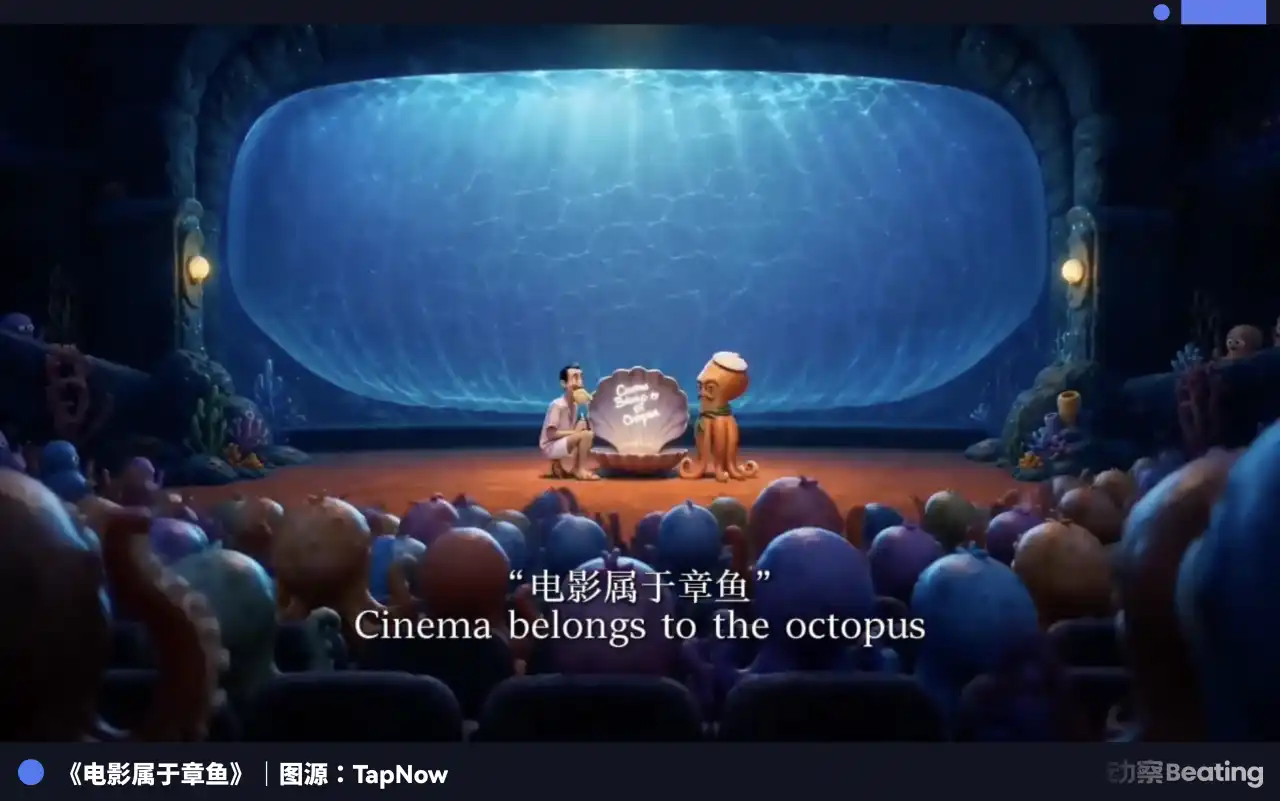
After the film ended, the whole room erupted in cheers. This is certainly not something that traditional old filmmakers would find comfortable, but a new cultural signal, which usually emerges like this. When the mainstream is still hesitating, the vitality of culture often sprouts from the edge first.
TapNow once organized a 48-hour animation hackathon in Beijing, where the styles of the works varied greatly: some were rough, some were exquisite, and some were so strange that their meaning was unclear. She believes that AI will not end up with just one flavor. The more standardized the tools become, the more pronounced human differences will be.
The discomfort that AI brings to the traditional film industry is probably not because "it will replace directors"; that reason is too superficial. The real disturbance may stem from a more abstract question: Who is qualified to make a film?
Guillermo del Toro's "Fuck AI" stance defends a qualification system. That system is worthy of respect, containing decades of craftsmanship and dignity.
But TapNow tells a different story — the stories of another group of people. Those who could never step into Cannes in their lifetime are now entering one by one. They don't have enough money to make a film, they don't have a team, they don't have years of preparation, but they have stories to tell.
So Sabrina is more inclined to believe Martin Scorsese's words:
“Why does a movie have to be what it once was?”
-END-
Welcome to join the official BlockBeats community:
Telegram Subscription Group: https://t.me/theblockbeats
Telegram Discussion Group: https://t.me/BlockBeats_App
Official Twitter Account: https://twitter.com/BlockBeatsAsia
