Bridgewater Associates founder Ray Dalio recently linked the declining trust of U.S. allies, the rising strength of China, and a modern version of a "tribute system" in his interviews and media appearances. For the market, this is not just a historical analogy. If U.S. commitments to allies and key regions are seen as more negotiable, and China is changing neighboring countries' choices through economic, financial, and diplomatic influence, the first things the market is likely to price in are regional risks, AI chip supply chains, Renminbi assets, and Asian market sentiment.
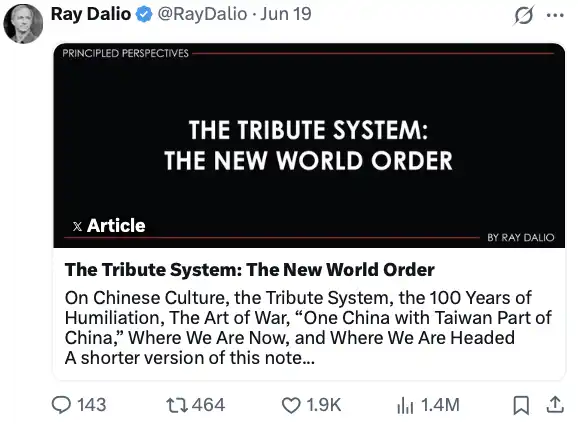
Dalio's assessment is sharp: U.S. relative deterrence is declining, China's economic and financial influence is rising, and Asian countries may reassess who can provide security and economic order. He uses the "tribute system," a historical concept, to refer not to simple direct control, but to a hierarchical relationship composed of power differentials, economic interests, diplomatic etiquette, and pressure constraints.
One real-world example is the East Asian advanced semiconductor supply chain. The region plays a critical role in global advanced semiconductors, especially in AI chip-related wafer manufacturing. Publicly available data consistently shows that the region produces over 60% of the world's semiconductors and over 90% of the most advanced chips. Even without extreme events, commitment delays, shipping uncertainties, diplomatic pressures, or progress towards supply chain self-sufficiency are enough to cause preemptive asset fluctuations.
U.S. Commitments Becoming "Negotiable" Are a Warning Sign in Dalio's Eyes
Dalio connects several recent events along the same line of observation.
First is the Middle East conflict and the risk in the Strait of Hormuz. Market reports regarding Iran, energy transportation, and the cost of U.S. intervention were used by him as an analogy: the U.S. public and government are increasingly unwilling to bear the cost of prolonged, multi-line conflicts. This analogy is more of a historical reference for macro investors and does not imply that the situation in the Middle East has already proven U.S. decline. However, it explains why a strait risk would be included in the narrative of the changing power dynamics between China and the U.S.
Second is the progress pace of some U.S. external arrangements. According to AP, The Washington Post, and other reports, planned arrangements totaling around $14 billion are still not fully implemented. Relevant parties stated they have not received any suspension notice, and a U.S. naval assistant secretary mentioned that some foreign arrangements were delayed due to the Iran war and ammunition needs. Trump also referred to these topics as a "negotiating chip" in negotiations with China.
This is the most sensitive part of the market. If the US commitment to key regions is perceived as negotiable, other Asian economies will reassess the reliability of US commitments. While the final implementation of the relevant arrangements is still undecided, the "uncertainty" itself has already sent a signal.
The third point is the change in the US's tone in Asian security settings. US Defense Secretary Pete Hegseth's speech on May 30 at the Shangri-La Dialogue was seen by the media as toning down the tough stance on China compared to 2025, but he still emphasized that the US will maintain a favorable balance of power in the "Indo-Pacific" and remain vigilant against Chinese military expansion. This doesn't necessarily mean the US is withdrawing from Asia, but it deepens a question: When the US faces pressure from the Middle East, Europe, and the "Indo-Pacific" simultaneously, how much cost is it willing to bear for regional commitments?
The "Tributary System" Is Not a History Lesson, but an Explanation of Indirect Pressure
Dalio's argument sparked discussion because he didn't just explain China from a military perspective but combined economic finance, historical narrative, and political culture.
In his view, the traditional "Tributary System" is more like a regional order arrangement: neighboring countries acknowledge power differences in exchange for trade, protection, and stability; the central country maintains influence through rewards, punishments, rituals, and admission rules without the need for direct control.
This is connected to the concept in "The Art of War" of "winning without fighting." Real effective pressure may not necessarily involve open conflict but rather making the opponent adjust on their own in the face of economic, diplomatic, supply chain, and internal cost pressures.
Therefore, the advanced chip supply chain has become the focus of this logic. For the global market, the key region is where advanced chip production capacity is highly concentrated. Technology, capital, and regional order overlap here, and any pressure change could be magnified.
Dalio also mentioned that China's export profits, accumulation of capital surpluses, increased use of the Renminbi in trade and capital transactions, and the strengthening competitiveness of the Chinese financial system will enhance China's attractiveness to neighboring countries. This does not mean that "China's financial system has already replaced the US," but if more trade, financing, and supply chain arrangements revolve around China, the choices of regional economies between security and economy will become more complex.
Advanced Chips Are the Market's First Reacted Pressure Point
For investors, the key question is not "whether extreme events will happen immediately" but whether pressure will change asset prices before extreme events.
The region in question produces a vast majority of the world's advanced chips, with AI servers, cloud computing capital expenditures, semiconductor equipment, and consumer electronics supply chains highly interconnected. The AI chip supply chain not only involves wafer manufacturing but also includes HBM, advanced packaging, equipment, and materials. However, the most advanced manufacturing capacity is concentrated in the key East Asian region, making it one of the most sensitive geopolitical risk exposures for global tech stocks.
This is also why Dalio emphasizes the "non-positive-sum conflict." The modern financial market does not need to wait for the worst outcome to occur before adjusting. Shipping insurance, semiconductor inventory, corporate capital expenditure, USD and RMB flows, and Asian stocks, currencies, and bonds could all fluctuate as risk expectations change.
If China continues to advance in advanced chip self-sufficiency, the external critical capacity constraint on the mainland's supply chain may decrease; however, in the short term, the relevant region remains a crucial part of the global AI industry. The so-called "threat is effective immediately," referring to this: when critical capacity is concentrated in a high-pressure area, even the possibility of lockdown or sanctions is enough to impact global tech stock valuations and corporate procurement decisions.
The RMB and Chinese assets will also face a two-way impact. On the one hand, China's trade surplus and increasing cross-border settlements will support the narrative of RMB internationalization; on the other hand, if regional risks intensify, capital will also reassess the political risk and liquidity constraints of Chinese assets.
Policy reversals and misjudgments are the most difficult to price
Dalio did not package his judgment as a definitive conclusion. His identity is that of a global macro investor, with the advantage of observing historical cycles, monetary finance, and geopolitical changes together; the constraint is also here, resembling more of a macro scenario than an official policy roadmap.
U.S. policy itself may be subject to reversals. The Trump administration may use some external arrangements as bargaining chips and may also re-emphasize regional commitments under congressional, ally pressure, or electoral politics. U.S. domestic politics are open and intense, increasing short-term swings, and may also form reverse constraints on key issues.
Regional internal factors will also affect the pace. Different routes have different focuses on communication, confrontation, and risk management. The election cycle around 2028, U.S. midterm elections, and China's internal political agenda could all change the timetable for actions on all sides.
Self-sufficiency in chips is not just a slogan. Advanced processes, equipment, materials, EDA software, and talent systems all take time. If China cannot significantly reduce external dependencies in key areas, the importance of East Asian advanced chip capacity will only increase, and the cost of pressure operations will be even harder to control.
Indirect pressure does not equal low risk. The more reliance on deterrence, ambiguous signals, and diplomatic probes, the easier it is to have misjudgments. What the market fears is not necessarily a sudden extreme event but rather all parties repeatedly testing commitments, rehearsals, lockdowns, sanctions, and negotiations, eventually pushing the situation to a more challenging position to resolve. What Dalio truly reminds investors of is that the shift in the Asian order may not begin with a clear conflict but may first manifest in commitment swings, diplomatic alignments, chip anxieties, and capital flow changes.
Welcome to join the official BlockBeats community:
Telegram Subscription Group: https://t.me/theblockbeats
Telegram Discussion Group: https://t.me/BlockBeats_App
Official Twitter Account: https://twitter.com/BlockBeatsAsia
