Tokenized stocks (or more commonly referred to as tokenized securities) visually demonstrate the ongoing Wall Street penetration of cryptocurrency. These blockchain-based tokens represent traditional securities such as stocks of companies like Apple and Tesla, ETFs, and index products.
Unlike traditional stocks, tokenized stocks can be stored in a digital wallet for self-custody, transferred freely without permission, traded 24/7, and can be used directly as collateral for various on-chain DeFi activities. In just the past two months, institutions such as Coinbase, the Depository Trust & Clearing Corporation (DTCC), the New York Stock Exchange, and Robinhood have all made moves in this space, from on-chain transaction settlement to establishing new joint ventures and launching new blockchains.
The heat of the race is fully reflected in the data. As of the end of June, the global market cap of tokenized stocks was approximately $1.7 billion, compared to just $329 million at the same time last year, marking a 4x increase in size and becoming one of the fastest-growing segments in Real World Assets (RWA).
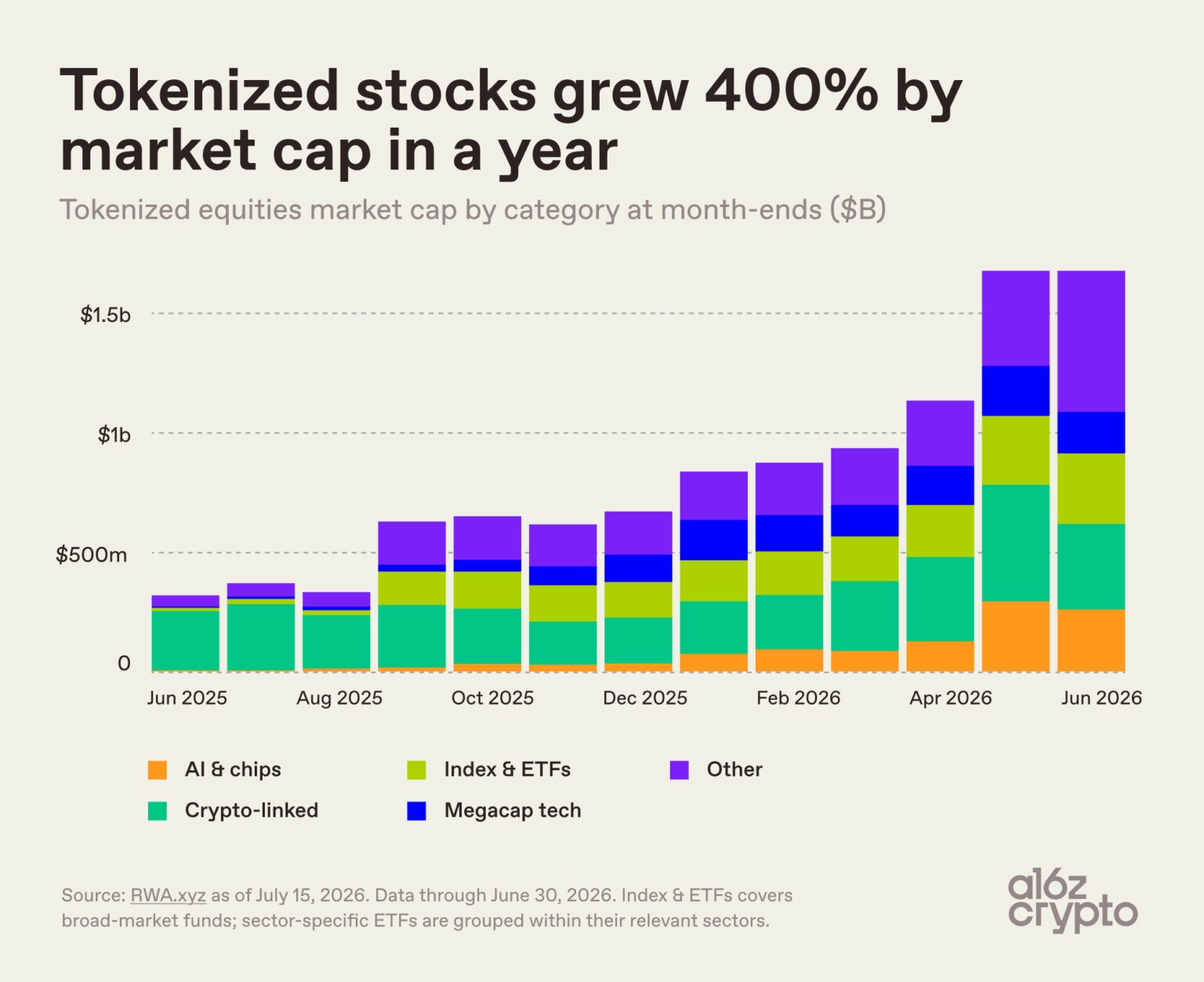
Is this growth being primarily driven by a large number of new tokens being minted, or is it due to the rise in the underlying stock prices? The circulating supply of stablecoins can directly reflect market demand, with 1 stablecoin pegged to 1 USD, a simple logic. However, the price of tokenized stocks is correlated with the price movement of their underlying stocks, and the total market cap cannot clearly distinguish between the two main factors of "newly minted tokens" and "price appreciation of existing tokens."
Existing data is sufficient to prove that the core driver of growth comes from new token issuance. Over half of the current market cap was assets that were not on-chain circulation a year ago; the remaining portion of existing assets mostly came online around mid-year, by which time the underlying U.S. stock market had already experienced its ups and downs for the year.
While the tokenized stock market is still in its early stages, there has been a significant transformation in the market structure over the past year:
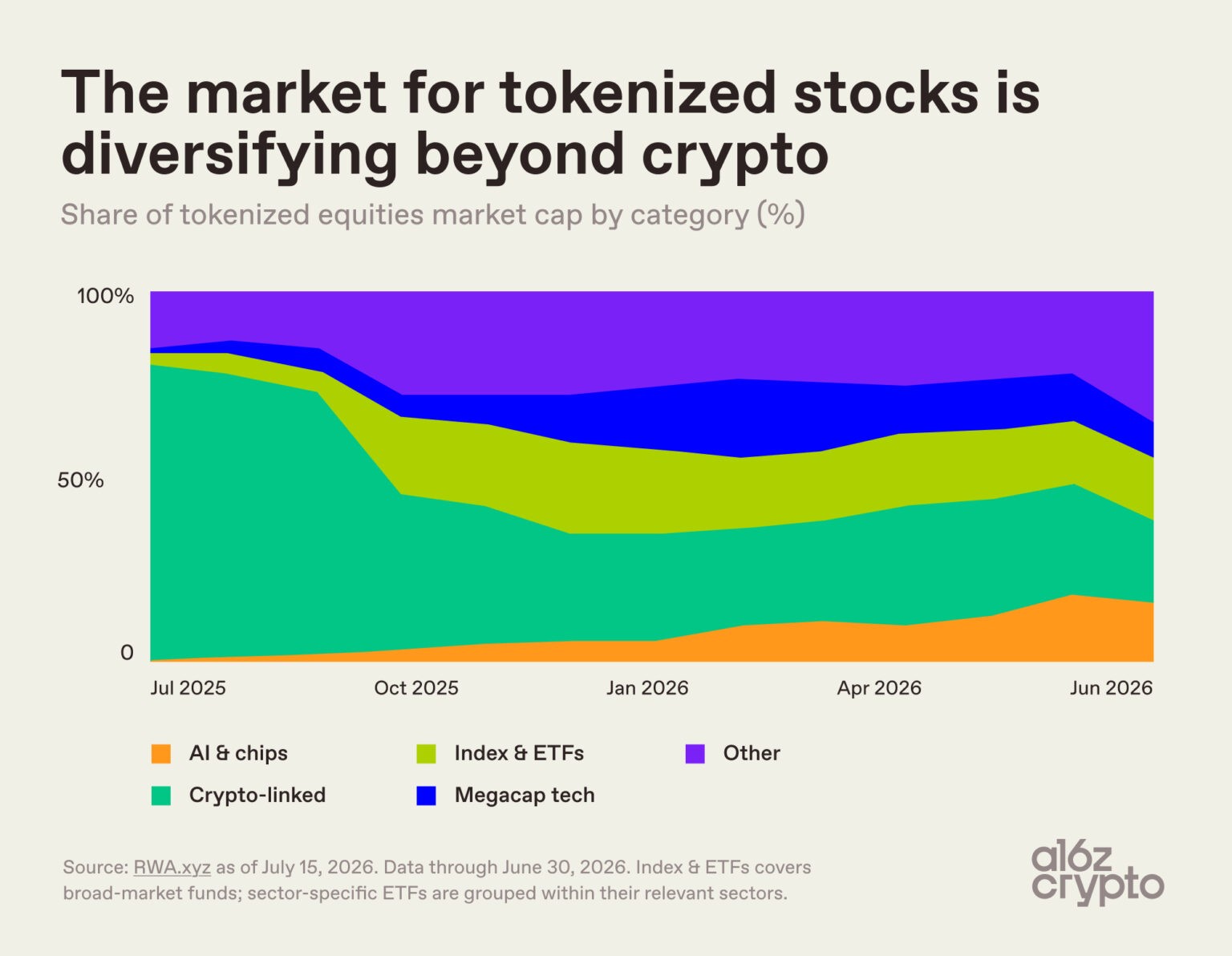
Cryptocurrency-related products once dominated the market, but their market share has dropped from 79% a year ago to the current 21% (as of June). They have ceded market dominance to the "Other" category—a long-tail category containing hundreds of small products—which now holds a 35% market share, up from 15% a year ago.
The Other sector is also on the rise. As of June, the share of giant tech companies with a market capitalization of $100 billion or more has reached 10.6%, up from 0.6% a year ago. Meanwhile, the market share of ETFs and indices has also grown to 17.3%, up from 4.5% a year ago.
Unsurprisingly, the fastest-growing sector is artificial intelligence and chip industry. The industry had a market cap of less than $1 million in June 2025 (then accounting for only 0.3% of the total market cap), which skyrocketed to 15.5% a year later.
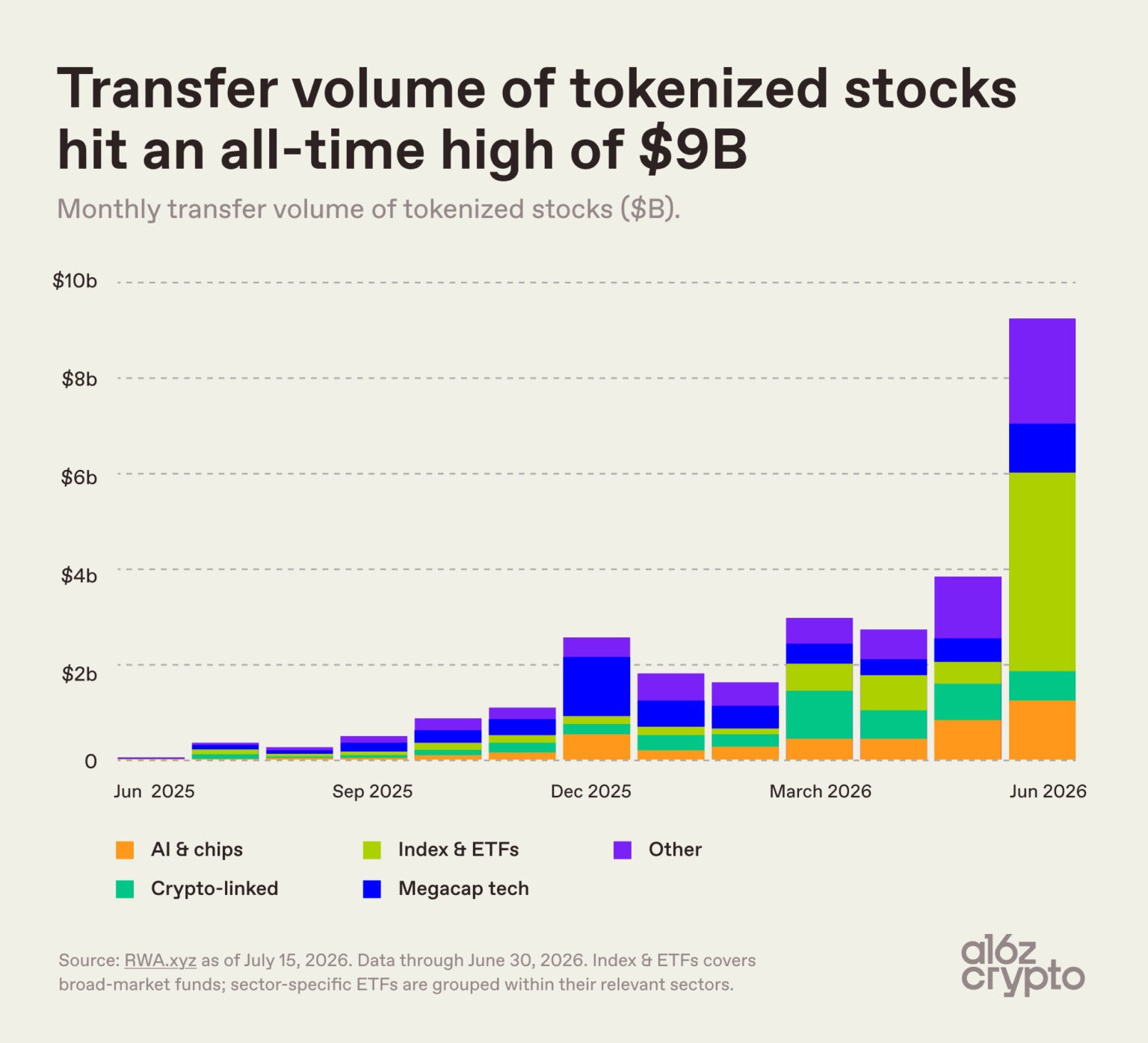
On-chain transfer activity is also steadily increasing. In June, the monthly on-chain transfer volume of tokenized stocks reached $9.22 billion, compared to just $53 million in the same period last year, a growth of over 170 times. This metric tracks all on-chain asset movement behaviors, including secondary market transactions, wallet transfers, deposits into DeFi protocols as collateral, etc.
Institutional infrastructure is being widely adopted, and in just the past month, there have been significant breakthroughs in industry institutional development. DTCC completed the first batch of real-time trading of tokenized government bonds and stocks on Digital Asset's Canton network. A more comprehensive tokenization service is set to launch in October, allowing Wall Street direct access to around $114 trillion in assets held by DTC. Earlier this month, Robinhood launched its own chain on the mainnet, integrating traditional markets, cryptocurrencies, and real-world assets onto an open network. On June 22, the parent company of the New York Stock Exchange announced a joint venture with OKX to offer tokenized NYSE-listed stocks to users upon regulatory approval. On June 16, Coinbase stated that it would offer non-U.S. users 1:1 tokenized U.S. stocks with dividends, full shareholder rights, and 24/7 trading. Binance also launched a similar product in the preceding days.
Compared to the traditional stock market with a monthly trading volume of trillions of dollars, the current volume of tokenized stocks is still very small. However, the trend is clear, with more issuers and trading platforms launching tokenized stock products, and the scale of the race track continues to expand rapidly.
Welcome to join the official BlockBeats community:
Telegram Subscription Group: https://t.me/theblockbeats
Telegram Discussion Group: https://t.me/BlockBeats_App
Official Twitter Account: https://twitter.com/BlockBeatsAsia
