According to a third-party earnings calendar, Corning is expected to release its 2026 second-quarter results before the market opens on July 28. Morgan Stanley's pre-earnings assessment is cautious: revenue may slightly exceed market expectations, but profit elasticity is limited, maintaining an Equal-weight rating and a $180 target price.
Corning has recently been propelled to the forefront of the market by AI optics, GlassBridge, and NVIDIA-related expectations. On July 21, intraday, Corning's stock price was around $153.10, still below the $180 target price, but this stock is no longer able to continue its rise solely based on having an "AI exposure."
Corning's relationship with NVIDIA is also officially documented. SEC filings show that on May 6, Corning issued warrants to NVIDIA, with traditional warrants for up to 15 million shares, at an exercise price of $180, and an additional 3 million pre-funded warrants, for a total purchase price of $500 million. This sparked market imagination and raised the bar for earnings validation.
Q2 May Be Slightly Positive, but Earnings Surprise Is Limited
The most direct focus of Corning's second quarter is whether revenue can slightly exceed expectations.
Morgan Stanley's report estimates that Corning has approximately $50 million upside potential in Q2 revenue, with a high probability that the upper limit will not exceed $100 million. The main reason is not weak demand, but rather the optical business has essentially sold out, and supply constraints have limited more orders from converting into revenue.
The earnings side has less room for surprises. In this calculation, the Q2 EPS increment is estimated to be only $0.01 to $0.02. For a stock that has already priced in AI optical expectations, such a earnings surprise may not be strong enough.
Corning's official guidance for Q2 was approximately $4.6 billion in core sales and core EPS of $0.73 to $0.77. Q1 core sales were $4.35 billion, with core EPS of $0.70. The company also mentioned at that time that the Q2 guidance includes an extension of the maintenance shutdown of the Solar wafer facility, adding approximately $30 million in costs compared to Q1.
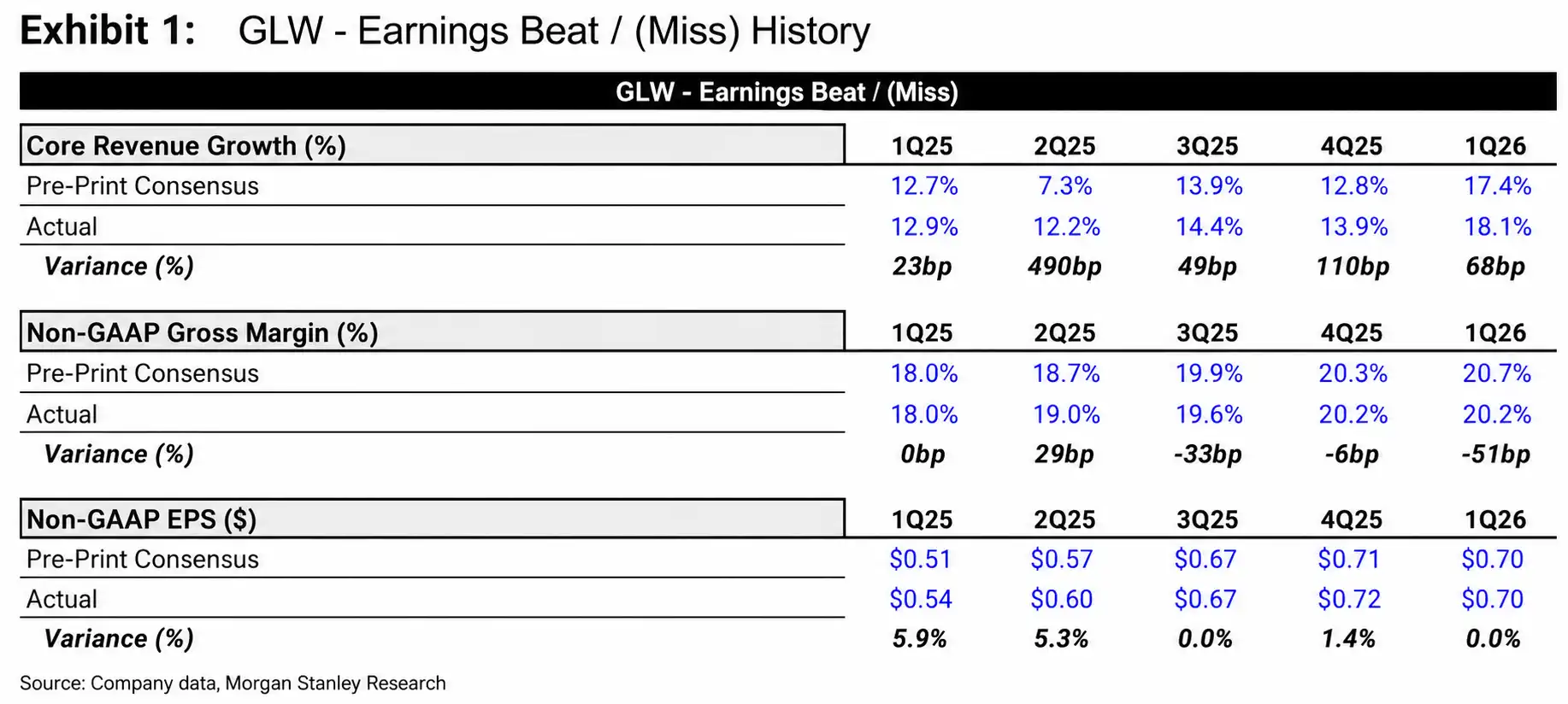
If Q2 is just "slightly better revenue, slightly better EPS," the market is more likely to shift its focus to management's outlook for the second half of the year. The key questions are whether the optical supply bottleneck has begun to ease and if revenue growth can continue to accelerate in Q3.
Market Has Already Bet on Q3, Optical Needs to Deliver More Revenue
Q3 guidance may be more critical than actual Q2 results.
A Morgan Stanley report mentioned that the market is already factoring in approximately $200 million in sequential growth. To meet this expectation, the optical business may need to contribute at least an additional $50 million. Due to tight optical supply in Q2, investors will be keen to hear how management describes capacity, delivery, and order visibility.
Corning's long-term story remains clear. AI data centers are transitioning from copper to more optical connections, with increasing demand for optical fiber, optical components, and passive photonics products. The company has exposure in architectures such as CPO, NPO, LPO, GlassBridge, and others. Management previously anticipated a gradual transition to copper-optical hybrid by 2028.
However, long-term opportunities do not directly translate into short-term profit realization. Different technology adoption speeds still vary, and the pace of AI capital expenditures will also impact optical demand release. If Q2 growth mainly comes from pricing rather than increased delivery volumes, the market reaction may be limited.
This also underlies the divergence behind the $180 target price. According to the report's risk-reward scenarios, the base-case target price is $180, the bull-case is $230, and the bear case is $72. The base case has already factored in a high AI and optical growth premium.
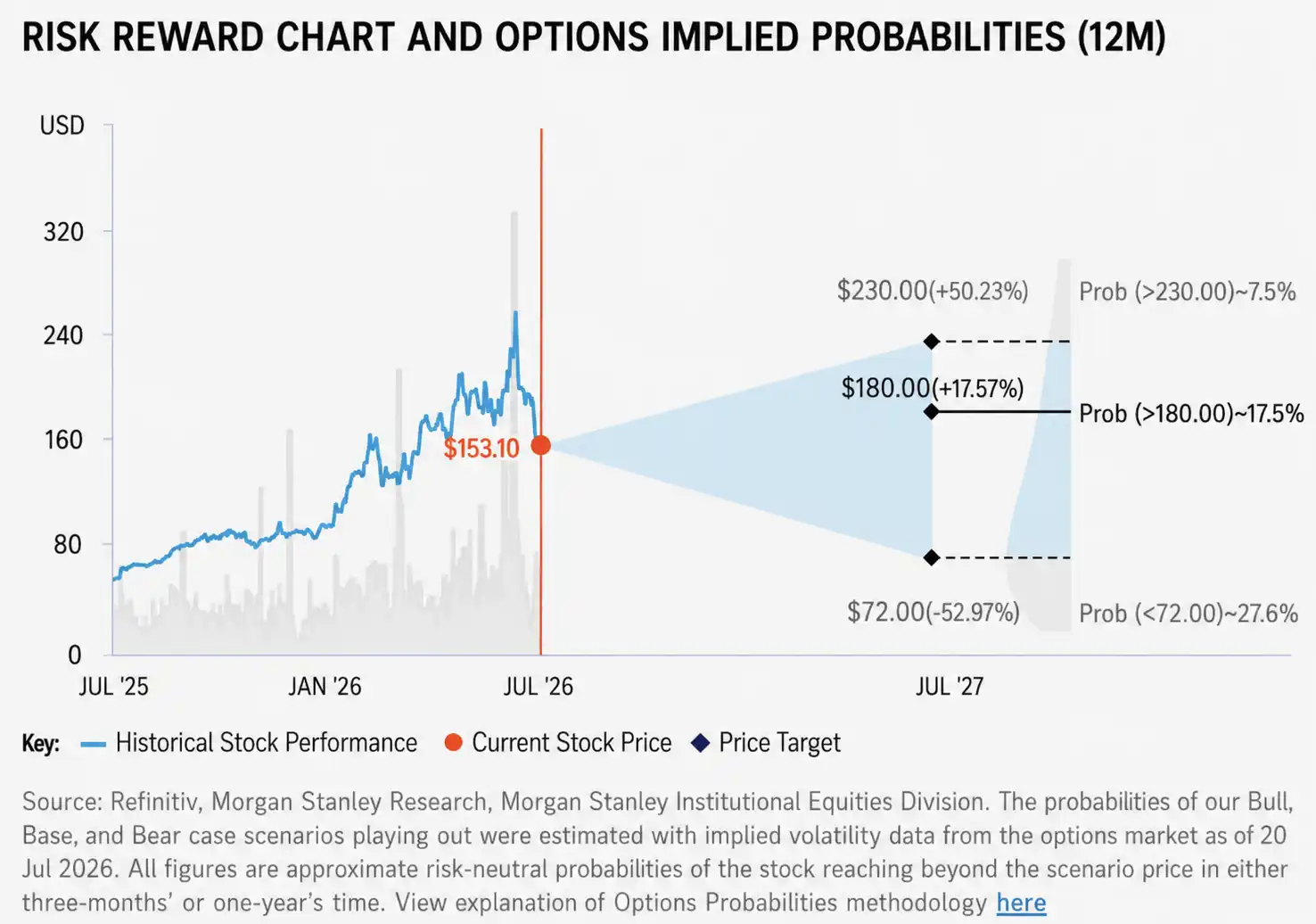
The implication of this set of scenarios is that the market does not deny Corning's AI optical opportunity, but the financial results need to demonstrate that long-term orders are turning into short-term revenue and margins.
Solar Initially Drags Profit, Display Business Only Provides Support
The short-term largest drag came from the Solar business.
Morgan Stanley's report estimates that the Solar business dragged core EPS by approximately $0.07 in Q2, representing around a 9% impact, or approximately $61 million after tax. Of this, about $0.03 came from $30 million in temporary shutdown costs, with the rest from wafer ramp inefficiencies.
The official Q1 press release also confirmed that the Q2 guidance includes additional costs from the extended maintenance shutdown of the Solar wafer facility. Temporary shutdown costs are expected to alleviate first in the second half of the year, but the improvement in wafer ramp efficiency is more uncertain.
This will squeeze the profit margin. Corning now has to prove not only that AI optical supply can ramp up but also that non-optical businesses will not eat into overall profitability. If optical revenue accelerates but Solar continues to drag down profits, EPS elasticity could still be constrained.
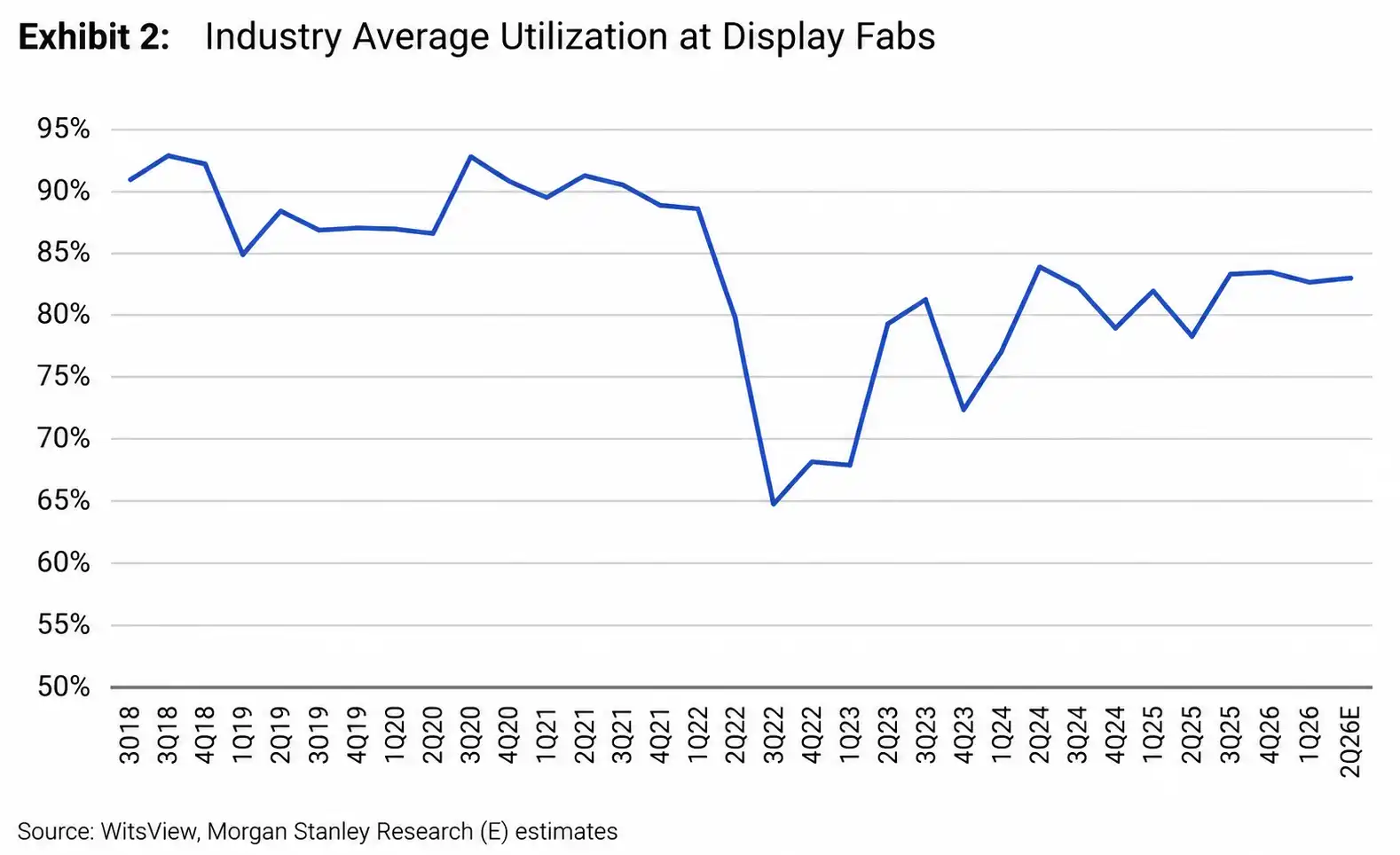
The Display business can provide some stability. Industry data in the report estimates that due to early-year inventory buildup for TV panels, Winter Olympics and World Cup stocking, as well as the China 618 promotion, display panel factory utilization maintained between 80% to 85% in Q2, higher than the low point of about 78% in Q2 2025.
However, early-year inventory build-up may also dampen demand in the second half of the year. The Display business remains important for overall profitability but more as a support factor, not the primary stock price catalyst this earnings report.
Valuation Has Priced in Significant AI Optical Expectations
Corning's mid-term financial outlook still looks good.
Morgan Stanley's report expects that core revenue from FY2026 to FY2028 will increase from around $17.6 billion to $26.6 billion, gross margin rising from 37.3% to 38.9%, and non-GAAP EPS maintaining rapid growth. If optical demand continues to surge, these numbers can explain why the market is willing to give Corning a higher valuation.
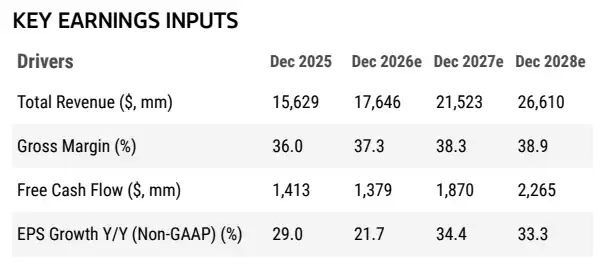
The challenge lies here as well. The $180 price target corresponds to a FY28 base case scenario EPS of approximately 35 times, higher than the historical median of about 16 times over the past 10 years. Even though the stock price has experienced a significant pullback from its late June local high, the current valuation still includes expectations for AI optical acceleration.
Therefore, if the Q2 earnings report only slightly exceeds expectations, it may not be enough to change the market's perception. Stronger signals should come from three things: whether third-quarter optical supply has significantly accelerated, if the Solar drag is beginning to fade, and if management can provide a clearer picture of the optical scaling pace around 2028.
The risks are also quite straightforward. If Q2 growth mainly comes from price rather than volume, the stock price reaction may be limited. If Solar wafer ramp continues to be inefficient, profit margin recovery will be delayed. If AI capital expenditure slows down, the long-term optical demand assumption will also be under pressure.
Corning's AI optical story is far from over, but this earnings report needs to prove more than just "demand is strong." What the market wants to see more of is whether the supply can keep up, profitability can be sustained, and the long-term expectations in the valuation are turning into near-term numbers.
Welcome to join the official BlockBeats community:
Telegram Subscription Group: https://t.me/theblockbeats
Telegram Discussion Group: https://t.me/BlockBeats_App
Official Twitter Account: https://twitter.com/BlockBeatsAsia
