$112.1 billion is the single-quarter net profit just reported by Google's parent company, Alphabet, and also the most easily misread number in this report. According to Alphabet's second-quarter performance press release on July 22, $99 billion of that came from net equity security gains, not cash directly earned from Search or Cloud.
On the other hand, the company's core business is indeed running fast. Alphabet's total revenue this quarter was $119.8 billion, with Google Cloud revenue reaching $24.8 billion. What the market sees is a beautiful income statement. However, another face appears on the cash flow statement, where data center investments are consuming funds faster than free cash flow.
Only by splitting these two accounts can we see where AI investment within Alphabet has actually landed. Search is still the lifeblood, Cloud is increasing its profit margin, and servers and chips are driving cash flow under the surface.
Cloud is still a small piece of Alphabet's revenue structure. Its volume accounts for only about one-fifth of this quarter's revenue. But when the question shifts to "Where is the new money coming from," the answer changes. Cloud captured nearly half of the new revenue and took about 60% of the new operating profit.
The old engine has not stopped. The company disclosed that Google Search & other revenue grew by 17% year-on-year, with Search still being Alphabet's thickest revenue base. Google Services added about $12 billion in revenue over a year, and Cloud's added revenue has also exceeded $11 billion. One is responsible for stabilizing the base, and the other is responsible for pushing up the marginal profit.
This is also the most noteworthy structural change in this financial report. Cloud has not replaced Search; it is more like the second engine attached to the side of the Search cash flow. The speeds of the two machines are different, and therefore, capital expenditures should no longer be read according to the logic of an advertising company.
What growth has changed first is not the ranking of existing stocks but the destination of the new parts. The advertising plate is still much larger, so the revenue share will not flip overnight. However, with every additional service sold, Cloud's share in new revenue and new profit is already much higher than its share of the overall size. For those who are used to viewing Alphabet as an advertising company, this is closer to the real change than the year-on-year revenue number.
Why has Cloud suddenly gained weight? The company attributes the acceleration to the demand for enterprise AI solutions, enterprise AI infrastructure, and core GCP services. Revenue is growing rapidly, operating profit is increasing even faster, and the rising profit margin shown in the chart indicates that the new revenue has not been fully eaten up by current costs.
This also explains why management combined AI infrastructure with AI solutions in the same section of the performance description. The former requires building up the computing power first, before the latter enables enterprise customers to integrate this computing power into their workflows. The revenue and profit in the chart do not grow at the same rate. Revenue reflects the scale of delivery, while the profit margin reflects the more thorough utilization of this infrastructure.
However, Cloud's high profit margin is not the entire AI bill. Alphabet has separately listed company-level activities in the segment reporting, primarily shared AI R&D expenses. While Cloud's segment profit margin has improved, expenses related to model development, infrastructure, and organizational aspects continue on the other side of the consolidated metric.
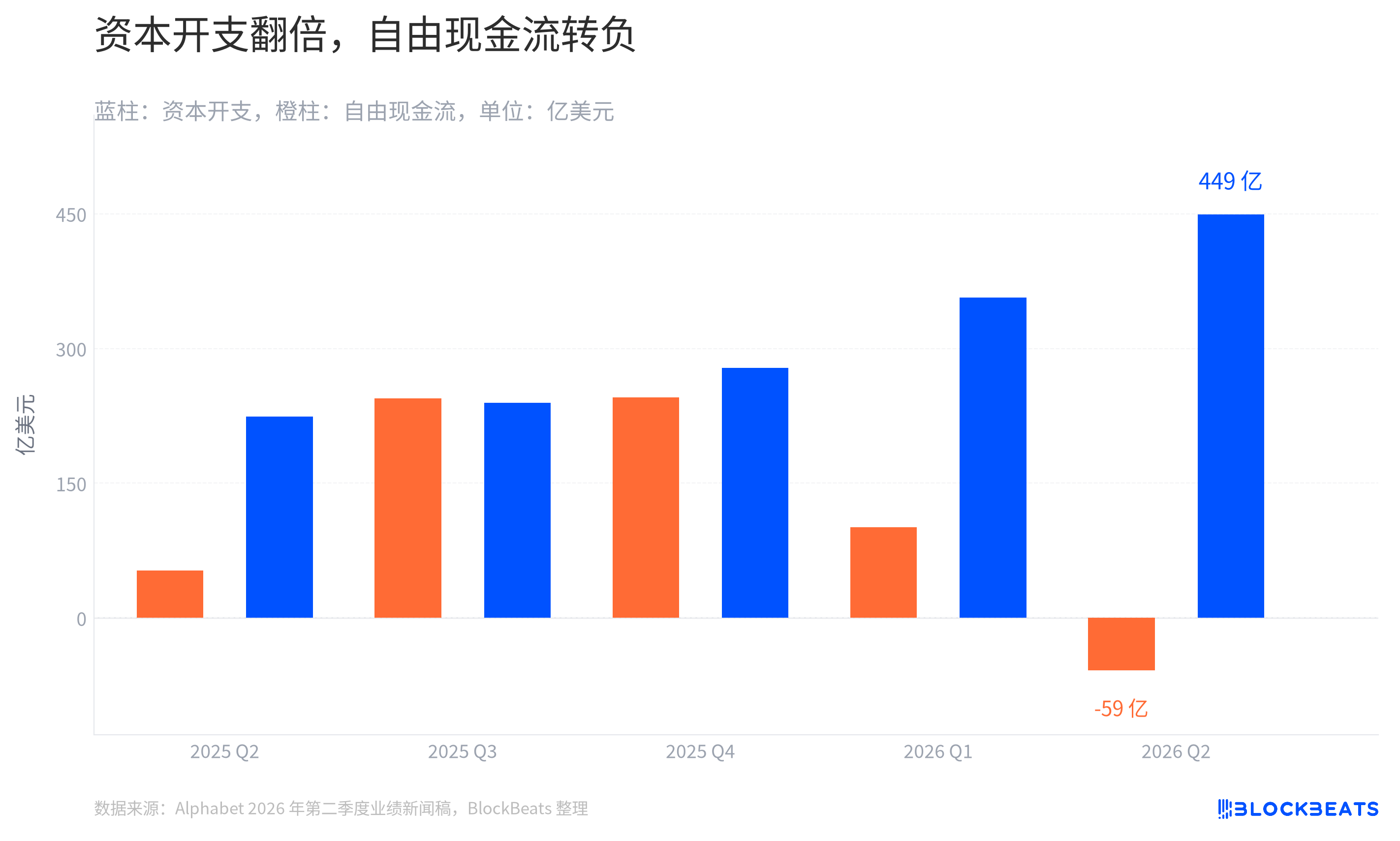
What truly caught the market's attention was cash. The free cash flow shown on the balance sheet indicates that capital expenditures reached $44.9 billion this quarter, resulting in negative free cash flow of $5.9 billion. The former figure represents investing in computing power, while the latter serves as a reminder that the returns have not yet flowed back into the account at the same pace.
This is not just a usual expense increase. Capital expenditures first turn into servers, networks, and data centers, with the opportunity to recover gradually as customers continue to use the Cloud. For Alphabet, the return on AI investment can already be seen in the Cloud's profit margin, but the cash recovery cycle is clearer on a different statement.
A negative free cash flow does not mean the core business is bleeding out. It indicates that the money flowing in from operating activities this quarter does not cover the cash outflow for purchasing property and equipment. Advertising and Cloud are still generating operating cash flow; it's just that the bill for the new round of construction arrives earlier.
The company's preparedness for this period is also outlined in the press release. In June, Alphabet obtained $49.6 billion in net proceeds from equity financing and issued $20.3 billion in unsecured notes. The company stated that the funds will be used for general corporate purposes, including expanding AI infrastructure and global computing power. Viewing that negative free cash flow in this context reveals not just a quarterly fluctuation but also a cash footprint left by an infrastructure expansion.
The improvement in Cloud's profit answers whether this infrastructure has been utilized, while the negative free cash flow records when it can turn the investment back into cash. The former answer is already reflected in this quarter's segment profit, while the latter question remains on the cash flow statement.
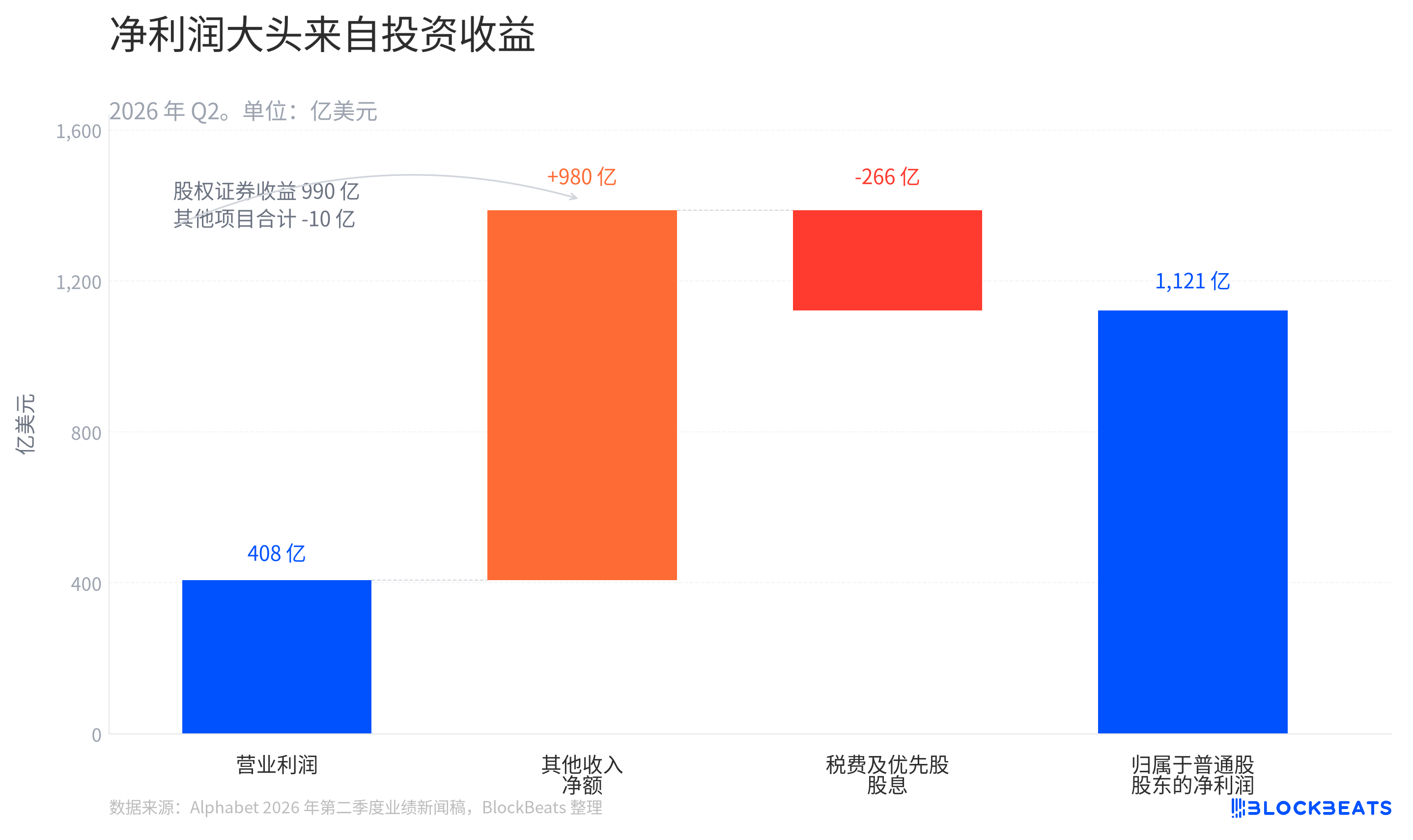
The drama in the income statement comes from the last tier. Other income, net, beyond operating profit, is significantly higher than the core operational contribution, with the main component being gains from equity securities. The company also disclosed that this $99 billion income increased net profit by $77.1 billion after tax.
This type of income can be realized or unrealized accounting changes. It can boost quarterly net profit, but it cannot replace the monthly usage fees paid by Cloud customers, nor can it replace the cash already paid by the data center. Only by putting it side by side with the core business on the same waterfall chart can we avoid reading "operating return" and "asset price increase" as the same thing.
This is not treating investment income as noise. It is a real change in Alphabet's balance sheet, has already been taxed, and has entered net profit. When placing it alongside Cloud and capital expenditures, readers need to view it as a third book, rather than a surrogate for the core business operating performance.
In Alphabet's Q2 report, Search provides the lifeblood, Cloud shows a return, moonshot projects initially consume cash, and the investment portfolio lifts net profit to another level.
Welcome to join the official BlockBeats community:
Telegram Subscription Group: https://t.me/theblockbeats
Telegram Discussion Group: https://t.me/BlockBeats_App
Official Twitter Account: https://twitter.com/BlockBeatsAsia
