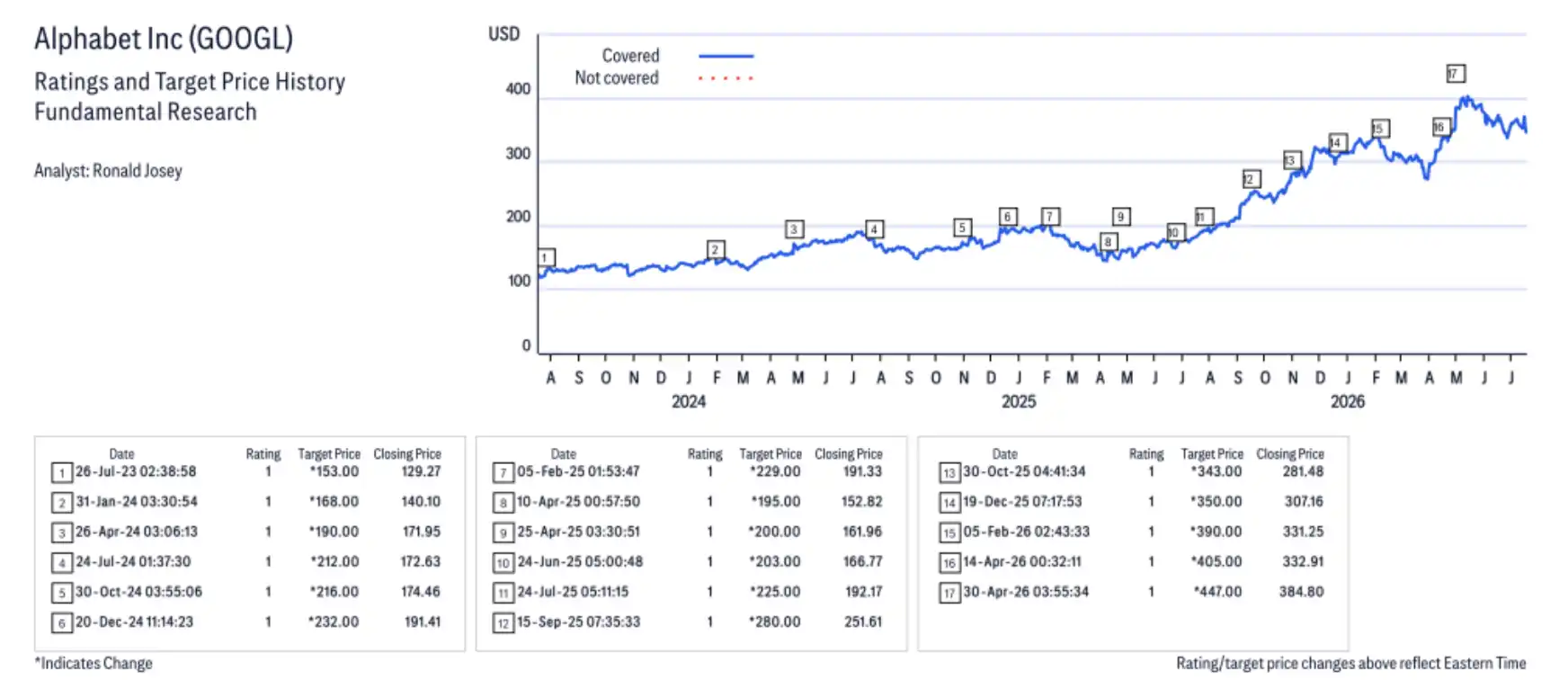
Citigroup reiterates its Buy rating on Alphabet post Q2 earnings and sets a target price of $447, representing a 30.7% stock price return and a 30.9% expected total return from the July 22 closing price of $342.09.
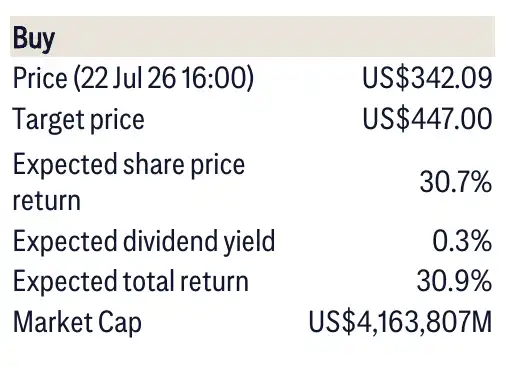
The key post-earnings shift, rather than Alphabet once again marginally beating market expectations, is the AI narrative reversal on Google: while the market previously feared AI search would erode Google's search ad and profit margins, the earnings report now indicates that search is still growing, YouTube is outperforming, and Google Cloud is significantly accelerating under AI demand.
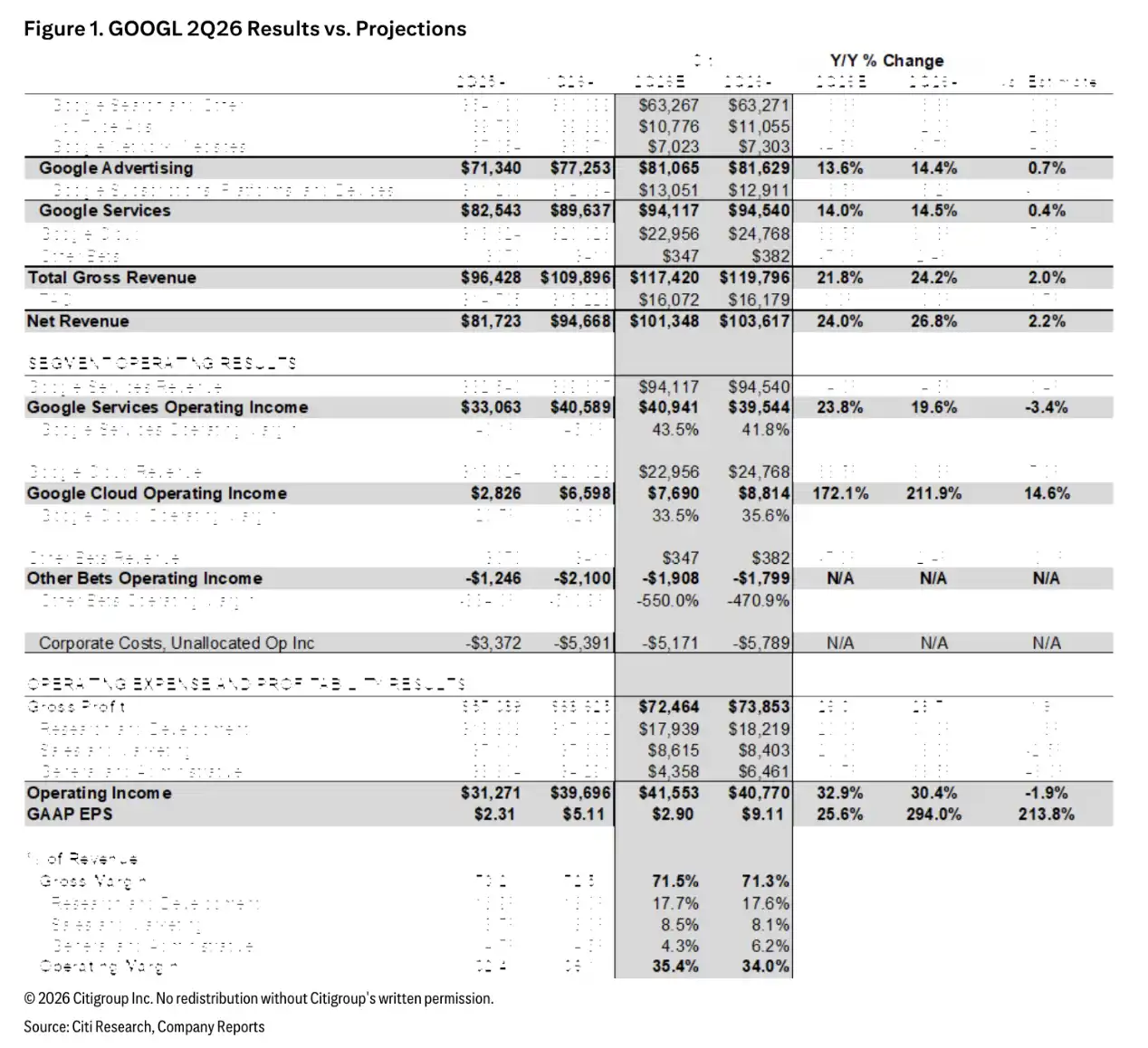
Alphabet's total revenue in Q2 was $119.8 billion, a 23% YoY increase at fixed FX rates, beating the FactSet consensus by about 2%; operating profit was $40.8 billion, with an operating margin of 34%, surpassing consensus by around 1%. GAAP EPS was $9.11, but this includes a $98 billion unrealized gain on equity securities, so it cannot be simply equated to operational profit surge.
Behind the $447 Target Price: Betting on AI Not Crushing Google
The $447 target price from Citigroup is based on a 2027 GAAP EPS of $15.90 and approximately a 28x P/E ratio. This valuation multiple is higher than the market and Google's historical range, driven by Google Cloud reaccelerating under TPU and Gemini demand, while search queries remain robust.
In other words, the most crucial takeaway from this Alphabet earnings report is that AI has not yet undermined Google's ad base but instead provided the company with new growth pillars in cloud services, computing power, and large-scale model products.
Over the past year, the market's main concerns about Google have focused on two areas. First, whether Generative AI will change user search behavior, thus weakening search advertising. Second, whether capital expenditure will rapidly consume profits in the race to catch up with AI models and computing power. Second-quarter data has temporarily provided a more optimistic answer: search is still growing, and cloud business profitability is also improving.
Search and other revenue totaled $63.3 billion, a year-on-year increase of 16.8%, roughly in line with market expectations; YouTube ad revenue was $11.1 billion, up 12.9% year-on-year, slightly higher than the consensus of about 2%. Google Services' total revenue was $94.5 billion, a year-on-year increase of 14.5%, essentially meeting expectations, with an operating profit margin of 41.8%, up 170 basis points year-on-year.
This means that the impact of AI on the commercialization of search has not yet manifested as a revenue decline in the second-quarter earnings report. On the contrary, AI query usage has reached a peak, the iteration of Gemini products, and the AI search commercialization plan have become the most discussed issues in the management conference call.
Cloud Business Suddenly Accelerates, Backlog Surges to $514 billion
What truly supported the target price was Google Cloud.
In the second quarter, Google Cloud revenue was $24.8 billion, up 81.8% year-on-year, exceeding market consensus by about 11%, and accelerating further from the 63% year-on-year growth in the first quarter. For a cloud business that already has a considerable scale, an almost 82% revenue growth rate is the most eye-catching number in this earnings report.
More importantly, the backlog. Google Cloud's backlog of orders grew 385% year-on-year to $514 billion, an 11% increase from the previous quarter, adding $52 billion in a single quarter. For investors, this number better illustrates the sustainability of AI cloud demand: the future orders that customers have already signed are rapidly accumulating.
Cloud business profitability has not been dragged down by growth either. In the second quarter, Google Cloud's operating profit was $8.8 billion, with an operating profit margin of 35.6%, higher than the market's expectations of $6.9 billion and a 31.1% margin, up 1490 basis points year-on-year. The cloud business, which was previously seen as a drag on Alphabet's profitability, is now beginning to contribute to both growth and profit.
AI demand is the key theme of this round of cloud business acceleration. TPU computing power, Gemini model usage, enterprise customer training and inference needs are all driving up Google Cloud's revenue and orders. Citi also focused the subsequent conference call on GCP demand, TPU sales, computing capacity, and product advancements like Gemini 3.5 Pro.
But this does not mean that the high growth rate of cloud businesses can be extrapolated linearly. Order backlog represents improved future revenue visibility, but factors such as delivery capability, data center construction pace, customer fulfillment, and AI demand intensity still need to be considered. Especially in the context of widespread investment in AI infrastructure, revenue realization speed and profit margin stability remain issues that the market will continue to focus on.
Search Remains Stable, with Increased Emphasis on Capital Expenditure
Alphabet's advertising foundation has not faltered, forming the basis for this optimistic AI narrative.
Search and other revenue totaled $63.3 billion, a year-over-year increase of 16.8%, indicating the continued resilience of core search advertising. YouTube ad revenue reached $11.1 billion, up by 12.9% year-over-year, demonstrating that the demand for online video ads is still recovering and expanding. Online advertising has not shown a significant weakening, providing Alphabet with the financial leeway to further invest in AI infrastructure.
However, the flip side of AI is the continued surge in capital expenditure. Capital expenditure in the second quarter was $44.9 billion, an increase of $9.3 billion from the previous quarter, broadly in line with Citigroup's earlier expectations. The focus of investment is primarily on technological infrastructure, including data centers, servers, and AI computing power-related expenses.
This will become one of Alphabet's most important stress tests in the coming quarters: if AI cloud revenue and orders continue to grow, high capital expenditure can be seen by the market as "expanding production to meet demand"; if cloud growth slows down and AI commercialization in search falls short of expectations, the same level of capital expenditure will become a pressure point on profit margins and free cash flow.
Therefore, the second-quarter financial report is not simply a proof that Alphabet has entered a risk-free expansion phase, but a shift in the market's focus from "Will AI impact search" to "Can AI-driven cloud revenue cover the increased investment."
The GAAP EPS of $9.11 also needs to be viewed with caution. This figure includes $98 billion in unrealized gains on equity securities and cannot be directly used to assess the core business's profitability. A more reflective measure of operational quality is the balance between revenue growth, operating profit margins, cloud margins, and capital expenditure.
Upside Potential Does Not Guarantee Returns; Regulation and Competition Continue to Weigh on Valuation
A target price of $447 gives Alphabet approximately 31% expected total return potential, but this is contingent on several conditions being met simultaneously: search usage and ad revenue remaining stable, Google Cloud sustaining high growth, AI demand from TPU and Gemini translating into sustainable revenue, and capital expenditure not significantly eroding profit margins.
The risks are also clear. Macroeconomic and consumer slowdowns will impact advertising budgets, with internet ad spending cooling off affecting both search and YouTube. If the AI competition intensifies more than expected, it could disrupt the search gateway and compel Alphabet to continue increasing model and compute investment.
Regulatory pressure has not dissipated either. Antitrust, data, and privacy-related regulations could still impact Google's search, ad tech, and platform business models. For a company with a market value exceeding $4 trillion, regulatory outcomes will directly affect the valuation multiple the market is willing to provide.
Therefore, the core message of this post-earnings report is not "Alphabet has already won in AI," but rather that the Q2 data temporarily proves: AI has not weakened Google's two key pillars, with search advertising still growing, and the cloud business accelerating in both orders and revenue. Looking ahead, if the $514 billion cloud orders can continue to translate into revenue, and the $44.9 billion-level capital expenditure does not erode profits, the $447 price target will have stronger support.
Welcome to join the official BlockBeats community:
Telegram Subscription Group: https://t.me/theblockbeats
Telegram Discussion Group: https://t.me/BlockBeats_App
Official Twitter Account: https://twitter.com/BlockBeatsAsia
