On August 19, U.S. Treasury Secretary Scott Bessent made his move.
He doubled the single transaction limits on 10-year, 20-year, and 30-year Treasury bond repurchases from $20 billion to at least $40 billion. The timing was as the long end yields hit their highest level in nearly two decades: the day before, the 30-year yield touched 5.33%, the highest since 2007.
He gave this action a name, calling it the "Treasury's Twist Operation," paying homage to the Fed's famous twist operation in the 1960s. He stated that the current yield levels were not in line with a "balanced" level.
The yield curve did twist indeed, but only for a day.
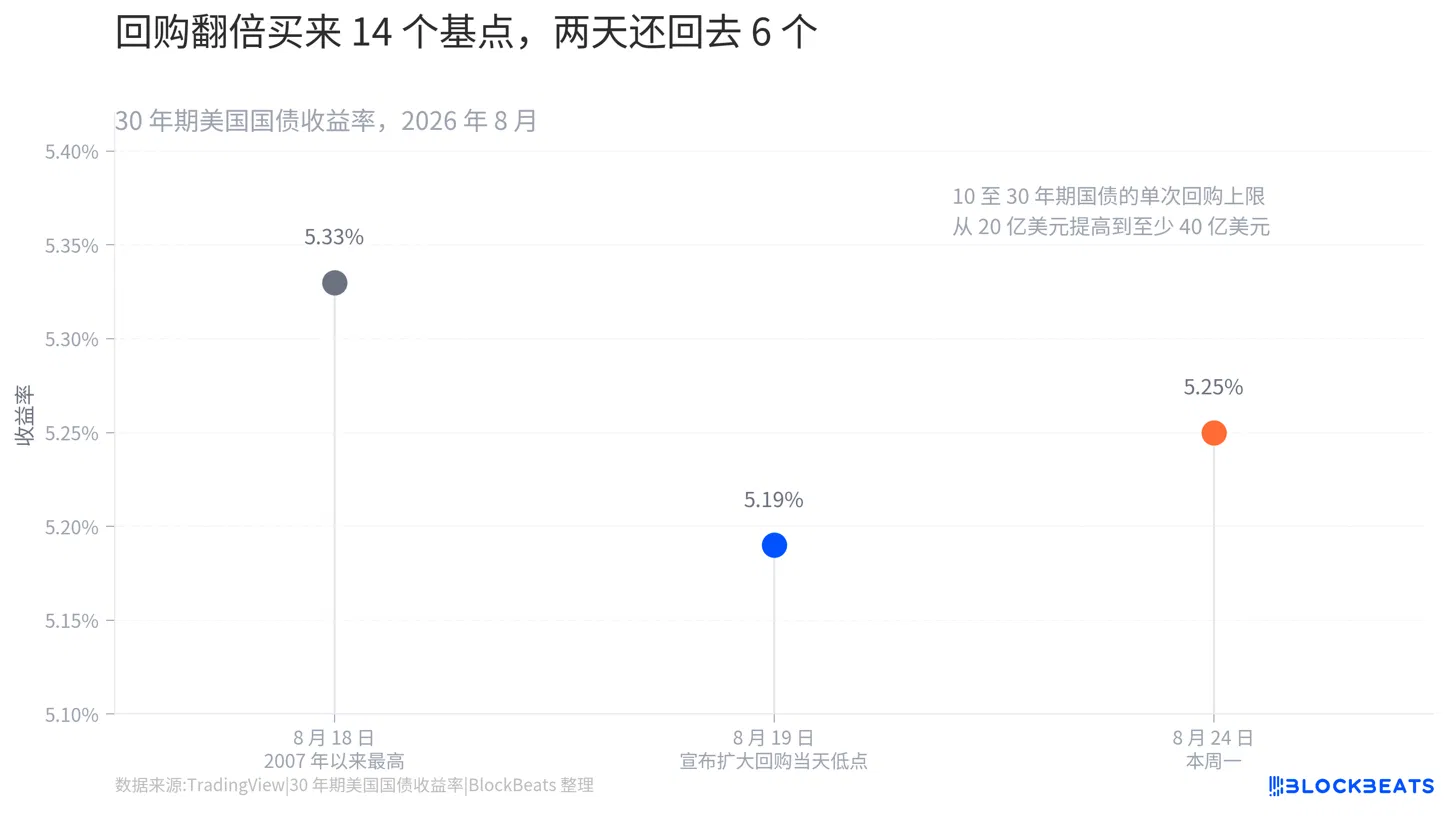
On the day of the announcement, the 30-year yield dropped to 5.19%, a 14 basis point drop. Then it climbed back up, still at 5.25% as of this Monday. The 10-year yield closed at 4.73% last Friday, near its highest point since he took office.
What saw significant surges were some other things: Bitcoin surged to nearly $80,000, leading to billions of dollars in short liquidations; gold approached a three-month high; XRP surged 51% in a week.
Why Can the Treasury Lower Rates by Buying Its Own Debt?
Let's first explain the mechanical principle behind this, which is not actually complicated.
The Treasury yield serves as the benchmark interest rate for the entire economy. It is not just the cost of government borrowing but also a pricing reference for mortgages, corporate loans, and many other debts. As the yield rises, both the government and American households face heavier interest burdens—especially a glaring issue before the midterm elections.
The Treasury's move to buy back its own debt on the open market effectively adds another buyer out of thin air. With increased demand, bond prices rise; and bond prices and yields move inversely, so when prices rise, yields fall.
But there is a key premise: the Treasury is not the Fed, it cannot create money out of thin air. The money used to buy debt comes either from existing cash or borrowing. Borrowing usually means issuing more short-term Treasury bills—so the repurchase is more of a "debt swap" than a "debt buyback": the total amount remains the same, just shifting from long to short.
Bank of America analyst Angelo Manolatos estimated that to finance the expanded repurchase plan, the Treasury would need to issue an additional $16 billion in short-term Treasury bills each quarter.
This playbook itself is not new. Since the beginning of Trump's second term in 2025, the Treasury has squeezed all new borrowing needs into short-term notes within one year—pushing up short-term rates but leaving the long end untouched. Interestingly, Bessent criticized former Treasury Secretary Yellen for this exact tactic before taking office.
So why didn't it work?
Because none of the forces that pushed yields higher were touched by this operation.
Satori Insights founder Matt King put it best: "Every road to a sustained relief in the long end goes through things this administration doesn't want." The three roads he listed are: a smaller budget deficit, a stock market decline, and reduced AI investment.
All three are blocked.
Debt is at a record high. The U.S. national debt has already exceeded $40 trillion by one measure this week. Bessent's promised deficit reduction plan looks bleak in Congress—a net budget cut is unlikely this year with a Republican-controlled Congress, and the budget deficit for this fiscal year is expected to be $2.1 trillion.
Corporate entities are also cashing in. The AI boom has led to a surge in corporate bond issuance. Earlier this month, Alphabet sold bonds with maturities of up to 40 years.
Inflation is on the rise. Trump's war with Iran has disrupted the energy market, causing oil prices to rise by about 30% since early July, with Brent crude reaching $93 per barrel.
The Fed itself is uncertain. Chairman Kevin Warsh's strategy has left investors puzzled, and the new chair's debut at Jackson Hole has yet to clarify matters.
More embarrassingly, the market doesn't see anything that needs fixing here. Edward Yardeni, who coined the term 'bond vigilante,' told Bloomberg TV about an hour before Bessent acted: "I think we are back to normal interest rate levels, with 4% to 5% being normal." The Treasury said this intervention was to support liquidity, while J.P. Morgan's rate strategy team wrote in a report last Thursday, "Market functioning has improved significantly this year."
Institutions like Goldman Sachs and Fidelity are more direct in their assessment: unless fiscal and inflation pressures are truly relieved, increasing long-end repurchases will not reverse the upward trend in long-term yields, and the yield curve will continue to steepen.
So why did Bitcoin rise?
Because the market read it as not "the problem is solved" but as "they are really desperate."
The explanation from Sygnum's Chief Investment Officer Fabian Dori was comprehensive: "The Treasury doubled down on long-dated bond buybacks to soothe the bond market, provide liquidity at the long end of the curve... This is not money printing; the mechanism is on the Treasury's balance sheet rather than the central bank's, but the signal is significant: managing the cost of U.S. debt has become an active policy priority, reigniting the narrative of currency devaluation. Gold and silver, along with Bitcoin, rose together, highlighting a key point — capital is rotating into scarce, non-sovereign value stores."
Citadel Securities' criticism was even more ruthless: this practice of suppressing long-term borrowing costs through buybacks is considered "financial repression," which could weaken the dollar and exacerbate inflation. The assessment is that lowering long-term yields will not alleviate fiscal and inflationary pressures, only shifting the pressure to the foreign exchange market.
The foreign exchange market indeed reacted first. Hedge funds increased their short bets on the dollar before Bessent announced the plan, leading to the dollar's largest single-day drop in almost three weeks. The options market saw hedging demand for a dollar decline rise to its highest level since February. On Monday this week, the U.S. dollar index still hovered near multi-month lows.
Where is this money coming from?
This is a new variable that emerged this week.
CNBC on Monday cited two senior Treasury officials saying the Treasury may use its cash account at the Federal Reserve — the Treasury General Account (TGA) — to fund the buybacks. On August 20, the balance in this account was $935 billion.
The TGA is essentially the U.S. federal government's checking account used for day-to-day expenses: Social Security checks, federal employee salaries, defense contracts, interest on the national debt, and principal payments. This year, it has been deliberately beefed up, in part because the Treasury is required to refund about $166 billion to importers — the Supreme Court earlier this year ruled that a significant portion of Trump's import tariffs was illegal.
The advantage of using the TGA is that it avoids issuing new debt, but the downside is it directly depletes the country's cash reserves. In 2015, the Treasury set a rule: the account must hold a balance enough for at least five days of spending or not less than $150 billion to prevent being locked out of the bond market.
Upon this news, the 10-year yield dropped by as much as 4 basis points that day to 4.69%.
During Monday's press conference, Bessent was asked about this — the conference's actual theme was sanctions on Iran. His response was: the Treasury will continue to execute the regular auction plan announced at the beginning of August, including long-dated auctions; the expanded buybacks have not purchased any bonds yet, and the 10-year and 20-year buybacks are set to commence on September 10.
What Else Does He Want to Shake Up?
Bessent's yield curve management ambitions go beyond just Treasuries.
He includes those massive tech firms that have borrowed heavily for AI in the mix. He argues that these investments will ultimately yield faster, non-inflationary economic growth, but for now, "it's causing short-term capital competition." And then he offers a suggestion:
"If I were in the CFO seat, I would think about issuing more of what is called 'belly' debt." — referring to five-year debt.
The U.S. Treasury Secretary publicly suggesting to corporate treasurers what tenor of debt to issue is a pause-worthy moment in itself.
Another line farther out leads to stablecoins. Last year's passed "Innovation Act" stipulates that stablecoins backed by the U.S. can only be backed by specified assets, including Treasuries maturing within 93 days. Bessent has cited a forecast that stablecoins could grow into nearly a $40 trillion market and has written, "This could lower the government's borrowing costs."
Currently, the total market cap of all stablecoins is around $300 billion, while U.S. money market funds are close to $8 trillion. But a comment from the Brookings Institution's Hutchins Center points out where the leverage lies: Banks typically hold only 8 cents of Treasury securities for every dollar of assets, while a dollar of stablecoin is typically supported by close to 80 cents of Treasuries.
This is the backdrop to Trump hosting crypto industry execs at the White House last week and urging Congress to pass the "Clarity Act." Both Circle and Coinbase surged over 20% last week.
The Rule He Broke
The Treasury has had a decades-long tradition of being "routine and predictable" — any changes to debt management are supposed to be thoroughly discussed internally and with market participants. Bessent himself reiterated this principle in a keynote speech last November.
This latest move comes just two weeks after the release of the plan's quarterly tentative calendar.
Wrightson ICAP's chief economist, Lou Crandall, captured the essence of this event most accurately in a report on Monday: "The decision to increase long-end repos in itself might not be so radical, but the timing and framework of the decision are certainly aggressive."
The cost may manifest in the most ironic way possible: If investors start worrying that auction sizes could change unexpectedly at any time, they will demand higher premiums to buy Treasuries — especially the longest-dated ones.
In other words, the very rule-breaking intended to lower long-end yields may itself push up long-end yields.
There are already discussions in the market about whether a "Bessent Put" has emerged, akin to the belief in the past that Greenspan would always step in to support the stock market.
As for Trump, he denied last week that he had instructed Bessent to intervene in the bond market.
As for that yield curve, he did indeed twist it. It's just that what he twisted were the US dollar, gold, and Bitcoin, not the one he intended to twist.
Welcome to join the official BlockBeats community:
Telegram Subscription Group: https://t.me/theblockbeats
Telegram Discussion Group: https://t.me/BlockBeats_App
Official Twitter Account: https://twitter.com/BlockBeatsAsia
