Editor's Note: As the U.S. bond yield approaches the sensitive 5% threshold, global risk assets come under pressure. This article begins with the first act in the bond market narrative, then shifts the focus to the crypto market, retracing the past experience of a bull market spurred by reverse repo downside, analyzing the practical effectiveness and constraints of the Treasury bond repurchase policy in the current market interplay, and deducing the potential market changes that Bitcoin and other crypto assets may face amid the backdrop of shifting liquidity. The following is the original content:
Please temporarily set aside your rational thinking, let your imagination run wild, and follow my narrative.
Act One
On a Saturday night, the newly renovated Brooklyn Mirage Club, now named the New York Pacha Club, stands as the true heart of the American hegemonic order. A group of elite dignitaries dressed in formal attire gather here, swaying to the music of Keinemusik.
The protagonist of the story, U.S. Treasury Secretary Scott Bessent (whom the author jokingly refers to as "Buffalo Bill"), confidently walks to the VIP area behind the DJ booth's exclusive booth. A mischievous smile plays on his lips as a thought crosses his mind: "Since Elvis stole Southern gospel music and appeared on 'The Ed Sullivan Show,' I haven't seen a group of white people with such good rhythm."
Citadel's Kenny G is present at the moment, celebrating his decisive victory over Leopold Aschenbrenner from San Francisco, a high-leverage bettor. Bessent couldn't help but take a second glance. He had always heard that Kenny G was a regular in Miami and thought he liked Latin women. "Who is this gorgeous woman next to Kenny G... Wait a minute, it's actually Leopold's wife." There's nothing more satisfying than humiliating a West Coast, pretentious high-leverage speculator, even if this woman is just average by Bay Area standards, so what, live in the moment.
What surprises and irks Bessent is that sitting next to Kenny G is his predecessor, former U.S. Treasury Secretary Janet "Bad Gurl" Yellen. Yellen waves at him and continues to chat with Hunter Biden. Bessent inwardly sneers at the situation, wondering what kind of party this is. He even imagines that Yellen is probably going wild tonight. Bessent feels extremely unbalanced: how can she afford a $20,000 booth? He quickly realizes that serving in the U.S. government itself implies enormous profit potential. Bessent himself is already extremely wealthy, so he doesn't need to profit excessively; but for ordinary politicians like Ro Khanna and Nancy Pelosi, such operations are already routine.
Yellen shouted at Bessent across the noise: "Hey, kid, how has the market been treating you lately?"
Bessent visibly twitched with anger. This week had been a nightmare for him, with the U.S. Treasury market in disarray. He had to suddenly announce that the Treasury Department would double the size of long-end bond buybacks in an attempt to suppress yields. Unfortunately, the market's rebound only lasted one trading day. By the weekend, yields had returned to levels seen before the policy announcement. He really wanted to call his true mentor, George Soros, for advice and wasn't sure if Druck would take his call.
Yellen continued to provoke: "Don't you think you're smarter than me? Think you understand the market better than the ivory tower types?" She let out a burst of laughter mimicking former Vice President Kamala Harris: "You're just Trump's puppet, hahaha. We're not so different at our core, arrogant folks. Enjoy yourself!"
As she finished speaking, Yellen let herself go completely. A group of male companions wearing custom diamond dog collars by Jacob the Jeweler followed behind her. She leaned in to one of the male companions and quietly recited Cardi B lyrics in his ear: "I want you to park that big Mack truck right in this little garage." It really was a "little garage" now, and she still had plenty of Reta hidden in her hand.
Bessent, consumed by anger, passed by Arthur and Ansem's booth, where a group of crypto gamblers were deep in discussion. Arthur waved at Bessent, and when he approached, he said, "I saw it all just now. Don't mind those haters. The crypto community is on your side. You have no choice, we support you, keep going! Whatever you do, keep printing money. Once the market crashes, the rich won't get their free lunch, and America's ordinary folks who naively believe capitalism will make them rich will also get nothing. Without those handouts, AOC will raise our taxes, oh my god."
At that moment, Bessent made a firm decision to be a dutiful Treasury Secretary. If Trump needed ten trillion to support the market, he would find a way.
Scene Change
No matter how different their pre-appointment rhetoric was, Bad Gurl Yellen and Buffalo Bill Bessent were essentially cut from the same cloth. They were both beholden to politicians—politicians who couldn't control themselves and were always willing to spend on frivolous endeavors. But they both believed that holding the highest financial power in America was a price worth paying. So whenever the Treasury market was in turmoil, they would deploy sophisticated money-printing strategies.
When the Treasury Department reduces the yield on government debt by printing money, it releases dollar liquidity into the market, which ultimately flows into the Bitcoin and crypto market. I will compare two historical periods: Yellen and Bessent reshaped the market, leading to a bull run in Bitcoin. The first period occurred at the end of 2023, with Yellen issuing a large amount of short-term Treasury bills to reduce the supply of long-term bonds; the second period is the current one, with Bessent intervening in the USD/JPY exchange rate and expanding the scale of Treasury bond buybacks. In the year Yellen introduced this money-printing scheme, Bitcoin rebounded strongly from its low point; and my assessment is that when Bessent is determined to follow in the footsteps of his predecessor and massively release dollar liquidity, Bitcoin will similarly replay this scene.
5% Threshold
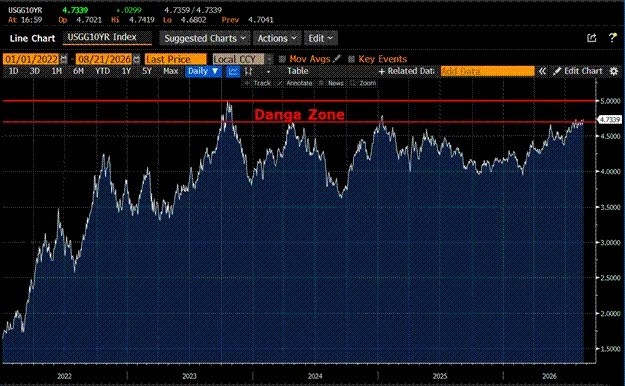
For some reason, both Yellen and the current Bessent are extremely fearful of the 10-year Treasury yield approaching 5%. The 10-year Treasury yield is the most important pricing anchor in the American financial order. Rates for 30-year fixed-rate mortgages (with prepayment options), corporate bonds, and various consumer credit products are all anchored to the 10-year Treasury. Once the yield surpasses 5%, the financing costs for residents and businesses will become so high that they will be difficult to bear, leading to a cooling of economic activity. That's why regulators are desperate to defend this threshold.
Treasury Bills vs. Bonds
Treasury bills (T-bills) have a term of less than one year, while bonds have a longer term. The shorter the term, the closer it is to cash, making it more liquid and attractive to money market funds (MMFs) and similar institutions. Money market funds aim to achieve as high a return as possible while bearing the lowest interest rate and counterparty risk. Depositing funds at the Federal Reserve is the safest option—the Fed can print money to repay the debt without requiring congressional approval. The Fed has the Reverse Repurchase Agreement (RRP) tool, where eligible institutions can deposit funds and earn returns close to the Federal Funds Rate.
In theory, lending to the U.S. government in dollars is risk-free because the government can print money; however, in reality, debt repayment requires congressional approval. That's why the debt ceiling drama rattles the market's nerves: investors cannot hold securities with uncertain maturity and repayment. If politicians refuse to pass spending bills, bondholders will not receive their principal and interest. Therefore, if money market funds want to hold Treasury bills, their yield must be slightly higher than the RRP to compensate for this policy risk.
By the end of 2023, the economic environment was very similar to today, with the most pressing issue for American voters being the cost of living. At that time, President Biden's team was well aware that the general public had realized the consequences of rate cuts or balance sheet expansion, making that path infeasible. With the 2024 election looming, the government had to consider the voters' financial stress. Yellen understood that her boss needed to support market liquidity while avoiding overt money printing and inflationary stimulus. Thus, she devised a clever form of stealthy money printing.
At that time, around $25 trillion was parked in reverse repurchase agreements (RRP). The issue with this funding was that it lay dormant on the Fed's balance sheet, unable to be rehypothecated by banks to create credit, resulting in a monetary multiplier of zero. However, if money market funds moved funds out of RRP and into higher-yielding short-term Treasury bonds, the banking system could repledge this asset. Liquidity would flow into the bond market, driving down yields and simultaneously boosting stock prices; for us crypto players, this also set the bottom for Bitcoin post-FTX bankruptcy.
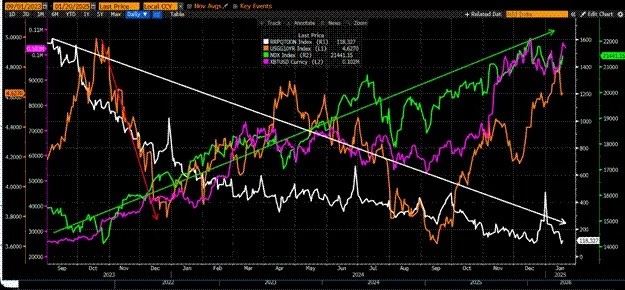
The chart clearly illustrates this transmission logic. The Treasury expanded the supply of short-term Treasury bonds, causing bond prices to fall and yields to rise significantly above RRP levels, prompting yield-seeking money market funds to shift funds from reverse repurchase agreements. By the time Bessent took office on 2025-01-20, the RRP balance had shrunk from $25 trillion to $1,000 billion. This equated to a liquidity injection of $24 trillion (funded by pandemic stimulus), with a large sum of money flowing into the financial markets, propelling the Nasdaq 100 and Bitcoin prices, rapidly pulling back the 10-year Treasury yield from a perilous 5%, while the federal funds rate remained near 5.3% without a cut.
Crypto traders, make sure to grasp the essence of this chart, as the foundation of market optimism lies here. If you are puzzled by why the Fed is maintaining its highest interest rates since 2008, while also unwinding its balance sheet, and yet Bitcoin and risk assets are still soaring, then you might miss out on the newly ignited bull market. The academic community has even coined the term Activist Treasury Issuance (ATI) to describe Yellen's magical maneuver.
Now, Bessent is facing the same dilemma as Yellen. His boss is keen on spending a lot of money, this time on an unwinnable war in the Middle East. However, where the President spends the money is inconsequential; the Treasury Secretary's task is to borrow money for the government at an affordable cost.
Distortion Operation
Everyone loves a cash-like asset. Treasury bills are the highest-yielding and safest near-cash instrument in the dollar system. Therefore, everyone is willing to hold Treasury bills; even the crypto community holds derivatives such as USDT, USDC, and other stablecoins. Bessent is well aware that as long as he is willing to offer, the market can absorb a massive amount of Treasury bills. However, the problem lies in the fact that Treasury bills mature within a year; the higher the proportion of short-term debt, the faster the debt compounds. Every week, the Treasury Department must issue increasing amounts of debt to cover new fiscal expenses and redeem maturing debt, causing the total U.S. debt to rapidly expand.
By increasing the proportion of Treasury bills in the total debt, Bessent can leverage the most important marginal buyer—the Federal Reserve. Currently, the Federal Reserve creates bank reserves and prints money to buy Treasury bills through the Reserve Management Purchases (RMP) program. The monthly purchase scale of RMP is decided by New York Fed President Williams, who leans dovish, or in Fed speak, "dovish." If Williams assesses that the market lacks dollar liquidity, he will instruct traders to create reserves and buy Treasury bills in the open market. Essentially, the Federal Reserve is printing money to foot the bill for the government's fiscal tab.
With the Federal Reserve picking up Treasury bills, Bessent can issue a large amount of short-term debt to raise funds for repurchasing medium to long-term bonds. Bessent whimsically manipulates the yield curve, like a tone-deaf child playing the violin. Ever since the "D-Day Event" last year, he hinted at wielding the powerful weapon of bond repurchase. At that time, Trump once wanted to use aggressive tariffs to completely reshape the global trade landscape, but he backed off after the market crash. Bessent warned the market not to challenge his policy tools. Over a year later, Bessent actually took action, announcing a large-scale repurchase to forcibly lower long-term yields.
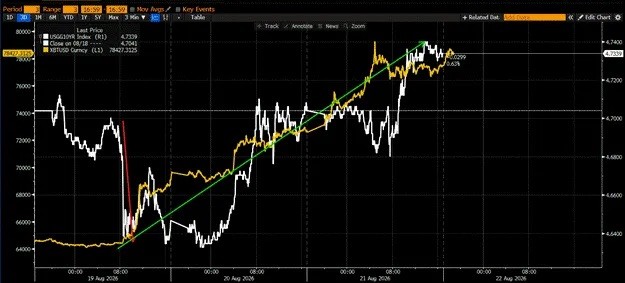
On August 19, without warning, Bessent announced that the repurchase scale of long-term bonds for the next fiscal quarter would be additionally increased by a mere $20 billion. As the news broke, the 10-year yield briefly declined, but the magnitude was limited. Bitcoin woke up from its slumber and saw two days of strong gains. However, this was precisely the reason why Bessent was gloomy at the party: just one trading day later, the 10-year U.S. Treasury yield surpassed the level before the policy announcement. Why did this happen?
First, Bessent's scale of action was far from sufficient. With total debt reaching $40 trillion, a $20 billion repurchase was a drop in the bucket. Second, the market sensed panic. Just a few weeks ago, Bessent proposed to remove the limit on the FIMA tool, allowing Japan and other major U.S. bondholders to pledge their U.S. debt holdings as collateral and borrow dollars directly from the Federal Reserve, rather than selling bonds in the open market. Third, and most importantly: the market believes that as long as it continues to push the 10-year yield upwards, it can pressure Bessent to replicate Yellen's approach and inject trillions of dollars of liquidity into the market. Bitcoin is the global liquidity smoke alarm, keenly picking up on this signal. If Bessent is indeed an upgraded version of Yellen, then Bitcoin will start a furious bull run from its lows.
Bessent's Next Move
There will be several evolutionary paths ahead.
For assets like Bitcoin that are highly sensitive to USD liquidity, the worst-case scenario is: U.S. politicians led by Trump choose to cut fiscal spending. However, I believe the probability of this happening is very low, with the next election not far off.
Leaving aside this doomsday fantasy and returning to reality, let's see what tools Bessent can use to fire up the printing press.
The best-case scenario for Bitcoin: Bessent emulates the Bank of Japan's bond market intervention model and announces that as long as the yield on 10-year bonds and above is above 5%, there will be unlimited bond purchases. Upon the news landing, long-term bond prices will soar, yields will quickly fall, and the market will temporarily fear Bessent. However, all interventions that go against market economic laws will eventually be tested, and the market will probe Bessent to see if he is truly willing to wield the USD cannon to fulfill his promise.
The most likely intermediate path (unless the MOVE volatility index exceeds 130, causing acute pressure on the market): Bessent will gradually increase buybacks while exploring other niche tools to indirectly release liquidity.
There is also an obvious means: using the Treasury General Account (TGA) funds to support buybacks. Buffalo Bill Bessent has already leaked this proposal to CNBC. The TGA account holds approximately $1 trillion.
I believe that unless the future AI credit bubble truly bursts, the Federal Reserve will find it difficult to directly cut interest rates or restart unlimited QE on a political level. Don't forget, voters are still most concerned about the cost of living; now even teenagers who watch short videos understand that rate cuts and QE are equivalent to printing money.
The Bull Market Is Here
Whether Bessent opts for a rapid liquidity injection or a gradual approach, Bitcoin will continue to rise. Volatility will increase; even if the overall direction is upward, there will still be brutal short-term pullbacks. Therefore, unless you are a full-time trader, do not use leverage. Buy Bitcoin or your favored altcoins, hold them, and patiently await the fermentation of Bessent's policies.
Within the Maelstrom Fund, we are fully allocated to risk assets. Bitcoin, Ether, Ethena, and Ether.fi are our core targets, and we expect them to surge ahead.
Welcome to join the official BlockBeats community:
Telegram Subscription Group: https://t.me/theblockbeats
Telegram Discussion Group: https://t.me/BlockBeats_App
Official Twitter Account: https://twitter.com/BlockBeatsAsia
