Introduction: The Bull Market Is Back, but the Real Change to Consider Is the Transformation of Capital Structure
The bull has returned. Over the past week, global risk assets have surged simultaneously, and the crypto market has returned to a path of increasing volume. While most people are focused on how much more BTC and ETH can rise, as researchers, we are more interested in a deeper change behind this market surge: the funds entering the crypto world this time are no longer just native crypto speculative funds and retail investors, but a large amount of globally compliant and traditional financial funds; what they want to buy is no longer just BTC and ETH, but stocks, gold, forex, Pre-IPO shares, RWAs—the entire global asset spectrum.
This leads to the core thesis of this article: the role of $HTX is undergoing a fundamental change. It is the governance token of HTX DAO and the exclusive designated partner token of Huobi HTX, to some extent serving the function of an exchange token. In the past, its valuation was anchored to the trading volume of spot and perpetual contracts in the crypto market; in the future, it should be reinterpreted as the "Equity Token for Global Assets Entering the Crypto World"—when global funds pass through the gate of the crypto world, holding $HTX is like owning a part of this gate. To substantiate this thesis, this article will provide a comprehensive quantitative analysis beyond the narrative: how large is the global traditional financial volume, how large is crypto now, based on Huobi HTX's market share, if only a small portion of global funds flow in, coupled with this year's incremental growth rate of the TradFi sector, where should the market value of $HTX be in five years.
I. Narrative Switch: Valuation Logic Completely Unveiled
Let's first clarify the concept. What is the valuation logic of an "Exchange Platform Token"? Very simple: the market cap of the platform token = crypto trading volume × fee rate × revenue distribution ratio. Since $HTX to some extent plays the role of a platform token, it has long been compared within the same framework as BNB of Binance, OKB of OKEx, etc.—who has a large crypto trading volume and strong buyback intensity, their platform token is more valuable. This framework was effective from 2020 to 2024 because it reflected the reality: almost all revenue of crypto exchanges came from the trading of crypto assets.
However, this framework is now failing. When the trading targets of an exchange expand from BTC and ETH to Nvidia, Apple stock perpetual contracts, extending to gold, silver, crude oil, S&P 500 index, further expanding to forex, Pre-IPO shares, and RWAs, its revenue base shifts from "crypto market trading volume" to "global financial market trading volume." The difference in volume between these two markets is orders of magnitude apart: the total market value of the entire crypto market is about $2.3 trillion, while individual asset categories in the global market are often valued in tens of trillions or hundreds of trillions of dollars.
What does this mean? If $HTX is still only seen as a "utility token," its valuation cap is locked within the cryptocurrency trading volume; but if $HTX is repriced as a "global asset entry token into the Crypto world" — where each dollar of global asset transaction volume flows through the Huobi HTX channel, with a portion of it being solidified for HTX holders' value through a buyback and burn mechanism — then its valuation ceiling is directly lifted. This is not a simple price increase logic; this is a paradigm shift.
II. The Ocean of Global Financial Assets and the "Drop" of Crypto
The premise of being bullish on $HTX is not how much crypto itself will rise, but how much of the global assets will enter crypto. First, make sure to understand this denominator.
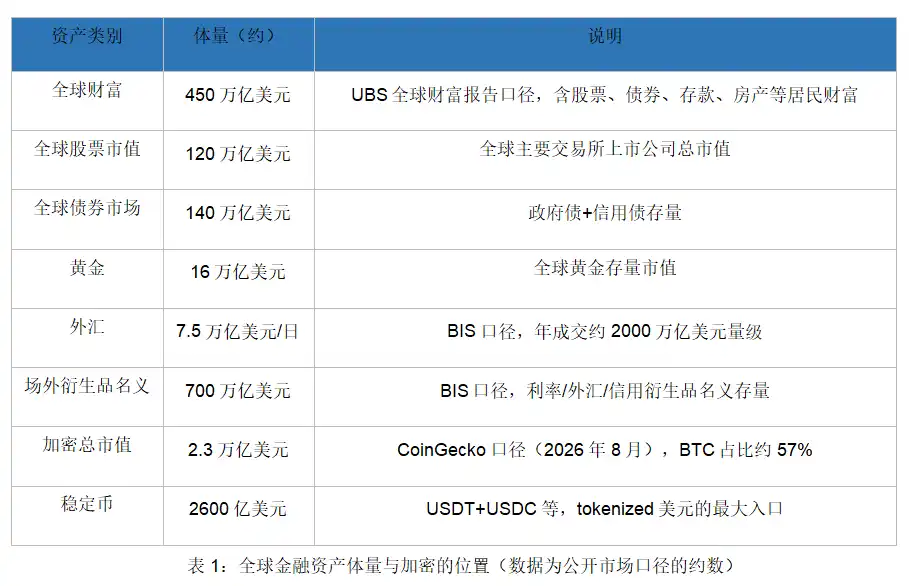
Putting these two numbers together, the conclusion is very intuitive: the total crypto market value is about $2.3 trillion, accounting for only 0.5% of global wealth and 1.9% of global stock market value. In other words, as long as 1% of global wealth enters the crypto ecosystem in any form, the corresponding incremental value is $4.5 trillion — close to twice the current total crypto market value. This is not a fantasy: institutional predictions of asset tokenization fall within this range — Citigroup estimates the tokenized securities market size to be around $4-5 trillion by 2030, 21.co estimates around $10 trillion, and BCG estimates that tokenized assets could reach $16 trillion. Even if only the lower end of the predictions materializes, it would still be a massive injection into the crypto industry.
And what Huobi HTX is doing is building the pathway for "how this 1% enters, and where it goes after entering" right to its doorstep. This is what the next section is going to talk about.
III. The Channel Has Been Built: The Explosion of the TradFi Sector is not a Concept, but Turnover in Progress
No matter how beautiful the narrative, there must be data to support it. The TradFi (Traditional Finance) sector of Huobi HTX, however, is the most competitive business unit in 2026. According to the Huobi HTX July official monthly report, the TradFi zone added 56 new contract varieties in the month, with 51 of them being stock contracts covering tech giants, AI chips, storage, commodities, and precious metals; the end-of-month average daily trading volume hit a historic high, increasing more than 10 times compared to June on a daily basis, with a cumulative volume of about $2.5 billion. It is worth noting that this was achieved during a month when the overall cryptocurrency spot market was sluggish, and industry trading volumes were generally shrinking — traditional financial assets are becoming the new growth engine for the platform.
More importantly, customer acquisition and retention are key. On August 5, Huobi HTX launched the second phase of the TradFi "Trade to Earn" event: selecting 28 highly liquid perpetual contracts covering stocks (NVDA, AAPL, GOOGL, MSFT, TSLA, etc.), stock indices (SPX500, QQQ), commodities (WTI crude oil, Brent crude oil), and precious metals (XAU, XAG, PAXG, XAUT). Users placing limit orders can receive a 110% fee rebate, while market orders receive a 105% rebate—this is what is known as "negative fee trading": the more you trade, the more you earn. The first phase of the event generated over $63 million in trading volume on designated trading pairs within 10 days; the second phase saw the prize pool directly expand to $80,000.
Pay attention to the most important part of this design: during the event, all fee income generated by users on all designated TradFi contracts will be used to buy back $HTX from the market, and the repurchased tokens will be included in the quarterly burn mechanism for unified destruction. In other words, every fee generated from trading US stock contracts or trading gold contracts by users will become buy pressure for $HTX and contribute to the token burning. The trading volume of global assets is, for the first time, directly converted into value capture for $HTX in an institutionalized manner.
Looking ahead on this path: stock perpetuals have already been implemented, indices, commodities, and precious metals are all in place, and the next logical step is forex, Pre-IPO shares, and RWAs. When global core assets can all be traded 24/7 with stablecoin collateral, without the need for brokerage accounts, waiting for market opening, or cross-border forex, traditional funds entering the Crypto world will no longer need the "buy BTC first" ritual—they will directly bring their USD stablecoins to trade their familiar assets on chain infrastructure. And Huobi HTX is becoming the gateway itself.
IV. Compliance and Traditional Funds: The Admission Ticket They Want, Huobi HTX Is Checking Them Off, One by One
Traditional financial funds have a characteristic that native crypto funds do not: they are not short of money, what they lack is a compliant entry point. Whether an institutional fund can enter depends on three things—whether there are tradable assets, whether there is a compliant license, and whether there is a trusted custody and reserve proof. In the first half of 2026, Huobi HTX has provided answers to all three.
On the asset side, it is the aforementioned TradFi sector; on the trust side, Huobi HTX has publicly disclosed Merkle tree reserve proof (PoR) for 46 consecutive months, with major asset reserves such as BTC, ETH, TRX, USDs, $HTX, XRP, DOGE, SOL, etc., consistently above 100%, strictly maintaining a 1:1 reserve. This is one of the earliest and longest-standing practices of reserve disclosure in the industry—a more convincing argument for institutions than any marketing campaign. On the compliance side, in the first half of the year, Huobi HTX progressed its VASP license application after obtaining a no-objection letter from the Pakistan Virtual Asset Regulator PVARA, and continues to align with the Dubai VARA regulatory framework. Dubai, Central Asia, South Asia—the pieces of the global licensing puzzle are being filled in one by one.
Putting these three things together, you will find a complete layout: the assets needed by traditional finance (TradFi sector), the channels needed (global licensed network), and the trust needed (46-month PoR) are all in place with Huobi HTX. The platform's total trading volume in the first half of the year approached $900 billion, reaching the top of the global centralized exchange net inflows ranking in April and experiencing a 15% monthly growth in registered users in July—funds are voting with their feet. Huobi HTX's market share is already the best endorsement: CoinDesk's April 2026 Exchange Review Report shows that Huobi HTX's spot market share has reached 3.79% (top four in CEX in Mandarin), derivative share at 1.98%, with a monthly spot market share increase of 0.88 percentage points, ranking third globally in growth rate. With increasing share and leading growth rate, this is the starting point for the next deduction.
Five, Value Capture Loop: The Larger Global Asset Trading Volume, the Scarcer $HTX
The previous section discussed the value of the "gate," now it's about demonstrating the value of the holders—the flow of global assets, how does it end up in the hands of $HTX holders? The answer lies in a two-and-a-half-year-old, repeatedly validated loop: 50% of platform revenue is used for quarterly buyback and burn.
Look at the data: in the first quarter of 2026, despite a significant 27% decrease in crypto market trading volume compared to the previous quarter, HTX DAO still completed the burning of 108.3 trillion $HTX, worth about $19.22 million; since the start of the burn in 2024, the cumulative burn and donations have reached 1,103.2 trillion tokens, accounting for over 11% of total supply, with an average annual deflation rate of about 5.5%. Note the significance of this 5.5%: among mainstream governance tokens, this is one of the very few tokens that have achieved a "transparent, large-scale, long-term publicly executed" burn strategy, with the annual deflation rate significantly ahead of the vast majority of mainstream crypto assets. Even in a bear market, the burn will only be more intense during a bull market.
The demand side is also tightening. Since April 1st, $HTX has become the only fee deduction token on the Huobi HTX exchange, deeply integrated into the core trading scene; the $HTX staking feature launched by HTX DAO offers up to 10% annualized return and overlays governance rights; all rewards for the two TradFi Trade to Earn phases are paid out in $HTX. On one hand, there is continuous burning driven by revenue (supply contraction), on the other hand, there is demand expansion through the threefold scenario of deduction, staking, and rewards—both ends of the supply and demand are tightening simultaneously, which is the source of $HTX scarcity.
Now let's string the entire loop together: global assets (stocks, gold, forex, Pre-IPO, RWA) go online in the TradFi sector → global compliant funds enter the trading scene → platform fee income grows → 50% of income used for buyback and burn of $HTX → circulating supply continues to shrink → holder equity grows. In this loop, $HTX is essentially a "bullish option" on global asset trading volume. Next, let's use numbers to calculate the exercise space of this option.
VI. Five-Year Projection: How Much Global Funds Coming In, and What Could Be the Market Cap of $HTX
This section is the culmination of the entire text. We break down the projection into four steps: Step One defines the denominator (global wealth entering crypto penetration), Step Two defines the share (Huobi HTX's share of the global crypto trading volume), Step Three defines the revenue (volume × fee rate), and Step Four defines the valuation (revenue × valuation multiple). Each step provides conservative, neutral, and optimistic scenarios, trying to lay out the assumptions for readers to cross-verify.
Step One, Penetration Rate. The current total crypto market cap is about $2.3 trillion, accounting for 0.5% of global wealth (approximately $450 trillion). By 2030, if the penetration rate increases to 1% / 2% / 3%, the corresponding total crypto market cap would be around $4.5 / 9 / 13.5 trillion—this aligns closely with Citigroup, 21.co, BCG's range of tokenized asset predictions ($4-16 trillion), falling within the "neutral value in the institutional forecast range," rather than an aggressive assumption.
Step Two, Market Share. Huobi HTX's current spot share is 3.79%, derivative share is 1.98%, with a composite share of approximately 2.5%-3%. Considering two bonus points—Huobi HTX is one of the few exchanges in the industry that has turned the "global asset channel" into a product matrix (leading in the TradFi sector), and its share's monthly growth rate ranks third globally—by 2030, the composite share will increase to 4% / 5.5% / 8% in three tiers.
Step Three, Trading Volume and Revenue. The crypto market's annual turnover rate (spot + derivatives combined) is currently around 20 times. As the market capitalization grows and institutional participation increases, the turnover rate usually decreases. We calculate based on 20 / 16 / 12 times in succession; Huobi HTX's annual trading volume = total crypto market cap × turnover rate × share. The comprehensive fee rate is calculated at 0.05% / 0.06% / 0.07% (negative fee marketing activities have phased dilution, but the overall fee structure of TradFi and derivatives is stable). Step Four, Valuation. Referring to the valuation center of comparable exchange assets, P/S is calculated at 3 / 5 / 8 times—where the conservative tier is close to traditional broker valuations, and the optimistic tier includes a revaluation premium of the "Equity Token + Global Asset Channel" narrative.
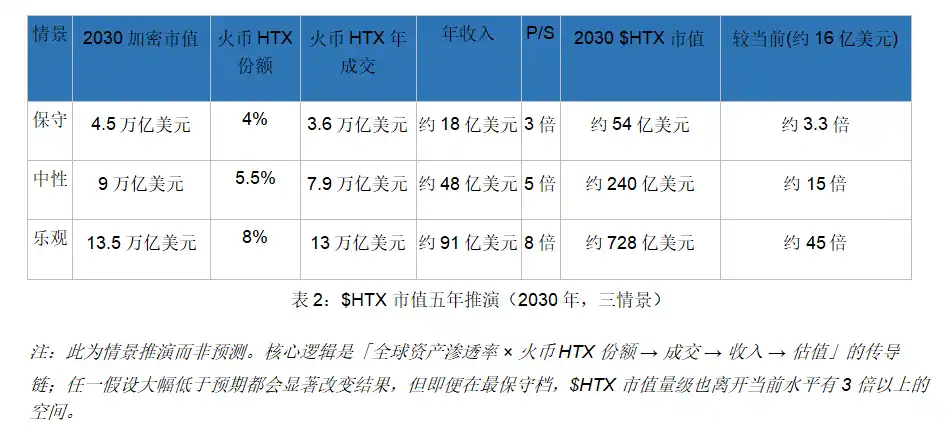
This projection may seem like large numbers, but each link is within the range supported by current data. For cross-validation: the implicit Huobi HTX annual trading volume in the neutral tier in 2030 is around $7.9 trillion, with the TradFi sector accounting for about 30%, approximately $2.4 trillion—while the annual trading volume of the global stock market is in the range of $150-200 trillion, and the forex turnover is around $2000 trillion. Even if Huobi HTX's TradFi sector achieves $2.4 trillion, it would only account for about 1.5% of the global stock market trading volume. In other words, the global asset inflow needed for $HTX to reach a billion-dollar market cap is merely a ripple in the ocean of global finance; the real scarcity is not funds, but channels—and this is exactly what Huobi HTX is building.
Furthermore, overlay the validation of the supply-side deflation effect: At the current 5.5% annual deflation rate, in five years, the circulating supply of $HTX will shrink by about 25%; if TradFi transaction fees are fully used for buyback and burn in a continuous issuance, doubling the burn base compared to now, the annual deflation rate could rise to 8%-10%, with a five-year circulation contraction of 35%-40%. As per the deduction from Table 2 on the demand side, applying a further discount of 30%-40% on the supply side, under a neutral scenario, the valuation of $HTX will only land higher than in Table 2, not lower.
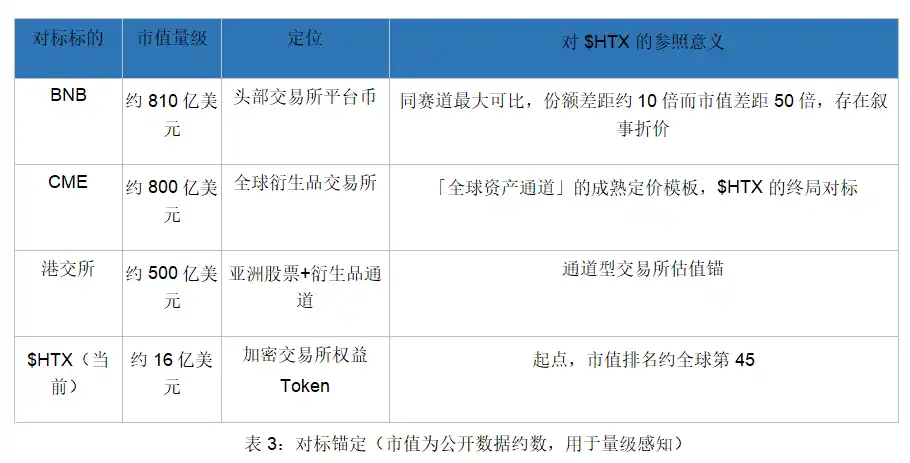
Lastly, let's use two benchmark anchoring perceptions. In the same category: BNB has a market cap of around $81 billion, which is 50 times that of $HTX (around $1.6 billion), while the difference in their spot share is only about 10 times (Binance around 40% to HTX's 3.79%) — part of this gap is the ecological premium, and another part is the discount of the "narrative yet to be reassessed." In terms of channels: CME (a global derivatives exchange) has a market cap in the range of $80 billion, and HKEX around $50 billion — they are the pricing anchors of the "global asset channel in the traditional world"; what $HTX aims to become is the "CME of the crypto world." Moving from $1.6 billion to the magnitude of any of these anchors represents the ultimate imaginative space for equity token narratives.
Seven, Why Now: Narrative Reassessment in a Bull Market is the Ultimate Alpha
Every bull market has two types of price surges: one is Beta, where the tide lifts all boats, BTC doubles, and most altcoins follow suit, only to fall back down later; the other is Alpha, stemming from a narrative reassessment — the market reevaluates an asset with a new framework, shifting the overall valuation center upwards, making it difficult to fall back.
The reason BNB's price trend in 2021 diverged was that the market reassessed it from being a "fee deduction coupon" to a "token of ecological equity"; today's $HTX is standing at a grander reassessment starting point: from a "cooperation token of a crypto exchange" to a "token of equity for global assets entering the Crypto world." The former's ceiling is the crypto trading volume, while the latter's ceiling is the global financial market. All the elements catalyzing this reassessment — the explosion of the TradFi sector, the negative fee rate mechanism drainage, compliance license landing, 11% cumulative burn, unique status as a transaction fee token, and global third-ranking share growth speed — are already in place as of the summer of 2026.
The bull is back. Funds will chase assets in each round of the uptrend, but what's truly scarce is the person who sees the river change course before the tide rises. The global financial asset ocean is opening its gates to the Crypto world, and Huobi HTX has already laid the channel to the gate, with $HTX being the equity of that channel itself. As global stocks, gold, forex, Pre-IPOs, and RWAs pass through the gate of the Crypto world, $HTX is the stake of the gate itself. This is the comprehensive reason to be bullish on $HTX.
Disclaimer: This article represents the views of HTX Research and does not constitute any investment advice. The quantitative analysis in the article is based on a series of explicit assumptions (penetration rate, market share, turnover rate, fee rate, valuation multiple). Any significant deviation from these assumptions will result in a significant change in the outcome. Cryptographic assets exhibit high price volatility compared to traditional financial derivatives, regulatory policies are uncertain, and the sustainability of TradFi sector trading volume remains to be further validated. Readers are advised to fully assess their own risk tolerance, take a rational view of the market, and make independent decisions.
About HTX Research
HTX Research is the dedicated research department under Huobi HTX, responsible for in-depth analysis of a wide range of areas including cryptocurrency, blockchain technology, and emerging market trends. It produces comprehensive reports and provides professional evaluations. HTX Research is committed to providing data-driven insights and strategic foresight, playing a key role in shaping industry perspectives and supporting sound decision-making in the digital asset space. With a rigorous research methodology and cutting-edge data analysis, HTX Research always stands at the forefront of innovation, leading the development of industry thought and facilitating a deep understanding of the constantly evolving market dynamics. Visit us.
If you wish to get in touch, please contact research@htx-inc.com
Welcome to join the official BlockBeats community:
Telegram Subscription Group: https://t.me/theblockbeats
Telegram Discussion Group: https://t.me/BlockBeats_App
Official Twitter Account: https://twitter.com/BlockBeatsAsia
