The SEC's "innovation exemption" has ignited market expectations for a new round of regulatory dividends, and DeFi tokens are taking off.
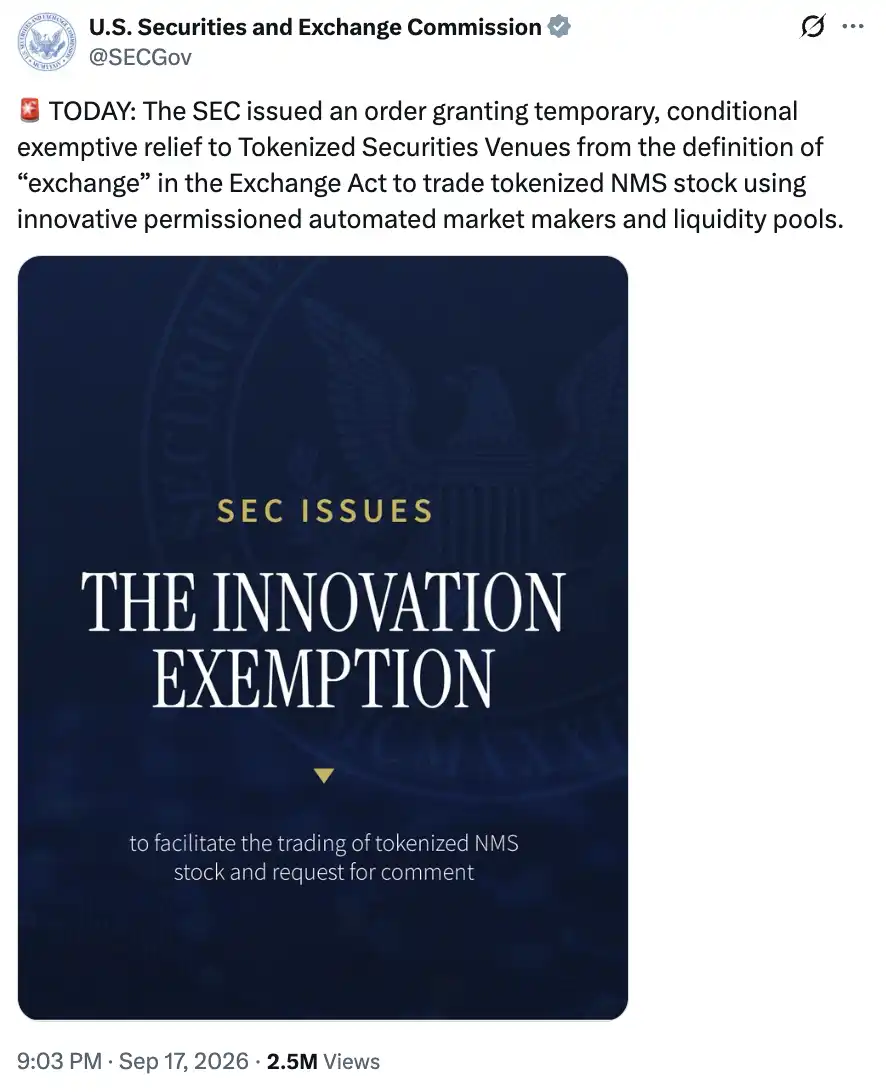
On September 17, the SEC issued an announcement allowing eligible tokenized securities trading venues to trade specific stocks through AMM liquidity pools, granting them a temporary, conditional exemption from the exchange definition; some institutions providing stock token liquidity may also receive an exemption from the dealer definition. The exemption period is five years after the announcement's publication.
But the market easily misinterprets "the U.S. allowing experimentation with a new on-chain stock market" as "all current on-chain stock projects can now enter the U.S."
However, the gap between the two is actually still wide.
Robinhood's stock tokens, Ondo and xStocks' stock-linked products, and stock perpetual contracts on Hyperliquid are precisely excluded from the exemption. The businesses that the crypto market has already been doing enthusiastically and what the SEC is willing to greenlight this time are fundamentally different.
Stock price on-chain vs equity on-chain
"Stock tokenization" is a name that easily leads to misunderstanding.
On the trading interface, a token bears the name of a listed company, its price moves with U.S. stocks, and it may even claim to be backed by sufficient stock reserves. Traders naturally interpret it as "U.S. stocks in their wallet." But holding such a token does not necessarily mean the holder has the same legal rights as a company shareholder.
For example, a contract can stipulate settling returns to investors based on the price of a certain stock. If the stock rises, the contract value rises accordingly; if the stock falls, investors bear the loss. The issuer can also hold real stocks to support its redemption obligations. The entire process is merely a contractual relationship between the investor and the product issuer, with no connection whatsoever to the company itself. These are "synthetics," which replicate the economic exposure of stocks, and what holders obtain are rights stipulated by the specific product.
The SEC's order explicitly excludes the model where third parties issue their own securities to provide synthetic exposure to underlying securities, including stock-linked securities and security-based swaps. Stock tokens that qualify for the exemption must provide the same rights as traditional stocks of the same type.
When a company holds a shareholders' meeting, the relevant rights should be able to pass through to token holders; when a company pays dividends, holders should enjoy the corresponding rights.
Comparing with current mainstream stock token products, the difference becomes very clear.
Robinhood's related stock tokens adopt a debt securities structure; Ondo and xStocks' related products only provide exposure to stock prices, and investors are not shareholders of the underlying companies.
Trading Still Has Barriers
So, is the excitement around DeFi entirely unfounded? Not exactly.
The exemption's recognition of the technological approach is quite clear. The SEC requires that the relevant smart contracts be public, auditable, and deployed on public, permissionless distributed ledgers. Carlos Domingo of Securitize is particularly optimistic about this: public chains like Ethereum, Solana, and Avalanche have the opportunity to host compliant tokenized securities trading venues.
This means securities trading can use the infrastructure that the crypto industry has already developed. AMMs complete trades through algorithms and liquidity pools, where liquidity providers inject assets into the pool, and traders exchange assets with the pool. Applying this mechanism to stocks is a commendable part of this innovation exemption.
But "permissionless" only modifies the underlying public chain.
Traders and liquidity providers entering these stock pools still need to obtain permission. Venues must set access standards (such as setting up KYC through Uniswap V4's Hook for access) and fulfill corresponding compliance obligations. The user experience of any wallet connecting at any time and anyone adding liquidity at any time has not been granted approval.
The exemption also retains restrictions on the number of securities, trading volume, and suspension linkage. If the underlying stock is suspended on its primary listing exchange, the corresponding on-chain stock trading must also be paused. So-called 24/7 trading does not mean escaping the constraints of the underlying securities market.
Wintermute's CEO Evgeny Gaevoy gave a very apt assessment of this: getting the exemption is a good thing, but those cheering may not realize that it likely does not apply to (almost) all existing products. This is still just the first step.
AMC Has the Right to Say No
This "innovation exemption" has settled a recent dispute.
Adam Aron, CEO of the publicly listed company AMC, had demanded that Robinhood stop offering tokens linked to AMC stock and threatened to report it to the SEC. He was concerned that investors would confuse the rights they were buying, and he opposed the emergence of a synthetic stock market using the AMC name without the company's involvement.
Robinhood CEO Vlad Tenev believes the company should control the rights attached to shares, but should not have a general veto over independent financial products tied to publicly traded stocks. He stressed that the AMC token on the Robinhood chain does not add holders to the company's shareholder register, nor does it change the rights of the underlying shares.
What the two sides are really arguing about is the relationship between synthetics and real equity. Vlad defends the product's legal structure as independent from the underlying stock, and that very independence is precisely what prevents the current product from directly qualifying for this stock-token exemption.
The SEC explicitly states in the document: "A trading venue must notify the underlying stock issuer in advance and wait at least 30 days from the date the issuer receives the notice; if the issuer objects in writing within the prescribed period, the venue cannot rely on this exemption to conduct the corresponding transactions."
Under this innovation exemption framework, AMC's CEO is right: they have the right to block the circulation of their own tokenized stock (with shareholder rights) through a "written objection."
Limited Goodwill, Real Opportunity
The value of this document lies in giving on-chain stock trading in the United States a market form that can be concretely discussed and concretely built.
Tokenized stocks that fully preserve shareholder rights can try to enter AMMs on public chains; relevant companies can redesign products around assets, custody, access, and trading. There is also a clearer direction for cooperation between technology companies and securities service institutions.
But for existing crypto projects, there is still a long way to go. The past approach of quickly replicating stock price exposure through synthetics bypassed a lot of the work of connecting with issuers one by one and handling shareholder rights; to enter the market covered by this exemption, they will need to confront these issues again.
The SEC has taken a step forward. But the revolution is far from successful.
Welcome to join the official BlockBeats community:
Telegram Subscription Group: https://t.me/theblockbeats
Telegram Discussion Group: https://t.me/BlockBeats_App
Official Twitter Account: https://twitter.com/BlockBeatsAsia
