Did you hear that? Those AI bigwigs suddenly grew a conscience and started worrying about humanity's survival—because the near-silicon-god product they've been building is about to be born. It's actually been close to silicon-god status for a while now, but with the final kick just around the corner, they've suddenly started reflecting on the path of artificial general intelligence (AGI) development. (Note: Silicon-God, the super AGI that Silicon Valley claims is imminent; the author uses this term sarcastically, questioning whether this grand narrative is just a fundraising and lobbying tactic.)
That's the narrative they're telling the public. But being the suspicious type, I checked the calendar—it's almost the end of Q3, and Anthropic still hasn't gone public. I can't help but wonder what their financials actually look like. Has the high-growth annualized revenue curve repeatedly mentioned in press releases already slowed down? They claim that after excluding all operating costs, the company is profitable. I can't wait to dig into the S-1 prospectus they're about to file, to figure out exactly how much it costs to serve each Token to users. And how many customers are actually profitable for them—is that profitable customer base expanding or shrinking? Unfortunately, I can't get answers to any of these questions, and the reason is—Safety First.
Readers can tell from my tone that I believe Anthropic, OpenAI, and SpaceX claiming to slow down AGI development on "Safety First" grounds is not out of concern for ordinary human welfare, but rather stems from brutal economic reality: the market is unwilling to buy the AI products they're selling at current prices in sufficient quantities. To put it more specifically, market demand for AI is robust, but what everyone wants is Chinese pricing—at just one percent of the American price.
When this "Chinese pricing" hit the self-important American AI practitioners, their first reaction was to shout: "But those Chinese products are low quality." And when Chinese models' quality rapidly caught up, they cried: "China only built their products by distilling our models." The market doesn't care why Chinese models are cheap—the market just wants the cheapest intelligence services. So these AI practitioners turned to lamenting: "We care about human safety, so we're pausing development." Sounds so noble... But this exaggerated "injury acting" worthy of a World Cup match will later come with demands: "But we still need to beat China, so the government should step in, introduce regulations, and continue funding this AGI race."
These three leading U.S. AI labs use "safety first" as a pretext to slow down AGI research and development. The reason this matters so much to financial markets and global fiat liquidity is that these labs' demand for compute underpins over $1 trillion in investment-grade debt, plus hundreds of billions in lower-rated loans.
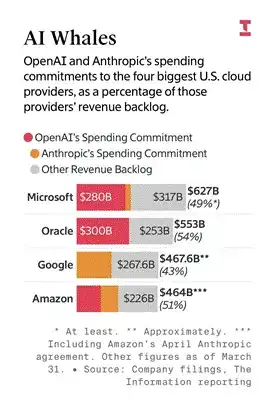
These AI labs collectively generate no profit whatsoever. As a result, they need profitable tech companies like Nvidia, Broadcom, Google, and Microsoft as backers to provide off-balance-sheet guarantees for data center leases and chip procurement debt. Follow-on purchases of chips and hardware depend on AI labs continuing to train the most cutting-edge model — the one that is "almost, almost, almost about to become a silicon-based deity" — while also processing inference requests for customers. But if "safety first" becomes the new core principle, spending on training new models won't go to zero, but it will certainly retreat from current highs; companies will focus on improving the efficiency of converting electricity into intelligence, which means customers will spend less on compute. In essence, safety first means destroying compute demand.
If AI capital expenditure were financed by operating cash flow, there'd be nothing to worry about. But the problem is, whether AI labs keep buying compute or not, these trillions of dollars in debt still exist. Default won't happen immediately, but once AI labs stop consuming compute at previously expected levels, the price of this debt will fall. The real core question: who bought this debt, and did they use leverage when buying it? The answer is obviously that these speculators used leverage to buy this junk debt. So who ultimately ends up holding the bag?
Millions of American insurance policyholders are effectively indirectly betting on the AI story. And "safety first" will hurt them with no buffer. I didn't fully understand this scheme at first — it was Nick Nameth on Substack who explained it very thoroughly. Next, I'll write it in simple language for my crypto audience. The conclusion is: if AI-related debt is repriced at fair market value, a large portion of the U.S. insurance industry is actually already insolvent. This leads to the core investment thesis in a global economy dominated by fractional-reserve banking: The U.S. government faces a binary choice — either act as the buyer of last resort for compute in the name of national security, or print money to bail out deeply loss-making insurance companies.
No matter which path is chosen, we Bitcoin holders and crypto investors are all winners. If the government ignores market signals and insists on investing funds to develop this commercially unprofitable "silicon-based deity," it will need to print money to finance such non-productive spending, which will inevitably breed more financial speculation and drive up the price of Bitcoin. If the government chooses to bail out the insurance industry, it will print money to absorb bad AI debt, expand the money supply, and consequently drive up the price of Bitcoin.
The rest of this article will break down this mechanism.
In the Name of China
As long as it is branded with national security, the U.S. government can find a justification for almost any action. Think about how much destruction was caused after 9/11, when the United States hyped up threats to the public and launched a global war on terror. This time, the imagined enemy being constructed is the Chinese, who bury themselves in mathematics, steal America's top technology, and then sell products back to the United States at one-hundredth of the price. To defeat China, it is necessary to promote state socialism within the capitalist system.
AI tycoons successfully persuaded Trump and his staff to ignore two realities: the market has already proven that the AI business is not profitable, and bipartisan voters oppose the construction of large numbers of new data centers and demand compensation for data theft. Since China can provide affordable AI products, America's response is to invest even more money to build that "almost, almost, almost, almost about to be born silicon-based deity." (I will keep adding "almost," because we are only belief, data theft, and taxpayer funding away from AGI.)
War, the economy, robots, and everything else are ultimately constrained by artificial general intelligence. Therefore, the rest of the world must use AGI according to America's wishes. According to this narrative, the United States has the world's most inclusive and fair culture, and this silicon-based deity must never be allowed to fall into the hands of a country from a non-Judeo-Christian civilization, such as China. (Roll eyes, then roll eyes again, and roll them hard.) I have my own preferred place to live, and others have theirs. Even if I believe the moral culture I identify with is superior to that of other countries, I am unwilling to spend all my wealth and even my life to impose those values on the whole world. You can believe that American or Western culture is superior, but do not hand trillions of dollars of taxpayer money to Elon, Sam, and Dario. (The heads of three leading American frontier AI companies: xAI, OpenAI, and Anthropic.)
The alleged superiority of the American system is that, most of the time, hundreds of millions of informed citizens determine the prices of goods and services through the free market, with the government not interfering, allowing market signals to determine what to produce and how much to produce. But now, because of national security, based on an assumption — that by investing enormous amounts of money and feeding data to predict the next token, AGI can be created — the signal given by the market is judged to be wrong. Therefore, the U.S. government must increase investment to build the next generation of frontier models and use cultural superiority to suppress China. This is hubris. Remember what happened to Icarus when he flew too close to the sun?
Alright, enough grandstanding—let's talk about the bailout plan.
"Safety first" means the compute demand from the three major U.S. AI labs is declining. At this point, the government can step in and sign offtake agreements to guarantee stable profits for the AI labs, just like the contracts the U.S. gives to certain defense and mining companies. The government will use this compute to advance AGI research. Finally, the government can lease its own models back to the AI labs, which will sell inference services to domestic and allied customers at extremely high prices.
This plan would let the government control frontier models for the Western world to use as it sees fit. The private AI lab model has a problem: these labs are global enterprises, and sometimes they sell model access to anyone in the world for profit, which conflicts with the government's national security objectives. If Chinese labs are partly relying on distilling U.S. frontier models to make technological progress, direct government control of R&D could set China back months or even years in the AGI race. Even if this idea holds, it will ultimately fail, just as the attempt to block advanced chipmaking equipment failed to stop China from producing cutting-edge chips. Information inherently wants to flow freely. In the internet age, information blockades are simply impossible. Even before the internet existed, after the U.S. successfully developed the atomic bomb, it still could not prevent the Soviet Union from obtaining relevant intelligence. Those who believe AGI can be an exception do not understand human ingenuity and adaptability in the game of interests at the national level.
Funding this silicon god requires issuing more debt. This plan is easy to sell because the key monetary policymakers—Treasury Secretary Bessent and Fed Chair Warsh—both believe AI can boost productivity. They are convinced that by fully embracing AI, the U.S. can grow its way out of its massive debt burden, and that judgment is not entirely wrong. In June 2026, U.S. nominal year-over-year GDP growth was 6.6%, while the effective federal funds rate was about 3.6%. Bessent keeps issuing short-term Treasury bills, and the government can earn a 3% return on this debt issuance, but savers will bear the losses. If the fiscal deficit is kept within 3% (a very big if), the debt-to-GDP ratio will decline. Economic growth is mainly driven by AI data center construction, and what supports all of this is the compute demand from AI labs. So from a financing perspective, if issuing short-term Treasuries can still yield 3%, it is financially feasible for the government to act as the ultimate buyer of compute.
There is no free lunch. The U.S. government runs deficits year after year and can only spend by borrowing. If Warsh cooperates, this is easy to do. But so far, the Fed under his leadership and the Treasury under Bessent have not been in step.
Since July 2023, U.S. monetary policy has raised rates for the first time: at last week's policy meeting, the Fed unanimously approved a 0.25% increase in the policy rate. The total amount of money the Fed creates is no longer growing, and as of August 14, the RMP short-term Treasury purchase program has stopped.
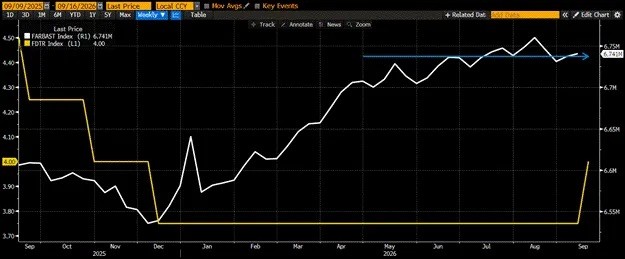
If the government pushes this plan, but the Fed doesn't lower the cost of funds or expand its balance sheet, massive debt issuance will drive up interest rates. Rising interest on mortgages, credit cards, and auto loans will only fuel voter anger over AI-related policies. If Trump and Bessent can't secure the support of at least 7 FOMC members, the feasibility of this plan will be greatly diminished.
What I just described is Fed policy from a traditional perspective, which easily makes people bearish on the market. But don't forget, there's another powerful money-printing machine: commercial banks. Both Warsh and Bessent argue that the banking sector should take on the burden of money creation. Since RMP purchases stopped on August 14, banks have created hundreds of billions of dollars in new money by expanding total assets, backed by a relaxation of liquidity regulatory constraints.
Beyond balance sheet expansion, after this 0.25% rate hike, banks' excess reserves held at the Fed will earn an additional $7.5 billion in interest annually. This capital will be used for new loans and financial market speculation. Therefore, one cannot look only at the Fed raising rates and stopping balance sheet expansion, but must also consider the impact of the commercial banking system. Combined, the overall effect is still stimulative. In other words, if the government is willing, the liquidity environment is sufficient to support new debt issuance for investment in AI computing power construction.
But if the government doesn't take over the procurement of computing power, the debt will be impaired. Those holding such debt with leverage will fall into crisis. Below, let's dive deep into the captive insurance scam.
Captive Insurance
I had never studied the insurance industry before. Large private equity firms using captive insurance company assets to raise funds for investments didn't initially seem like a scam to me. But after digging deep into how this mechanism operates, I found the ultimate victims.
Every credit bubble has a group of ultimate bag holders. Usually, it's ordinary retail investors' money managed by trustees with impressive credentials. Trustees invest other people's money and earn double returns: collecting management fees, and selling their own assets to retail investors to inflate the prices of their own holdings. This time, the victims are policyholders who purchased American life insurance and annuity products. To understand this scam, we first need to understand the life-extending tactics that private equity titans devised after the golden age of private equity came to an end.
After the 2008 global financial crisis, the private sector deleveraged, and the Fed pushed interest rates to near zero. The classic private equity playbook: find mature companies with stable cash flows and almost no debt, load them up with leverage, then cash out through dividends, and finally leave the broken companies in the private market. When the public market heats up, relist this rotten company and complete another cycle. In the low interest rate era, this logic held up perfectly. Ordinary people, burdened with underwater mortgages and struggling to make monthly payments, had no capacity to increase consumption. Private equity titans didn't want to expand production or offer better products; they only wanted to maintain existing cash flows, cut costs, and extract cash dividends for their own investors.
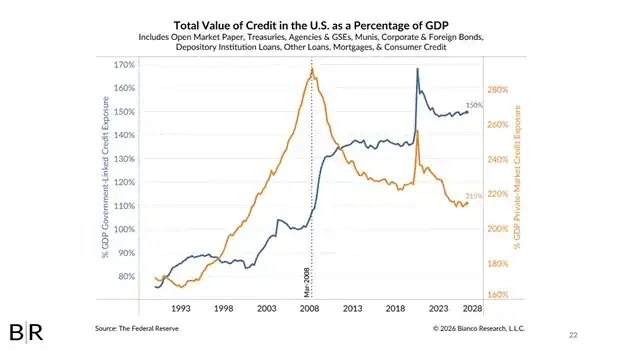
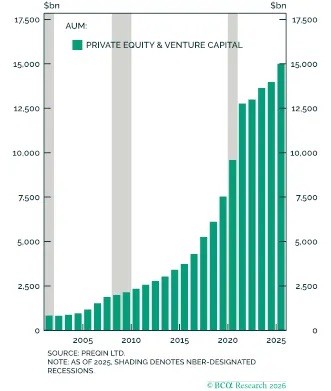
In the post-pandemic era, rising capital costs and the law of diminishing marginal returns have dealt a heavy blow to private fund returns. Because financing was cheap, securing a deal required offering higher valuations to acquire cash-flow assets. Private fund returns subsequently declined. To complete the next round of fundraising, private equity titans began searching for long-term capital pools that would not worry about short-term redemptions — and insurance companies stepped onto the stage. Insurance companies sell life insurance and annuity policies, policyholders pay premiums, and the insurers invest that capital to generate returns, paying out on policies decades later. This is exactly the perpetual capital pool that private equity has dreamed of, one that can be poured into private funds stuffed with overvalued private companies and high-yield private credit.
So private equity titans acquired insurance companies, installed themselves as investment managers, and packaged劣质 assets to sell to unwitting policyholders. This is Captive Insurance.
The most outrageous part of this arrangement is how captive insurers satisfy legally required capital buffers. Asset prices fluctuate, and regulators require insurance companies to set aside capital buffers to guarantee policy payouts. The insurance industry thus gave rise to reinsurance institutions that assume the payout risk of primary insurers. Under normal circumstances, the primary insurer and the reinsurer are two mutually independent institutions, and reinsurance prices risk at fair market value. But this set of rules does not work for the private equity insurance scam, the core of which is finding a counterparty to take on the risk, while private equity itself does not need to commit substantial own capital. So private equity-controlled insurance companies set up affiliated captive reinsurance entities. The parent company only needs to commit minimal own capital to obtain reinsurance coverage.
These are all regulated entities that are required to make regular public disclosures. If policyholders knew that insurance companies were operating such a system, would they still buy policies? To conceal the scam, the U.S. capital system has sided with private equity. Regulations in some states, such as Vermont, run counter to national prudential regulatory standards. Primary insurers and affiliated reinsurers can privately establish reinsurance risk assets, capital buffer sizes can be set arbitrarily, and after approval by state regulators, the relevant materials are sealed and kept confidential.
There are more details. Before we continue dissecting this bold scam, let me draw an analogy using a crypto case. Do you all remember Terra Luna? Luna collapsed because USDT holders sold off the stablecoin, breaking its dollar peg. If Do Kwon had the resources of those nearly seventy-year-old New York private equity tycoons, how would it have ended?
When the price of USDT fell, Luna acquired an insurance company called Alameda Insurance. Luna used premium funds to buy USDT, trying to stabilize the peg. Alameda sold life insurance to Californians and held billions of dollars. Alameda could not directly buy altcoin stablecoins, but it could buy investment-grade corporate bonds. Luna bribed Moody's analysts to rate its own corporate bonds as investment grade. To attract buyers like Alameda, Luna offered interest 5% higher than the 10-year U.S. Treasury yield. What a dazzling return! Alameda registered a reinsurance company in Vermont called Three Daggers. For every $100 of reinsurance assets, Alameda pledged only $1 of its own equity. Then Alameda told regulators: the $10 billion of Luna investment-grade debt it bought with policyholder premiums was safe, and if anything went wrong, Three Daggers would be responsible for paying. Everything looked fine. But USDT kept falling, and Luna's coin price collapsed. A few weeks later, Luna could not pay bond interest. Even if the Moody's analyst took a Rolex to hide the rating, it could not ignore a default event and could only downgrade the debt to junk.
A ratings downgrade would cause the entire structure to collapse. Regulated insurance companies must top up capital after a debt downgrade. But the problem was that this reinsurance asset had been fake from the start. Three Daggers simply did not have hundreds of millions of dollars in cash to transfer to the parent company to meet capital requirements. The scam was exposed, Alameda was insolvent on paper, and regulators could only clean up the mess.
Policyholders would suffer huge losses. In most U.S. states, insurance guarantee limits are only $250,000 to $300,000. If your policy was supposed to pay out millions of dollars, the difference could not be honored. Worse still, insurance guarantee funds are funded after the fact by surviving insurance companies, completely different from the bank insurance system. The FDIC (Federal Deposit Insurance Corporation) requires banks to pay premiums in advance. This after-the-fact funding mechanism indirectly encourages institutions to take extreme risks, because institutions do not need to pay for a crisis in advance.
Back to traditional finance. Replace altcoin project debt with private credit to software companies hit by AI, and with AI data center debt, and the value of this kind of debt depends entirely on the three major AI labs continuing to purchase computing power.
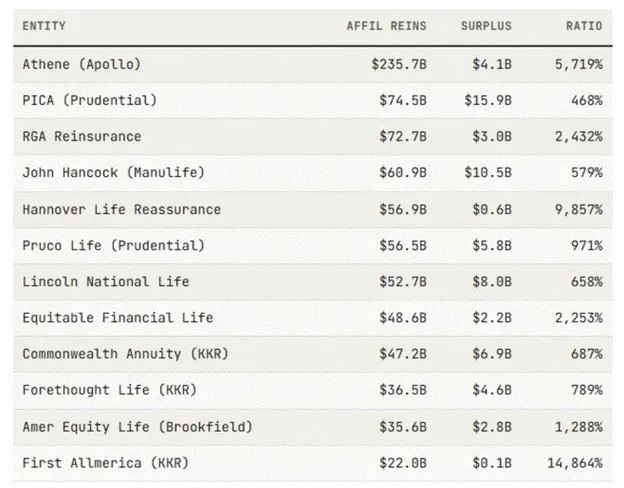
The "affiliated reinsurance" column in the table represents this fake capital buffer, which private equity giants like Apollo, KKR, and Brookfield rely on to package all their AI-related investments. The true quality of the assets on the books of captive insurance entities is unknowable, because they are deliberately registered in states and jurisdictions that allow the concealment of true financial data. But from public news reports, almost every large AI data center debt issuance has these major private equity firms behind it. At the same time, they are also the largest private credit funds, investing heavily in SaaS companies. These private credit funds have already restricted investor redemptions, because these illiquid loans cannot be quickly converted to cash at a discount.
Nick Nameth believes the scale of these fake captive reinsurance assets is as high as $1.54 trillion. We cannot determine the true amount, but he gave the example of Brookfield's reinsurance assets: carried on the books at a value of $1.48 billion, but the entity providing the reinsurance reported to regulators that its actual claims liability was 0.
The private credit and AI debt markets are beginning to show cracks under the heavy pressure of massive outstanding debt. Before the market fully realizes that private captive insurers are insolvent, we have already seen cracks emerge. The trigger is the downgrade of investment-grade debt in AI data center securitizations. Insurers originally bought the highest-rated tranches, enjoying higher yields relative to Treasuries of the same maturity. Once the leading labs cannot purchase computing power at the expected scale, the cash flow generated will be insufficient to repay the data center debt, and rating agencies will eventually downgrade the debt, triggering the parent companies to replenish capital, but the affiliated reinsurers cannot produce the cash. For those of us who profit from money printing and expansion, this multi-trillion-dollar hole on insurance company balance sheets will inevitably lead to a bailout. Baby boomer policyholders hold votes, and they will vote to push through a bailout plan. In 2008, AIG, as the final backstop institution, absorbed a large amount of low-quality secondary CDO debt, and the government stepped in with a bailout. Don't forget, after TARP (the Troubled Asset Relief Program, the core U.S. bailout tool during the subprime crisis) bailout funds filled AIG's hole, the money flowed directly to Goldman Sachs, which paid record bonuses in 2009. Ordinary people got foreclosure notices, while the elite got fat checks.
This scene will play out again. But Bessent and Warsh are not stupid, and they will not repeat the pure free-market rhetoric of those years. Paulson and Bernanke (Hank Paulson and Ben Bernanke, former Treasury Secretary and former Fed Chair) still insisted on the bottom line back then: if an investment fails, you go bankrupt. They let Lehman fail, a decision that was a mistake, letting the public see clearly how financial institutions plunder the masses. This time, Bessent and Warsh will absolutely not allow major insurance companies to go bankrupt and stage a financial disaster drama like The Big Short. They will keep printing money to avoid this reckoning. Because after 2008, populist political forces rose, and the public will not be as compliant as before. Back then, Obama, the nominal progressive Democrat, won partly on the financial crisis and rhetoric about punishing bankers, but after taking office he still approved bailouts and did not stop home foreclosures on a large scale. By 2028, AOC will not be so easy to deal with. So Warsh and Bessent must prevent a public credit disaster.
If Trump chooses not to be the ultimate purchaser of computing power, and rating agencies downgrade the debt of AI data centers, money printing will be rolled out in batches and slowly, to prevent the market from fully realizing that the insurance industry is insolvent.
History Repeats
"Safety first" will not immediately bring about large-scale money printing. This matter is left to Trump to decide, but as a Bitcoin and crypto investor, no matter which path he chooses, more monetary injection will ultimately come. This article will convince you that after the slight rise at the end of August, the volatile market conditions in the crypto market will soon end. The total supply of US dollars will continue to expand, and the prices of Bitcoin and some altcoins will rise.
As the founder of the AI/crypto project Flop Network, this macro environment is very favorable for me. The US government will not let the free market halt data center construction, the raw cost of computing power will fall, and an oversupply of spot computing power will drive the adoption of AI intelligent agents. In addition, a large amount of newly added US dollars will drive capital into crypto assets — during periods of monetary expansion, crypto assets perform most brilliantly.
Welcome to join the official BlockBeats community:
Telegram Subscription Group: https://t.me/theblockbeats
Telegram Discussion Group: https://t.me/BlockBeats_App
Official Twitter Account: https://twitter.com/BlockBeatsAsia
