Alphabet, Google's parent company, has just delivered an earnings report that shows both growth and pressure. Its cloud business set a record, with revenue doubling year-over-year, but the market reaction was lukewarm.
According to the Associated Press, Alphabet's third-quarter revenue and earnings per share both fell short of analyst expectations, and the stock dropped more than 10% in after-hours trading. This is not a simple "AI investment failure" earnings report: operating profit is still growing, but new revenue, profit, and cash are flowing into the company at different speeds.
Where does Google's growth come from?
The most eye-catching numbers in the earnings report come from the cloud business. Alphabet disclosed that Google Cloud's third-quarter revenue reached $30.7 billion, up 103% year-over-year. The company's explanation is that enterprise demand for AI infrastructure and solutions grew, and sales of its self-developed TPU systems also made a significant contribution.
If you look only at the growth rate, it is easy to underestimate its impact on the entire company. Compared with the segment revenue in the same period last year, the cloud business added about $15.6 billion, accounting for about 62% of Alphabet's total revenue increment. In other words, for every $100 of new revenue, about $62 came from the cloud business.
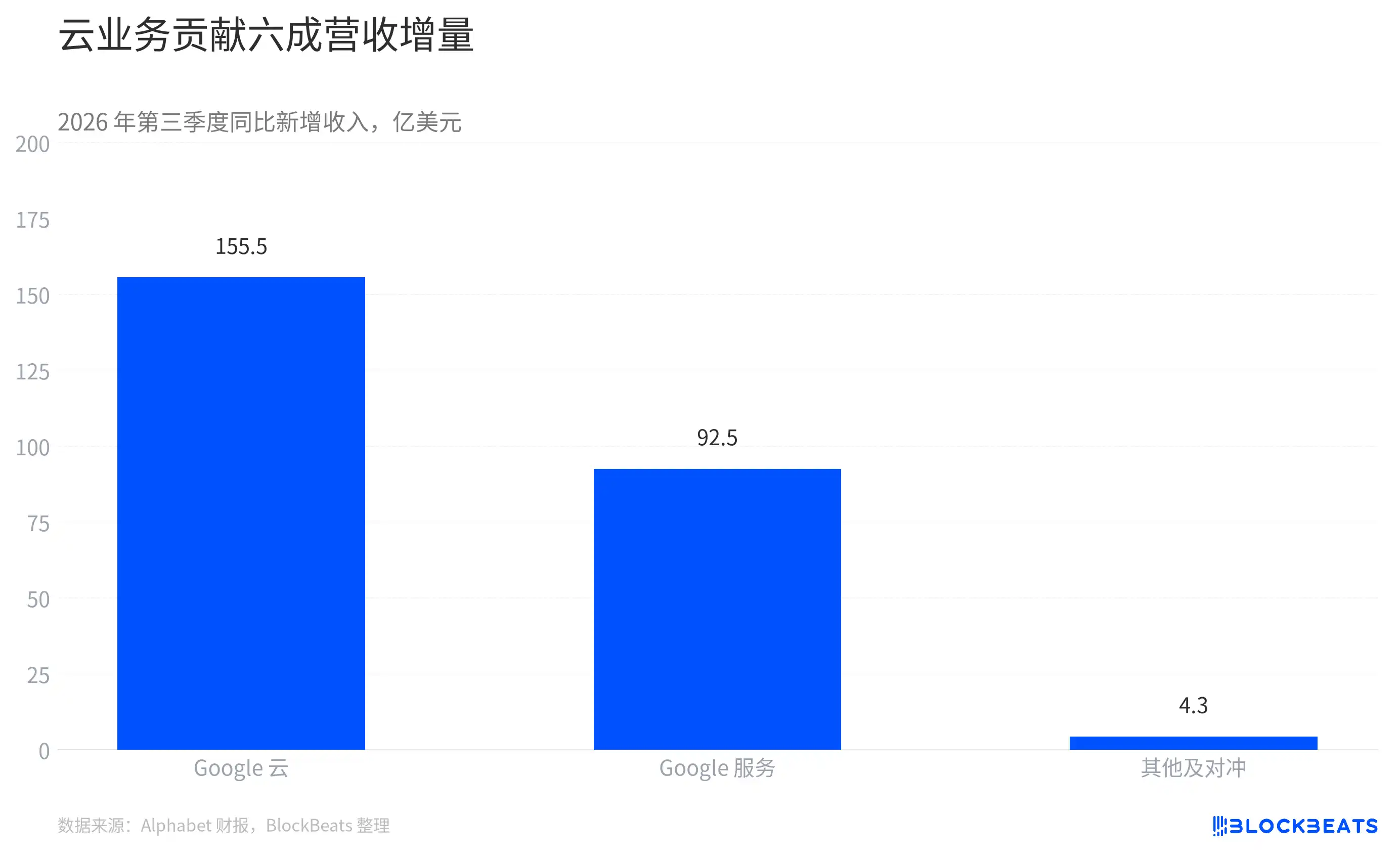
Google Services remains the larger business, including Search, YouTube ads, subscriptions, platforms, and devices. The cloud business's revenue in the quarter was only about one-third of Google Services, yet it contributed more new revenue. This is how a smaller-base business, after accelerating growth, begins to change the company's overall revenue structure.
The cloud business is also making money. The earnings report shows that Google Cloud's operating profit in the quarter was $11.1 billion, more than triple the same period last year. Based on segment revenue, the operating margin rose from about 24% to 36%.
But this does not mean that all AI costs in the cloud business have been settled in this segment income statement. Alphabet lists shared AI research and development and other expenses at the company level and does not allocate them to business segments. Therefore, the cloud segment margin can illustrate the business's own performance, but it cannot be used alone to measure the AI investment return of Alphabet as a whole.
There is another easily overlooked change in revenue. Google used to mainly sell cloud computing services to customers, but now it is also selling TPU systems. On the earnings call, management said these sales contributed significantly to growth but did not disclose the specific amount. Therefore, a doubling of cloud revenue cannot be directly equated with a doubling of cloud computing service revenue, and even less can all the increment be counted as generative AI software revenue.
More People Are Searching, So Why Are Ads Slowing Down?
Search remains Alphabet's largest source of revenue. The earnings report shows that Search and other advertising brought in $63.4 billion in revenue for the quarter, more than twice that of the cloud business. But its year-over-year growth rate slowed from 17% in the previous quarter to 12% this quarter.
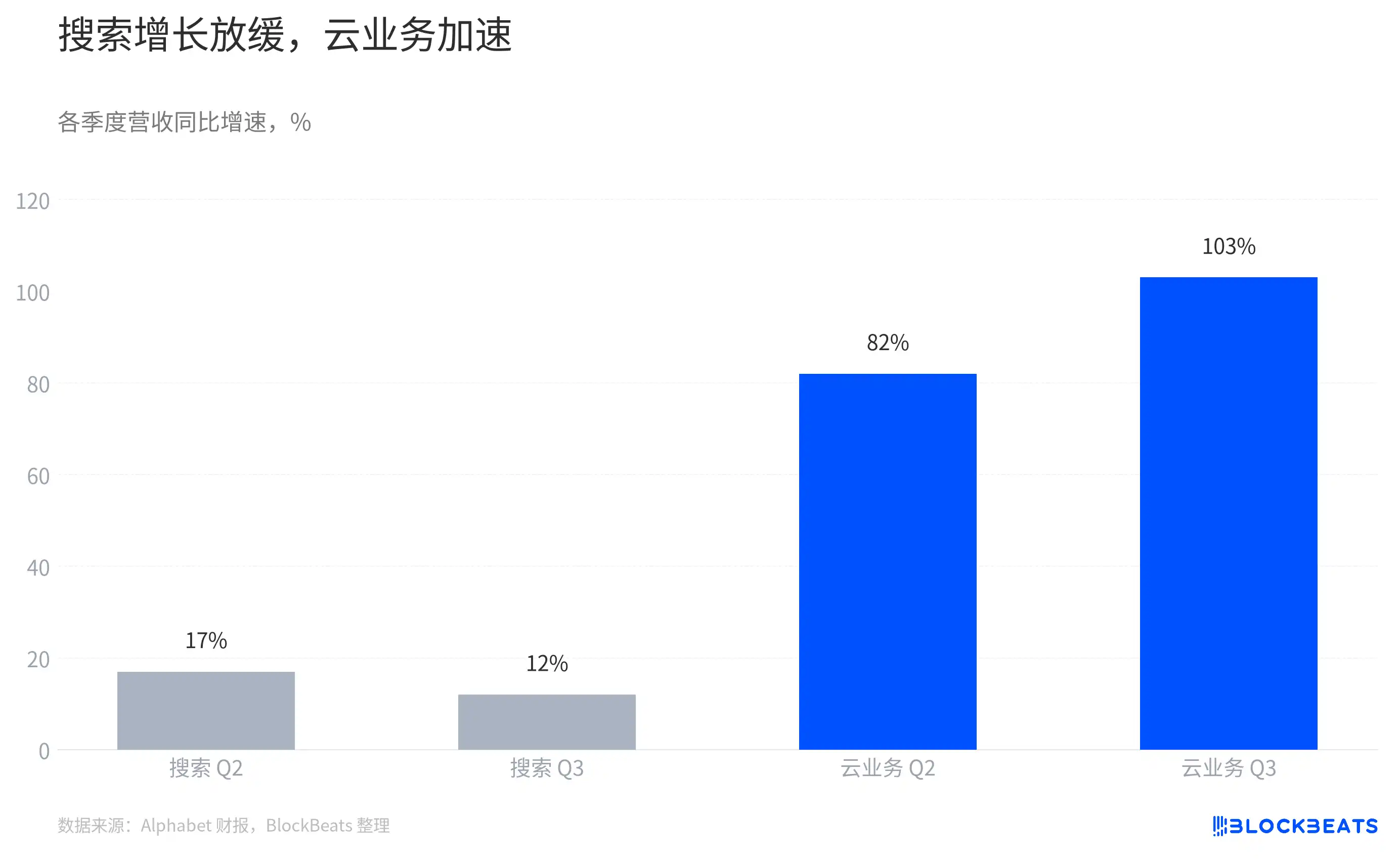
Looking at this alongside another piece of information Google provided makes for an interesting picture. The company said search query volume grew at its fastest year-over-year pace in nearly five years. Usage is growing faster, yet advertising revenue growth has slowed.
Management gave several reasons on the earnings call. Chief Business Officer Philipp Schindler said foreign exchange was the biggest factor in the slowdown relative to the previous quarter, and the pacing of ad spending in some advertising industries also changed. At the same time, AI Mode queries are growing rapidly, and their lower monetization level has also affected the growth rate.
A distinction needs to be made here: Google has not disclosed how much AI Mode alone dragged down revenue growth, nor has it proven that AI search is causing an absolute decline in search advertising revenue. What the earnings report can confirm is that search revenue is still growing, and the usage brought by new query formats does not necessarily translate into advertising revenue at the same pace immediately.
For a company where search advertising still accounts for the bulk of revenue, whether users continue to search and how much revenue each search can generate are two questions that need to be answered separately.
The Cloud Is Earning More, So Why Isn't There Enough Money to Spend?
Alphabet generated $42.3 billion in cash from operating activities in the third quarter, while capital expenditures reached $51.4 billion. Free cash flow, calculated on the company's basis, was negative $9.1 billion, equivalent to a shortfall of about $9.1 billion after operating cash flow covered all capital expenditures for the quarter.
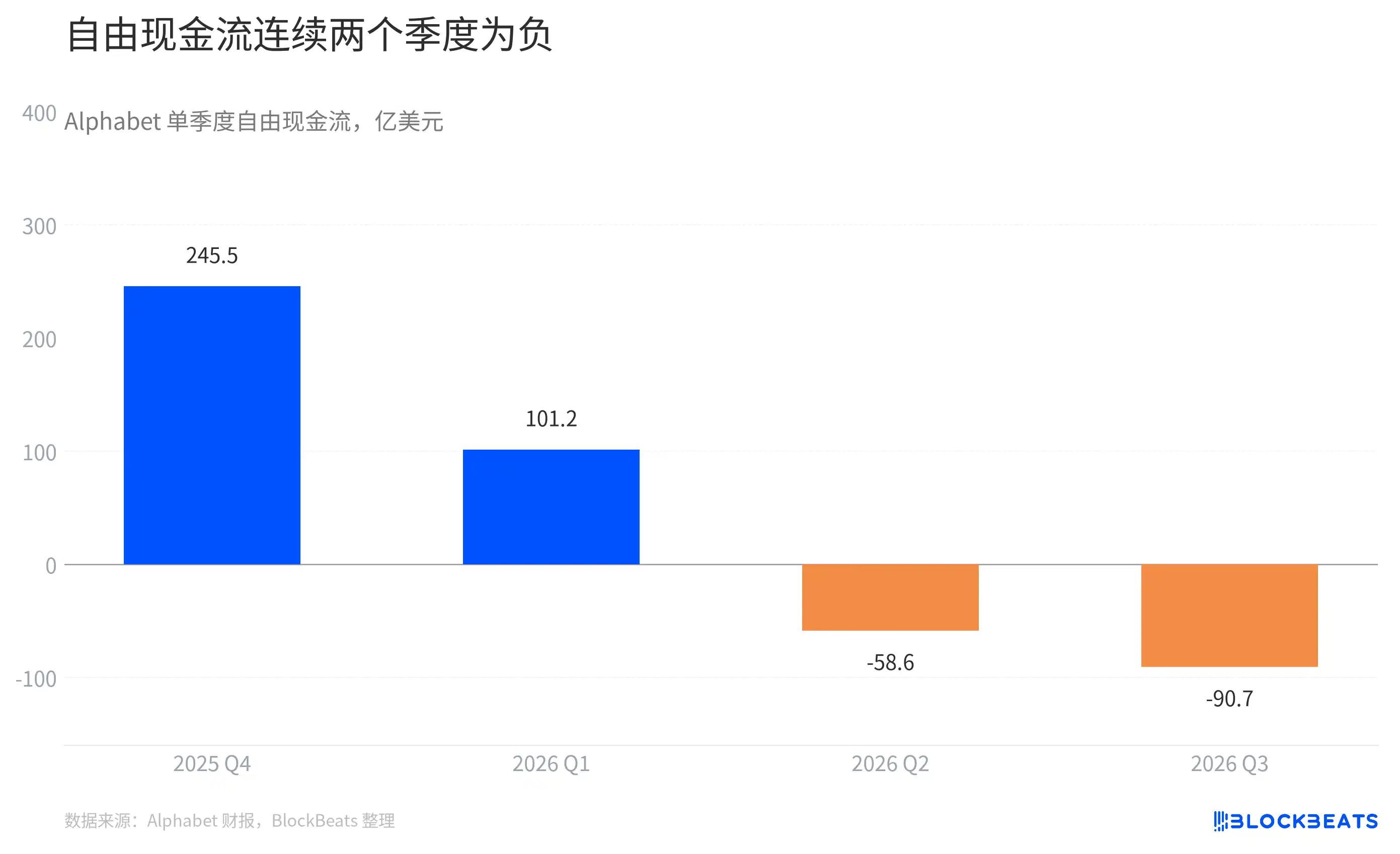
The chart shows that free cash flow has been negative for two consecutive quarters. Capital expenditures are mainly flowing into technical infrastructure, as the company is purchasing servers, networking equipment, and data center capacity in advance to serve future computing demand. These expenditures are first reflected in cash flow, while asset costs will enter the income statement through depreciation over subsequent quarters.
However, the impact on third-quarter cash flow was not solely due to capital expenditures. CFO Anat Ashkenazi said on the earnings call that the company also increased inventory for TPU system sales and paid a previously imposed European Commission fine. These two items also weighed on operating cash flow for the quarter, and the cash shortfall cannot be entirely attributed to data center construction.
The company maintained its full-year capital expenditure guidance at $195 billion to $205 billion and said it will increase significantly again next year. This range is more than double last year's full-year capital expenditures, but it is a management plan, not spending that has already occurred.
The profit decline the market observed also needs to be broken down separately. Alphabet's operating profit for the quarter grew 30% year over year, yet net income attributable to common shareholders declined. The financial statements listed a net loss on equity securities of $8.7 billion, which management said mainly came from an unrealized loss on its investment in SpaceX. Price changes in investment assets affect net income, but they do not directly indicate a decline in operating profit from the search or cloud businesses for the quarter.
In Google's earnings report, the cloud business is generating revenue and profit, while the bill for building computing capacity comes due earlier.
Welcome to join the official BlockBeats community:
Telegram Subscription Group: https://t.me/theblockbeats
Telegram Discussion Group: https://t.me/BlockBeats_App
Official Twitter Account: https://twitter.com/BlockBeatsAsia
