On October 27, the U.S. fintech company SoFi delivered a record-breaking quarterly earnings report and once again raised its full-year revenue guidance. Its app includes deposits, investments, and credit cards, but the fastest-growing main business in the earnings report is actually lending.
According to SoFi's third-quarter earnings report, the company's net revenue for the quarter grew 44% year-over-year, with net income reaching $241 million. Behind the revenue growth, lending, financial services, and the technology platform performed differently.
SoFi wants users to fulfill more of their financial needs in one place. For SoFi, deposit and investment accounts can bring in customers and funds, lending can contribute interest and fees, and the technology platform provides financial infrastructure to other enterprises. These businesses are interconnected, but that does not mean they make money at the same pace.
Where does the growth money come from?
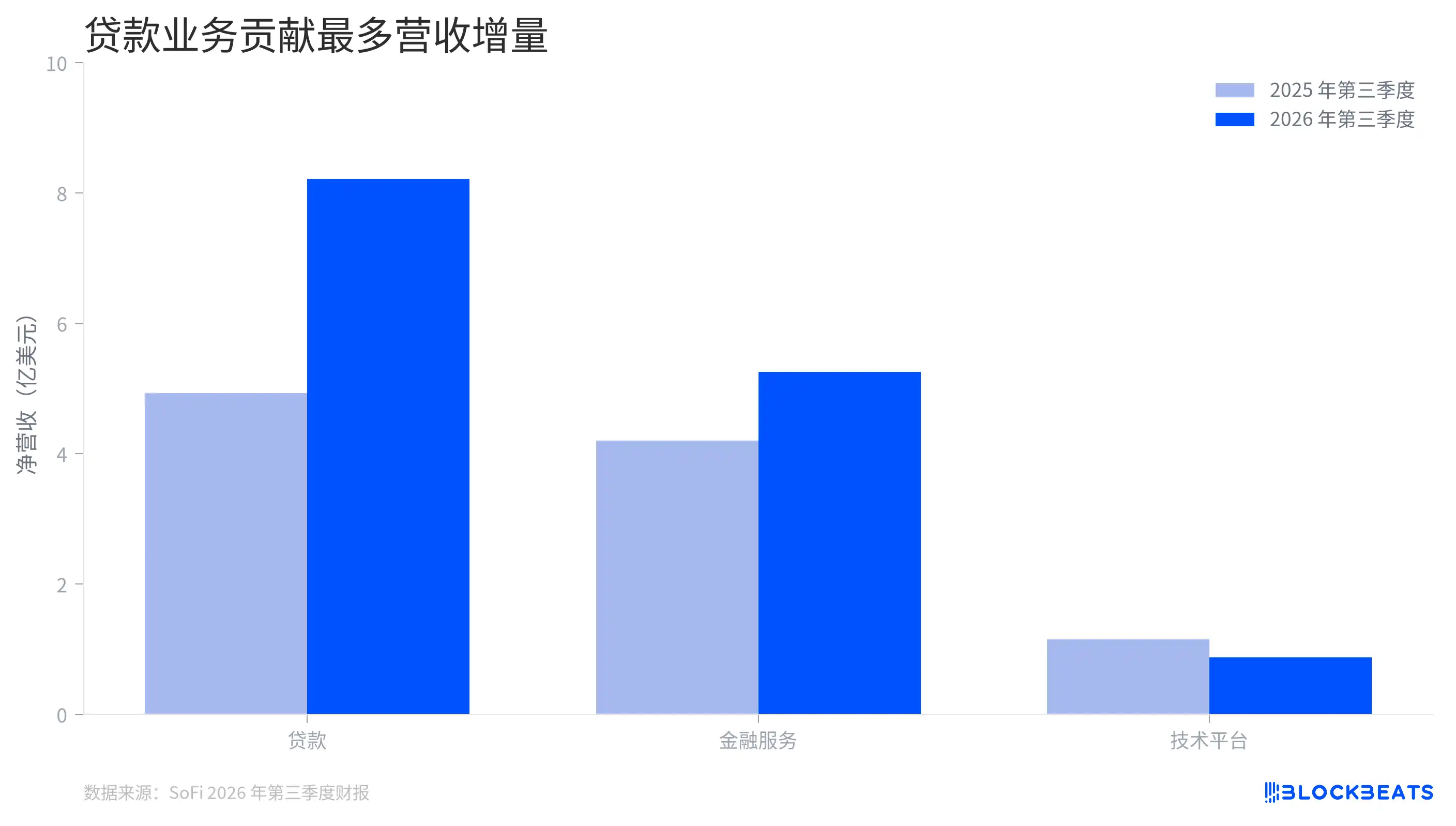
The lending segment was the largest source of growth this quarter. Compared with the same period last year, net revenue for this business increased by approximately $328 million, an increment larger than the changes in the other two segments. The expansion of personal loan origination brought in more interest income and loan origination fees.
This growth also changes the way SoFi is understood. When users open the app, they see a set of financial tools, but the company's revenue growth remains closely tied to borrowing demand, loan pricing, and funding costs. More product entry points do not automatically mean revenue has escaped the lending cycle.
The financial services segment is also growing. It includes deposits, investments, and other businesses, as well as the loan platform business that finds borrowers for third parties or provides loan origination services. Revenue generated by the latter is recorded in the financial services segment, so directly treating "financial services" as revenue completely unaffected by the lending market would also underestimate the presence of the lending business.
There is also a detail in the segment data methodology. The chart shows the company's disclosed net revenue for each segment. There are inter-segment transactions and eliminations between segments, so the bars cannot simply be added together and directly treated as consolidated revenue.
The technology platform took a different trajectory. According to the financial report, revenue for this segment fell 24% year-over-year, with the main comparison period affected by the exit of a major customer. The company said that excluding the impact of that customer, segment revenue grew 18% year-over-year. These two figures answer different questions: the former is the actual change in reported revenue, while the latter is used to observe the growth of the remaining business.
Why are deposits important for loan growth?
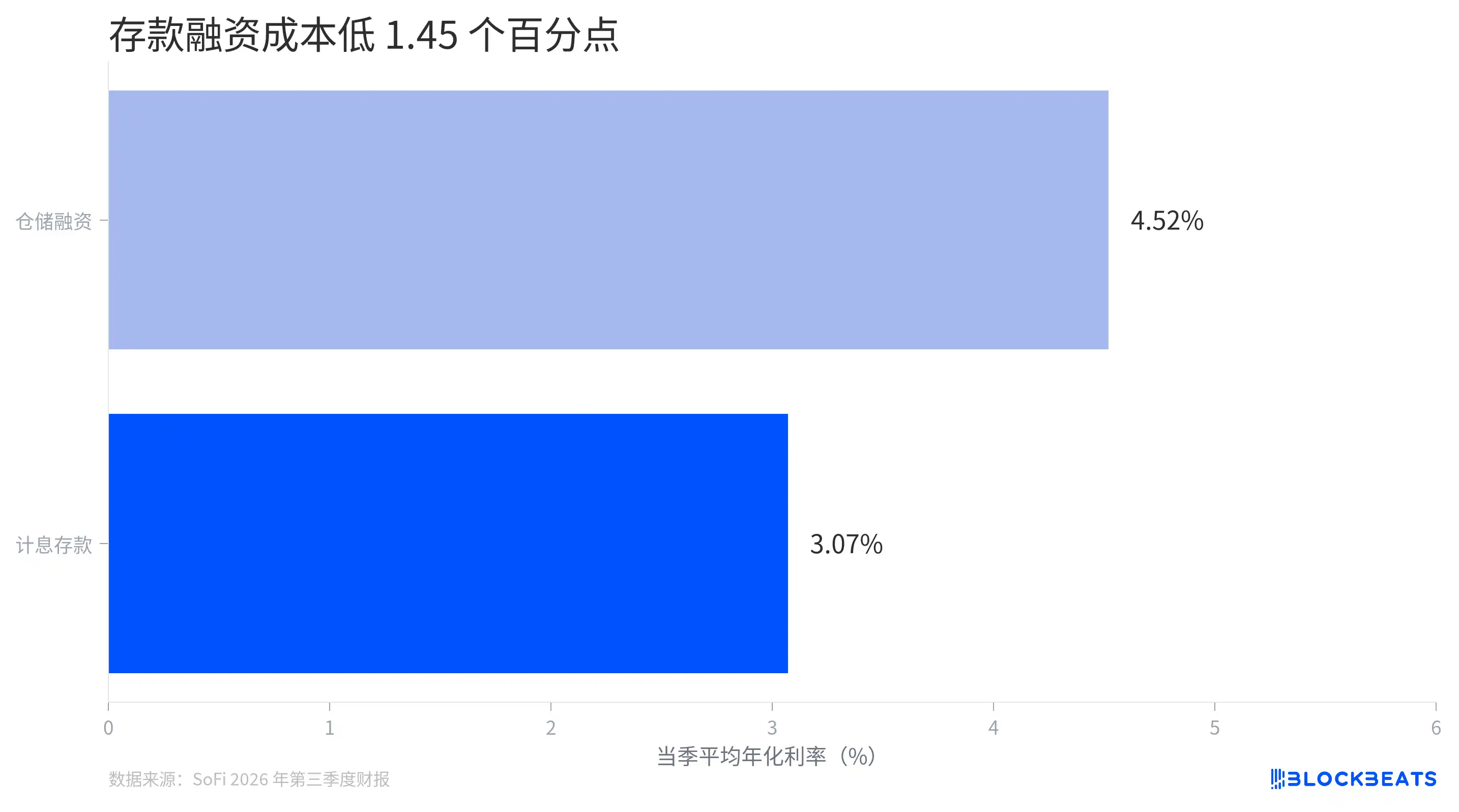
Lending requires funding. SoFi can use deposits or obtain funding through channels such as warehouse financing. Warehouse financing can be understood as financing secured by loan assets, typically used to support lending operations before loans are sold or securitized.
According to the financial report, the average annualized cost of interest-bearing deposits in the third quarter was 3.07%, while warehouse financing was 4.52%. All else being equal, for every $100 of funding raised, the annualized interest cost difference between the two methods is about $1.45.
Multiplied by a massive funding scale, this gap produces another estimate in the company's financial report. SoFi said the change in the funding source mix brought about approximately $745 million in annualized interest expense savings. This is an annualized comparison calculated under the company's assumptions, not the actual cash saved in the quarter, and cannot be directly added to quarterly profit.
Deposit growth has given the company more room to use this funding channel. At the end of the third quarter, SoFi's deposit balance reached $51.3 billion, an increase of $5.8 billion in the quarter. Deposits are not free money; the company still needs to pay interest to depositors, and the cost advantage will also change with deposit pricing and other funding rates.
Funding cost is only one side of the loan book; whether the money lent out can be recovered is the other side. SoFi disclosed that the annualized charge-off rate for personal loans was 2.26%, down 34 basis points year-over-year. But the company also noted that this metric is affected by asset sales, new loans, and sales of delinquent loans. Changes in the loan pool alter the numerator or denominator, and one cannot conclude solely from a decline in the charge-off rate that credit risk has declined in tandem.
Does having more users necessarily mean making more money?
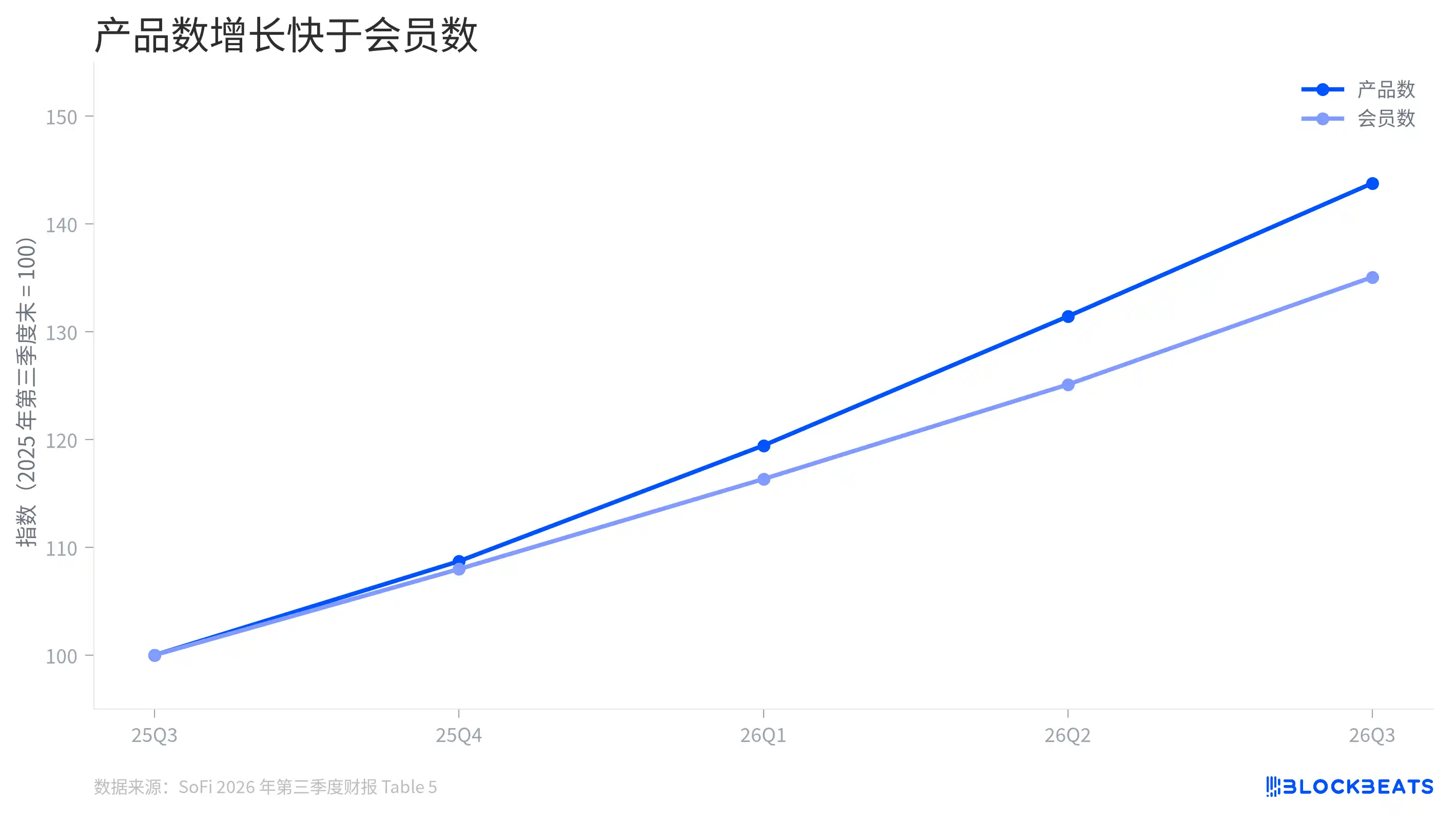
SoFi's members and product scale are both expanding, with the number of products growing faster. Setting the end of the third quarter last year as 100, by the end of the third quarter this year, the product count index rose to about 144, while the member count index was about 135.
This means that, based on the company's disclosed cumulative figures, the number of products per member has increased. But it cannot on its own prove how much growth was contributed by cross-buying from existing members, nor can it directly represent an increase in usage frequency per active user. New members purchasing multiple products could also drive this ratio higher.
The reason lies in the statistical definitions. SoFi counts as members people who open an account, link an external account, or use its credit score monitoring service, and once someone becomes a member they typically continue to be counted in the total. Total products also include products that were previously selected but may no longer be in use. They help observe the scale of the platform's reach, but they are not monthly active users or active products.
Revenue monetization also depends on the products themselves. The earnings report shows that revenue per product in the financial services segment rose from $88 last quarter to $90. This indicates that the revenue metric disclosed by the company has improved somewhat, but like members and total products, it still needs to be read in conjunction with product mix and calculation methodology.
Where does the crypto business stand?
SoFi relaunched its crypto investment service in the fourth quarter of 2025. Users can buy, sell, and hold digital assets on the platform, and the number of Crypto products reached 503,000 by the end of the third quarter.
The headline crypto revenue figure needs to be broken down. According to the earnings report, the company's crypto trading revenue for the quarter was $161.6 million, against corresponding trading costs of $160.0 million. Subtracting the two leaves net crypto trading revenue of $1.633 million, mainly from fees charged for facilitating users' buy and sell orders.
This net amount accounts for about 0.12% of consolidated net revenue for the quarter. It shows that the disclosed direct crypto trading revenue is still small. The significance of crypto products to the platform is that they add an investment entry point for existing members, potentially creating linkages with deposits and other investment products. However, the earnings report does not separately disclose the revenue that crypto users bring to other businesses.
After the end of the third quarter, SoFi launched its consumer-facing tokenized deposit product SoFi Earn in October. Data for that product will only be visible in the next earnings report.
Welcome to join the official BlockBeats community:
Telegram Subscription Group: https://t.me/theblockbeats
Telegram Discussion Group: https://t.me/BlockBeats_App
Official Twitter Account: https://twitter.com/BlockBeatsAsia
