Next Monday, November 9, "Hyperliquid Layer2" Elysium, built by Kinetiq, will officially launch. Fomo and Pumpfun trading apps will both support this chain, and GMGN has also announced its participation on the first day. As the Robinhood Chain market cools down, on-chain traders have already sensed new opportunities. Ansem has also expressed strong interest in Elysium.

The launchpad is also warming up. In the first-day test data released by Ascend, trading volume was approximately $5.97 million, with 47,254 transactions completed, 873 tokens deployed, and $34,808 in protocol fees generated. This demonstrates strong new token supply and trading demand.
But new chains are never short of opening-day excitement. What truly deserves attention about Elysium is the Hyperliquid and Kinetiq behind it, as well as a group of applications attempting to connect new token issuance, trading, and long-term operations.
Gap in the Hyperliquid On-Chain Ecosystem
Hyperliquid's trading business has already taken off, but there is still a significant gap on the application side.
HyperCore handles the order book and trade matching, while HyperEVM handles smart contract applications. The two share underlying state, and HyperEVM's execution capacity needs to accommodate HyperCore's operations. This gives Hyperliquid a powerful trading market, but makes it difficult to simultaneously support high-frequency, congested, and constantly evolving on-chain applications.
Kinetiq has firsthand experience with this problem.
Elysium emerged from this. According to Kinetiq co-founder Omnia in an interview, this chain adopts the Arbitrum tech stack and Conduit's G2 sequencer, with a target block time of 100 milliseconds, gas paid in HYPE, and settlement to HyperEVM. As we introduced in a previous article, Elysium's goal is to provide a more spacious execution environment so that token trading, issuance, and DeFi demand around Hyperliquid have a place to land.
The value of Fomo, Pumpfun trading apps, and GMGN lies in integrating Elysium into traders' already familiar usage habits. Seeing new tokens, checking trades, buying and selling—without first having to learn an unfamiliar set of tools. For new projects, this also means that at launch they have the opportunity to reach audiences beyond Hyperliquid's native community.
Post-trade services are also being filled in. Omnia's ecosystem list includes Uniswap, 0x, KyberSwap, Li.Fi, Wormhole, as well as wallets and infrastructure such as MetaMask and Rabby. Nest plans to build trading pools on Uniswap v4 to capture the mainstream asset exchange demand brought by new coins, as well as the ongoing liquidity demand as projects grow.
An Aligned-Interest Launchpad
The easiest business to build for a launchpad is to continuously issue new coins and then extract fees from trading. As long as creators and the platform can get paid quickly, whether a project survives to next week becomes the traders' own problem.
Ascend attempts to break this dynamic.
On the token creator side, it ties fee distribution to project growth. A portion of early creator fees on new coins is held in escrow and released as the project meets corresponding conditions; at higher market cap tiers, creators receive a larger share of base trading fees while the protocol's cut decreases. Creators can also choose to allocate their share toward holder rewards, project token buybacks, or a combination of these uses.
The behavior this design aims to encourage is clear: making a project continuously grow is more attractive than mass-issuing tokens and immediately taking fees. Teams willing to leave trading revenue to the community also have ready-made tools available.
Ascend has made further arrangements for its own revenue.
It does not issue a separate platform token and directly adopts KNTQ as its protocol token. The launchpad's business growth is aligned with the interests of Kinetiq and Elysium.
According to the allocation model in the official documentation, out of every $100 in protocol fees, $10 goes to the treasury, $72 is used to buy KNTQ, and $18 is used to buy HYPE. Of the KNTQ purchased, 40% is used for burning, and the remaining 60% supports ecosystem token buybacks, the Ascend points program, and protocol-owned liquidity; the HYPE purchased is used for participant rewards and staking respectively.
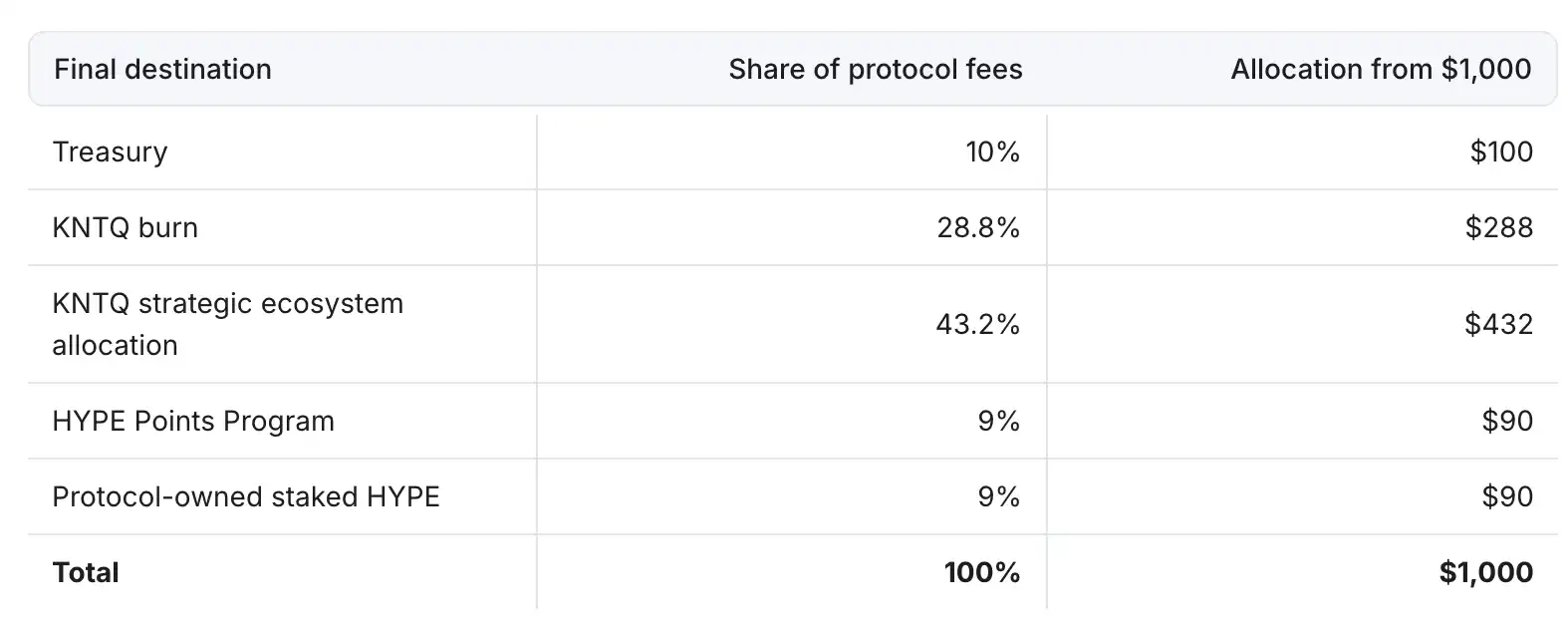
Therefore, the more actively new coins trade on Ascend, the more funds flow into KNTQ, HYPE, and ecosystem projects under this design. KNTQ holders can pay attention to Ascend without having to go through another launchpad token; Ascend can also gain initial attention through the already-existing Kinetiq community.
Omnia introduced that Elysium will use 50% of its sequencer revenue to buy back KNTQ; Ascend, on the other hand, uses its share of Elysium sequencer revenue to support builders, including grants and preparation for HyperCore spot listings. Revenue generated from on-chain transactions has the potential to continue helping new projects enter the market.
For HYPE holders, Ascend has designed another way to participate: deposit kHYPE into its staking vault, use the yield generated from staking to purchase eligible ecosystem tokens, and then distribute the tokens to the corresponding stakers. Holders retain HYPE exposure while using staking yield to participate in new projects.
These mechanisms collectively point to one goal: allowing the launchpad's trading activity to continue funding the assets and projects that support it.
Activating HyperCore's "listing effect"
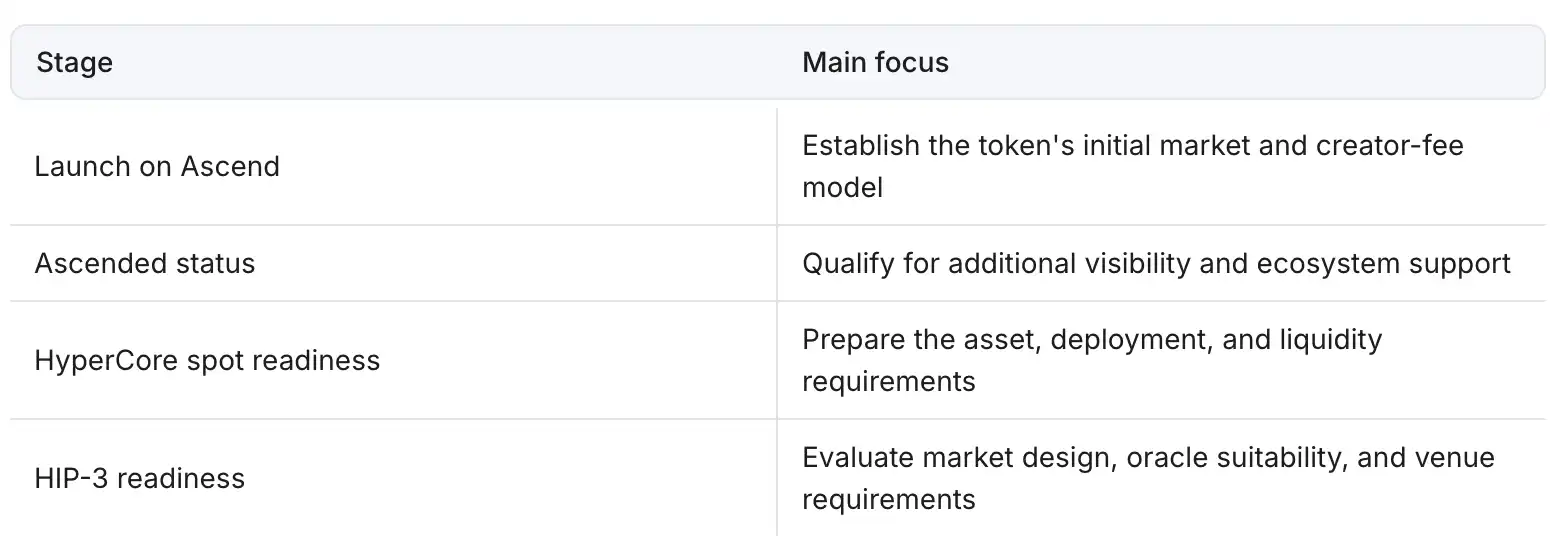
The growth goal of many new coins ultimately comes down to "listing on a larger exchange." In the interview, Omnia outlined a similar path for Elysium: projects first accumulate attention, trading, and liquidity on-chain, then enter the HyperCore spot market, and further seek to have HIP-3 deployers open perpetual contract markets.
Ascend has written this path into its project support system. Eligible projects can obtain Ascended status, enter the scope of subsequent ecosystem support, and prepare for HyperCore spot and HIP-3 markets.
The same path also applies to assets beyond memes.
Elysium designs its interface around HyperCore prices and order book depth, aiming to attract professional market makers to provide spot quotes here and then hedge risk on HyperCore. When traders complete an ordinary swap on the front end, the market-making demand behind it can further turn into contract transactions on Hyperliquid.
Montra
Unlike Ascend, which directly adopts KNTQ as its protocol token, another launchpad, Montra, retains its own protocol token MONTRA and uses it to organize early participants.
Montra's standard token issuance process is built directly on Uniswap v4. Token creators can choose to direct their fee revenue to the team wallet, multiple recipients, or directly distribute it to token holders; the protocol takes its own share, and in the MONTRA buyback design, 70% of that is used to buy and burn MONTRA, while 30% goes to the treasury.
For traders preparing to explore Elysium, a more immediate focus is MONTRA's token airdrop.
25% of MONTRA's total supply will be allocated to the airdrop, divided into five categories, each accounting for 5% of the total:
-Existing active users of HYPE, KNTQ, and Elysium.
-Early active creators and traders on Montra.
-Participants who discovered, traded, and held Montra's top ten tokens at the time of the snapshot.
-Liquidity providers.
-Verified quality creators and builder referrals, as well as social media content and dissemination contributions (verified through the official Discord).
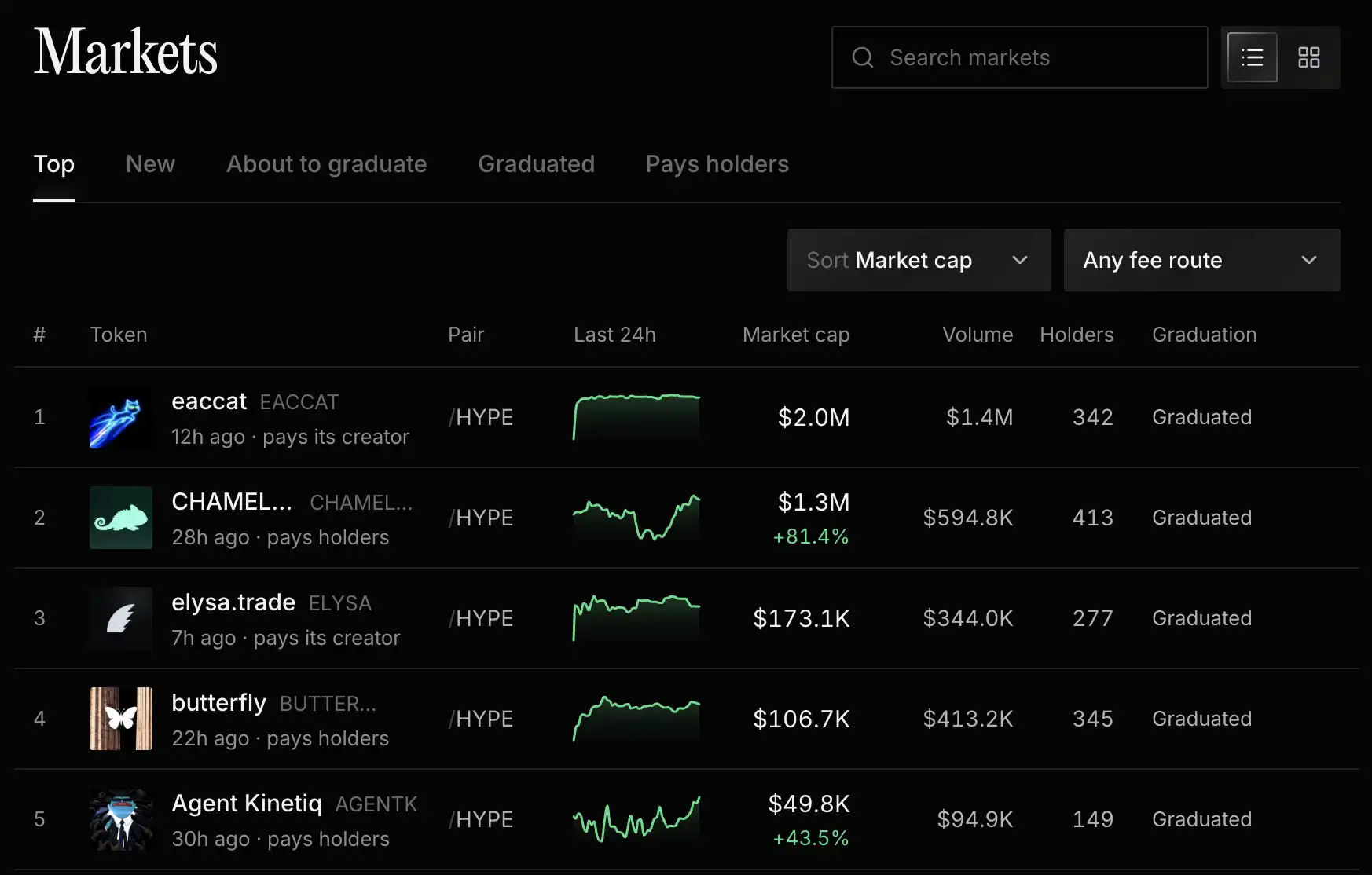
Montra has already opened pre-trading, and two tokens with market caps above 1M have emerged.
Ascend concentrates value into KNTQ, while Montra expands distribution with independent tokens. The two options offer Elysium different launch approaches. For traders, these two launchpads will also be important windows for observing where new projects emerge and where capital gathers.
After Robinhood, Elysium has the conditions to become the next on-chain focal point: Pumpfun, Ascend, and Montra issue assets, fomo and gmgn serve as trading gateways, and Hyperliquid provides "listing" expectations and exit liquidity.
Welcome to join the official BlockBeats community:
Telegram Subscription Group: https://t.me/theblockbeats
Telegram Discussion Group: https://t.me/BlockBeats_App
Official Twitter Account: https://twitter.com/BlockBeatsAsia
