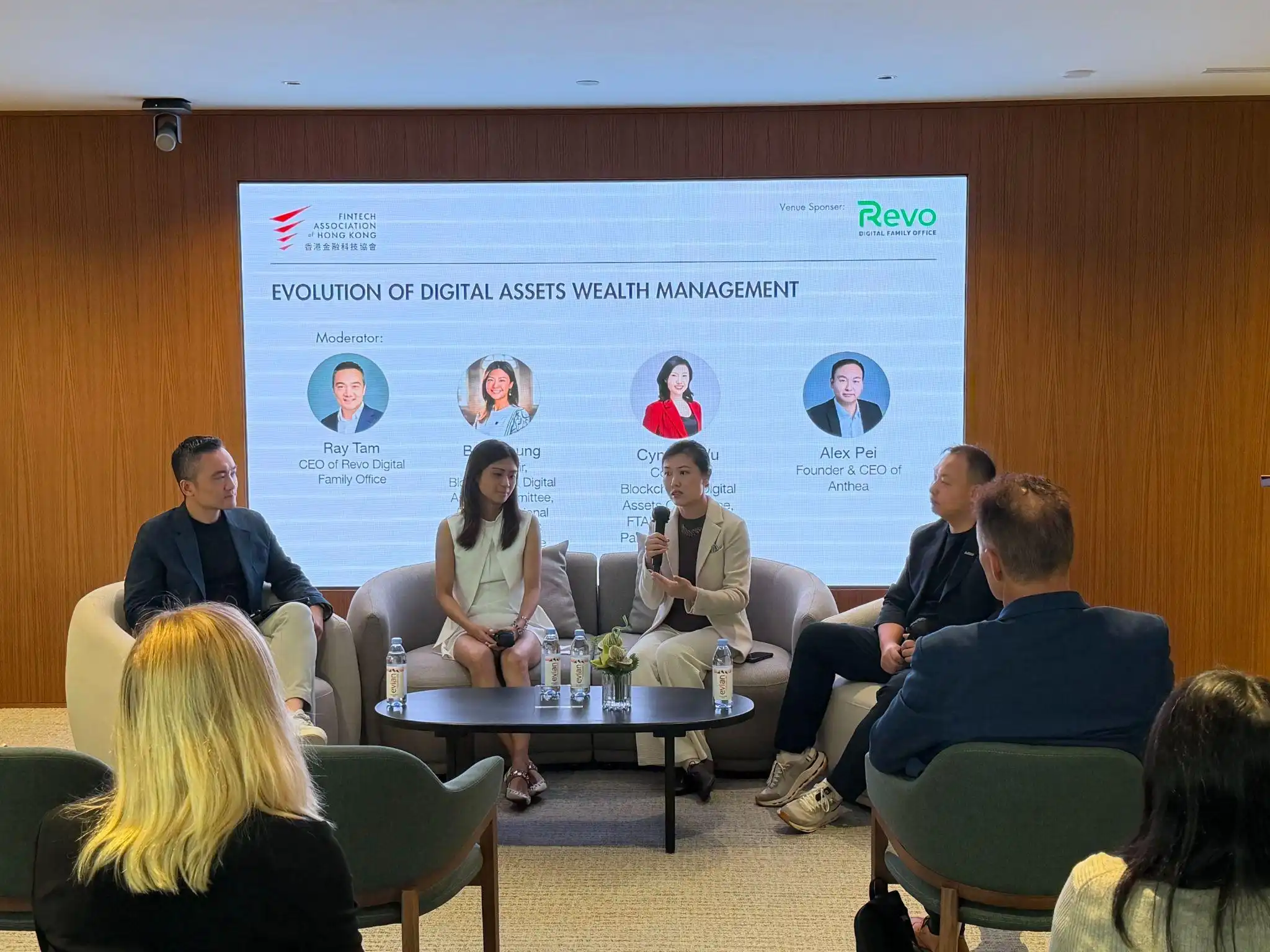
On November 3, 2026, the FinTech Association of Hong Kong (FTAHK) hosted a roundtable event themed "The Evolution of Digital Assets Wealth Management" at Raffles Family Office in Central, Hong Kong. Cynthia Wu, Founding Partner and Chief Commercial Officer (CCO) of BIT and Co-Chair of the FTAHK Blockchain and Digital Asset Committee, was invited to attend and shared the stage with Belle Leung, Head of Asia Pacific at Xapo Bank, and Alex Pei, Founder and CEO of Anthea.
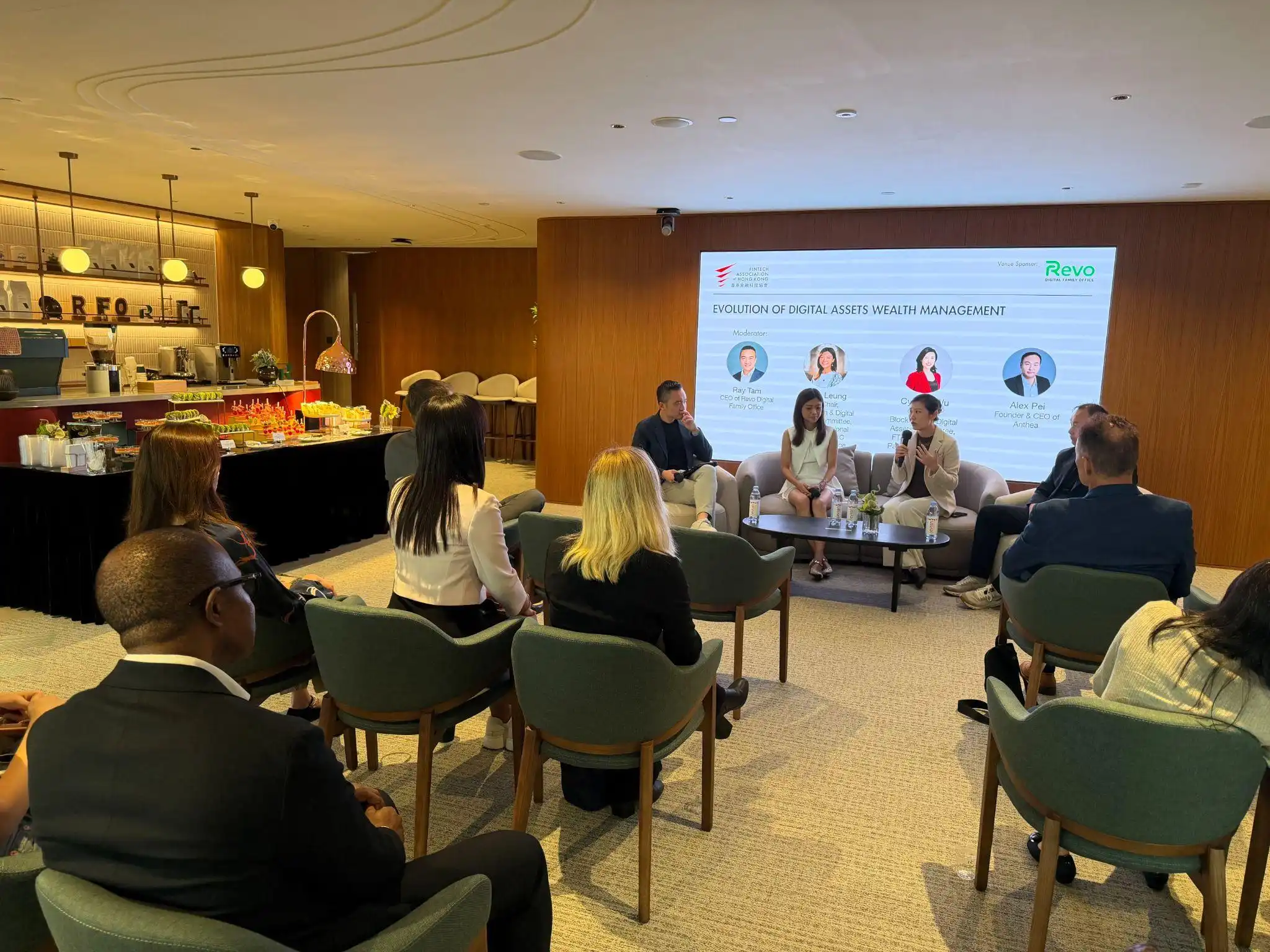
The roundtable centered on the evolving needs of private wealth clients, delving into how digital asset custody, insurance, yield products, structured products, and regulatory developments are collectively shaping the future of digital assets wealth management. Having weathered a full market cycle, family clients' focus on digital assets has shifted from price to operational security; yield and structure themselves are not the issue—the key is whether risks are clearly priced and effectively isolated.
I. Family Clients' Demands: From "Can I Buy It" to "Can I Hold It Properly"
Speaking to the changing needs of private wealth clients, Cynthia reflected on the industry landscape three years ago: the market had just experienced the FTX collapse, trust had hit rock bottom, and most families' first question was not "What should I buy" but "Is my money safe where it is"; for investors looking to allocate to digital assets, there were no regulated investment vehicles available in the market, and U.S. spot Bitcoin ETFs would not have a chance of approval for several more months.
She noted that today's investors are more sophisticated, and their questions are more specific and professional: where exactly are assets held, are they segregated, who regulates the institution they are dealing with, and can they appear in the same report as other assets in their portfolio. Clients are also increasingly inclined toward investment vehicle formats they are familiar with, which is one of the reasons BIT recently launched a spot Bitcoin ETF (BBIT) in Switzerland—some families want to hold Bitcoin in a way that auditors, trustees, and investment committees are all familiar with.
"The industry will certainly encounter new problems, but the most important concern has never changed: families are still asking 'Is my money safe'—they're just asking more precisely," Cynthia said. Clients' concerns have shifted more from price to the operational level: memories of 2022 linger, and counterparty risk remains a top concern; wealth succession is another—if something happens to me, how will these assets be handled? "The demand has shifted from 'Can I buy it' to 'Can I hold it properly.'"
II. Identifying Returns: The Problem Is Not Returns Themselves, but Returns with Unclear Sources
Regarding the phenomenon that after the successive blowups of lending institutions in the previous cycle, "returns" became a derogatory term in the eyes of many families, Cynthia believes: "Returns themselves have never been the problem; returns with unclear sources are."
She explained that genuine returns are essentially the pricing of time and risk: investors commit assets over a period of time, or assume a clearly defined risk exposure, and are compensated accordingly. Therefore, risk is not something to be eliminated, but a component of returns. The key lies in whether risk is isolated and quantified, whether investors clearly understand what risks they are bearing, whether there are caps on risk, and whether risk is segregated from the institution's other businesses.
She cited Buffett's famous saying "Risk comes from not knowing what you're doing" and pointed out that this is precisely the crux of the previous cycle: the problem is not returns, but that risk was neither reasonably priced nor effectively controlled. In this regard, she suggests that families ask the same question to any institution, "and we very much welcome you to ask us first": What risk does the return I receive correspond to? Where are the boundaries of this risk?
III. Structured Products: Structure Can Reallocate Risk, but Cannot Eliminate All Risk
In the face of increasingly structured products such as tokenized funds, RWA, and principal-protected notes, Cynthia believes that to judge whether they make digital assets safer, one must first clarify the meaning of "safe."
She pointed out that no structure can solve the problems of the asset itself: whether it is protocol-layer risks such as software vulnerabilities, governance failures, or cyberattacks, or market risks such as price volatility, liquidity depletion, and overnight gaps, none can be eliminated through product structure. Tokenized products run on smart contracts, which instead layer code risk on top of the asset itself.
What structure can change is who bears the risk. She took the Swiss SIX exchange as an example: shortly after the Lehman crisis in 2009, SIX allowed structured products to be issued in collateralized form, with issuers pledging collateral to the exchange and revaluing it every trading day. Once the issuer defaults, the exchange disposes of the collateral to repay investors, greatly reducing the risk of issuer inability to pay. But more often, risk is merely transferred: although uncollateralized principal-protected notes reduce downside risk, the protection comes only from the issuer's promise, and investors actually increase their exposure to the issuer's credit risk; while the bitcoin buffered and income ETFs already listed in the United States show that whether buying protection or obtaining additional yield, the cost is giving up part of the upside.
"The signal that most warrants vigilance is a product promising to protect you from risks that no structure can eliminate. If the network itself fails, or the market drops 30% overnight, no product structure can change that. Protection can truly work only if the market is still functioning."
IV. AI Agent Accountability: You Can Delegate Trades, But Not Responsibility
On the question of who should be held responsible when future family assets are partly managed by AI agents and erroneous trades occur, Cynthia said that while the question sounds cutting-edge, the principle behind it is long-standing: the alignment of authority and responsibility.
She believes responsibility cannot rest with the model. Today's models are merely software—they have no balance sheet, no license, and bear no duty of care. "Whether AGI has arrived remains debatable, and I personally remain skeptical. But regardless, existing legal, regulatory, and social infrastructure does not treat AI as an independent entity like a person or a company." Therefore, responsibility should fall on the party that deploys the agent and defines its authority: if the agent is provided by a platform, the platform must not only enforce limits but also ensure that the agent and its authorization are genuinely suitable for the family; if the family introduces the agent itself, more responsibility reverts to the family, with the platform responsible for enforcing limits and maintaining complete audit records.
She also noted that the real difficulty lies in attribution. No matter how intelligent an agent is, it cannot be error-free forever, and good decisions do not necessarily produce good outcomes. "We don't fire an asset manager over a single losing allocation in a given quarter; instead, we evaluate their decision-making process over the long term. The same standard should apply to AI agents. Intelligence raises the odds of success, while boundaries determine the cost of a single mistake. You can delegate trades, but you cannot delegate responsibility."
V. The Next Three Years: The First Regulated AI Agent Fund Is Expected to Emerge
When asked about the most important development for digital asset wealth management over the next three years, Cynthia offered a specific judgment: "I believe that within three years, we will see the first regulated digital asset fund managed by AI Agents and running entirely on blockchain, and these agents themselves will be compensated in Bitcoin."
About BIT
BIT (formerly Matrixport), founded in 2019, is a leading global digital asset financial services group. Headquartered in Singapore with offices in seven countries and regions worldwide, the group connects traditional finance with digital asset markets through robust governance frameworks, technical capabilities, and compliant operations.
BIT provides comprehensive digital asset services to global institutions and professional investors, covering trading, custody, asset management, liquidity, and financing services, and supports the on-chain introduction and application of real-world assets (RWA). Its entities hold relevant licenses and are subject to local regulation in Singapore, Hong Kong, Switzerland, the United Kingdom, the United States, and Bhutan, including the Major Payment Institution (MPI) license in Singapore and the collective asset management license issued by Swiss FINMA.
Currently, the group manages assets exceeding $6 billion, with monthly trading volume surpassing $7 billion, cumulative interest paid to clients totaling over $2 billion, and a valuation exceeding $1 billion. It has been listed on the 2024 Hurun Global Unicorns Index and the 2025 Singapore Fintech Unicorn List.
Disclaimer
This content is for reference only and does not constitute investment advice, an offer of investment, or an invitation to purchase any financial product, nor does it constitute a public offering or promotion of the products mentioned herein in any jurisdiction. The information contained in this article should not be regarded as a recommendation for any specific investment strategy or product. Digital asset prices are highly volatile, investment involves risks, and past performance does not guarantee future returns.
Welcome to join the official BlockBeats community:
Telegram Subscription Group: https://t.me/theblockbeats
Telegram Discussion Group: https://t.me/BlockBeats_App
Official Twitter Account: https://twitter.com/BlockBeatsAsia
