Editor's Note: As AI companies secure higher valuations through large funding rounds, market discussion is shifting from whether models can create commercial value to how much investors have already paid for that value. The debate around bubbles often stops at projections of future revenue and profits. But even if companies ultimately deliver on growth expectations, investors may suffer significant losses before that happens. A more direct question is: when holders need to convert paper wealth into cash, how much buying interest remains in the market to absorb it at the original price?
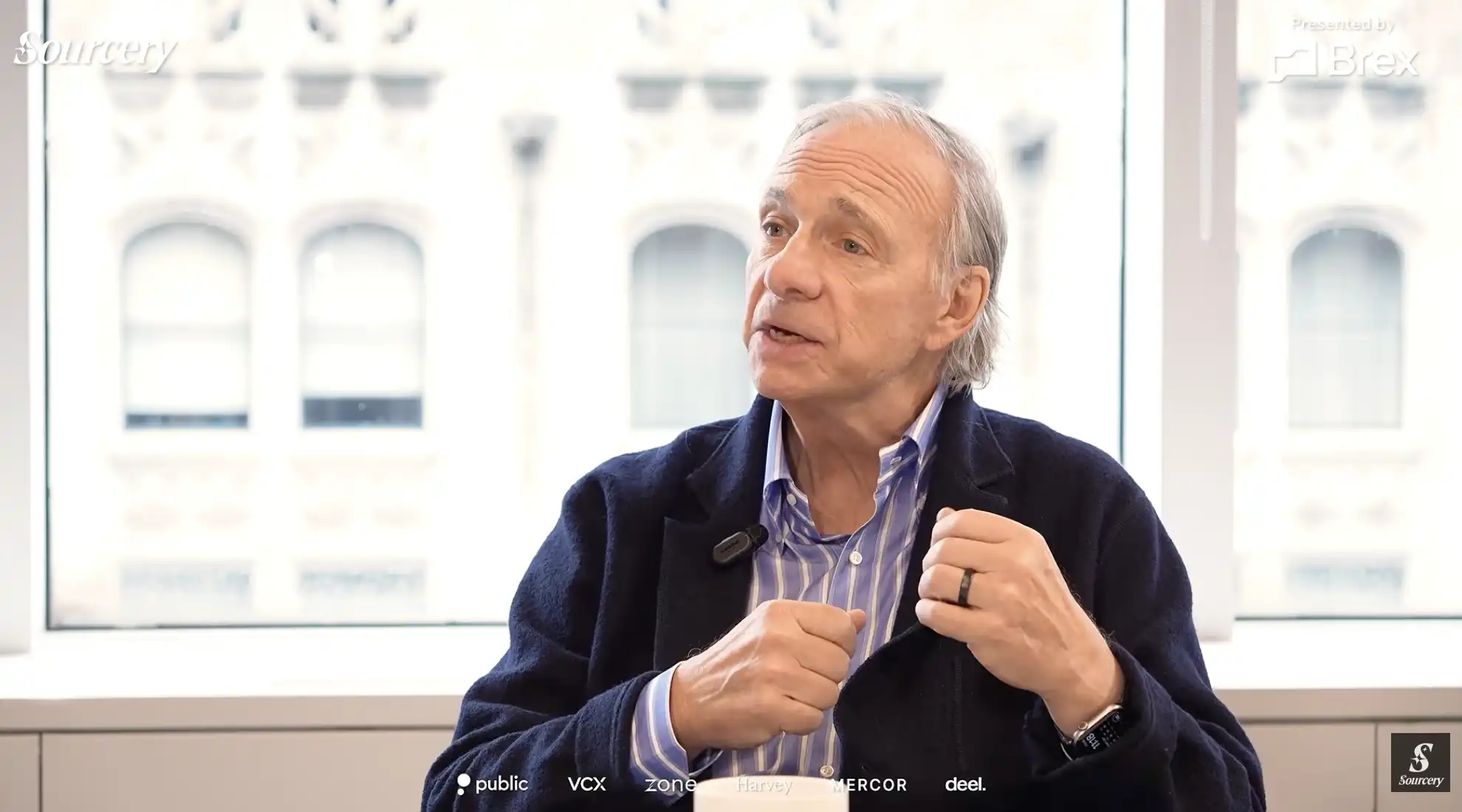
In the Sourcery podcast episode released on November 23, 2026, host Molly O'Shea discussed the AI investment boom and the bubble mechanics behind it with Ray Dalio, founder of Bridgewater Associates. Dalio broke down "when the AI bubble will burst" into three more fundamental questions: how valuations are formed, who will be forced to sell, and what will absorb the market when sell orders concentrate.
First, how a small number of transactions can revalue all equity. In the past, startups established valuations through successive funding rounds, and the transaction price of a small portion of shares could serve as the pricing reference for the rest. Today, driven by large funding rounds and IPO expectations, a single trade in a tech company can correspond to a much larger scale of paper wealth. Dalio gives an example: a company raises $50 million at a $1 billion valuation — the company actually receives $50 million in that round, while the book value of existing shares may rise accordingly. If many shareholders sell simultaneously, whether the previous round's transaction price can hold depends on how much new capital the market is willing to commit. Funding can establish a price; large-scale cash-out will test that price.
Second, how debt changes how long investors can wait. Dalio draws an analogy to the electrification, automobile, and radio booms of the 1920s. Back then, the changes brought by these technologies were already clearly visible and attracted investors to borrow and enter the market. Today, AI companies' long-term cash flows similarly depend on demand and profitability years down the road, while investors' interest and principal have definite payment deadlines. If loans are difficult to refinance at maturity, or if financing costs rise beyond what holders can bear, even if they remain bullish on the company's long-term prospects, they may need to sell early. How long it takes for companies to deliver returns and how long investors' capital can last thus become two equally important variables.
Third, how capital concentration turns individual investors' liquidity needs into collective selling pressure. During the upswing, new capital flooding into the same theme can absorb selling from existing holders and can continue to push prices higher with relatively few transactions. Dalio worries that as the market's dependence on AI deepens, more and more positions will be exposed to similar financing conditions and risk appetites. Once some investors are the first to cash out, and buyers become cautious due to falling prices, selling will require larger discounts. Price declines may also prompt more holders to reduce positions. At that stage, even if companies' operating prospects have not deteriorated in tandem, the buying interest that originally supported valuations may have already receded.
If this conversation is compressed into one judgment, it is this: when holders' demand for cash exceeds the market's capacity to absorb assets at existing prices, a bubble may burst. The AI investment boom thus raises a broader market question. Technological revolutions can last for years, but capital markets must at every point in time find buyers willing and able to bid for these long-term expectations.
The following is the original content (lightly edited for readability):
TL;DR
· A $50 million financing round can establish a $1 billion company valuation, but how much a founder can cash out depends on how many shares can be sold and at what price.
· Dalio believes that the long-term cash flows of new technologies are difficult to estimate, and even if substantial cash flows eventually materialize, the related assets may experience a bubble burst along the way.
· Debt servicing, rising interest rates, and wealth taxes payable in cash can all force holders to sell assets. The more concentrated investors are in the same theme, the more easily sell-offs can amplify one another.
· Dalio also views the U.S. debt problem as a political problem. Both tax increases and spending cuts require someone to bear the cost, and after elections, a compromise must still be reached on how costs are shared.
· Dalio himself is turning investment principles into backtestable rules and handing them to AI for assisted execution. He believes human judgment is still responsible for proposing causal hypotheses and setting decision criteria.
How a $50 million financing round supports a $1 billion valuation
Host Molly O'Shea began by asking about the enormous wealth created by tech company IPOs.
Dalio gave an example. A company raises $50 million at a $1 billion valuation, and the new round of transactions provides a pricing reference for the entire company's equity. The company actually raised $50 million. The founder's paper net worth is recalculated based on their ownership stake, and only when shares are sold does corresponding cash come in.
A financing round can price a small number of shares, but if many shareholders simultaneously demand to cash out, buyers must commit more capital to maintain the original price. For those who bought assets with borrowed money, the timing of sales is also constrained by repayment deadlines and financing costs. Paper net worth can grow rapidly as valuations are marked up, but cash outlays have definite amounts and due dates.
This is Dalio's entry point for judging when a bubble may burst. During booms, new buying pushes up asset prices, and holders can continue to hold. When debts come due, interest rates rise, or taxes payable in cash arise, some people have to sell. If simultaneous selling exceeds the scale buyers are willing to absorb, prices will fall. The decline may in turn cause more people to worry about losses, shrink positions, and further drain the market of buyers.
AI Can Create Long-Term Returns, Yet Investors May Still Lose Money Along the Way
A common approach to judging whether a stock is expensive is to discount the cash flows a company will generate in the future to today's value and compare that with the current price. Dalio argues that this method faces a challenge when applied to new technologies: investors find it hard to reliably forecast cash flows decades out. Even if a company ultimately makes money, its share price may endure a sharp selloff before that happens.
He draws an analogy to the 1920s. Electric lights, refrigerators, radio, automobiles and airplanes successively entered the lives of Americans, and the changes brought by technological progress were plainly visible. Such changes were enough to attract a large wave of investors, some of whom borrowed to buy in. The more convincing the technology, the more easily capital clustered. By the time financing conditions changed, positions could be sold under funding pressure even as consumers were still using those products.
Dalio worries that the market's reliance on AI is concentrating investment risk. When a single theme attracts large amounts of capital, the buyer base will also include a group of holders who cannot withstand a prolonged drawdown. In the upswing, concentrated capital can support valuations rising further. In the downswing, as these holders raise cash or cut positions, the very forces that drove the rally may反过来 accelerate the decline.
In this discussion, Dalio lays out a risk transmission chain: rising asset prices attract borrowing and buying, and financing demand may then turn into selling pressure. Following his logic, observing a bubble requires watching two things at once—how much money companies can earn in the future, and whether investors can continue to finance the assets they hold before companies deliver those returns.
America's Debt Problem Ultimately Comes Back to Who Bears the Cost
Dalio places money and debt within a longer historical framework. He recalls that in 1971, while still working at the New York Stock Exchange, he expected stocks to plunge after Nixon announced the suspension of dollar convertibility into gold—yet stocks surged. That experience prompted him to study the 1930s, and made him realize that changes in the value of money can cause assets denominated in that currency to behave counterintuitively. He says his later research on the Great Depression helped him anticipate the 2008 financial crisis.
In his framework, money and debt, domestic politics, geopolitics, natural shocks and technological progress jointly shape long-term cycles. U.S. fiscal policy embodies the intersection of two of these forces. When debt pressure hits the budget, the discussion often turns to raising taxes or cutting spending. Whichever path is chosen, it will touch the interests of specific groups. Dalio believes whether a bipartisan compromise can be reached will determine whether these measures can actually be implemented.
The wealth gap makes compromise even harder. In Dalio's view, technological progress raises productivity, but whether the gains broadly translate into higher living standards depends on whether more people have the opportunity to obtain education, build skills and participate in production. If the gains from growth are concentrated in the hands of a few, while other families struggle to afford even basic education expenses, debates over taxes, public spending and distribution will become more intense.
How Dalio Himself Uses AI for Investing
Dalio is also bullish on AI's use in investment decision-making. He said that when he founded Bridgewater, he recorded his investment criteria, wrote them into programs, and then tested how these rules would perform in different historical environments. Identifying bubbles follows the same process. First, clarify which signs are enough to make one judge that risk is rising, then look back at what happened after similar signals appeared in different environments.
Now, he is building an AI system that incorporates his own investment principles, hoping to pass on the decision-making experience he has accumulated to others. Under his vision, models can help researchers compare more historical scenarios, while humans need to ask questions, explain causal relationships, and decide which criteria are worth adopting. Bridgewater's internal Dot system also reflects a similar approach: recording team members' judgments and feedback in meetings, and through long-term accumulation identifying what each person excels at and where they are prone to err.
Whether discussing market bubbles or how AI participates in investing, what Dalio repeatedly asks is how results come about. For today's AI trade, this question can land in more concrete places. Once funding costs rise, who is the first that needs to sell? When these sell orders appear in the market, how many buyers are still willing to take them at the original price?
Welcome to join the official BlockBeats community:
Telegram Subscription Group: https://t.me/theblockbeats
Telegram Discussion Group: https://t.me/BlockBeats_App
Official Twitter Account: https://twitter.com/BlockBeatsAsia
