As more decisions are delegated to models, we are facing a more fundamental challenge: How was this result obtained? Can it be verified? Has the computation process been tampered with? Has data privacy been breached?
If the answer is negative, then no matter how powerful the model, it is merely a "black box faith." OpenGradient aims to address this.
This project, originating from the a16z Crypto startup accelerator and funded by a16z, is not trying to create a new AI product, but rather an infrastructure — making AI computation verifiable, auditable, and settleable.
Background
OpenGradient emerged from the a16z Crypto Fall 2024 Startup Accelerator (CSX). The label itself is quite telling — CSX prefers projects with the potential to become "foundational networks."
Soon after, just one month later, it raised approximately $8.5 million in its first round of funding, with investors including a16z crypto, Coinbase Ventures, Foresight Ventures, SV Angel, Coinbase Ventures, SALT Fund, Symbolic Capital, as well as angel investors Balaji Srinivasan (former CTO of Coinbase), NEAR founder Illia Polosukhin, Polygon founder Sandeep Nailwal, etc.
Earlier this month, in April 2026, OpenGradient announced that it had raised a total of $9.5 million.
In terms of the team, it is also more "engineering-oriented." According to LinkedIn profiles, OpenGradient is primarily based in New York, founded in 2024, with a team size of 11-50 people. The OpenGradient website lists 11 key team members.
· CEO and Co-Founder Matthew Wang: Formerly a Two Sigma research engineer, also interned at NASA, Meta, and Google.
· CTO and Co-Founder Adam Balogh: Formerly the CTO of the Big Data Analytics and AI software company Palantir AI Platform (AIP), with a background at Google and Amazon.
· Blockchain Engineer Khalifa Toumi: Previously served as the Blockchain Engineer and Team Lead at the DeFi infrastructure platform Zenrock (formerly Qredo), contributing to the design and implementation of the Qredo protocol using the Tendermint consensus algorithm and Cosmos SDK.
What is OpenGradient? A "Verifiable AI Network"
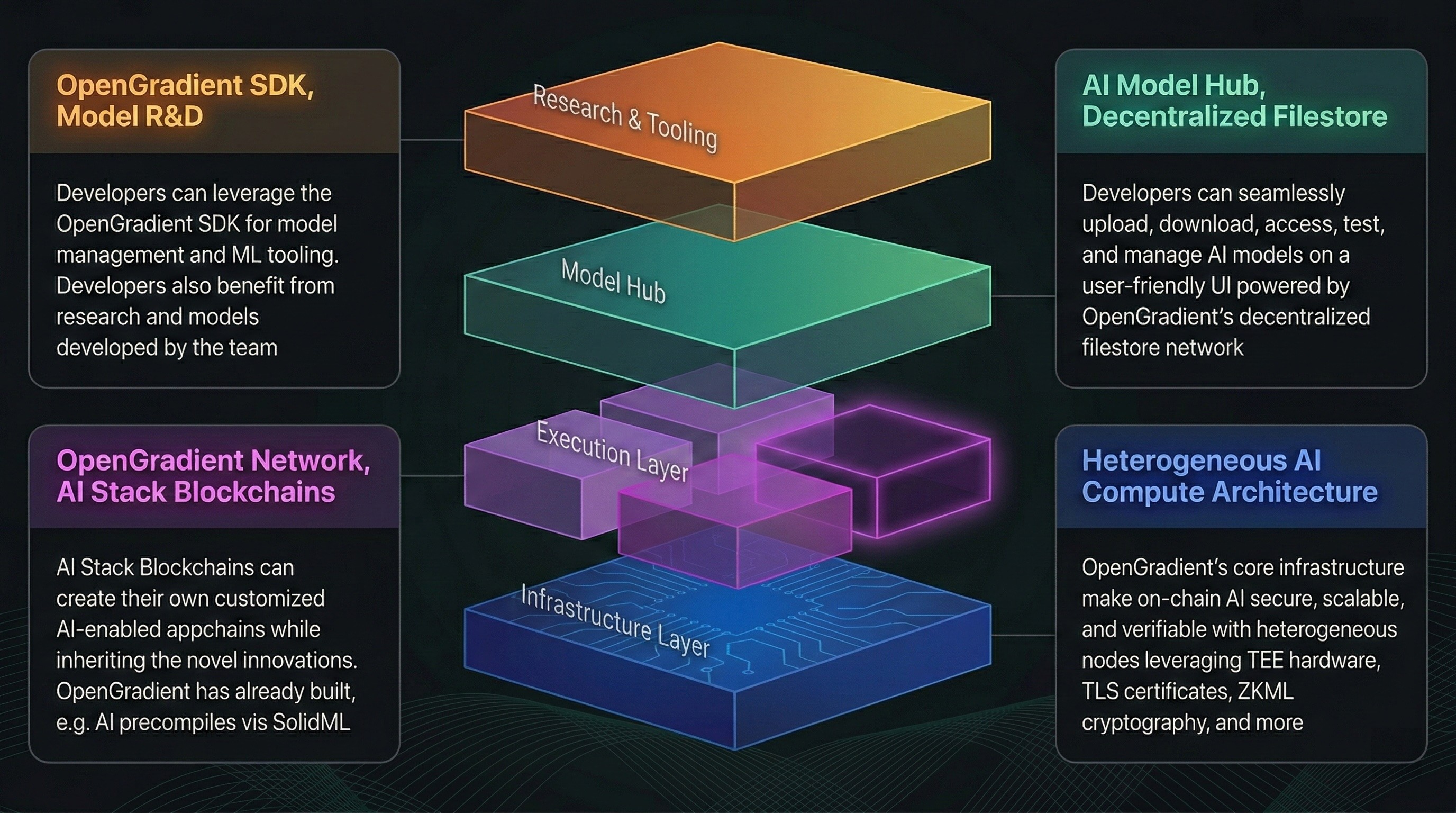
OpenGradient describes itself as "The Network for Open Intelligence." At the core of this system is HACA (Hybrid AI Compute Architecture).
The solution involves performing AI inference off-chain, where dedicated inference nodes execute model computations and generate verifiable proofs (such as TEE or zero-knowledge proofs); on-chain nodes are responsible only for proof verification, without redundant model execution, significantly reducing costs.
The direct benefits of this approach are maintaining performance while bringing "trust" back on-chain.
The entire network operates in different roles:
· Full nodes handle consensus and validation;
· Inference nodes provide computing power to execute models (locally or calling external models);
· Data nodes are responsible for fetching trusted external data;
· The storage layer (Walrus) is used to store models, inputs and outputs, and proof data, ensuring data availability and consistency through on-chain references.
Furthermore, HACA features a key design element—asynchronous verification: users receive the inference result first, with verification and settlement following.
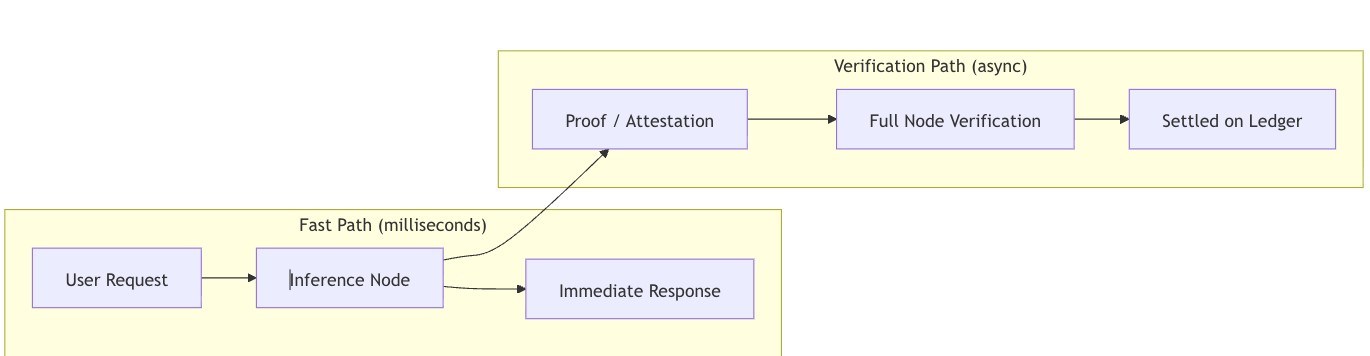
So, what does the on-chain layer do? Serving as the validation and settlement layer for AI inference and applications, OpenGradient's blockchain layer utilizes the CometBFT consensus, is compatible with Cosmos SDK and EVM, and is specifically responsible for node registration, proof validation, payment processing (payments for x402 LLM inference scenarios are settled on Base), and ledger management.
Regarding Proof of Validation, how to "prove that AI hasn't deceived"? OpenGradient provided a "Trust Level Menu":
· TEE: Runs in secure hardware, proving that the code and environment have not been tampered with.
· ZKML: Zero-Knowledge proof that the model is executed correctly, suitable for high-risk, high-impact scenarios;
· Vanilla: Only signature verification, suitable for low-risk scenarios.
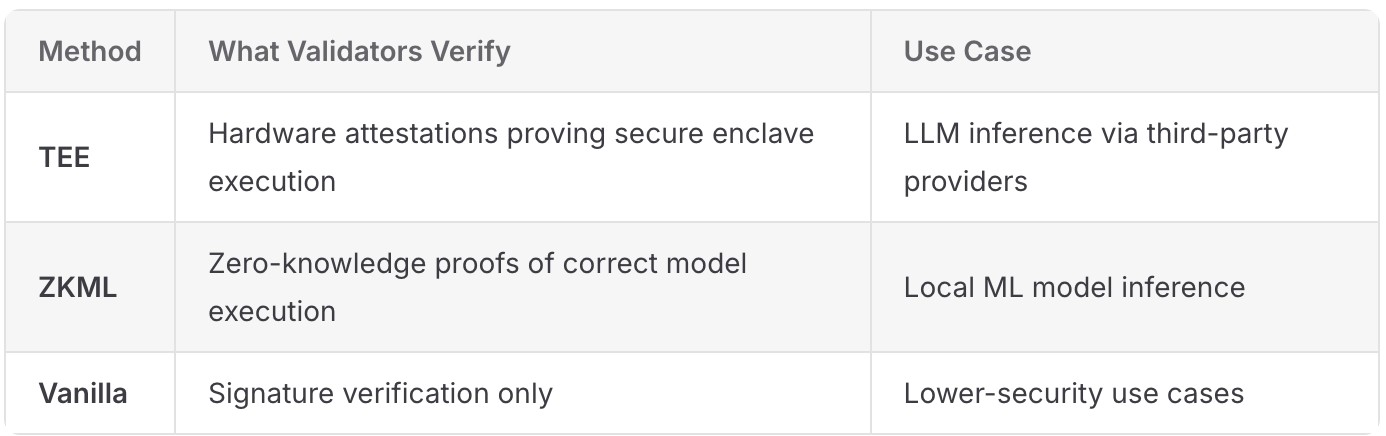
For different scenarios, you can choose different cost and security level solutions. Regardless of the validation method chosen, it ultimately needs to go through network consensus confirmation—proof will only be formally written onto the chain when over 2/3 of validators reach an agreement.
OpenGradient has also built a series of products and services around this core capability, aimed at creating a complete on-chain AI ecosystem.
· Model Hub: A decentralized model repository where developers can publish, discover, and use various open-source models. Model Hub also utilizes the Walrus decentralized storage network to ensure the permanent availability and censorship resistance of model data.
· x402 Gateway: Enables paid AI invocation.
· MemSync (AI Long-Term Memory): Addressing the core needs of an AI Agent, MemSync provides a persistent AI memory layer that automatically extracts meaningful memories from conversations, documents, websites, Twitter profiles, and other sources, intelligently organizes them, and enables searching through semantic search.
· Twin.fun (Digital Twin Marketplace): An AI avatar marketplace that can trade, unlock tools, and provide utility.
What about the Tokenomics?
If the network architecture answers "how to establish it technically," then the OPG token answers "how to operate it economically."
OpenGradient will conduct a TGE on Virtuals on April 23 and will also be listed on Coinbase. Additionally, the 46th exclusive TGE project, OpenGradient (OPG), will be listed on the Binance Wallet.
The design of OPG is not merely incentivization but rather binding network behaviors, including inference payments, model monetization, staking, and app access.
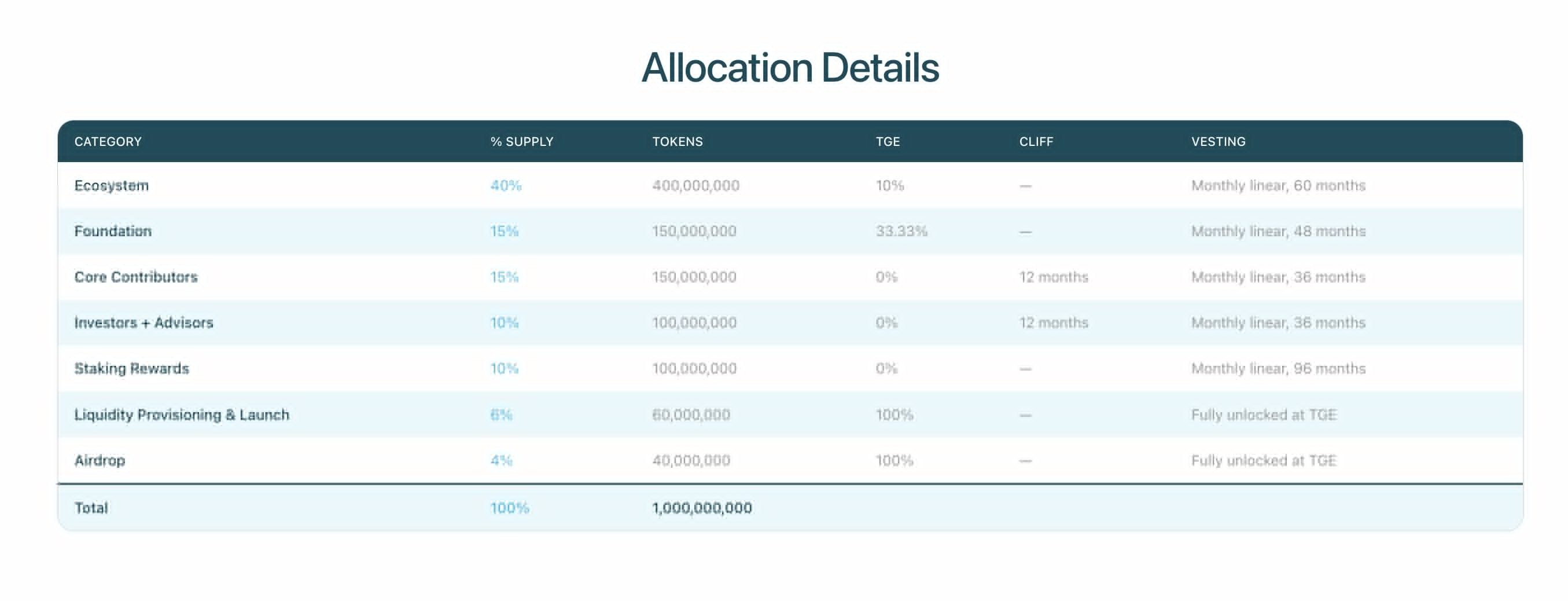
The total supply of OPG is fixed at 1 billion tokens, distributed as follows:
· Ecosystem (40%):
· Foundation (15%): 33.33% unlocked at TGE, with the remaining released over 48 months.
· Core Contributors (15%): Team allocation, with a strict 12-month lockup period and 3-year linear vesting.
· Investors and Advisors (10%): Unlocking conditions aligned with the team.
· Staking Rewards (10%): Supporting network consensus security.
· Liquidity and Airdrops (10%): Including a 4% airdrop allocation.
Summary
The core logic of OpenGradient is not complicated: if AI begins to engage in transactions, decisions, and fund flows, then "trust" must be proven.
Of course, the real issue is this: do most scenarios really require "AI validation"? Will users be willing to pay a higher cost for "verifiability"? These questions have no standard answers. What OpenGradient is doing is not optimizing AI but rewriting "how AI is trusted."
