This week on Wall Street, the most discussed topic was Jane Street.
With 3,500 employees, no banking license, no advisory fees, and no investment banking business, Jane Street relies solely on trading and is projected to generate $39.6 billion in revenue for the full year 2025. This surpasses JPMorgan Chase, Goldman Sachs, and any other institution in Wall Street's history.
Based on a 65-70% profit margin, the company's per capita profit is approximately $8 million to $9 million. Among all companies with more than 1,000 employees worldwide, this is a record. Citadel Securities next door, with 1,800 employees, has a per capita profit of $3.6 million; Hudson River Trading is at $6.6 million; even a company like Nvidia, which is showered with money from around the world, has a per capita profit of only $2.9 million.
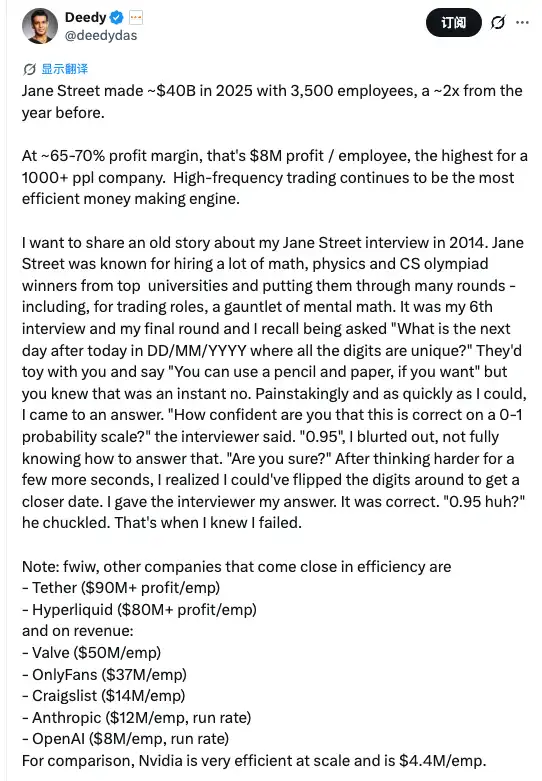
So this week, the entire Twitter finance community was discussing one thing: how did Jane Street manage to recruit these people?
The Most Difficult Company to Enter on Wall Street
The name Jane Street is not unfamiliar in the crypto world.
FTX founder SBF's first job was as an intern at Jane Street. SBF's ex-girlfriend, Caroline Ellison, who later became the CEO of Alameda, also came from Jane Street. SBF later mentioned repeatedly in Michael Lewis' book that the market mindset he learned at Jane Street nearly determined all his trading instincts for FTX and Alameda.
Many fund founders and project leaders in the crypto world, before transitioning to crypto, had intersections with Jane Street on their resumes, but most of them only "interviewed" with them, not "received an offer."
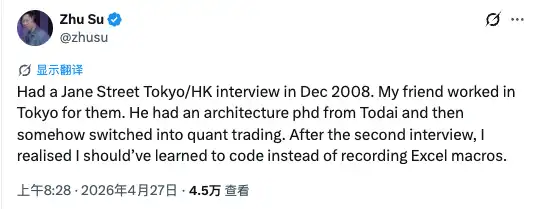
Zhu Su, founder of Three Arrows Capital, also tweeted a recollection: "In December 2008, I interviewed at Jane Street in Tokyo and Hong Kong. My friend was working in their Tokyo office at the time, a Tokyo University PhD in architecture who switched to quant trading. After my second round of interviews, I figured something out - I should learn programming instead of messing around with Excel."
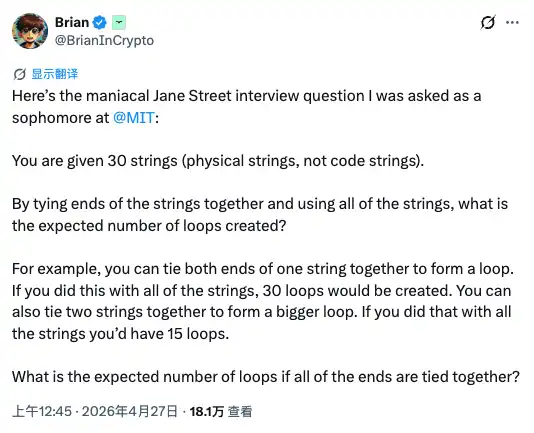
The growth lead of the Monad Foundation retweeted a question he was asked during his sophomore year at MIT, saying, "I still remember how insane that interview was." Brian, co-founder of Glider Finance, also discussed the same long-standing cryptographic puzzle from Jane Street.
Many senior players in the crypto community have crossed paths with this company at some point.
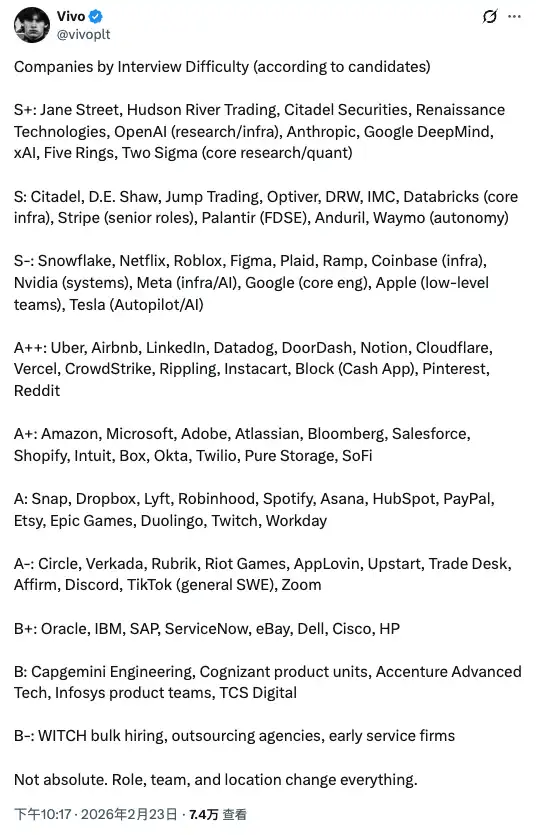
And Jane Street's company interview difficulty is among the top in the entire Wall Street. According to Twitter user @vivoplt's candidate interview difficulty ranking, Jane Street is at the top of the S+ difficulty level, on par with top AI labs.
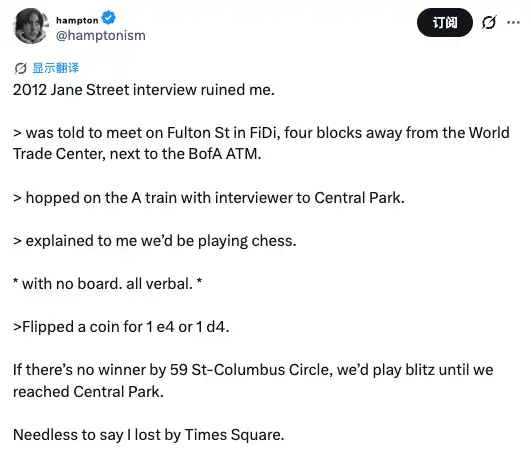
A Twitter user, Hampton, shared a memory of his 2012 interview. It reads somewhat like dark humor: they met in the financial district near Fulton Street, next to a Bank of America ATM near the World Trade Center. Then the interviewer took him on the A train towards Central Park. They played international chess on the subway. However, they had no board; it was all verbal. They tossed a coin to decide whether to start with 1.e4 or 1.d4. If they hadn't determined a winner by Columbus Circle on 59th Street, they would start speed chess until Central Park. Hampton said he lost at Times Square station.
Another investor named Alex Song recalled his Jane Street interview in 2010: "The worst interview of my life. One hour, the guy across from me explained the rules of a certain card game and gave me an hour to figure out a winning strategy. This was definitely not something from the Putnam Math Competition, but worse than D.E. Shaw, QVT, DRW."
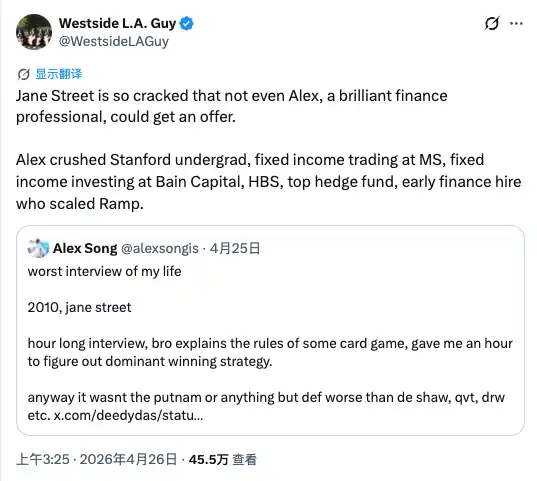
Another retweeter added: This Alex later went on to crush Stanford undergrad, trade fixed income at Morgan Stanley, do fixed income investing at Bain Capital, get a Harvard MBA, work at a top hedge fund, and be an early finance recruiting lead at Ramp, but Jane Street didn't hire him.
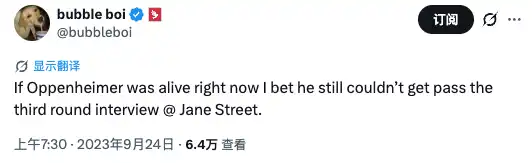
One interviewee said, "This is still the toughest interview process in investment banks. You can prepare for interviews at other companies, but you really can't prepare for Jane Street." Some even joked online, "If Oppenheimer were still alive today, I bet he still couldn't pass Jane Street's third-round interview."
Tricky Interview Questions
Just hearing stories is not satisfying enough. Below are several questions that have been repeatedly discussed on Twitter. The Lawrencium editor has selected a few questions of varying difficulty levels. Readers can also try them out and see how many they can answer.
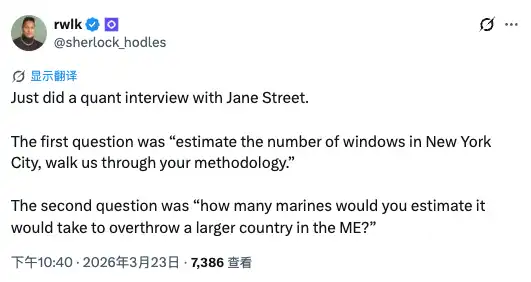
Question 1: "Estimate how many windows there are in New York City? Explain your methodology."
Question 2: "How many Marines do you think would be needed to overthrow a major country in the Middle East?"
Question 3: "A safe has a six-digit password. The lock will indicate whether we have entered four or more correct digits, but it will only truly open when all six digits are correct. What is the optimal strategy to find the password with the fewest attempts?"
Question 4: "You have 30 actual ropes in your hands (not strings in the code). Pair up all 60 endpoints randomly. How many loops would you expect to form? For example, tying both ends of a rope together = 1 loop; doing this with all 30 ropes = 30 loops. Tying the ends of two ropes together = 1 big loop; doing this with all 30 pairs = 15 loops."
Question 5: "What is the next nearest date after today where all the digits are unique? Format DD/MM/YYYY. How confident are you?"
Question 6: "What is the nearest integer to the square root of 1420?"
Question 7: "I have a relative who is a professional baseball player. What is the probability that this statement is true?"
Question 8: "What is the smallest positive integer consisting only of 1s and 0s, and is divisible by 15?"
Question 9: "At 3:15 PM, what is the angle between the hour and minute hands of a clock?"
Question 10: "You have the opportunity to bid on a treasure chest. The actual value of the chest is a number between 0 and 1000 US dollars, and you are 100% confident it is within this range. If your bid equals or exceeds the true value, you get the chest at your bid price; if it's below, you get nothing. Meanwhile, you have a friend willing to buy it from you at 1.5 times the true value. How much should you bid?"
Question 11: "I will now roll a 20-sided die (with numbers 1 to 20). How much money are you willing to pay to play this game once, where the amount of money you receive is equal to the number on the die? Now, let's change the rules: each round, you can choose to either 'take the current number on the die' or 'reroll once'. A total of 100 rounds. What is your optimal strategy? How much is this game worth?"
Question 12: "There are 100 sentences written on a blackboard. The 1st sentence says 'Of these 100 sentences, at most 0 are true.' The 2nd sentence says 'Of these 100 sentences, at most 1 is true.'... The nth sentence says 'Of these 100 sentences, at most n-1 are true.' The 100th sentence says 'Of these 100 sentences, at most 99 are true.' How many sentences among the 100 are actually true?"
Question 13: "I flip 4 coins. What is the expected number of heads? Now, you are given one chance to flip all 4 coins again (you must accept the new result). What is the new expected value?"
Question 14: "Two evenly matched teams are playing a best of seven series. What is the probability that the series will go to the 7th game before a winner is determined?"
Question 15: "Assume you are co-hosting a party with one of your roommates and have invited 10 other pairs of roommates. During the party, you ask everyone except yourself: How many people have you shaken hands with? It is known that no one has shaken hands with their own roommate, and each person gives you a different answer. How many handshakes did your roommate participate in?"
Question 16: "100 prisoners are held in 100 independent cells. There is a single light bulb room in the prison, and only one prisoner is allowed in at a time to turn the light on or off. Prisoners are randomly taken to the light bulb room, and the order and frequency are completely uncontrollable. Any prisoner can declare at any time: We have all been in this room. If correct, they all go free; if wrong, they are all executed. The prisoners can strategize before the game begins but cannot communicate once it starts. What is the optimal strategy?"
Question 17: "I have 10 coins. One is a fair coin (50% heads, 50% tails), and the other 9 are biased, but the extent of bias is unknown for each. With a limited number of tosses, how do you identify the fair coin?"
Question 18: "1000 ninjas are standing in a circle, each holding a knife. Ninja 1 kills Ninja 2, Ninja 3 kills Ninja 4, Ninja 5 kills Ninja 6, and so on around the circle until only one remains. Which ninja survives?"
If you’ve made it through all the previous phone interviews, the final stage is called Super Day. When you walk in, the staff hands you 100 poker chips. Next up are 4 to 6 consecutive one-hour technical interviews, each conducted by a current trader facing off against you. In each round, you must use these chips to place bets or make markets. When SBF entered Super Day years ago, he was told, “No one who has lost all their chips has ever received an offer.”
What Jane Street Is Looking For
Augustin Lebron, a former trader at Jane Street who worked in the London office for several years and managed the intern class that included SBF, wrote a book called "The Laws of Trading" after leaving Jane Street. In an interview, he candidly stated, “On a global scale, maybe only one or two thousand newcomers can enter truly good quantitative trading firms each year."
“I've talked to many students. If you ask them: Why do you want to do this, they would say math is very interesting, AI is very interesting, statistics is very interesting. But these skills can be applied in many other areas, so this reason alone is not convincing.” However, Augustin Lebron believes that the real answer is usually twofold: first, it's a prestigious thing to do; second, they actually want to get rich.
So, what kind of people does Jane Street actually hire?
In the interview, Augustin Lebron clearly stated that these institutions recruit based on raw talent, not knowledge. This means their past experiences have pre-trained them for this profession, such as people who have played poker, engaged in sports betting, and have actually made money. People who have experienced making decisions in uncertainty in life and have to bear economic consequences for those decisions.
Another very typical type of person is one who will quickly drop out after joining, even if these individuals are extremely intelligent, excellent at math, and great at problem-solving, but they simply do not enjoy trading. They care more about solving that math problem rather than making money. “In this trading business, you ultimately have to make money.”
Some seasoned Jane Streeters have also summarized a few common reasons why candidates are rejected: overconfidence; silent thinking – Jane Street highly emphasizes thinking out loud, and silent contemplation is a big no-no; refusal to bet – if offered a chance to make a market and you refuse, it means “you are not willing to take risks”; additionally, when you are stuck in a bad position, the interviewer will deliberately give you a terrible quote, if you accept it in a panic, you prove you shouldn’t be hired. Ignoring hidden information in problems, and so on.
And these might just be the key reasons why Jane Street raked in a whopping $40 billion in profit in one year.
Welcome to join the official BlockBeats community:
Telegram Subscription Group: https://t.me/theblockbeats
Telegram Discussion Group: https://t.me/BlockBeats_App
Official Twitter Account: https://twitter.com/BlockBeatsAsia
