The arrival of the AI Agent Economy is providing Web3 with a real opportunity to operate in economic activities.
The promise made at the birth of Web3 was to allow value to flow as freely as information. However, over the past decade, the primary use case of this technology has always revolved around price discovery and asset trading. It has only addressed the question of "how much is this token worth," without truly answering "what can it be used for."
Meanwhile, AI has undergone a key transition in the past two years: from "being able to talk" to "being able to act." With tools such as Tool Invocation, Agent Frameworks, and the MCP Protocol emerging, AI can now autonomously manage wallets and initiate on-chain transactions. However, a new issue arises — when an Agent becomes a new "on-chain user" and needs to collaborate with other Agent users, what "currency" do they use for transactions? What mechanism ensures contract fulfillment? And who arbitrates in case of issues?
Today, these two threads converge on one answer: OKX
The Onchain OS has released the Agent Payments Protocol (hereinafter referred to as: APP) yesterday — an open payment standard designed specifically for AI Agent commercial behavior, and one of the most comprehensive Agent economic infrastructures to date.
What Issues Does the APP Protocol Address
When we talk about a certain protocol, does it feel a bit abstract? Let's use a specific scenario to intuitively understand the design approach of the OKX APP.
Recently, a certain Web3 concept track suddenly became popular, and you wanted to figure out which projects to focus on first. You delegated this task to your trading AI Agent (let's call it Beta). After breaking down the task, Beta found that to give reliable advice, it needed three types of data: on-chain fund flows, the funding background of each project, and a security assessment of the contract code. So, it published three subtasks on-chain, with a total budget of 50 USDG, to be delivered within 24 hours. At this point, the APP's escrow mechanism kicked in — 50 USDG was automatically locked on-chain, securing your payment funds. The three receiving data Agents also confirmed the existence of the reward and could confidently start working.
Five professional Agents were invited to bid simultaneously, and Beta reached agreements with the first three to collaborate: the on-chain data Agent responsible for tracking fund inflows and outflows and whale holdings, costing 15 USDG; the funding data Agent responsible for scraping the funding rounds, investors, and valuations of each project, costing 20 USDG; the contract audit Agent responsible for scanning for code vulnerabilities and risk levels, costing 15 USDG. The APP's negotiation mechanism came into play — each party reached an agreement with Beta on-chain, contracts were automatically confirmed, with no need for any manual intermediaries, and they began working independently.
After 24 hours, three reports were submitted by stakeholders. The APP's verification and settlement mechanism was triggered—Beta automatically checked against preset criteria: Did the on-chain data cover the entire project? Was the funding information traceable to a source? Did the smart contract audit provide a clear risk rating? With all three reports approved, three escrowed funds were automatically released, and the rewards were instantly disbursed.
If any report is missing data or does not meet the requirements, the funds remain locked, and the APP's built-in dispute resolution process is automatically initiated—instead of relying on manual coordination as is the case today, or paying for a service delivery that is not up to par.
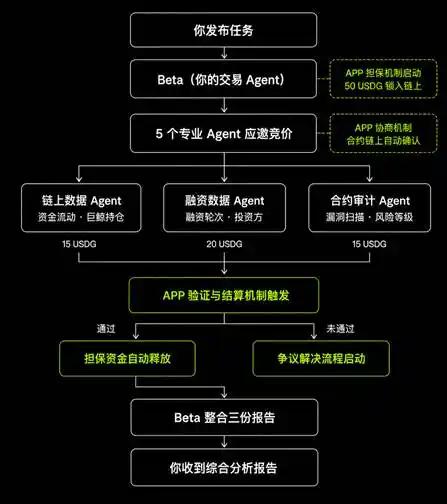
Ultimately, Beta will consolidate the three reports, generating a comprehensive analysis covering the financials, fundamentals, and security aspects, which will be directly sent to you. After reviewing it, you can then devise a trading strategy. The entire process is free of human intervention, invoices, manual transfers, task reminders, or unresolved disputes.
How the APP Protocol Supports Agent Commercialization
Previously, the payment capabilities of AI Agents were at a very rudimentary stage, with existing protocols mainly addressing only the "payment" aspect, corresponding to the basic logic of HTTP-402 protocol: straightforward but extremely limited. The fundamental issue is that these solutions were designed for human-centric services, not for autonomous business interactions between Agents.
What the APP aims to address is precisely this gap: not just enabling Agents to make payments but empowering Agents to reliably conduct business. Meanwhile, you only need to review the results and make decisions.
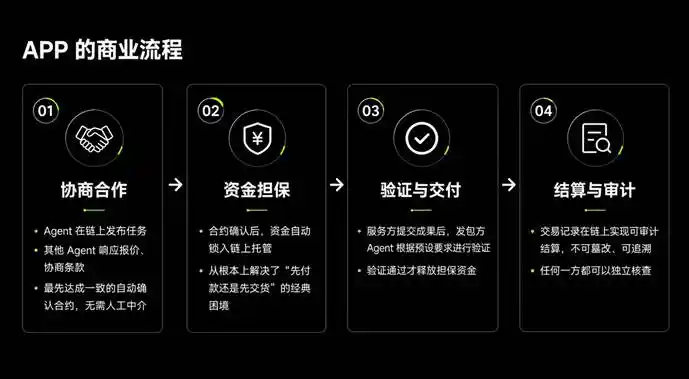
Upgrade of the Business Paradigm: In contrast to existing solutions, the difference in APP lies not in a single feature but in the overall design logic: supporting bidirectional business relationships between Agents.
Open Business Protocol: The APP is an open protocol standard, not an exclusive product of OKX. Similar to how TCP/IP is to the internet, any chain, developer, or protocol can adopt this standard for building, with OKX being the initiator but not the sole participant.
Solid Underlying Logic: The APP protocol is built on top of the OKX OnchainOS foundation. Prior to the release of the APP, OnchainOS had already provided full on-chain operational capabilities for the AI Agent. The APP completes the final piece of the puzzle by introducing a business settlement layer between Agents.
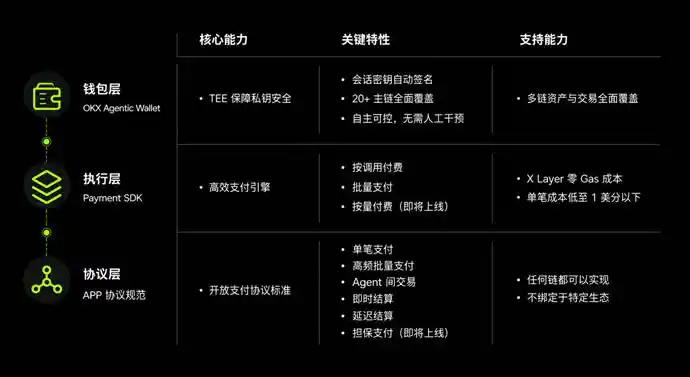
The underlying infrastructure of this system is the OKX core system that has been running in a production environment for many years: with daily API calls exceeding 1.2B+, $3 billion in trading volume, a response time of less than 100 milliseconds, and a system availability of 99.9%. For the AI Agents, the stability of the infrastructure directly determines whether the Agent can reliably fulfill its business commitments. This is particularly crucial for autonomous Agents.
Why Top Institutions Quickly Responded to Join
On the day of the APP release, partners from the public chain, data infrastructure, DeFi protocols, and cloud computing fields successively announced their support. Their evaluations also defined the value of the APP from different perspectives.
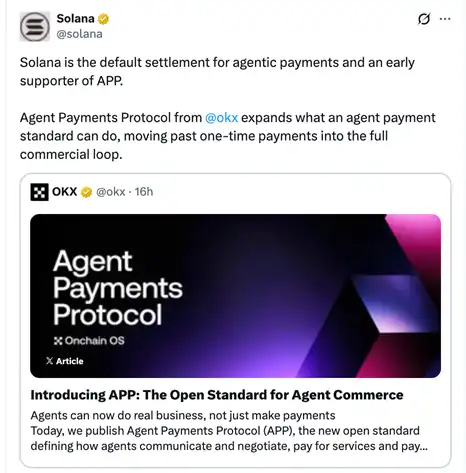
Solana: APP is the Preferred Settlement Layer for AI Agent Payments
The high-performance public chain Solana stated: The APP has significantly expanded the payment capabilities of Agents from individual payments to a complete business loop, positioning itself as the default settlement layer for AI Agent payments—this is backed by Solana's long-term layout for high-frequency, low-latency on-chain settlement scenarios.
Ethereum Foundation: Open Standards are the Way to Scale
Ethereum is currently the world's largest smart contract platform, hosting the vast majority of mainstream Web3 applications. As a first-day partner of the APP, the Ethereum Foundation stated: "Open standards are the way to scale everything," expressing its recognition of the entire open protocol ecosystem, which aligns closely with the APP's positioning as a cross-chain open standard.
Optimism: The True Breakthrough of the APP Lies in the Complete Business Process
Optimism is one of Ethereum's most important Layer 2 scaling solutions, and its assessment of Web3 goes straight to the core: "The real breakthrough is not that an Agent can make payments, but that an Agent can run through an entire business process. Open standards are the way to scale all of this."
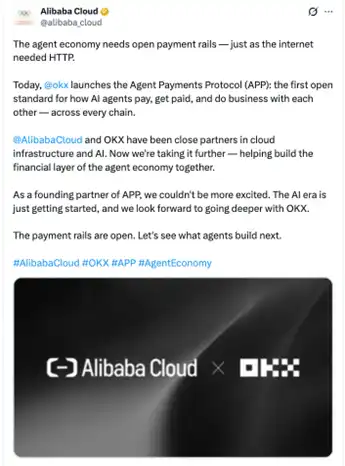
Alibaba Cloud: Just as the Internet needs HTTP
As one of Asia's largest cloud computing service providers, Alibaba Cloud has joined as a founding partner, likening this moment to a key point in the history of the Internet: "The Agent economy needs open payment infrastructure—just like the Internet needs HTTP."
Nansen: On-chain data directly serves the Agent
Nansen, a globally renowned on-chain analytics platform known for tracing the movements of "smart money" in the Web3 investment community, announced its integration into APP as a data partner, enabling Agents to directly query smart fund movements and on-chain P&L data without human intervention—meaning an AI Agent will, for the first time, be able to autonomously make decisions and trades based on professional on-chain data without human involvement.
Uniswap: Born for the Agent
As the largest decentralized exchange protocol in the DeFi space by trading volume, Uniswap announced its support for APP and opened integration interfaces to developers, stating that "Uniswap is born for the Agent."
Web3 Will Become the Mainnet of the AI Economy
Every major technological revolution in history has spawned a primary use case that did not exist before. From email to search, social, and e-commerce, each layer of the Internet has become more deeply embedded in human daily life than the previous layer.
Web3 has followed a similar path—price discovery, DeFi, digital ownership—each stage exploring the boundaries of this technology. The AI Agent economy is likely the next and most substantial use case to date. This assessment is based on a structural match: AI Agents inherently require the features provided by Web3.
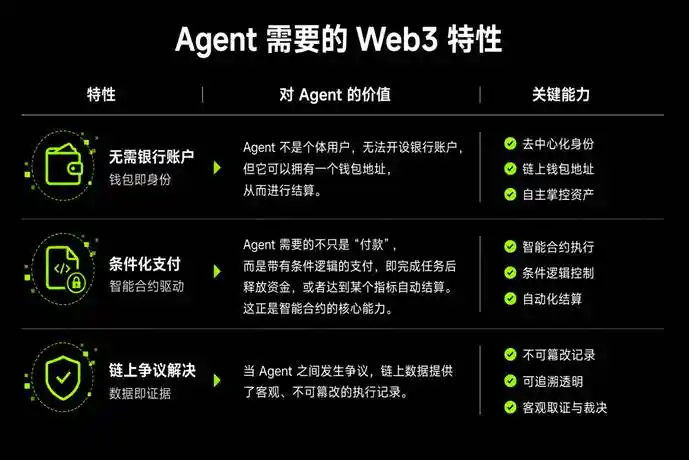
Web3 is not just a tool that AI Agents can use; it is highly likely to become the mainnet upon which the AI Agent economy truly operates—similar to how mobile Internet requires a 4G/5G network, the Agent economy needs Web3 as its foundational infrastructure layer.
The APP is the first specific implementation of this vision. It not only enables the Agent to make payments but also defines a complete business language for the Agent. As more and more chains, protocols, and applications adopt this standard, the Agent Economy establishes a unified settlement rule, much like the Internet has TCP/IP and the global trade has a letter of credit system.
Web3-Based AI Payment Rail Ready
Web3's transition from price discovery to a broader range of use cases is not a new vision and predates the birth of Bitcoin.
However, what is needed between vision and reality is specific infrastructure. The Internet's ubiquity is not due to how great the TCP/IP protocol is but because there are enough applications built on top of it that allow ordinary people to feel its value.
The arrival of the AI Agent Economy is providing Web3 with such an opportunity: not just a speculative tool but a settlement layer for economic activities that actually operate on it.
The Agents are learning to do business. They need a payment rail.
The APP is exactly that rail.
Welcome to join the official BlockBeats community:
Telegram Subscription Group: https://t.me/theblockbeats
Telegram Discussion Group: https://t.me/BlockBeats_App
Official Twitter Account: https://twitter.com/BlockBeatsAsia
