Following a non-deal roadshow with NVIDIA CEO Jensen Huang, CFO Colette Kress, and the investor relations team, Morgan Stanley maintains an "Overweight" rating on NVIDIA, with a target price of $288 and a top pick status in the semiconductor industry. Based on the analyzed closing price of $202.78 on July 9th, the target price implies approximately a 42% potential upside.
The core conclusion of this report is that even as NVIDIA's quarterly revenue nears $100 billion, the growth rate could continue to accelerate. This acceleration is not driven by a single product cycle but by demand sources transitioning from traditional hyperscalers to AI Labs, new AI clouds, enterprise clients, and sovereign AI projects. The networking and CPU businesses are also expanding the company's addressable market.
$288 Relies on Earnings Growth, Not Valuation Multiple Expansion
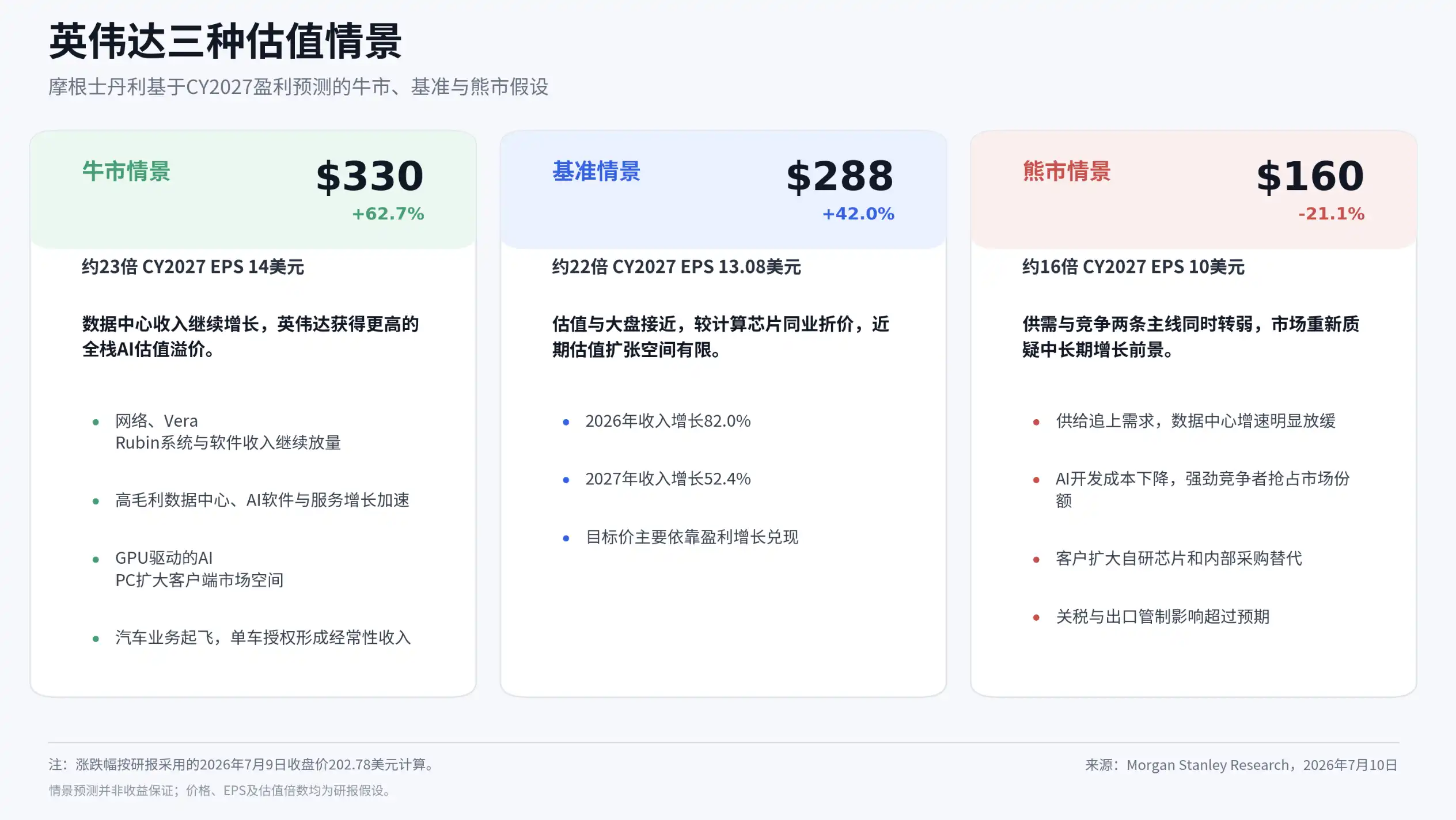
Morgan Stanley's base case scenario uses a roughly 22x 2027E P/E multiple, corresponding to earnings per share of $13.08 and a target price of $288. The report specifically notes that this valuation is roughly in line with the broader market and lower than computing chip peers like AMD, Broadcom, and Intel.
In other words, Morgan Stanley does not assume that NVIDIA can sustainably achieve a higher valuation multiple. With the company's market share, gross margin, and market value all at elevated levels, there is limited upside in the short term from valuation expansion driving the stock price. Whether the target price is met largely depends on the continued significant growth in revenue and earnings.
The base model forecasts NVIDIA's revenue to grow by 82% in 2026 and another 52.4% in 2027. GAAP revenue is projected to increase from $215.9 billion in 2026 to $393 billion in 2027, reaching $598.8 billion in 2028, and further rising to $783.9 billion in 2029. During the same period, EPS is expected to rise from $4.61 to $17.63.
The bull case scenario target price is $330, corresponding to roughly 23x 2027E EPS of $14. This scenario requires data center revenue to maintain high growth, the Vera Rubin system, network, and software businesses to scale further, while AI PCs and automotive businesses open up new markets.
In a bear market scenario, the price target is $160, corresponding to a P/E ratio of about 16x with an earnings per share of $10. Triggering factors include a significant slowdown in data center growth, rapid decline in AI development costs, loss of market share to competitors, cloud providers introducing custom chips, and increased impact from tariffs and export restrictions.
Three Growth Drivers Simultaneously Activated
During the roadshow, the management team categorized the sources of growth into three types, which is also the main basis for Morgan Stanley's optimistic outlook.
The first category is the AI Lab, currently accounting for about 20% of NVIDIA's total demand. The report mentions that a customer primarily relying on ASICs to develop cutting-edge models had a low historical usage of NVIDIA, which has now increased to nearly 50%. Other major cutting-edge models still primarily use NVIDIA's computing platform.
This information was used by Morgan Stanley to counter concerns that "ASICs will rapidly replace GPUs." While cloud providers will continue to develop custom chips, lower-priced chips may not necessarily result in lower token costs. Software maturity, network efficiency, cluster utilization, and deployment speed will all affect the final cost. The report predicts that NVIDIA's and Broadcom's AI businesses could both grow by over 80% in the next year, indicating that GPUs and ASICs can grow simultaneously during a phase of rapid demand expansion.
The second category is traditional hyperscale cloud providers, accounting for about half of the company's revenue under the new segmentation. This demand remains strong, and factors limiting expansion are gradually shifting towards land, power, and data center space. NVIDIA's growth within cloud providers is also starting to extend from GPUs to networking and CPUs.
The company reaffirmed that the 2026 CPU business target is about $20 billion, with nearly half of it potentially coming from standalone CPU cabinets rather than complementary nodes in GPU systems. The Vera CPU plan is set to enter standalone cabinets in the second half of the year, targeting AI scheduling, single-threaded computing, and memory optimization tasks.
The third category is AI clouds, industrial, and enterprise customers, currently representing about half of data center revenue. Morgan Stanley believes that power and land constraints, localization requirements, and countries developing autonomous AI capabilities may drive the growth rate of new AI clouds and sovereign AI projects beyond that of traditional cloud providers.
Retail, financial, and biotech enterprise customers are also building more specialized AI systems. The pace of project initiation may be slow, but once individual projects enter the construction phase, procurement scales may rapidly increase.
Rubin Plan on Track, Memory Shortage Bringing Two-Way Impact
In terms of the product cycle, Morgan Stanley expects Vera Rubin to drive growth in the next 12 months.
Regarding market rumors that Rubin Ultra may be delayed until 2028, NVIDIA management stated that the product will still be delivered next year. The company is indeed adjusting the cabinet form factor, with the original Kyber cabinet being replaced by a new solution to support a larger single-cabinet expansion scale. However, the 800V power supply and cross-cabinet optical interconnect are still progressing as planned.
This distinction is crucial. Confirming that the product schedule remains unchanged does not mean that there have been no adjustments to the cabinet design and mass production process. Whether Vera Rubin can smoothly ramp up still depends on the progress of power supply, optical interconnect, data center construction, and customer deployment.
Memory supply may be tight for several years. Management proposed that computing, networking, and memory can compensate for each other through system design. The report cited examples where NVIDIA had halved the usage of LPDDR5 in a single cabinet to ensure more cabinet deliveries, and mentioned that Groq's use of SRAM technology may provide another architectural direction.
This is not a one-way benefit for memory manufacturers such as Micron, Samsung, and SK Hynix. Years of shortage have been favorable for prices and profits, but NVIDIA may control consumption by reducing memory per cabinet, changing the architecture, or optimizing the network. The view from Morgan Stanley is that the premise of architectural adjustments occurring still relies on years of ongoing supply tightness and is currently insufficient to change the memory landscape.
Why NVIDIA is Back at the Forefront of the Supply Chain
Morgan Stanley had previously shifted semiconductor preference from NVIDIA to SanDisk and then to Micron, citing that storage and supply chain targets have greater profit elasticity in an upswing cycle. Now, Morgan Stanley has once again chosen NVIDIA, emphasizing relative valuation and profit certainty.
Since being reinstated as the top pick, NVIDIA's stock price has risen but has lagged behind some supply chain peers. The report suggests that other parts of the supply chain may still have greater elasticity, but NVIDIA has become a more prominent target in the sector. With an estimated 2027 P/E ratio of around 22 times, lower than some computing chip peers, and with high growth visibility in the next two years.
The management's roadshow this time also actively reached out to more value-oriented investors. The report states that the company plans to use at least 50% of its cash flow for cash returns starting now. For NVIDIA, which is already widely held by growth funds and some fund positions are close to the upper limit, expanding the group of value investors could become a new source of funds.
But the position is not light. Page 5 of the report shows that active institutional ownership is approximately 50.9%, related hedge funds have a long/short ratio of 2.1, and sector net exposure reaches 29.5%. The market consensus is also highly bullish, with page 4 showing that 94% of analysts have a Buy rating.
This means that NVIDIA's future stock price increase will still require continuous earnings forecast revisions. Simply maintaining strong demand may not be enough to drive a stock, with a market capitalization close to $5 trillion and already high institutional ownership, to continue to significantly outperform.
Morgan Stanley's $288 price target ultimately hinges on three things. The AI lab and new customers continue to drive demand, Vera Rubin maintains product leadership, and the CPU and networking business increase NVIDIA's revenue in a single AI system. Falling short on any one of these factors could compress earnings growth. Only when all three materialize does NVIDIA have the opportunity to approach $288 based on profit growth without further expansion in valuation multiples.
Welcome to join the official BlockBeats community:
Telegram Subscription Group: https://t.me/theblockbeats
Telegram Discussion Group: https://t.me/BlockBeats_App
Official Twitter Account: https://twitter.com/BlockBeatsAsia
