Let's start with a fun math puzzle: If you double 1 cent every day for 30 days, how much money would you have at the end? Most people would guess a few hundred dollars. But the real answer is over $5 million.
Almost no one gets it right on the first try because the human brain isn't built to intuitively understand these calculations. Our minds are naturally inclined toward linear logic. We can quickly assess the safety of crossing a street with a glance at oncoming traffic, but when it comes to imagining something growing exponentially each year, we tend to severely underestimate the final scale, often by thousands or millions of times.
Throughout human history, this cognitive limitation was largely irrelevant. The speed of development for every tool we created, every system we built, was in line with our linear intuition.
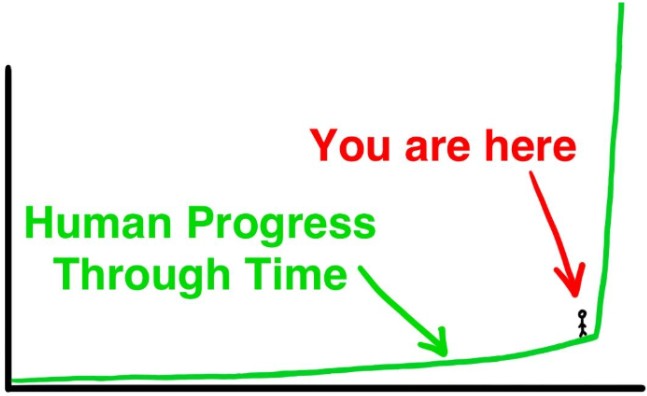
However, for the first time, humanity now possesses a non-linear intelligent system: one that self-compounds, self-feedbacks, and accelerates continuously. In tandem, five or six exponential growth curves have reached the steep incline of the S-curve simultaneously, ushering in a convergence of multiple transformations.
In April 2021, I first presented this perspective in my GMI column "The Age of Exponential Growth." Looking back now, I realize that the trends I observed at that time were far larger in scale than I had imagined.
What Did I Get Right and Where Was I Wrong?
In 2021, my core belief was crystal clear: the depreciation speed of fiat currencies far exceeds market pricing, and only a few assets' compounding growth rates can outpace inflation, with Bitcoin and tech stocks being prime examples. This assessment still holds true. However, I severely underestimated the scale of the subsequent transformation.
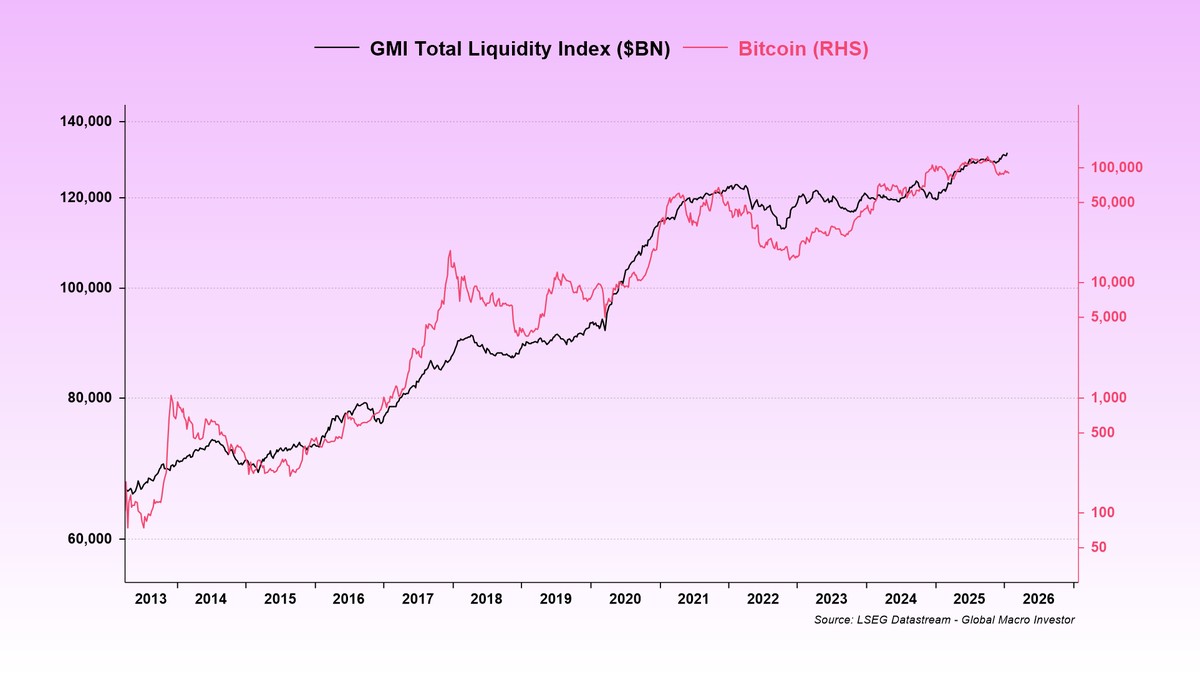
At that time, my focus was primarily on central bank balance sheets, with a specific emphasis on the Federal Reserve. This analytical direction was not wrong, but my perspective was incomplete. The true core driver was not a single central bank but global aggregate liquidity: major central banks worldwide, ongoing sovereign debt rollovers, and commercial bank credit expansion, all acting in concert like a relay race. If the Fed tightens, China or Europe will take the baton of easing.
If one only focuses on a single central bank, they would misjudge the entire market cycle. The year 2017 is a classic example: the Fed was unwinding its balance sheet, yet global markets continued to rise unilaterally because of synchronous easing in China and Europe, leading to the ongoing expansion of global aggregate liquidity. Those who solely tracked the Fed failed to anticipate this bull market.
With the current global liquidity expanding at an annual average rate of about 8%, on top of the usual inflation, for assets to maintain their purchasing power, your real minimum yield needs to be close to 11%.
A Truly Transformative Force
The logic of currency devaluation can explain why money is becoming increasingly worthless, but it fails to fully account for the sensation of everything accelerating at this moment. What is accelerating is not just the market trends; the entire pace of societal transformation is rapidly increasing.
This is another independent force on top of liquidity, and it is the core reason why the logic of the "Age of Exponential Growth" has become even more crucial today, five years later.
In 2021, I identified five major growth curves: Artificial Intelligence, Robotics, Photovoltaics and Energy Storage, Biotechnology, and Blockchain Networks. The race list remains unchanged, but what has changed is the growth stage at which they find themselves.
In 2021, most of these technologies were still on the eve of theoretical implementation. Those who observed closely could foresee the trends, but large-scale commercialization had not yet arrived. Five years later, the five major technologies have all accelerated simultaneously, empowering each other and developing in synergy. This kind of technological fusion has completely rewritten the logic of development.
Artificial Intelligence
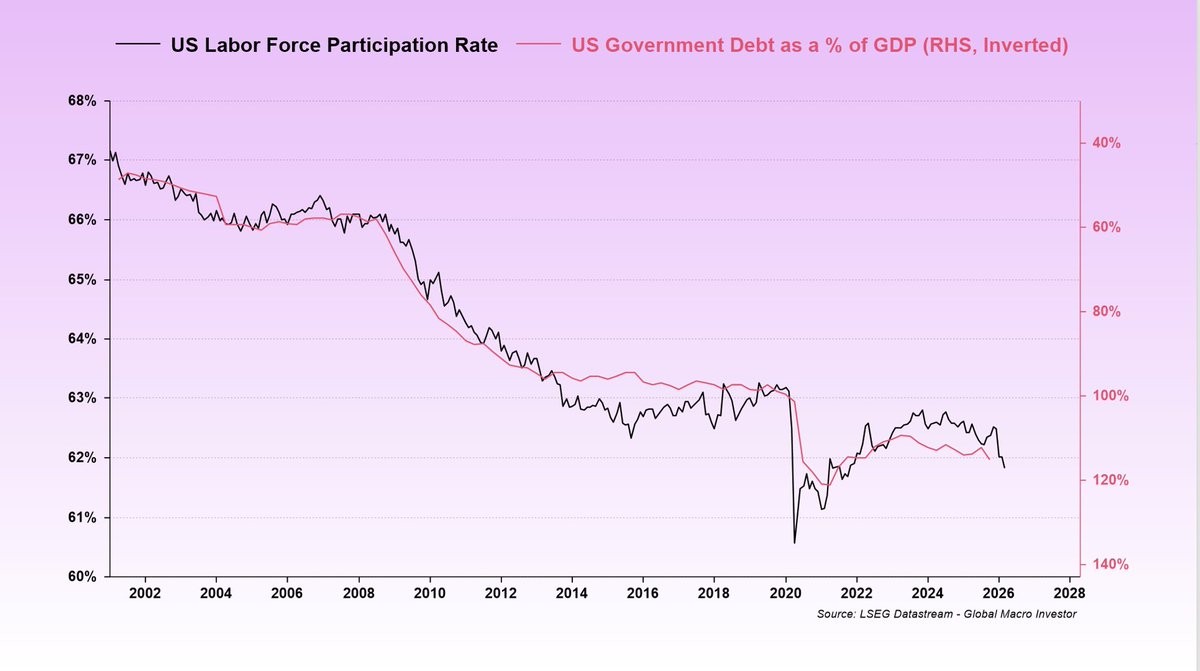
Most people overlook the underlying logic behind debt expansion. Countries continue to increase their debt not out of leaders' stubbornness or incompetence, but due to demographic structure. Aging populations, shrinking workforces, fewer producers, and more social welfare recipients. Relying solely on human labor cannot achieve natural economic growth, so countries can only expand debt, relying on expanding their balance sheets to bridge the gap.
Artificial intelligence has disrupted this cycle. AI agents can perform white-collar knowledge work, humanoid robots can take on physical labor, and economic growth is no longer limited by the quantity of working-age population. We have created "artificial labor supply." The productivity curve that was burdened by demographic structure is now on the rise again, without the need for the debt expansion that has been relied on for the past fifty years.
At the same time, there is a deflationary force at work. The marginal cost of intelligent services is approaching zero, and the prices of many goods and services are rapidly declining. This cannot immediately eliminate the issue of currency devaluation, but it will reshape the logic of yield calculation. When AI compresses the entire production chain's costs, the significance of the previously mentioned 11% yield threshold will also undergo a fundamental transformation.
The speed of all these developments is astonishing and deserves our careful examination. Over the past six years, the duration for which AI can autonomously complete complex tasks has roughly doubled roughly every seven months. OpenAI's GPT-3 model has already surpassed human performance in the corresponding research field of some domains, and its development speed shows no sign of slowing down.
Energy
Every technological transformation faces a core bottleneck: energy. AI and robots rely on computing power, which consumes electricity. Currently, the global computing power being built is unprecedented, and energy has become a hard constraint on the entire technological transition. Microsoft is investing in nuclear power, Google has signed a geothermal project, not just to achieve carbon neutrality, but because the local grid power supply is no longer sufficient to support the operation of computing clusters.
China was the first to see this, and its efforts are the most aggressive. In 2024 alone, China's newly added photovoltaic installed capacity exceeded the total newly added capacity of all other countries in the world.
At the core of this is a little-known economic law—the Wright's Law. This law was derived from production data from aircraft manufacturing plants in 1936: as the total cumulative production of a certain type of product doubles, the production cost per unit will decrease by a fixed percentage. As workers become more skilled, defect rates decrease, and engineers optimize materials (reducing silver, thinning silicon wafers, etc.), costs continue to be reduced.
Among all known technologies, photovoltaics best fit the Wright's Law. For every doubling of the global installed photovoltaic capacity, manufacturing costs decrease by over 20%. By relying on large-scale production capacity, China has significantly increased the global cumulative photovoltaic production, driving the entire industry to achieve cost reductions more rapidly along this downward curve.
Today, the price of photovoltaics has plummeted by 90% compared to a decade ago, and there is still ample room for cost reduction. Photovoltaics have four unique advantages: low cost, short construction period, distributed deployment, and unlimited scalability, making them incomparable to fossil fuels. Other energy categories will always encounter a production capacity ceiling in some part of the supply chain, while the only limit for photovoltaics is the available sunlight area.
Energy storage was once the biggest weakness of photovoltaics, but this weakness is rapidly being addressed. Tesla's Megapack energy storage business has grown at an annual rate of 50%-70%, with new factories continuously meeting demand. The cost of grid-level energy storage batteries is rapidly declining, and most people have yet to realize how much this will bring about a transformation.
Even more crucial is the closed-loop positive feedback cycle: AI optimizes grid scheduling, reducing electricity costs; lower electricity prices further reduce computing costs; cheap computing power, in turn, iterates on stronger AI, and AI optimizes the energy system once again. Several growth curves are no longer developing in parallel but are mutually reinforcing, amplifying the growth rate.
Cryptocurrency
The correlation between Bitcoin and global liquidity has been thoroughly demonstrated. Since 2012, about 90% of Bitcoin's price fluctuations have corresponded to liquidity cycles. This core logic remains valid to this day, even more so than the correlation I summarized back then.
However, the crypto industry has a core logic in 2021 that was almost non-existent and is now impossible to ignore. AI agents need to transact, and in the future, there will be millions or even billions of intelligent entities that autonomously purchase services, allocate resources, and settle transactions automatically between machines. The current human financial system, including clearinghouses, correspondent banks, and a three-day settlement cycle, is wholly incapable of meeting this demand. An intelligent economic system cannot be built on top of the traditional financial infrastructure.
The cryptographic technology aligns perfectly with the demand: programmable, trustless, instant settlement, and no counterparty risk. Blockchain is the only infrastructure capable of adapting to a super-intelligent economy with synchronous scalability. The landing logic of the crypto track has become convincing, and the necessity of adapting to AI autonomous trading has made cryptocurrency an inevitable trend.
Convergence
The uniqueness of this round of transformation lies here. Every previous technological wave appeared independently, taking decades to achieve mass adoption: the internet followed one growth curve, and mobile internet followed another. Each reshaped the economy in succession, with ample buffer time in between for various institutions to gradually adapt.
However, currently, multiple exponential curves are synchronously reaching the steep ascent stage of the S-curve and mutually propelling each other. AI designs more advanced chips, and advanced chips train stronger AI; cheap energy supports massive computing power, and massive computing power optimizes energy scheduling; the encrypted network completes intelligent body transactions without humans or banks.
A single technological curve can continue to grow on its own, but when stacked and fused together, the overall growth rate far exceeds the level of development of a single technology evolving independently.
Global cloud service providers' capital expenditures exceed $600 billion annually, with a year-on-year increase of 36%, a figure that does not yet include Tesla, xAI, cutting-edge AI laboratories, and the national computing power infrastructure investments in various Middle Eastern countries. The proportion of enterprise capital expenditure to GDP has surpassed the fiscal investment scale of each country in developing atomic bombs in that year.
Double Exponential Growth
This compound effect has a specific name, which is the real reason human intuition cannot keep up with the developments. Single exponential growth has already exceeded the scope of human comprehension. When multiple curves empower each other, they do not form a steeper ordinary exponential curve but give rise to double exponential growth—where the growth rate itself is accelerating, driven by a clear operational mechanism.
We can understand this through three network laws:
· Sarnoff's Law: The value of a broadcast network increases linearly with the number of users;
· Metcalfe's Law: In a network where any two points can communicate with each other, the value is proportional to the square of the number of users (n²);
· Reed's Law: In a network that supports the free formation of groups, the value grows exponentially (2ⁿ), and the number of collaborative communities that can be formed grows far faster than simple pairwise connections.
In human history, Reed's Law has long been a theoretical concept because network nodes were all humans: slow in action and with limited supply, only able to participate in a small number of communities at the same time.
Today, network nodes have evolved into intelligent AI entities that never tire, can infinitely replicate themselves, and rapidly organize, dissolve, and reconfigure collaborative communities at machine speed. The scale of this network is beyond the reach of human networks. For the first time in human history, network nodes themselves possess intelligence, and Reed's Law is fully realized at the macroeconomic level. The power of 2 is not a steep line; even when taking the logarithm of the data, the curve continues to bend sharply upwards.
This is the true form of the current growth curve.
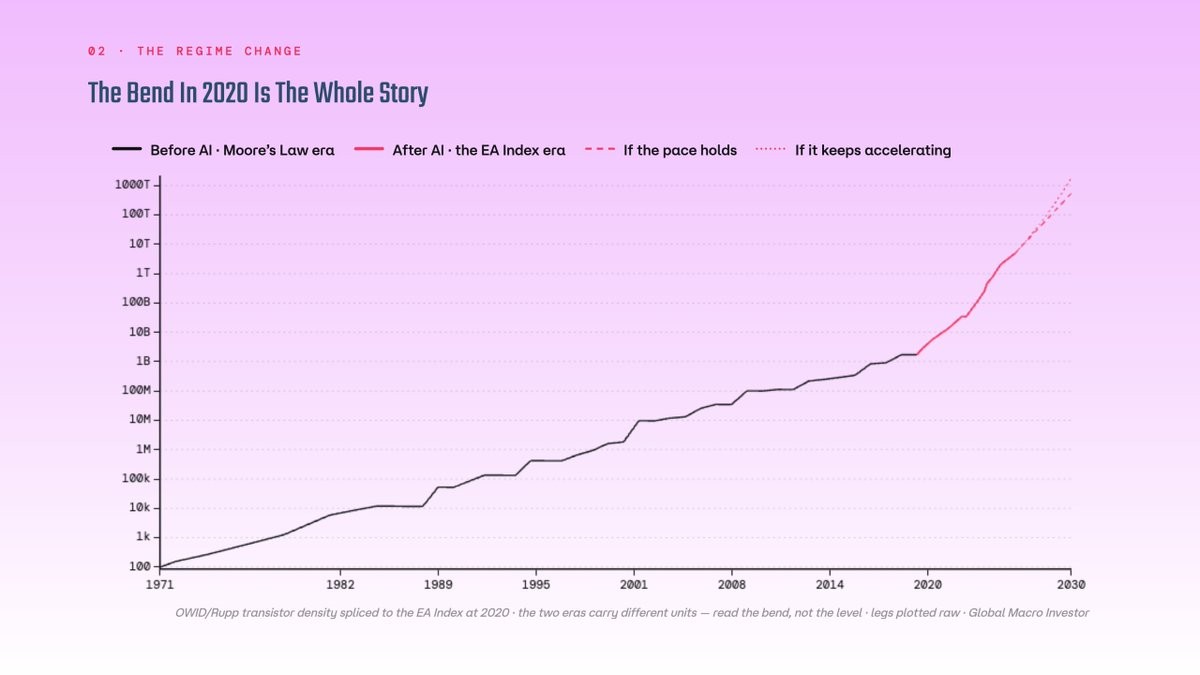
Returning to the example of a coin: single exponential growth has already surpassed human intuition, while double exponential growth belongs to a completely different order of magnitude. No life experience, thought model, or evolutionary instinct can predict its scale. Neither you nor I can envision this curve in our minds.
This is also where the real change has occurred in 2021. The technological race track itself has not added anything new since last year when I listed out the five major directions. But I underestimated one key point—they are no longer growing independently but are merging into a supercurve that shoots straight to the top of the chart. Currently, we are still in the relatively flat beginning stage of this curve, and the future space is unimaginable.
How Should Ordinary People Respond?
So, how should you respond to all of this?
If you accept that artificial labor will replace human labor, AI entities and robots will become the core economic productivity, then you must understand that the benefits will ultimately flow to those who control the machines and underlying infrastructure.
The core issue is no longer "how to keep your job from being replaced by machines" but rather "how to hold a share of machine-related assets." The underlying logic of AI replacing human labor also points to the track of value deposition, in which ordinary people can participate in the layout.
When this logic is applied to society as a whole, it is referred to as "universal basic fairness." The public directly holds productive machine assets, and the benefits of increased productivity are returned to the owners in the form of asset appreciation, rather than relying on fixed wages. This is also one of the mainstream solutions to address the failure of the wage system.
I define the window from 2030 to 2032 as the "economic singularity," during which all technological trends will fully integrate, the economic system will undergo a fundamental transformation, and traditional economic models will be completely obsolete. Whether this transformation is smooth or not depends on the choices made by everyone at the present moment.
I am not merely predicting the future but demonstrating the facts that are unfolding: the quantifiable expansion of global liquidity, the traceable curve of technological diffusion, the double exponential growth that breaks through the chart's limits, and the core assets that directly anchor all trends. Even if you define the current market as a bubble, the objective data does not support this assessment.
This is the era of exponential growth.
Welcome to join the official BlockBeats community:
Telegram Subscription Group: https://t.me/theblockbeats
Telegram Discussion Group: https://t.me/BlockBeats_App
Official Twitter Account: https://twitter.com/BlockBeatsAsia
