The AI infrastructure budgets of global major cloud providers are still on the rise.
According to TrendForce's May press release, the total capital expenditure of the Top 9 CSPs globally for 2026 has been revised up to around $830 billion, and the year-on-year growth rate has increased from 61% to 79%. This includes Google, AWS, Meta, Microsoft, Oracle, as well as ByteDance, Tencent, Alibaba, and Baidu.
Materials related to JPM also indicate that the 2026 capital expenditure of large hyperscalers has exceeded $600 billion. However, different statistical methods handle leasing, power, land, Chinese cloud providers, and emerging AI cloud platforms differently. The more prudent interpretation is that regardless of using a narrow or broad calculation method, the AI infrastructure budget for 2026 has not cooled down.
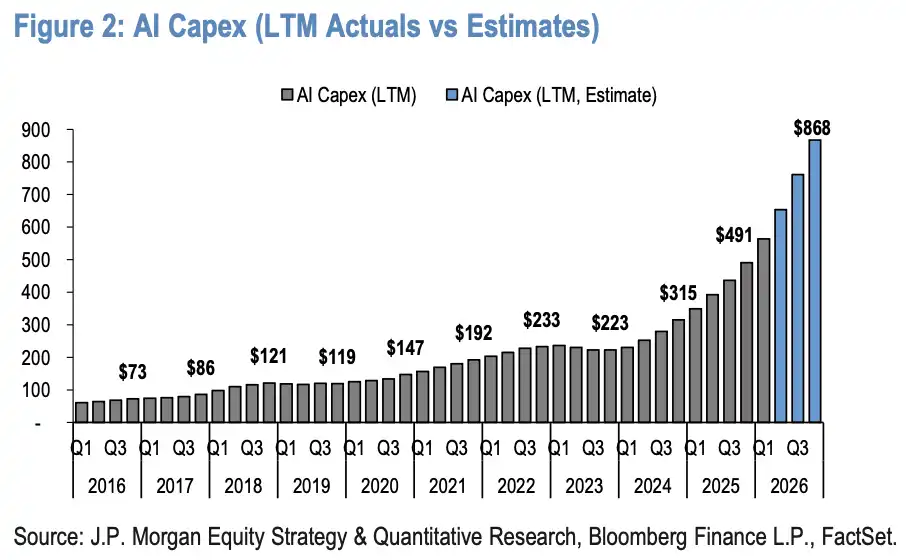
This round of spending is not just about buying more servers. GPUs, in-house ASICs, network equipment, data center land, power connections, and cooling systems are all contributing to the increased budget. For the market, AI infrastructure investment has shifted from tech company internal investments to semiconductor orders, data center leases, utility investments, and large tech company free cash flow.
A Broader $830 Billion Perspective, Cloud Provider Budgets Continuously Rising
The $830 billion provided by TrendForce is a total for the global Top 9 CSPs. It is broader than statistics focusing only on U.S. large cloud providers and includes Chinese cloud providers.
This is also why current AI capital expenditure figures may vary. A narrow scope is closer to the self-owned capital expenditure of a few American hyperscalers, while a broad scope includes financing leases, data center construction, power-related investments, and more cloud platforms. The numbers cannot be directly added, but the trend is clear: AI infrastructure investment continues to increase.
The disclosed figures from several leading companies are already indicative of the magnitude of this trend.
Microsoft's Investor Relations data shows that the 2026 calendar year capital expenditure is approximately $190 billion. Alphabet's Q1 earnings call and SEC filing indicate a 2026 CapEx expectation of $180 billion to $190 billion. Meta's Q1 announcement and SEC filings provide a 2026 capital expenditure range of $125 billion to $145 billion, including financing lease principal.
Amazon's official statement earlier stated that the company's 2026 total capital expenditure is around $200 billion. There are also third-party estimates in the market for AWS-related spending, but this does not equate to Amazon officially issuing guidance of over $230 billion specifically for AWS.
In other words, the cloud giants have not hit the brakes due to the AI return-on-investment debate. They are still prebuilding data centers, purchasing chips, and securing power for training, inference, and enterprise AI needs.
Out of Microsoft's $190 Billion, $25 Billion Comes from Component Price Increases
Microsoft's numbers best illustrate the complexity of this round of upward revisions.
The company mentioned in its FY2026 Q3 earnings call that the 2026 calendar year CapEx is around $190 billion, with approximately $25 billion coming from the impact of higher component prices. In other words, the increase in capital expenditure does not solely equate to a synchronous increase in the number of servers, GPUs, or AI computing power.
This is crucial for investors. The budget is expanding, partly being demand-driven and partly cost-driven.
The demand side comes from the continued expansion of training and inference. Cloud providers need to purchase more GPUs, build larger clusters, and are also advancing in-house ASICs to lower the unit cost of computing power. The cost side comes from price hikes in high-end chips, storage, network equipment, power equipment, construction, and key components.
Therefore, what the semiconductor, network equipment, data center, and power chain see is order and construction demand; what large tech company shareholders see is cash flow pressure, depreciation pressure, and profit margin pressure. If AI revenue growth can keep up, the market will continue to give these expenses time. If revenue realization lags behind investment, the controversy will revert to a more straightforward question: Can the money spent turn into revenue fast enough?
Data Center Vacancy Rate Drops to 1.6%, Power Becomes a Harder Constraint
What supports the continued escalation of cloud giants is not only management's statements but also supply-side constraints.
CBRE IM data shows that the vacancy rate in major North American data center markets is approximately 1.6%, with a pre-leasing rate of around 74.3% for capacity under construction. This indicates that many new data centers have been reserved by cloud providers and AI customers before delivery.
For CSPs, delaying construction by a year may result in missing customer demands. For data center operators, power equipment suppliers, and utility companies, order visibility is extended.
High-end chips are also in short supply. Next-generation AI chips like NVIDIA's Blackwell have strong demand, and supply scheduling will still impact server delivery timelines. Even as cloud providers advance their in-house ASICs, GPUs remain a crucial resource for training and high-end inference clusters.
Another increasingly challenging constraint is power. AI data centers cannot simply start operations after purchasing servers; they also require substations, power access, backup power, cooling systems, and long-term power contracts. With a significant share of power generation in the U.S. coming from natural gas, the addition of data center loads will also affect natural gas, grid infrastructure, and utility investments.
This is also why the AI capital expenditure benefit chain continues to expand outward. GPUs and ASICs receive initial orders, followed by data center developers and lessors benefitting, leading to the expansion of power equipment, natural gas, grid infrastructure, and cooling systems. However, the further along the chain, the more the projects rely on local approvals, grid connection progress, labor, and supply chain deliveries.
Money is on the way, but income realization speed needs to catch up
In this round of AI capital expenditure, the most easily exaggerated aspect is equating a budget increase directly with AI commercialization being completed.
Reality is more nuanced. While cloud giants are indeed scaling up, data centers are indeed strained, and high-end chip orders are still strong, part of the capital expenditure growth comes from component price increases, and power and delivery issues may slow down actual computational power deployment. A larger balance sheet in 2026 does not necessarily mean that available compute power will increase at an equivalent rate.
Investors are more concerned not about whether cloud providers will continue to spend money, but about how quickly this money will turn into revenue. AI training demand supported the first wave of investment, while inference, enterprise applications, and cloud service pricing capabilities will determine subsequent returns.
If the cloud revenue, software revenue, and productivity gains brought by AI cannot cover depreciation, energy, and financing costs, the market's patience for massive CapEx will decline. The money is already on the way, with chips and data centers in line, but what may truly hinder this expansion cycle is not the budget but rather power access, project delivery, and income ramp-up speed.
Welcome to join the official BlockBeats community:
Telegram Subscription Group: https://t.me/theblockbeats
Telegram Discussion Group: https://t.me/BlockBeats_App
Official Twitter Account: https://twitter.com/BlockBeatsAsia
