TL;DR
If you were to place a bet on a poker match from the sidelines, never rush to bet during the early stages of the game.
1. Starting Hands, Advantage US. Cutting-edge models, high-end chips, USD capital, cloud platforms, and a global software gateway form the United States' most coherent hand. If the cards were revealed today, the US would have a higher winning rate.
2. Rapid Card Updates, Advantage Not Victory. The Big Model's lead window is transitioning from a stable lag difference to a continuously opening and closing time difference. The partial reversal of the Kimi K3 in some long-range code tests indicates that China's speed in observing, dismantling, and recombining cards has greatly accelerated.
3. Compute Power Determines Chip Depth, Algorithms Reassess Chip Values. The US has control of high-end chips, HBM, interconnects, CUDA, and massive clusters, allowing for more simultaneous bets and trial and error opportunities; China, unable to get the same number of high-value chips, seeks to increase the purchasing power of each chip.
4. US Holding the Hole Card, China Expanding the Table. OpenAI and Anthropic aim to transform leading capabilities into chargeable "model rent"; Chinese manufacturers exchange low prices, open weights, and local deployment for distribution rights, competing for "ecosystem rent" formed by cloud services, industrial deployment, and development standards.
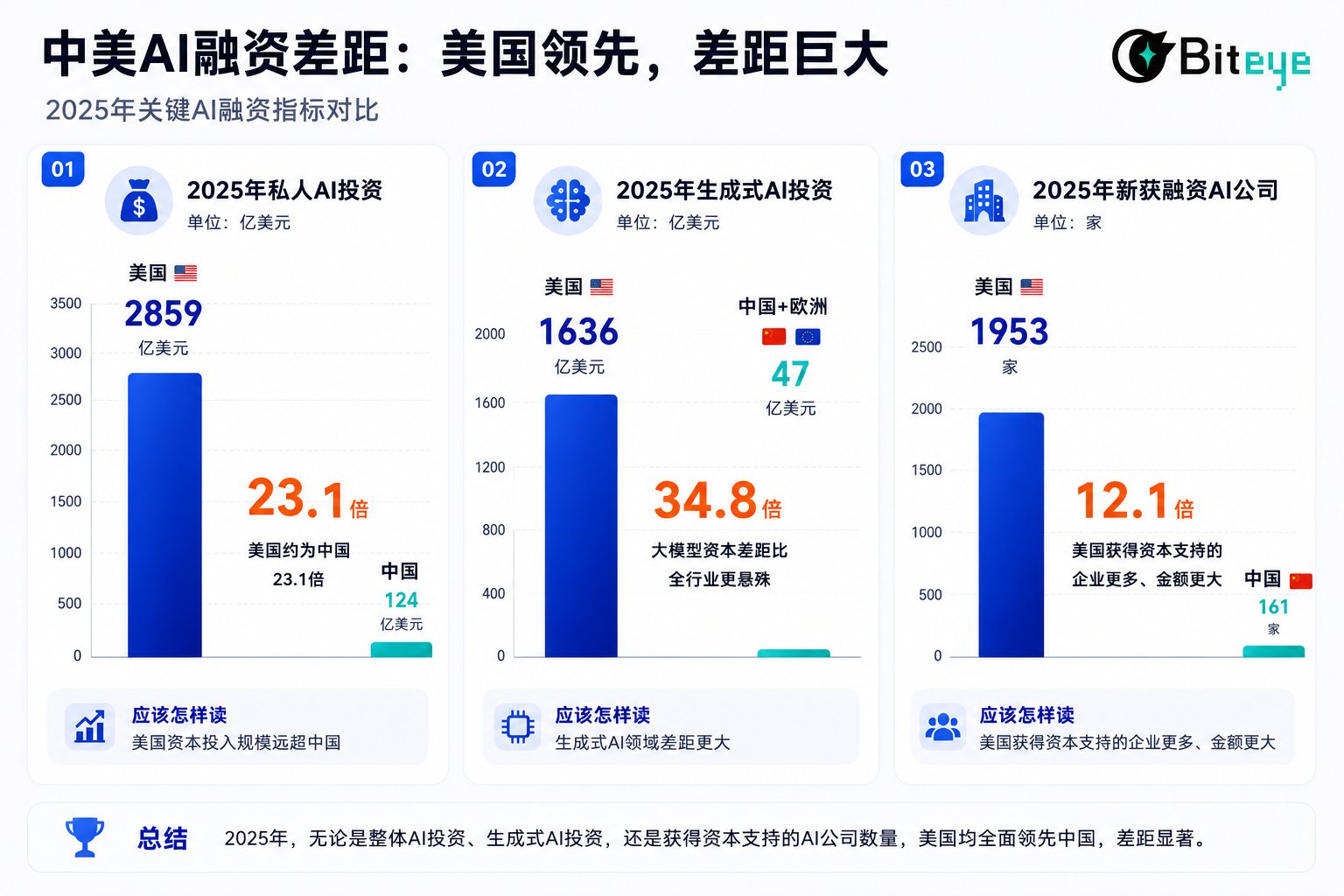
5. Token price is just the bet amount, while unit task cost corresponds to the pot. The checkmate is still far from cheap. The real showdown is how much money it takes to complete the same task. The US holds onto the key task with the highest failure cost, while China attempts to qualify a larger number of ordinary tasks to enter the pot.
6. Capital Buys Both Trial-and-Error Rights and Triggers the Return Countdown. The scale of private AI investments in the US is significantly ahead, enabling bets on more routes simultaneously; Chinese capital is more diversified and relies more on large companies, industrial capital, and policy forces. Both sides are burning not just money but also the time borrowed from the future.
7. Having Many Scenarios Does Not Equal a Completed Hand. China is not lacking a business card portfolio with real wins and losses, but only results from transactions, performance, quality inspection, and equipment operation that can be fed back for training, transforming industrial scale into model advantages.
8. It will also depend on who can control the drawdown, and evade the table-flip variable. Job market fluctuations, fraud, privacy incidents, Agent misbehavior, capital bubbles, upgrade lockdowns, and even an early arrival of AGI could all lead to a repricing of today's most valuable chips.
Prologue: Players Sit Down, Texas Hold 'Em Begins
The light hangs low from the ceiling, the green felt table absorbs the surrounding cold light, leaving only chips, playing cards, and two pairs of eyes that refuse to blink first. The air is filled with the psychedelic scent of coffee, cold smoke, server exhaust, and freshly minted banknotes. It's the smell of someone willing to mortgage the future.
The dealer shuffles with bowed head, fingers clean, movements gentle. Time is always like this. It deals for you, but it doesn't take responsibility for you.
Various players have sat at the AI table before. Europe has come with regulatory documents, Japan and South Korea have clung to their positions in the chip supply chain, and the Middle East has placed stacks of energy and oil capital on the table. But as the blinds increase, those who can truly keep up with cutting-edge models, massive clusters, and global access are mainly the U.S. and China.
In front of the U.S. is a stack of chips piled up like the Manhattan skyline. OpenAI, Anthropic, Google, and Meta shine brightly, unmatched; NVIDIA, cloud platforms, Dollar Capital, and global software access are firmly pressed below. China's chips are not as neatly arranged, but they are quickly becoming thicker: DeepSeek, Qwen, Kimi, Zhipu, MiniMax, Jieyue, along with the backing of internet platforms, open-source communities, domestic chips, and a huge app market, have become so solid that opponents can no longer leisurely bet according to the old odds.
The dealer remains silent, flips over the card, on which is boldly written in water-resistant ink: Large Model.
When ChatGPT was released, it was indeed shocking, but initially entering users' lives was perhaps just a smarter Siri. People had it write poetry, tell stories, explain quantum mechanics, and seriously nonsense it into images that were then forwarded everywhere. Just a few years later, that chatbox has imperceptibly infiltrated search, programming, office work, customer service, and research processes.
It truly and tangibly started taking over work, or rather, productivity.
1. Advanced Model Capability: First Look at the Cards, Then See If They Can Make a Hand
Whether playing Texas Hold 'Em or any other card game, there's a very simple truth: Having a good hand doesn't mean you've won. Because having a good hand is still a long way from making a winning hand.
Holding an A and a K may seem strong, but if the flop is not cooperative, they are just two high cards for now. On the contrary, two seemingly insignificant small cards, once connected to the community cards, may surprisingly form a straight.
It is precisely this starting hand that is key.
1. First, Assess the Hand: US Holds the Big Cards, China Already at the Front
Various benchmarks measure different capabilities and cannot be directly combined into a single score. However, looking at several core leaderboards up to July 17, 2026, can still provide an overview of the current table.
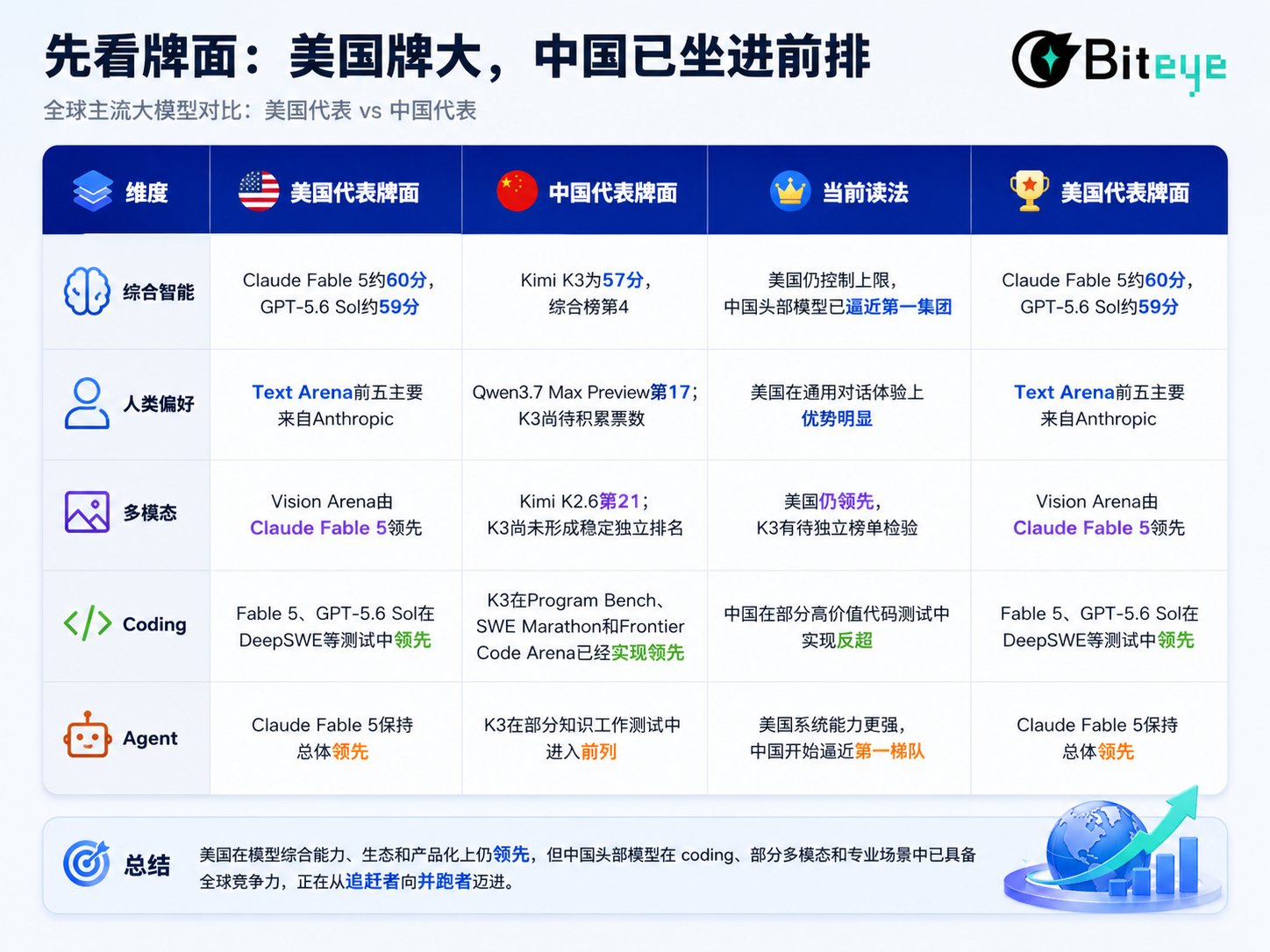
While there are more big players, no single player can dominate across the board.
If we only consider the strongest models, the US still holds a stronger starting hand. Anthropic, OpenAI, Google, xAI, and Meta form a solid frontline of advanced models that take turns leading in general reasoning, coding, multimodality, and agent capabilities. The US advantage is not merely a company occasionally taking the top spot but the overall depth of advanced model offerings.
However, today's release of Kimi K3 has significantly narrowed China's distance from the top player. Third-party Artificial Analysis awards K3 a score of 57, ranking it 4th on the comprehensive intelligence leaderboard, just two to three points below Claude Fable 5 at around 60 points and GPT-5.6 Sol at about 59 points. Chinese models are thus beginning to approach the global ceiling of comprehensive capabilities.
Coding is where K3 plays its best card. In public group tests, K3 scored 77.8 in the Program Bench, slightly above Sol's 77.6; scored 42.0 in the SWE Marathon, higher than Sol's 39.0; and achieved a score of 88.3 in Terminal-Bench 2.1, closely following Sol's 88.8. In the Frontend Code Arena, where users blind-selected works, K3 topped the leaderboard with 1679 points and ranked first in six out of seven frontend subfields.
The hand has thus changed. The US still holds the upper hand in comprehensive capabilities, general experience, and systematic agent abilities, but China is now able to win several rounds with the high-value community card of Coding.
The competition between cutting-edge models in China and the U.S. is shifting from comprehensive catch-up to partial back-and-forth.
2. Game Pace: Delta is Turning into Delta-T
Benchmarks remain crucial, but they are gradually becoming less so.
The key point is that they are increasingly only able to show us a snapshot of the table at this moment, but find it difficult to predict who will still be leading weeks later.
When model iteration is slow, a one-time lead often means a delta of six months or even longer. At that time, a high ranking on the leaderboard is not just an impressive report card, but also signifies a wide enough technical moat. In March 2026, the Stanford "2026 AI Index" showed that the top U.S. models had squeezed into a narrow range of less than 25 Arena Elo points, with Qwen and DeepSeek also entering the frontier area. Since 2025, Chinese and U.S. models have exchanged positions multiple times. By March 2026, the performance gap between the top models of both sides was about 2.7%.
Therefore, what benchmarks are losing is not the ability to measure but the ability to predict the endgame.
The saying "China and the U.S. are only three months apart in large models" emerged in this context. This does not actually mean that China is consistently lagging behind the U.S. by three months in all aspects, but that the competition between the two is moving from a relatively stable "delta" to a fluctuating "delta-t." From the release of the code-specific model K2.7 Code on June 12 to the launch of the flagship K3 on July 17, only 35 days had passed. Code, math, multimodal, Agent, and real-world product experience each follow their own timelines, sometimes months apart and sometimes just weeks.
Further accelerating the catch-up is distillation. Student models do not need to see the parameters of the teacher model; they only need to learn extensively from its answers, code solutions, and tool usage to potentially grasp parts of the decision-making path more quickly along the road already traveled by the other. Distillation itself is a common technology; the controversy lies in whether competitors are using another company's commercial model on a large scale without permission.
In June 2026, Anthropic wrote to U.S. senators, alleging that operators linked to Alibaba and the Qwen team engaged in about 28.8 million interactions with Claude through nearly 25,000 fake accounts, attempting to extract its Agent reasoning, software engineering, and long-range task capabilities. The claims, made by Anthropic, should still be distinguished from the conclusions of an independent investigation. However, it at least reveals one thing: U.S. leading model companies are no longer treating just parameters, chips, and training code as strategic assets; even the answers generated by models are beginning to be seen as potential leakage points for capabilities.
The United States is still playing new cards more frequently, but China's speed of observing cards, breaking down hands, and recombining them has far exceeded the past. The top spot has become a short-term maneuver right, no longer inherently equal to long-term advantage.
II. Recalculating Win Rate: How Computing Power, Algorithms, Data, and Talent are Changing the Game
"The tree desires tranquility but the wind will not cease, the cards desire stillness but the heart is restless."
A player may hold a better hand, yet they may have too few chips, insufficient information, or simply not understood the opponent's range, leading to defeat; another player with a slightly weaker starting hand may slowly regain their win rate as long as they can see more rounds at a lower cost.
Computing power, algorithms, data, and talent together determine this yet unrealized win rate. They determine how many paths an AI company can attempt, how expensive a trial and error process is, whether experience can be retained, and if they can sit at the table again after the next round of model updates.
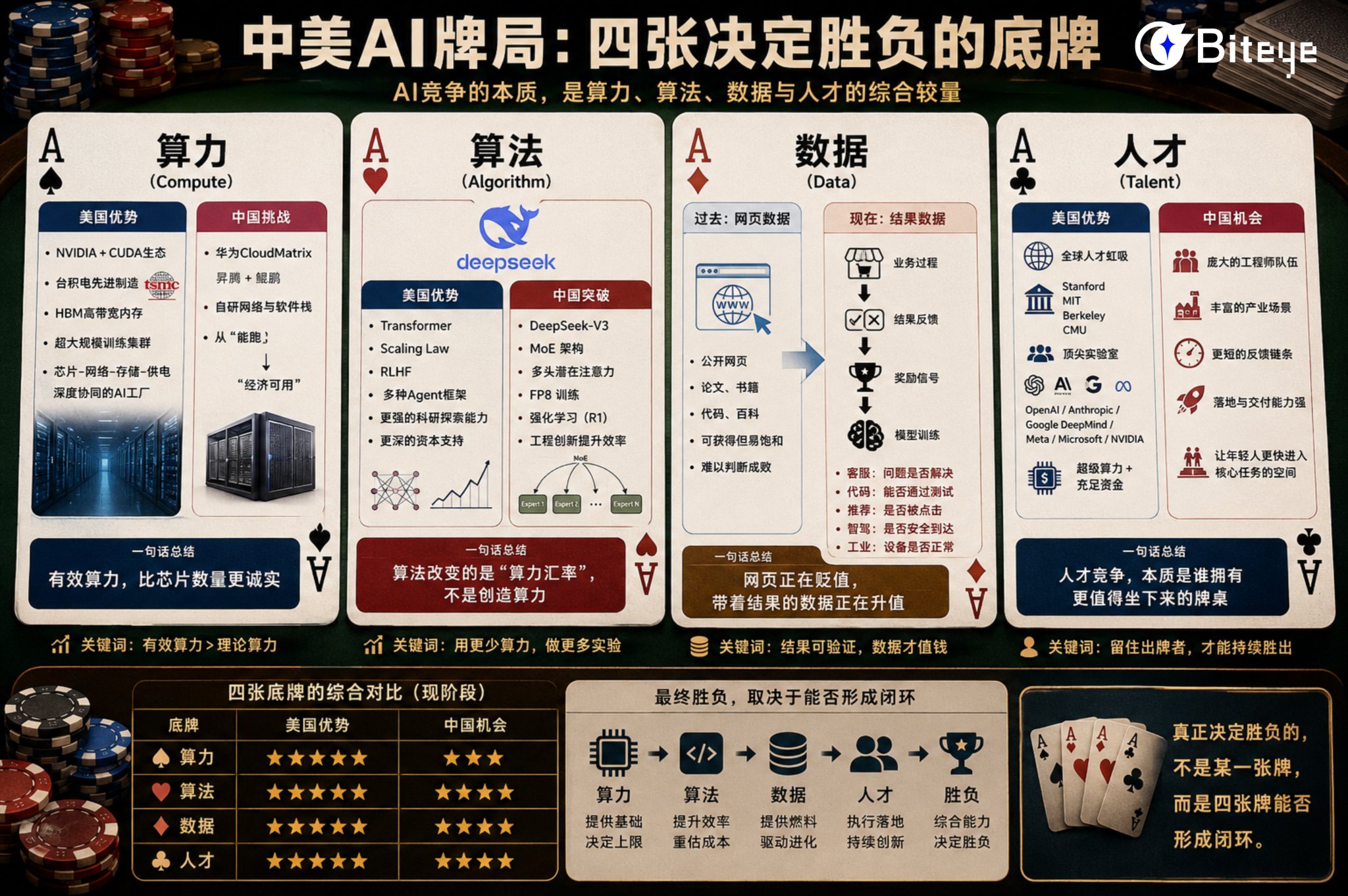
1. Computing Power: The United States Controls the Highest Face Value, China Vies for Economic Utility
Compared to the basic model as a starting hand, computing power is the United States' true trump card. While a bad hand can wait for the next community card, once the chips are gone, it is hard to remain at the table.
The United States holds the casting right of high-end AI computing power: NVIDIA defines the accelerator, interconnect, and software stack, TSMC undertakes advanced manufacturing, Japanese and Korean companies supply HBM, and cloud providers organize tens of thousands of chips into training clusters. Chips, networks, storage, power supply, and CUDA are harmonized, and the cutting-edge competition is no longer about single-card benchmarking but whether an "AI factory" can integrate tens of thousands of chips into a whole.
China has surpassed the threshold of "whether there are domestic AI chips". Huawei CloudMatrix organizes Ascend, Kunpeng, networking, and software into a unified system, used for training and inference with the DeepSeek model. The real leap to be made is from "can run" to "economically usable": chips must be available, stable connectivity is needed, and models must be easily transferrable without unbearable engineering costs; running a cluster of ten thousand cards for a month cannot be bogged down by communication, fault, and compatibility issues.
Effective computing power is more truthful than the number of chips. Theoretical computing power is subject to layers of degradation such as memory bandwidth, node communication, software operators, faults, and utilization rates. While ten thousand cards on paper may seem impressive, the actual training capacity may be much lower than a simple multiplication. The advantage of the United States lies in the optimization around a single training demand of chips, HBM, interconnect, and software; China's challenge is that every time one bottleneck is fixed, it may immediately shift to the next.
Once China crosses the threshold of "economic utility," the United States can continuously leverage its chip advantage to the model's win rate. Once crossed, export controls will still increase costs, but it will be difficult to get China to walk away from the table.
2. Algorithm and Engineering: DeepSeek Reannotates Chip Denominations
In Texas Hold'em, the more chips, the better the advantage, of course. But if your opponent can erase two zeros from your 10,000-denomination chip, the purchasing power on the table will be recalculated.
China once played such a stunning card, DeepSeek.
The DeepSeek-V3 technical report provided a rare breakdown: the final full training round used approximately 2.788 million H800 GPU hours. This figure did not account for early exploration, failed experiments, hardware procurement, and infrastructure, so the claim that "it only cost about $6 million to train the cutting-edge model" omitted a large part of the bill. But it still shook the industry because it ripped apart an old adage that many considered common sense: there is no fixed exchange rate between model capability and computational power input.
V3 adopts the MoE architecture, activating only a portion of the parameters for each token; multi-headed potential attention compression cache, FP8 training reduces computation and communication costs, load balancing reduces expert idleness. R1 then pushed efficiency into the post-training phase: in tasks where results in mathematics, code, and the like are verifiable, the model uses reinforcement learning to iterate through trial and error, transforming some expensive human reasoning demonstrations into automatically assessable reward signals. In other words, DeepSeek did not simply obtain more chips out of thin air; it made the chips work more efficiently.
The United States still excels at exploring new paths. Transformers, Scaling Law, RLHF, and various Agent frameworks, for the most part, were first advanced by American research institutions and companies; a deeper pool of capital also allows labs to simultaneously bet on multiple unproven directions. China's past strengths lay more in replication, compression, and engineering optimization. After DeepSeek, this boundary began to loosen: Chinese teams are no longer just making others' paths cheaper but also proposing methods significant enough to rewrite industry cost expectations.
However, algorithmic dividends will not permanently replace hardware. Papers will spread, leading models will also absorb the same techniques; efficiency improvements will spur more calls, quickly depleting the saved computational power with new demands. Players have learned to bet more precisely, but blind bets continue to rise.
Therefore, the strategic value of engineering efficiency for China lies more in increasing the number of experiments with limited computational power, shortening the verification cycle, and buying time for domestic hardware maturity.
3. Data: Data with Results is Appreciating, with the U.S. Currently in the Lead
A professional poker player's analysis does not only record whether they received an A or a K. They must preserve the complete action: who bet first, how the flop was raised, how the community cards evolved, what the opponent finally revealed, and where their own judgment went wrong.
Regarding data and models, it is exactly the same.
Early large models mainly learned language, knowledge, and code from the open web, with the U.S. enjoying a first-mover advantage by using English webpages, GitHub, published papers, and global digital platforms. As high-quality open datasets are repeatedly utilized, what is truly scarce is not just text that the model has not read, but rather data with explicit results that can determine the success or failure of a task.
The value of a customer service conversation lies not only in what the customer service representative said but also in whether the issue was resolved; the value of a piece of code lies not only in how it looks but also in whether it can pass testing after modifications. Data that does not point to a result is mostly noise.
In early 2026, Alibaba trained a customized version of Qwen-Coder, named Agent Qoder, for programming tasks, incorporating real software tasks, product environments, and engineering rewards into the training. Alibaba disclosed that after iterations, the online code retention rate increased by 3.85%, tool anomaly rate decreased by 61.5%, and token consumption decreased by 14.5%. These numbers come from the vendor and still await external validation, but they highlight the most costly part of professional data: not the text itself, but a verifiable result behind the text.
The U.S. has a broader feedback loop. Platforms like ChatGPT, Claude, Gemini, GitHub, and office suites connect global consumers, developers, and enterprises, allowing model companies to observe where users modify answers, which code programmers retain, and where Agents fail in their tasks.
China's opportunity lies in more intensive business processes. From ByteDance's short videos and advertisements, Meituan's food delivery and logistics, Alibaba's e-commerce and fulfillment, to smart driving in new energy vehicles and quality inspections and equipment operations in factories, each link carries real wins and losses.
What China truly lacks is high-quality complete game records. A large amount of industrial data is still fragmented across different companies, departments, and local systems. Only when tasks can be standardized, results can be verified, and data can flow under compliance conditions, will business traces become model assets. Having numerous scenarios is akin to having abundant raw materials; only when a "model execution, real-world feedback, result feedback" short chain can be formed will it decide whether the next round of training gains nutrients or ends up with a warehouse full of uncountable old cards.
4. Talent: China is the Talent Source, While the U.S. is the Talent Amplifier
In the previous rounds of the game, the competition between China and the United States always seemed to be represented by individual tech companies. On the U.S. side, there are players like OpenAI, Anthropic, Google, Meta; while on the Chinese side, there are players like DeepSeek, Zhipu, Dark Side of the Moon, Alibaba, ByteDance.
Tech companies release models, stockpile computing power, and compete for users, representing their respective countries' continuous "battles" on the poker table. However, companies are ultimately just a vehicle for great power competition in the business world. What truly determines which cards a company can read, which path it dares to bet on, and whether it can sustain its lead is still the talent behind the organization.
Talent can be the researcher proposing a new architecture, the engineer building the training system, or the product team pushing the model to the market. If we expand the scope a bit, it can also include universities, labs, and competition systems that continually cultivate and send newcomers into the entire large-scale model ecosystem.
The success of large models is often portrayed as a scientist's moment of inspiration, which is a kind of deifying fallacy. Just like in professional poker, although one person is sitting at the table, behind the top player are coaches, Solvers, hand databases, physical fitness management, and long-term bankroll management. A truly sustainable advantage and edge do not just come from a stroke of genius but from a whole set of continuous review and error correction systems.
AI companies are no different. Top researchers can make decisions on whether a path is worth betting on, but behind them, hundreds of system engineers are involved in calculating losses, handling failures, and turning a chance success into repeatable training and products.
The essence of the talent competition between major powers is still about who can provide a more inviting table. Top researchers will choose where the salary is higher, the computing power is deeper, the peers are stronger, the problems are more significant, and where failure is more permissible. The United States has long attracted top talent globally precisely because of this "table selection factor."
The most paradoxical aspect of this table is that China does not lack talent. Quite the contrary, China is already one of the most important sources of top AI talent globally. The issue lies in the fact that many talents, after completing their early training, ultimately plug into the U.S. amplifier.
The U.S. advantage in large-scale models is not the result of a closed self-sufficient system. It is more like a massive global talent centrifuge: absorbing the smartest youngsters from China, India, Europe, and around the world into the U.S. doctoral system, then feeding them into the top labs at Stanford, MIT, Berkeley, CMU, and finally channeling them into companies like OpenAI, Anthropic, Google DeepMind, Meta, Microsoft, NVIDIA, and others.
Universities still provide methods, papers, and talent, but the entities that can truly scale methods to a million-core cluster, global products, and commercial revenue have increasingly consolidated into enterprises. The Stanford AI Index also shows that the entities releasing important state-of-the-art models have become highly industrialized. Universities are responsible for inventing the playbook, while enterprises have taken control of the high-stakes table.
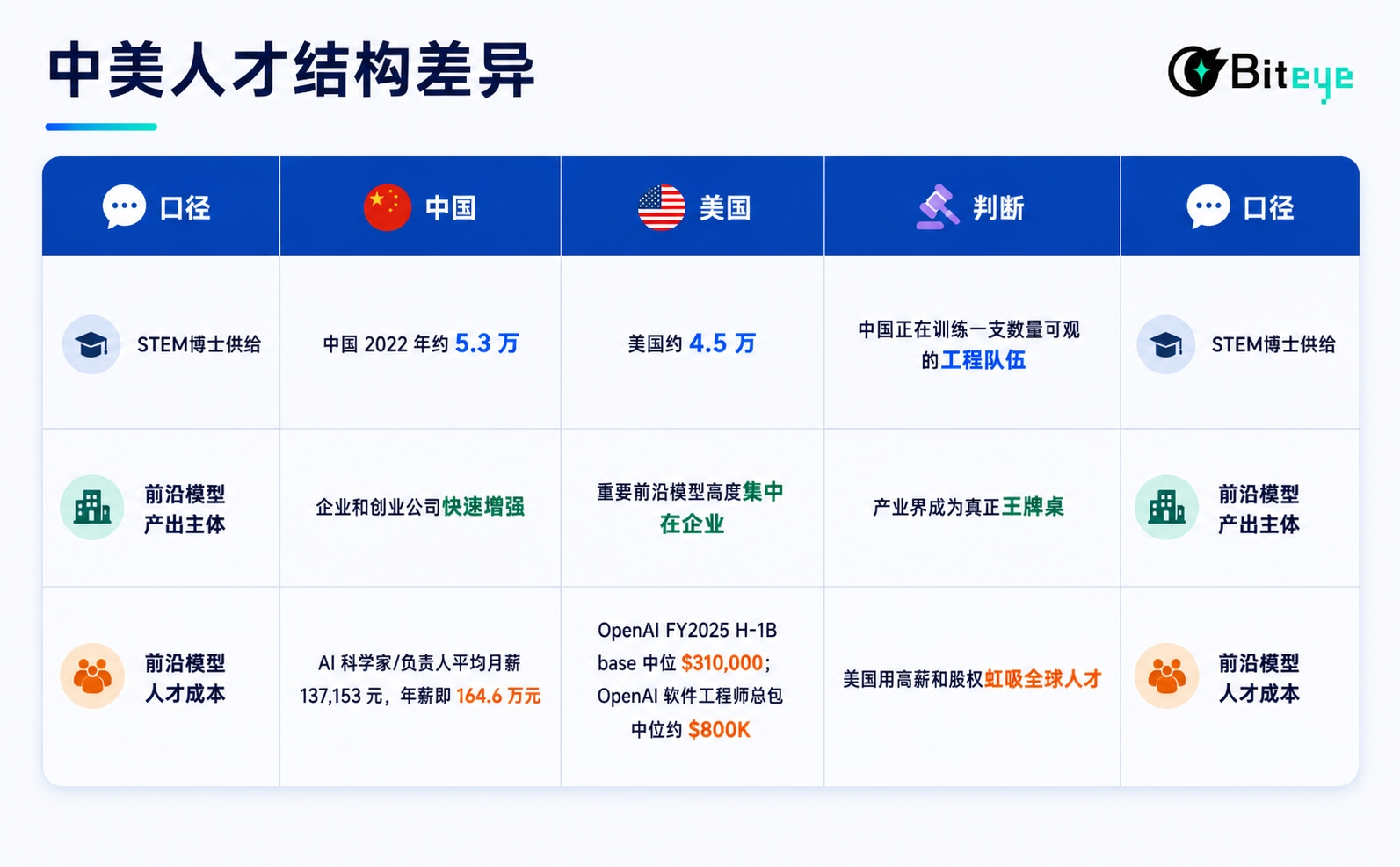
The game is slightly different in China. China's strength lies in a larger engineering talent pool, a shorter chain of command, and tasks with a closer proximity to industrial settings.
The value of this engineering workforce only truly manifests when large-scale models enter complex systems. State-of-the-art models require a few top scientists, but deploying the models requires hundreds or thousands of system engineers, data engineers, inference optimization engineers, chip adaptation engineers, and product teams. The U.S. excels at pushing a few top talents to the limit of their capabilities, while China excels at embedding a large number of engineers into industrial settings. The former is suitable for pushing the boundaries of general capabilities, while the latter is suitable for rapid transformation, deployment, and delivery.
This is also the change brought to the Chinese large-scale model narrative by companies like DeepSeek and DarkMatter. They have proven that Chinese companies can participate in the game with a different organizational structure: tighter teams, shorter feedback loops, stronger engineering compression capabilities, and space that allows young individuals to quickly engage in core tasks.
Perhaps, the true outcome of the China-U.S. large-scale model game does not lie in the present but depends on the next generation of scholars setting off from Beijing, Shanghai, Guangzhou, etc., and which location they will consider their home ground. Will it be flying to Silicon Valley, accessing America's super amplifier, or staying in China, at a newly expanding table, connecting domestic models, chips, systems, and industrial scenarios into a closed loop.
III. Card Game Strategy: U.S. Holding the High Ground, China Encircling Cities with Rural Areas
When the model lead changes from differential pressure to timing pressure, the issue is no longer just "who plays the big card first" but whether this card can be converted into a long-term advantage.
1. The U.S. Holding the Bottom Line to Prove Pricing Power
OpenAI, Anthropic, and Google keep the strongest models in subscription products, APIs, and cloud platforms. Developers can call them but cannot download full weights, freely modify, or deploy outside the platform.
Closing the source code is primarily a pricing strategy.
Whenever OpenAI and Anthropic enter the public market, they will face the pricing logic of Silicon Valley and Wall Street. The capital market will not pay for a benchmark topping in the long term, but is more concerned about revenue, retention, gross margin, and bargaining power. Only by controlling the entry of the most advanced models, can they charge for every call, each subscription user, and each enterprise contract, turning temporary leadership into a repeatedly sellable asset.
These two companies bear the heavy asset costs of chips, data centers, and energy, yet they aim for the valuation of a software platform. If the weight is fully lifted, cloud providers and application companies can quickly host, package, and reduce prices, turning the foundational model into a homogenized raw material. Trainers bear the heaviest risk, yet profits flow to computing power and access.
Therefore, what the United States is guarding is not just technological secrets, but also model rent. APIs, agent frameworks, enterprise permissions, data connections, and security audits all add a locking layer around the model. The deeper the customer integration, the higher the migration cost, and only temporary leaders are more likely to break through the next reshuffling of the leaderboard.
2. China Partially Opens Source Code to Exchange for Distribution Rights
Today, Xi Jinping proposed at WAIC (World Artificial Intelligence Conference) to uphold openness and win-win cooperation, encourage open-source initiatives, collaboration, and sharing, and listed helping global Southern countries enhance capacity building and bridge the digital divide as a key direction in global AI governance. The Chairman's Declaration released on the same day further suggested that a responsible approach should be taken to jointly build an open-source ecosystem, aiming to enhance the accessibility of AI technology and services while respecting companies' autonomous choices and intellectual property protection.
Most Chinese model companies do not have global gateways like ChatGPT, Google, and Workspace. Therefore, locking large models within their own platforms may not necessarily yield high profits as in the Silicon Valley model.
Therefore, open-sourcing weight is primarily a distribution tactic.
DeepSeek, Qwen, GLM, and others are competing for developers with downloadable weights, low-cost APIs, interface compatibility, and on-premise deployment. The newly released Kimi K3 today takes this route to the extreme of "generosity": with a total of 2.8 trillion parameters, native support for vision, and a maximum context of up to 1 million tokens. The Dark Side of the Moon calls it the first open 3T-level model and promises to release the full weights by July 27.
China allows others to take this card from its hand, observe and explore on their own, enabling more countries to have an alternative set of technological options that do not rely entirely on American APIs. This is the logic of "encircling the cities from the countryside": not first competing for the most expensive, most closed central market, but entering scenarios with more quantity, tighter budgets, and unwillingness to share data through open weights, low-cost APIs, and hardware adaptation.
For many developing countries, what matters most may not be winning a few more points on the leaderboard. They are more concerned about whether the models can support local languages, if the data must leave the country, if the prices are affordable, if they can be deployed on local servers, and if the supplier will suddenly cut off services due to geopolitical changes.
In his speech, Xi Jinping announced that over the next 5 years, China will offer 5,000 AI training slots to developing countries, establish an International AI Application Cooperation Center for ASEAN, Arab League, African Union, CELAC, SCO, and BRICS countries, and promote the implementation of intelligent weather warning systems in 30 countries. The World Artificial Intelligence Organization was also inaugurated in Shanghai.
As a result, China is forming a three-tiered distribution system that works in coordination.
The first tier is the model: It aims to reduce the usage threshold with open weights and low-cost APIs.
The second tier is infrastructure: It addresses practical needs through cloud computing, domestic chips, on-premise deployment, and industry-specific solutions.
The third tier is the institutional network: By means of training, cooperation centers, and international organizations, it transforms a one-time model download into a longer-term technical relationship.
Of course, openness can attract global attention and adoption, but it cannot automatically recoup costs through substantial cloud services. Revenue must be sought through official APIs, enterprise services, private deployments, and upper-layer products.
China must, within a foreseeable time frame, transform open weights into development standards, convert development standards into cloud and application revenue, and then translate international adoption into a long-term ecosystem. Otherwise, the so-called distribution rights will merely result in temporary download volume, rather than a business loop capable of benefiting the next generation of models.
3. The U.S. Seeks Model Rent, China Vies for Ecosystem Rent
The U.S. aims to collect model rents: leveraging top capabilities and platform lock-ins to ensure that calls, subscriptions, and enterprise contracts continue to flow through its own payment gateway. China is more inclined to compete for ecosystem rents: lowering the price of the model itself, using openness to attract developers, cloud workloads, enterprise deployments, and technical standards, and then reclaiming value from within those layers.
Both approaches could fall into their own traps. Closed platforms are most afraid of narrowing capability gaps; if high walls do not have significantly better support, they may turn from moats into toll booths. The open route is prone to applause but loss of cash flow, with overseas cloud and app companies taking revenue while the original manufacturers bear the most expensive training costs.
China's path must undergo a transformation: from open weights to development standards, from development standards to cloud and deployment revenue, and then acquire the computational power and data needed for the next generation of models from revenue and real-world tasks. The U.S. must also demonstrate that its leadership is deep enough into user workflows to become an indispensable layer of intelligence.
The U.S. is betting on: proving that my card is rare enough to charge every time someone looks at it.
China is betting on: as long as enough people use the same deck, diffusion itself will generate bargaining power.
4. Assessing Pot Odds: Cheapness is not a favor, but a premise for scalability
Pot odds answer a cold question: how much more do you need to pay to compete for the chips on the table? No matter how good your hand is, if the cost of every call is exorbitant, you will eventually burn through your capital.
1. API Pricing Table is Just the First Bill
As of July 17, 2026, the public API prices for several representative models are as follows, in units of per million tokens. (Prices are subject to change at any time and do not represent long-term enterprise contract prices. Kimi K3's input price is calculated based on cache misses.)
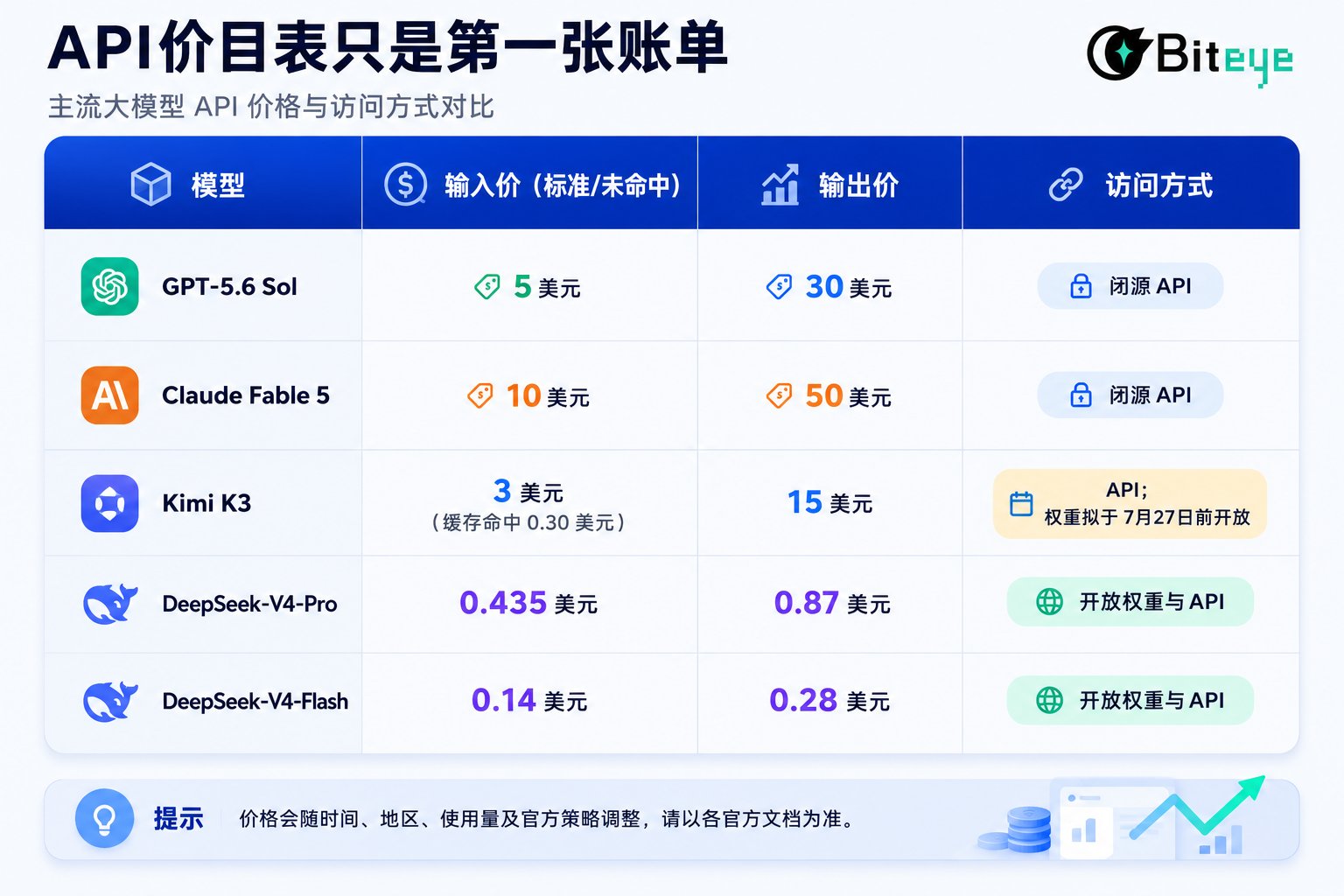
While this table still shows the price advantage of domestic models, it is no longer possible to generalize that "all domestic models are tens of times cheaper." DeepSeek continues to push low prices to the extreme, while Kimi K3 attempts to price upward based on cutting-edge code capabilities and a context of 1 million tokens. The strategy of Chinese models is evolving from a single-price war to differentiation through low-cost high volume and premium high-end routes.
Things are not that simple, and Tokens are not that generous.
An enterprise's full bill needs to include tokens, tool invocation, failure retries, manual checks, and redundancy reserved for delays and stability. The pricing table only lists the first item; once an error occurs, the enterprise has to foot the bill for all subsequent error correction processes.
A truly fair comparison is not "how much for a million tokens" but rather how much money was finally deducted from the account after completing the same task.
However, even so, low prices are still a powerful card. Customer service, summaries, document processing, and batch code reviews may be called hundreds of thousands of times a day, and a small price difference per call can quickly escalate at scale. Cheapness means that startup teams dare to make mistakes, small and medium enterprises can enter the market, and agents also have the opportunity to transition from the demo stage to daily work. China is trying to qualify more ordinary tasks for the pool.
2. Capital Double-Edged Sword: Financing scale buys the right to trial and error, but also initiates the countdown to returns
If we further bring together the four cutting-edge labs, the difference in capital structure will be more intuitive.
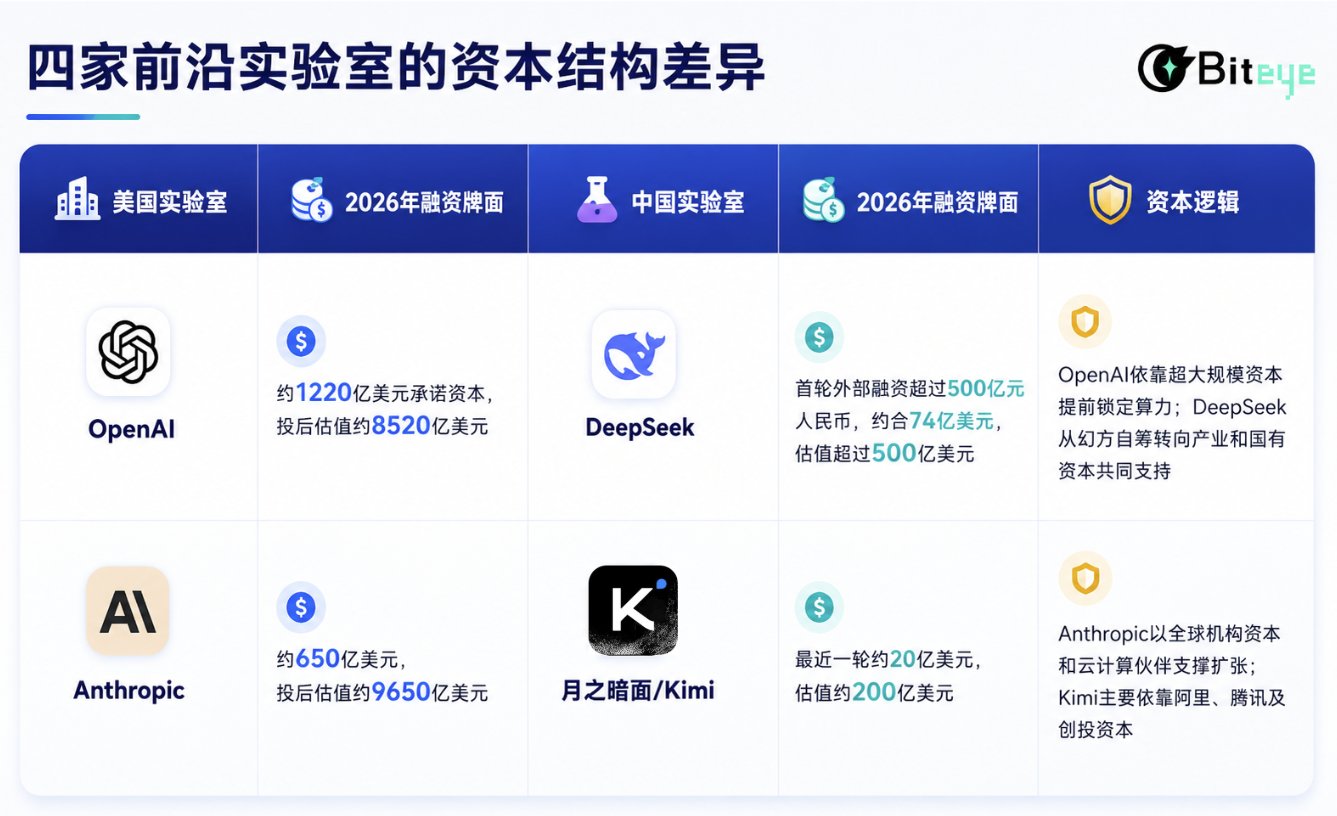
The scale of the funding is enough to show that a top U.S. laboratory could move the budget for chips, data centers, and talent for the next several years to today in one go.
What is actually being backed by capital is the right to fail of large-scale model companies. As long as there is enough money, it can run ten research paths simultaneously, let nine fail while the tenth continues, and lock in data center and power contracts before revenue is generated.
But the price tag for all fates has been silently marked in the shadows. The more money there is, the louder the clock of returns ticks. Massive valuations, credit, and infrastructure commitments are all demanding repayments from future cash flows. OpenAI and Anthropic must turn their leadership in capability into subscriptions, APIs, and corporate contracts, proving that they are shouldering heavy industrial costs yet have a software platform's profit structure. Capital has given them a stronger hand, but it has also quietly written down the date of profitability under the table.
China's capital structure is relatively more decentralized. Internet giants are supported by the cloud and consumer businesses, while startups receive support from industry capital, local and even central policies, and public computing facilities take on some of the basic investments. This can prevent key initiatives from immediately halting due to insufficient short-term profits but may also lead to redundant construction, low utilization rate clusters, and projects only accountable to subsidies.
The risk in the U.S. is that there is enough hot money, making it easy to capitalize on unverified demand early on; the risk in China is that hot money is not concentrated enough, and cutting-edge research may be forced to shift to short-term deliverables at a time when long-term investment is most needed. The former must prove that high-priced models can cover massive investments, while the latter must demonstrate that low prices and openness are not permanent subsidies but can be exchanged for cloud revenue, enterprise deployments, and industry efficiency.
In this round of poker, both sides are burning not just money but, more importantly, time borrowed from the future.
3. Power Constraint Strategy Space: China has Infrastructure Depth
Training is a burst of concentrated load, while search, office work, and agent reasoning are round-the-clock loads. When the model is called billions of times, electricity prices, grid connections, cooling, and chip utilization will all factor into the cost of each task.
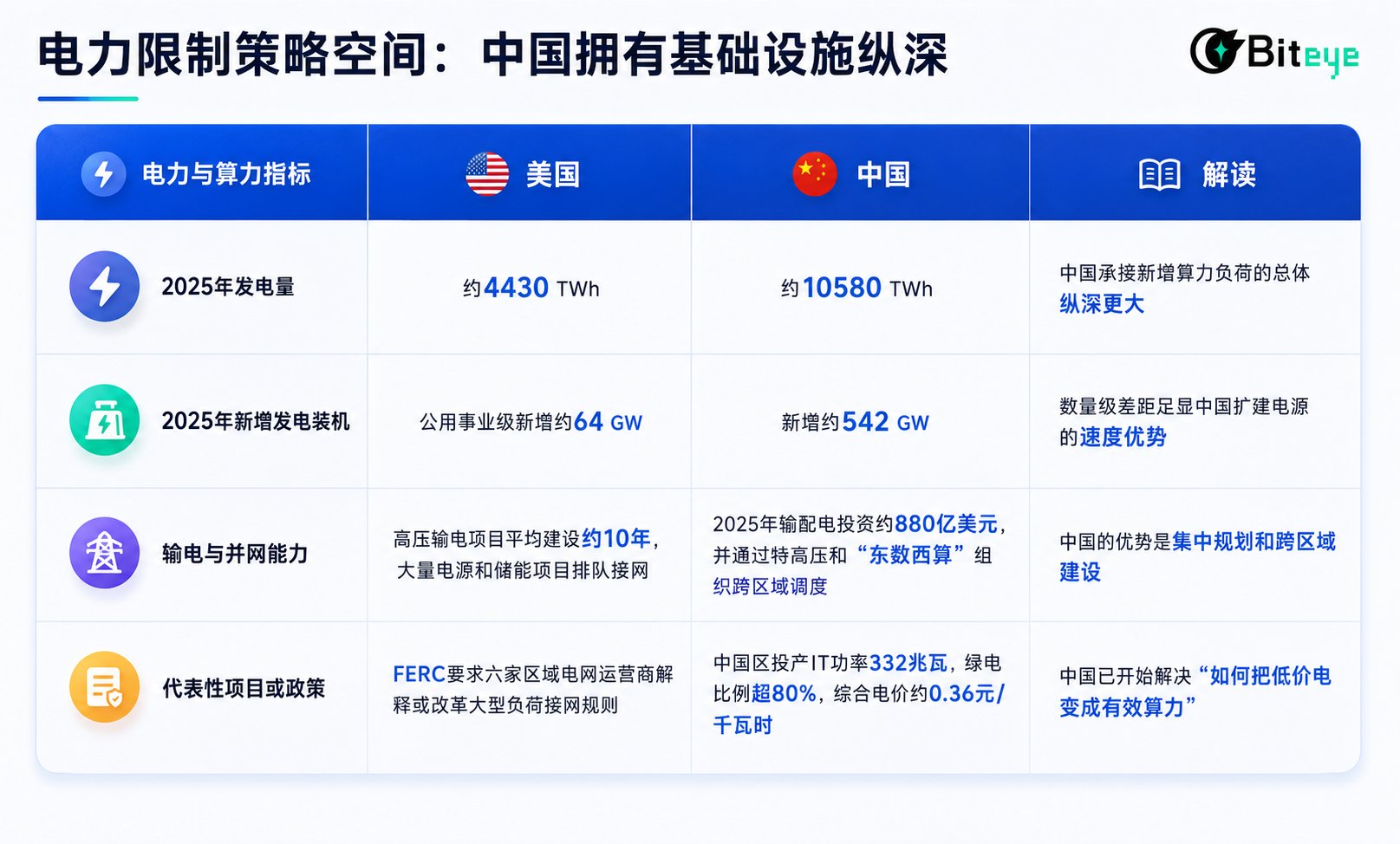
China's advantage in energy infrastructure lies first in its scale.
As an "infrastructure maniac," China has a larger power system and continues to build wind, solar, energy storage, nuclear power, and interregional power grids. When the construction of data centers required for large models brings new large-scale loads, China clearly has larger supply depth and stronger engineering expansion capabilities.
The problem in the United States is that while capital and chips are ready to go, the grid cannot be expanded with just a software update. Research from the U.S. Department of Energy shows that on average, it takes about 10 years for a high-voltage transmission project to go from development and approval to completion, with a typical range of 5 to 17 years. The average time for power projects from grid connection application to operation has also increased from about 2 years in 2008 to about 5 years in 2023.
In June 2026, the U.S. Federal Energy Regulatory Commission further required six regional grid operators to explain or reform the rules for connecting large loads to the grid. The decentralized nature of the federal system means that regional transmission line approvals are slow, delivery cycles for equipment like transformers are long, and the costs between different states, power generators, grid operators, and data centers need to be negotiated repeatedly.
In contrast, the China Mobile Ningxia Zhongwei Data Center Park, fully operational in 2026, has a cumulative IT power capacity of 332 megawatts, with a computing scale exceeding 100 EFLOPS. It maintains a renewable energy proportion of over 80% and has a comprehensive electricity price of about 0.36 RMB per kilowatt-hour. The significance of this project lies not only in its low electricity price but also in the synchronized construction of power sources, the grid, energy storage, and data centers, directly converting energy resources into computing power.
Therefore, in terms of energy infrastructure, China's advantage is even clearer than benchmark indicators. The International Energy Agency predicts that global data center electricity consumption will increase from around 485 TWh in 2025 to about 950 TWh in 2030. The United States and China will contribute nearly 80% of this growth. As competition shifts from model training to billions of continuous inferences, China's advantage in energy infrastructure will become even more critical: training can wait for a cluster schedule, but inference services need to continuously receive stable, low-cost electricity throughout the year.
However, energy advantages ultimately need to be translated through chip efficiency, software optimization, and cluster utilization. If cheap electricity is consumed by inefficient chips and idle data centers, it cannot automatically turn into low-cost intelligence. What truly needs to be compared is how much electricity, chip depreciation, and manual operation are required to complete a million real tasks.
Whoever can first achieve a lower unit task cost will be more capable of dragging this competition into a long-term war of attrition. In this regard, China's national system may have the upper hand.
4. What China needs to leap over is a cost loop
By stacking APIs, capital, and energy together, victory can easily be attributed to who has more money. The United States can indeed use high investment to impact the upper limit of the model, then recoup costs through global subscriptions, cloud services, and enterprise software. China, on the other hand, is attempting to lower the barrier to entry through engineering optimization, cost-effective models, and infrastructure, and then seek income and data through large-scale usage.
The risk of the China route is that every link is focused on price suppression without leaving enough margin. If low-price API only brings in traffic, open weight only brings in downloads, and local data centers are only about construction scale, the sum of these three may still result in a huge loss. The risk of the US route, on the contrary, is that every link can charge a high price, but the cost is so high that it must maintain a significant capability gap.
The current bottom pool odds still lean towards the US because it can sell technological superiority to the world's most expensive customers. However, once the model's capabilities gradually converge, the unit task cost will quickly become heavier, and China's low price, power, and engineering efficiency will also demonstrate their strength.
The premise is that these advantages will eventually converge into the same cash flow, rather than leaving behind three beautiful but lonely account books.
Five, Capturing the Bottom Pool: Who Can Implement the Model into Real Work
Holding the best cards doesn't automatically move the chips to the front. Technological superiority is only realized when users continue to use it, companies are willing to pay, tasks leave behind verifiable results. The real bottom pool competition of Large Language Models (LLMs) consists of four things: revenue, entry point, feedback data, and work processes reorganized by the model.
1. The US Dominates the Entry Point, China Closer to Transactions
ChatGPT first changed people's habits of seeking answers, then entered writing, research, code, and enterprise workspaces; Google embedded Gemini in search, Workspace, and the cloud; Anthropic relies on Claude and Claude Code to enter knowledge work and software development. Behind US model companies are browsers, office suites, code repositories, and global cloud platforms.
The entry point is an advantage harder to catch up with than rankings. Once an enterprise has established identity, permissions, data, and procurement, switching models is no longer just a name change but rather requires dismantling part of the workflow. OpenAI's Signals data shows that about six months after registration, the average daily message count increased by about 50%, the number of types of tasks attempted doubled, and non-English users accounted for over half of active users.
Chinese platforms are further from the global office entry point but closer to specific transactions. Alibaba integrates Qwen into Taobao and Tmall's billions of product listings, allowing users to compare, order, track logistics, and handle after-sales in conversations. The model connects not just webpages but also merchants, orders, and fulfillment systems. Every step, from placing an order to accepting recommendations, completing logistics and after-sales, has outcomes.
General-purpose US models first occupy the user entry point and then connect to external services; Chinese super platforms can put the model into the transaction loop from day one. The former has stronger global distribution, while the latter has more dense behavioral feedback.
2. Coding: The First High-Value Battleground
Coding was one of the first fields to see stable monetization, as the outcomes are easily verifiable: whether the code compiles, tests pass, bugs are fixed, and which large models are effective, all are visible at a glance.
In the field of Coding, the United States originally held the most organized cards: GitHub, Microsoft, OpenAI, Anthropic, and a large number of development tools controlled the global code entry points, with leading models consistently excelling at complex repository tasks. Kimi K3 introduced a new gap in model capabilities. Through monthly benchmark disclosures, it surpassed GPT-5.6 Sol and Claude Fable 5 in Program Bench and SWE Marathon, lagging behind GPT-5.6 Sol by only 0.5 points in Terminal-Bench 2.1, and demonstrated long-range execution capabilities in some GPU kernel optimization, compiler development, and chip design tasks. However, winning in several benchmarks does not mean it has taken over the development environment. Kimi Code and open weights are being distributed, and China still needs to catch up with the user base, toolchains, and feedback loops accumulated by GitHub, Codex, and Claude Code.
The code has already revealed the shape of the future market: the most powerful models handle complex tasks, while affordable models are responsible for autocompletion, testing, and batch reviews, and enterprises switch between closed-source cloud and on-premises models based on difficulty and sensitivity. In the end, the one who captures the value may not be a specific model, but the system that knows when to use which model.
Whoever controls the development environment can correct models more quickly. Whether the code is retained or recalled, at which step the test failed, and how developers made changes will all become part of the next round of training.
3. To C Agent: The Downstream Ace Card in User Mindshare
If the comparison of cutting-edge models is about the face value, then what To C Agents contend for is who can turn model capabilities into the unconscious actions of millions of users.
When a person wants to search for information, organize files, make presentations, plan trips, or solve work problems, who do they open first?
Currently, the most representative entities in the United States are OpenAI and Anthropic.
ChatGPT has already formed the strongest AI-native brand in mindshare. OpenAI has divided this brand into two paths: ChatGPT Work (CodeX) is responsible for research, documentation, spreadsheets, presentations, and other end-to-end deliveries. Users can go from asking a question to receiving a finished product without leaving ChatGPT.
Anthropic's occupied mindspace is relatively narrow but deeper and more valuable, with disclosed annual revenue even surpassing OpenAI at one point. Claude Code has become the preferred choice for many programmers handling complex projects; Claude Cowork extends the same modality to researchers, analysts, and other knowledge workers, enabling Claude to directly manipulate local files, desktop applications, and multi-step tasks.
The U.S. is establishing a very clear product awareness: when faced with a complex task, there is no need to first think about which several software to open; just hand it over to the Agent.
Yet China actually did not take this path.
Initially, Chinese companies have always tried to force the Agent into scenarios where the enterprise was already proficient.
Alibaba integrated Qianwen into Taobao and Tmall's 4 billion products. Users can search, compare, place orders, inquire about logistics, and handle after-sales in conversations. Qianwen relies on Alibaba's existing operation of over two decades, encompassing the entire transaction chain of goods, merchants, payments, logistics, and after-sales.
ByteDance, on the other hand, has placed its bet on content production. Seedance 2.0 allows ordinary users to use text, images, audio, and video to control complete audiovisual creation, fully integrating into the content distribution network composed of Douyin, TikTok, Jianying, and the creator ecosystem.
Meituan, based on LongCat's upgraded "Xiaotuan," has deeply intervened in life scenarios such as dining, shopping, entertainment, travel, and medical consultation. During the "May Day" period in 2026, Meituan announced that "Xiaotuan" served over a hundred million people. Compared to a general Agent, Meituan not only knows the answers but also includes merchants, reviews, locations, inventory, fulfillment, and transaction results.
As a result, To C Agents in China and the U.S. have taken two different expansion paths—the U.S. extends outward from an AI-native entry point, while China encircles inward from existing scenarios.
The risk of the Chinese path lies in cognitive dissonance—opening Qianwen for shopping, Douyin for creation, and using WorkBuddy for office tasks is already a form of chaos. The scenarios are deep, yet the entries are still dispersed. China has many well-positioned tables, but there has not yet emerged a super entrance like ChatGPT that can consolidate all user mindsets under a single name.
Now, Chinese tech giants are all realizing this and starting to emulate the proven universal Agent form in the U.S., transforming chat boxes into workbenches.
Tencent's WorkBuddy is now able to start from a single command and complete data organization, data analysis, document preparation, and content creation; Kimi's Universal Agent, Kimi Claw, and Xiaomi's MiMo Claw are also attempting to take over files, tools, and long-range tasks. What they are doing is becoming more and more similar to ChatGPT Work and Claude Cowork: users only state the goal, and the Agent is responsible for breaking down the steps, invoking tools, and finally delivering the finished product.
Because holding a good hand can only win one round, but seizing the user's default entry point can "cheat" to transform every subsequent use case into training experience, thereby "cheating" to see all the cards.
Six, Control Drawdown: Institutional and Social Resilience
Texas has never been a game of just winning. Even the strongest player will be dealt a bad hand, will be narrowly surpassed when making the right judgment, and will watch a huge pot being pushed to the other side.
What truly differentiates a professional player from a regular player is not that the former never incurs losses, but that they can control drawdowns, avoid emotional outbursts, and prevent the loss from the previous round from ruining the judgment of the next round.
AI competition is the same. While a model can increase productivity, it can also reduce employment; lower content costs can also amplify fraud and deepfakes; once inside an enterprise system, it can improve efficiency, but it can also spread a single error to payments, code, and critical data.
1. Regulatory Decisions Determine Pool Entry Range
The United States is closer to a wide-ranging strategy. Companies first release products, and then boundaries are delineated by the market, courts, state legislation, and regulatory agencies. This gives companies more room to experiment but also means that some copyright, privacy, and product harm will be borne by society first and then corrected afterwards.
China emphasizes predefining boundaries more. Filing, content governance, platform responsibilities, and industry pilots can reduce obvious risks and facilitate the formation of unified standards; but if the boundaries are blurred, companies and regions may escalate measures layer by layer to evade responsibility, turning stop-loss into premature folding.
The United States tolerates higher volatility in exchange for more experimentation; China reduces the probability of losing control in exchange for a more stable advancement. A truly ingenious system knows when to expand the scope and when to retract the chips.
2. Employment Impact Determines How Much Drawdown Society Can Withstand
LLMs first affect jobs that have a high proportion of language and information processing: customer service, translation, administration, content creation, basic programming, legal research, and some analysis. The International Labour Organization estimates that about a quarter of global jobs face some level of exposure to generative AI, but those at the highest exposure level represent around 3.3% of employment. This is more like tasks being restructured rather than all professions disappearing neatly.
The danger lies not in the disappearance of certain jobs, but in the pace of change outstripping society's ability to reorganize jobs, income, and security. While companies can introduce AI in a matter of months, workers may need years to reskill; the economy may continue to grow, but some individuals are on the brink of bankruptcy.
The U.S. labor market is more flexible, allowing companies to restructure roles, but the cost falls more heavily on individuals and families. China can provide training through vocational education, industrial policies, and large-scale organizational coordination, but it faces a larger labor force and higher stability requirements.
Effective risk management does not guarantee no drawdowns but ensures that a single drawdown does not prevent one from re-entering the game.
3. The Most Dangerous Game is not Losing, but Tilt
Tilt is when a poker player, after experiencing a streak of bad luck, loses rationality, starts chasing losses, increases bets, and abandons their original effective strategy. Society may also tilt back and forth between technological fervor and regulatory panic.
If AI continues to bring fraud, fake content, job anxiety, and privacy incidents, the public will shift from curiosity to distrust. While companies may still believe that the next generation of models can solve everything, society may demand broad restrictions due to several serious incidents. The former is prone to creating bubbles, while the latter may forsake long-term gains for short-term losses.
Societal acceptance is not about expecting everyone to remain optimistic but about ensuring that the public understands technological boundaries and has the right to information, exit, and appeal. Risk governance should not only focus on what the model "says" but also inquire about what it "is allowed to do": when an Agent initiates a transfer, modifies code, or calls a critical system, processes must include principles of least privilege, dual authorization, log auditing, and incident accountability.
True resilience is the ability to maintain judgment, control drawdowns, and adjust strategies after a failure, ensuring that the losses of some individuals do not turn the entire technological advancement into bad debt that no one is willing to bear.
Seven, Table-Flipping Variable: Potential External Shock to Game Failure
All the previous comparisons imply one assumption: the game will continue according to the current rules. Models will continue to advance gradually, computing p
