Morgan Stanley analyst Shawn Kim has described the recent US memory stock sell-off as a "healthy reset" and believes this is not a turning point in the memory cycle.
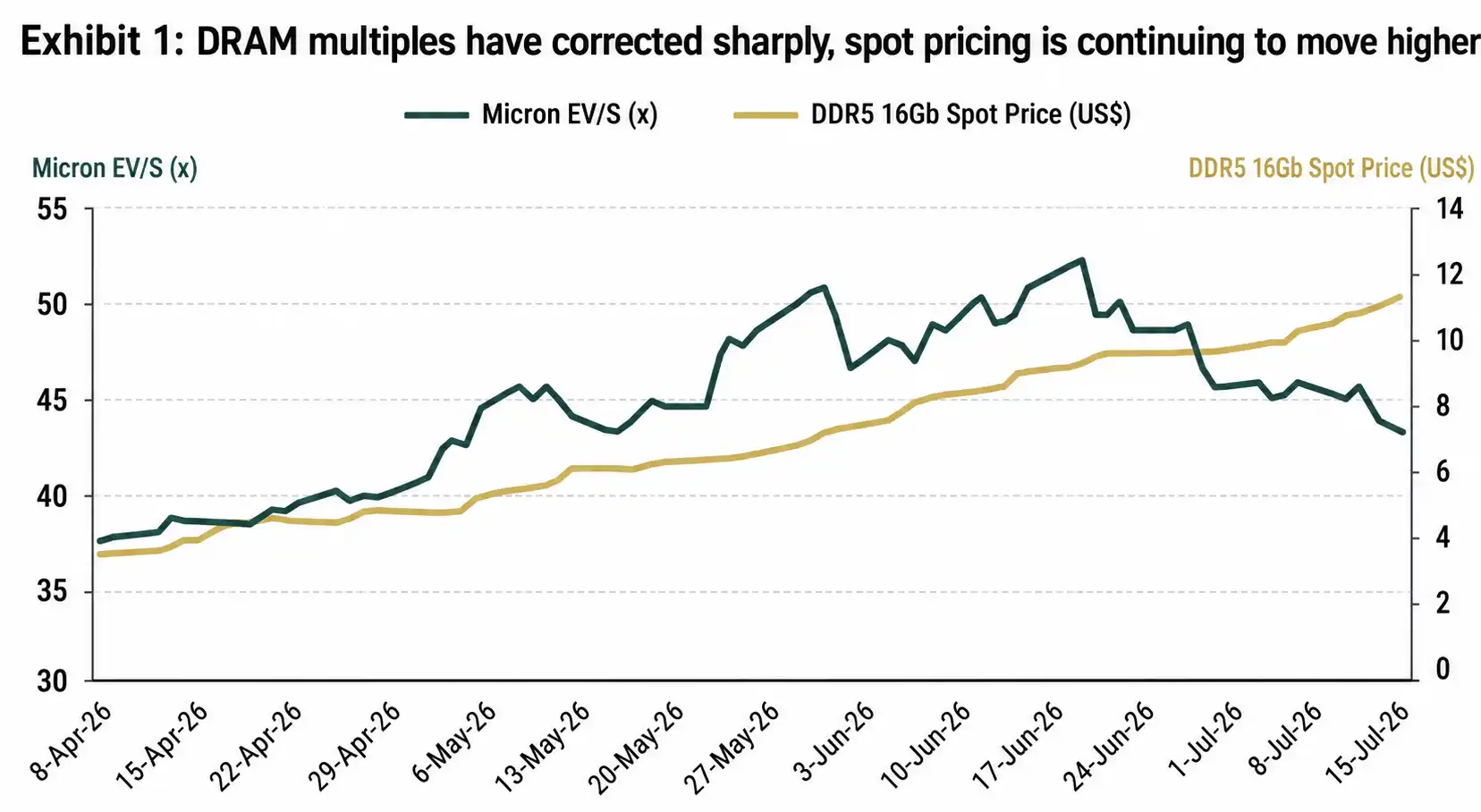
The most straightforward reason is that prices have not peaked yet. Publicly quoted sources indicate that Morgan Stanley expects DRAM prices to potentially increase by 20%-30% or more quarter-over-quarter in the third quarter of 2026. This assessment refers to certain channels and categories and cannot be simply equated with the official server DRAM contract price across the industry. However, it explains why memory stocks like Micron Technology (MU), despite the pullback, still find favor on Wall Street as a buying opportunity.
In recent weeks, the market's concerns about memory stocks have mainly focused on three things: a slowdown in price increases, rising capital spending, and some AI customers beginning to reduce memory configurations. For the traditional memory cycle, these are often dangerous signals that could indicate an accelerated supply response and prices nearing a peak.
What sets Morgan Stanley apart is that this cycle is not being primarily driven by PC, mobile, or regular server restocking but rather by AI data center demand. Memory, along with power and data center space, is becoming one of the bottlenecks in AI deployment pace.
Stocks Falling While Data Center Pricing Rises
The recent dilemma for memory stocks is that the stock prices have fallen while prices continue to rise.
In Morgan Stanley's publicly quoted sources, the third-quarter increase is pegged at 20%-30% or more, continuing the first-half trend of DRAM price hikes. TrendForce public data also indicates significant quarter-over-quarter increases in DRAM contract prices in the first and second quarters of 2026. However, the magnitude of the increases varies between different institutions, categories, and customer channels.
This is where qualifiers are needed. TrendForce's forecast on July 9th suggests that due to long-term agreements, server DRAM contract prices are expected to increase by 13%-18% quarter-over-quarter in the third quarter of 2026, lower than Morgan Stanley's quoted increase of 20%-30% or more. The differences may not be directly conflicting, and they could stem from contract prices, spot prices, specific categories within data centers, and customer procurement channels.
For investors, the key is not to apply a single price increase to all memory products, but to judge whether the price has already turned. At least from public transcripts and industry quotations, the data center supply-demand balance remains tight, and a slowdown in price growth does not necessarily indicate the end of the price increase cycle.
AI Moves Memory from Cyclical to Bottleneck Position
The scenario that the traditional memory cycle fears the most is that price increases stimulate manufacturers to expand production, and a few quarters later, the additional capacity crushes prices. Once PC and mobile demand slows down, inventory will quickly reverse the price gains, and memory stocks usually decline in advance.
The difference this time is that AI data centers have raised the demand baseline.
AI training and inference require not only GPUs but also a large amount of DRAM, HBM, and low-power memory to support model execution, data scheduling, and rack-level system design. As AI applications consume more tokens, memory capacity, bandwidth, and energy efficiency all become constraints. TrendForce also mentioned that AI inference and the demand from North American cloud service providers are driving server DRAM and high-capacity RDIMM purchases, keeping the near-end supply tight.
This explains why the weak signals from PCs and mobile devices have not become the main focus of Morgan Stanley's analysis. Consumer electronics demand will still affect the spot market and inventory sentiment and may continue to disrupt stock prices. However, as long as data center customers are still competing for supply, the cooling of traditional endpoints may not necessarily indicate that the entire memory cycle has peaked.
Customer reductions in some configurations are not entirely bad news. The so-called configuration reduction is when AI system manufacturers or cloud customers, in response to cost and supply pressures, reduce the memory configuration in some racks or redesign systems. Superficially, this may reduce the memory usage per rack, but the fact that customers are willing to redesign also indicates that memory constraints are significant enough to affect deployment pace.
Long-Term Agreements Trim Some Elasticity and May Also Extend the Cycle
Long-term supply agreements are another point of contention.
Long-term agreements between memory manufacturers and large cloud customers usually stipulate the supply volume and price range for a future period. Investors are concerned that if the agreements lock in a price ceiling in advance and spot prices continue to rise, the actual prices obtained by the suppliers may be lower than the market expects.
However, agreements also have another side. Customers get a supply guarantee, and suppliers gain a more stable demand and price floor. The quarter-to-quarter profit flexibility may be weakened, but profit visibility will increase, and the duration of the cycle may be extended.
This is crucial for memory stocks. The challenge of the traditional memory cycle is that the profit peak is often short-lived, and the market tends to discount valuations in advance. If AI data center demand can prolong the shortage, then even if the rate of price increase slows down in a single quarter, the profit cycle may be smoother than in the past.
Capex escalation remains a key risk to watch. Higher prices and higher profits will incentivize manufacturers to increase investment, leading to new supply entering the market. However, the complexity of high-end products like HBM will also consume more capacity, and supply may not quickly catch up with AI data center demand.
Establishing a Buying Point Depends on Whether AI Spending Can Sustain Supply Pressures
This is not a risk-free chase for higher prices.
The first key risk is a cooling in AI capex. If major cloud players begin to more strictly control AI spending, or if the pace of GPU, server, and data center construction slows down, the sustainability of memory demand will be reassessed. Whether memory prices can continue to rise ultimately depends on the expansion of AI deployments.
The second key risk is a faster-than-expected supply release. Memory manufacturers have already seen high prices and high profits, prompting increased capital expenditure. If additional capacity is concentrated and released post-2027, without demand growth keeping pace, the pressure of a traditional memory cycle downturn may return.
The third key risk is long-term contract execution prices falling below market expectations. Long-term contracts can enhance predictability but may also limit suppliers' profit flexibility during spot price surges. Varying customers and terms differ significantly, and not all spot price increases can be directly translated into company earnings.
Morgan Stanley refers to this downturn as a "healthy reset," where the core issue is not whether memory stocks have fallen enough but that AI data centers continue to drive up certain memory prices. If third-quarter prices, cloud customer procurement, and contract execution prices continue to support the same direction, the pullback will resemble more of a cooling-off in positions. If any of these links loosen, the market's concern will not only be short-term fluctuations but also an early arrival of a cyclical inflection point.
Welcome to join the official BlockBeats community:
Telegram Subscription Group: https://t.me/theblockbeats
Telegram Discussion Group: https://t.me/BlockBeats_App
Official Twitter Account: https://twitter.com/BlockBeatsAsia
