On July 25, Bloomberg reported, citing sources familiar with the matter, that DeepSeek has temporarily halted its ongoing second round of financing and verbally informed some potential investors that the company will not sign the investment agreement as previously expected.
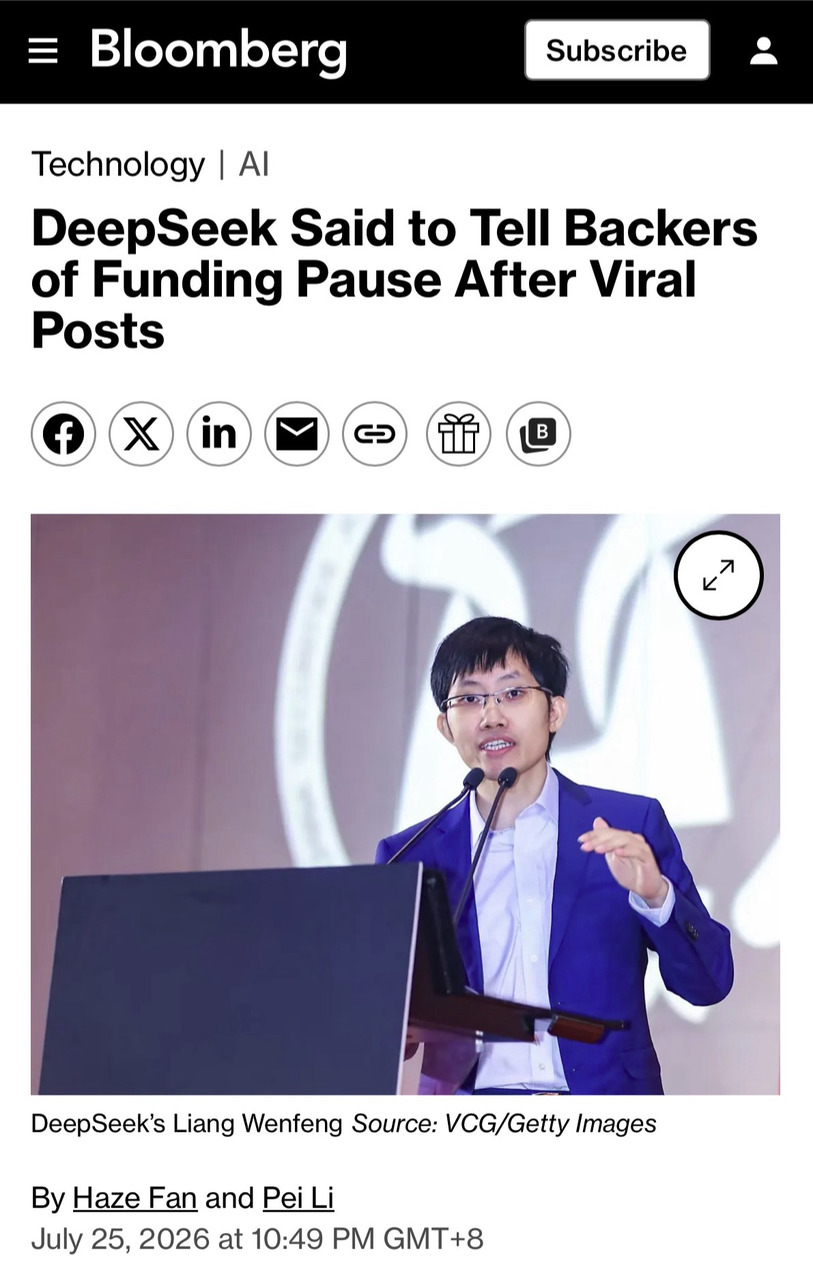
The pause is partly due to founder Liang Wenfeng's frustration over the leakage of content from a closed-door meeting. The meeting took place during the first round of financing, where Liang Wenfeng spoke to potential investors for nearly four hours, discussing commercialization, model roadmap, computing power reserves, domestic chips, and future revenue. Two months later, a tens of thousands of words transcription of the recording began to circulate on the internet.
According to Bloomberg's disclosure, this round of financing is only paused and has not been completely canceled, with negotiations possibly resuming in the future. DeepSeek's domestic IPO preparations have not been halted either, with the earliest possible submission of the listing application later this year.
In June this year, DeepSeek completed its first external financing since its establishment, with the amount disclosed by multiple media outlets around 50 billion yuan, and a post-investment valuation of about 3.5 trillion to 4 trillion yuan.
Shortly after the first round concluded, the company began engaging with investors in mid-July to plan the second round. Reuters reported on July 15, citing another group of sources, that the company aimed to raise funds at a valuation of around 500 billion yuan, with the potential size reaching up to 50 billion yuan.
It was reported that some institutions were expecting to enter the signing stage soon.
This round of financing is considered to be directly related to computing power expansion and IPO plans. Bloomberg previously reported that DeepSeek had started engaging financial and banking advisors, with an internal target of submitting the application as early as this year and aiming to complete the listing by 2027. If the second round is successful, it would not only supplement funds before the IPO but also establish a higher valuation benchmark.
Leaked Documents
The meeting took place on May 20, lasting about 3 hours and 44 minutes in total, with Liang Wenfeng introducing the business philosophy, open-source logic, and AGI roadmap in the first half, followed by an investor Q&A session in the second half.
From July 22 to 23, this material began to spread in the domestic tech and investment circles, then was widely reposted by numerous media, self-media, and overseas communities. Media outlets have verified with institutions involved in investing in DeepSeek, confirming that the closed-door meeting did take place in May and that the overall content is authentic and credible.
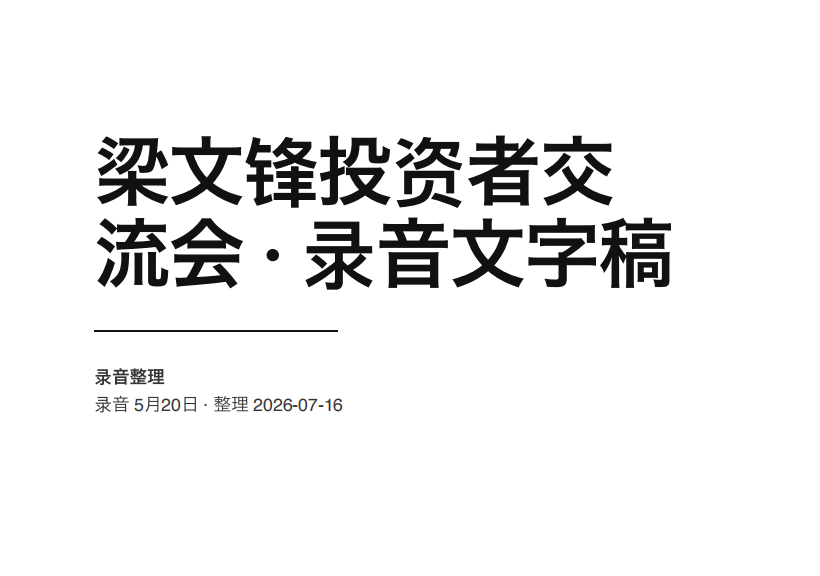
Before the end of Liang Wenfeng's keynote speech and the start of the Q&A session, the host specifically reminded the attendees: "Liang Wenfeng has shared a lot of sensitive information, so please do not disclose any numbers or details, including card issuance numbers. Also, please do not screen record or share externally."
Two months later, the content that was explicitly told not to be disclosed appeared almost in its entirety on the internet.
What Was Discussed in the Meeting
The rapid spread of the transcript is attributed to Liang Wenfeng's rare public discussions about DeepSeek and the significant amount of previously undisclosed company information revealed during the meeting.
Liang Wenfeng continues to place AGI at the forefront of the company's goals. He believes that consumer-facing products, B2B business, and commercial revenue are all just transitional products in the journey towards AGI. The company is currently not planning to align product development and research directions around short-term profits.
He describes AI development as a series of ascending steps: starting with language models, then the cognitive chain, followed by Agents, with the most critical issue being continual learning. DeepSeek hopes that the next-generation model will not only be used by external users but will also assist their own researchers in developing the next generation of models. At this stage, the company is more focused on General Agents and Coding Agents, with a lower priority given to vertical agents in areas such as finance and healthcare.
Compute power and chips represent the most sensitive part of the discussion. The transcript states that the main gap between Chinese and American AI companies lies not in talent but in resources. Liang Wenfeng estimates that DeepSeek may have only used one-twentieth of the compute power of its American counterparts in the past, resulting in an overall model lag of about 12 to 18 months. The goal for the future is to reduce this lag to 3 to 6 months and achieve breakthroughs in certain directions. The material also mentions DeepSeek's equivalent compute power, the scale of chips required for future models, the number of chips provided by Huawei, and the performance conversion between Huawei cards and NVIDIA cards. These figures were repeatedly cited in the dissemination of information but without any public procurement contracts or formal confirmation from DeepSeek or Huawei.
Regarding the team, he mentioned that the company can exercise restraint in many areas of interest, but there can be no concessions when it comes to the stability of the core team. The recent funding round has provided a true valuation of employee stock options, significantly mitigating the risk of talent outflow.
From the leaked content, it is evident that what was exposed was not a scandal at DeepSeek but rather a quite positive dissemination of information. Moreover, the principles of open sourcing, prioritizing AGI research, and focusing on model efficiency, as revealed in the leak, have previously surfaced in his public interviews.
The issue is that this was a closed-door meeting with explicit confidentiality requirements for investors. In addition to ideas and judgments, the meeting also involved hashrate reserves, chip supplies, model scale, revenue forecasts, and financing purposes. This information not only concerns DeepSeek itself, but may also involve suppliers, investment institutions, and ongoing business negotiations.
For a company about to undergo a second round of financing and prepare to enter the public market, the ability to maintain confidentiality is itself part of the due diligence process for investors. The full content of a closed-door meeting will be widely disseminated two months later, prompting the company to reassess the attendee list, communication methods, and boundaries of information disclosure.
Why the Confidence to Halt Financing
One key reason the second round can be paused just before signing is that DeepSeek currently does not face cash pressure.
Prior to this year, DeepSeek had not conducted external equity financing for a long time. The company emerged in 2023 from Phantasm Quant's AI research system, with early R&D investment mainly coming from Phantasm's operating income and R&D budget. Financing rumors began circulating in April of this year, and the valuation and scale rapidly rose within weeks. The first round landed in June, becoming one of the largest single-round financings in the Chinese AI industry.
According to Reuters, Liang Wenfeng personally contributed about 20 billion yuan in this round, making him the largest individual investor, Tencent invested about 10 billion yuan, CATL about 5 billion yuan, with NetEase, JD.com, IDG, and the National Artificial Intelligence Industry Investment Fund also participating.
The post-financing equity structure shows that Ningbo Cheng'en Enterprise Management Consulting Partnership holds about 60.19% of the operational entity, Liang Wenfeng directly holds about 31.01%, Hangzhou ChingLee Platform, where external investors are located, holds about 8.52%, and the National Artificial Intelligence Industry Investment Fund holds about 0.28% directly. Domestic media estimates, after penetrating through multiple layers of partnership relationships, that Liang Wenfeng's direct and indirect control rights are about 84.29%, a figure closer to controlling rights and should not be understood as him personally holding 84.29% of the shares.
According to The Information and other media reports, most commercial investors enter through limited partnership platforms, facing a five-year lock-up period and not enjoying voting rights in the operating company; the National Artificial Intelligence Industry Investment Fund holds direct shares and retains voting rights.
In other words, after external capital comes in, the main decision-making power still lies with Liang Wenfeng. Pausing the second round just after completing the about 50 billion yuan financing will not immediately impact the company's operations.
Phantasm Quant is often seen as another source of his confidence. The average return rate of the funds under this entity in 2025 is about 56.6%, ranking second among domestic large-scale quantitative institutions with assets under management exceeding 100 billion yuan. Its current asset management scale exceeds 700 billion yuan. Phantasm focuses on providing management fees, performance rewards, shareholder profits, and other legitimate R&D investment. What truly demonstrates Liang Wenfeng's financial strength is the 20 billion yuan he put up in the first round of financing.
Still Not Enough Money
DeepSeek's current flagship model is the V4 preview version released in April this year, originally scheduled to launch the official version in mid-July, divided into Pro and Flash versions. V4-Pro has a total of 1.6 trillion parameters, with 490 billion parameters activated per token; V4-Flash has approximately 284 billion total parameters, with 13 billion parameters activated. Both versions support a context of 1 million tokens and have made the model weights available.
As the competition shifts from chatbots and reasoning to agents, continual learning, and larger-scale model training, the company needs to invest in more chips, data centers, high-quality data, and engineering talent. The scale of the first round of about 50 billion yuan, while considerable, still lags significantly behind the capital injection of the leading AI companies in the United States. This is also the reason why the second round quickly started soon after the first round was settled.
As of the time of publication, DeepSeek has not publicly responded to the suspension of the second round of financing, nor has it provided any explanation regarding the authenticity of the leaked transcript, the dissemination process, and the sensitive figures.
Welcome to join the official BlockBeats community:
Telegram Subscription Group: https://t.me/theblockbeats
Telegram Discussion Group: https://t.me/BlockBeats_App
Official Twitter Account: https://twitter.com/BlockBeatsAsia
